
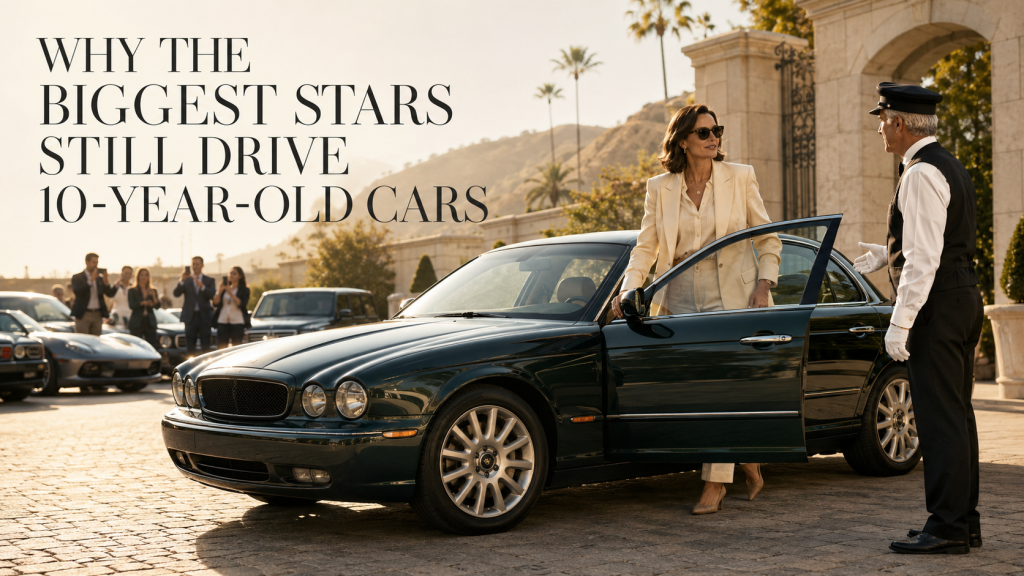
At the private entrance of a Malibu screening, two cars sit ten feet apart. One is a current-model Range Rover, blacked out and still sharp. Meanwhile, the other is a 2014 Land Rover Defender. It shows a cracked plastic cowl and mud dried in the wheel arches.
The owner of the second car holds the higher net worth. Even so, he also holds the longer list of lasting credits. He shows almost no interest in being photographed getting out of a vehicle. Yet he hands the key to the valet without looking and walks inside.
This is one of the cleanest hollywood stars old cars tells in the industry. Even so, it maps directly onto the same divide in the New Money vs Old Money framework. New money announces. Old money assumes. The parking lot simply makes the difference visible.
The Logic of the Old Car
A ten-year-old Defender does three things at once. So does an inherited Porsche 911. First, it signals that the owner no longer needs to prove liquidity. Second, it removes the car from the cycle of constant replacement. Third, it quietly communicates membership in the group that treats vehicles as tools or heirlooms rather than press releases.
The opposite move still works for attention. A brand-new, fully optioned, frequently replaced luxury SUV draws eyes. It simply stops working for permanence. You can watch the pattern across the long-term data in the Movie Star Legends Net Worth cluster. Names whose estates compound after the peak earning years are disproportionately the ones who stopped updating the driveway.
What the Parking Lot Actually Measures
It measures residual need for external validation. The actor who still requires the car to do part of the talking has not yet crossed the ownership inflection point. Even so, the one who is willing to look slightly under-updated has already decided the real scoreboard sits elsewhere. Backend points matter more. Production companies matter more. Land and time matter more.
You cannot fake the absence of a need to impress. You can only stop having it. Even so, that is why the tell stays durable. A person can buy any car on the lot before lunch. They cannot buy the internal condition that makes the older car feel like the obvious choice.
Hollywood Stars Old Cars and the Status Economy
Cars in Hollywood are never only cars. They are mobile status statements that move through the same social circuits as the people who drive them. The private screening has a parking situation. So does the restaurant with the difficult reservation. So does the house in the hills that does not appear on any map. Each location becomes a small theater of hierarchy.
The actor who arrives in the current-year statement vehicle is still participating in a conversation about arrival. In fact, the actor who arrives in the ten-year-old Defender has largely exited that conversation. Their presence in the room is no longer dependent on the statement the car makes. That independence is itself a form of power.
Even so, this is why the code belongs inside the larger Hollywood Status Codes system. It is not an isolated preference. It is one visible expression of a broader shift from performance to possession.
How the Tell Travels Across Other Codes
Once you start noticing the parking lot, you begin noticing the same logic in other domains. The watch that is inherited rather than purchased this year follows the same pattern. The house that has been held for decades rather than flipped for a better view follows it too. Still, the conversation that never turns to fees or net-worth estimates completes the set.
Stars who make that decision early enough tend to be the ones whose names still carry weight when the industry’s attention has moved on. Stars who keep updating the signal often discover that the signal was the only thing holding the position together.
The CassWorld Take
A reader who has just watched the parking-lot hierarchy rearrange itself around a dusty Defender is already seeing the difference between performing wealth and possessing it. That shift is the opening for any brand founder, fund manager, or creative director who recognizes these codes as the real operating system of prestige and wants to be considered for an editorial feature in Social Life Magazine’s print or digital ecosystem — reach the team via the editorial contact page or go directly to Submit a Paid Feature. The same room is reached weekly by the 82,000-reader email list (sign up here), in person at Polo Hamptons 2026, and in print through a subscription; those who want to keep the signal clean can support independent luxury journalism here. Written by CassWorld. Cass Almendral is Head of Business Development at Social Life Magazine and Co-Founder of Polo Hamptons. Reach editorial at [email protected].
Continue the Hollywood Status Codes Cluster
Author

Written by
Recent Posts
Periorbital Biorevitalization: Top Methods for Combating Dark Circles

Why a Natural-Looking Hairline Matters More Than a Perfect Haircut

Melanotan 2 and the Regulatory Grey Zone: What Research Buyers Should Understand
Discovering the Elegance and Durability of Slate Roof Tiles
Montauk Calls Itself The End Of The Road But Ushuaia Actually Is
Categories
- Art
- Articles
- Business of Luxury
- Celebrities
- Culture
- Entertainment
- Events
- Faces of Summer 2026
- Fashion
- Fashion & Style
- Featured
- Finance
- Food, Spirits, Wine
- Hamptons
- Hamptons Celebrities
- Health
- Health & Beauty
- Lifestyle
- Luxury Lifestyle
- Press
- Profiles
- Real Estate
- Technology
- The Chronicles
- Travel
- Uncategorized
- Weddings