
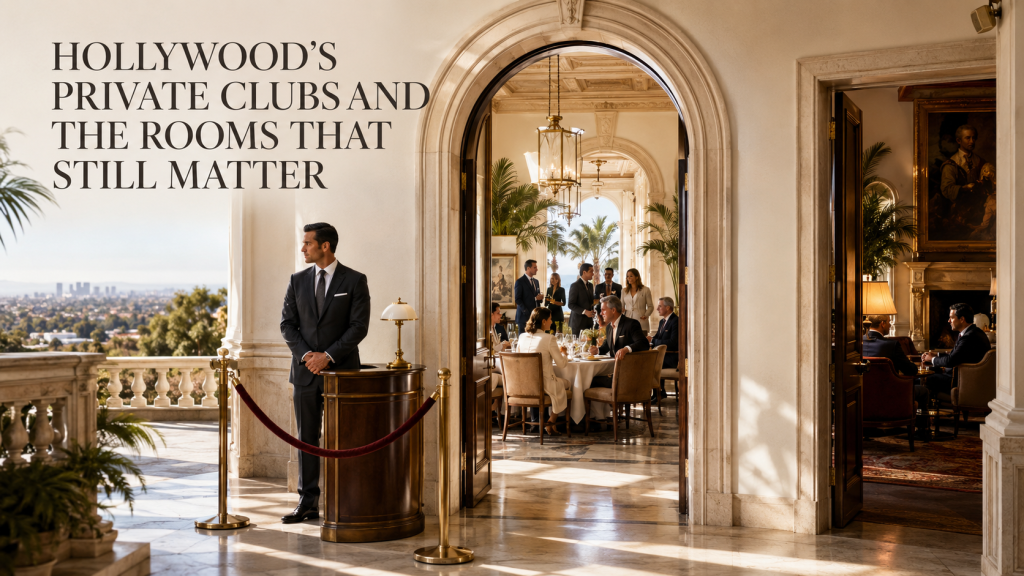
There are still rooms in Los Angeles where the guest list is more tightly controlled than any awards show. Photographs never leave the building. Membership is not primarily about leisure. Meanwhile, it is about residual access to the people who decide what gets made and who gets paid.
However, this is the same social-capital logic that appears in the Old Money Playbook. The clubs and private tables that matter are infrastructure, not decoration.
These hollywood private clubs and rooms still sort power more effectively than any premiere.
Hollywood Private Clubs as Infrastructure
It provides low-friction introductions. It provides early information. Instead, it provides a filter that keeps opportunistic noise outside. However, in an industry where almost everyone is selling something, the value of a space where selling is considered poor form stays high. The lasting players treat these rooms as part of their operating system rather than as lifestyle perks.
The same names that dominate the upper end of the Movie Star Legends tables are disproportionately the ones who invested in these relationships early. They maintained them after the heat of their peak earning years cooled. Access that does not depend on current box-office ranking is a form of insurance.
The Status Code Inside the Club
Once inside, the codes of the larger Hollywood Status Codes cluster reassert themselves. Loud money talk is rare. Visible hierarchy stays muted. In fact, the people with the most leverage are often the least performative. The room itself becomes another environment in which old-money optics quietly outperform new-money display.
The newcomer who arrives performing status often discovers that the performance is the wrong register. The established player who arrives without performing it is read as already belonging. Still, the difference is subtle and decisive.
Why These Rooms Persist
Digital communication has made many forms of access easier and cheaper. It has not replaced the value of physical rooms with strong filters. Certain conversations still happen more efficiently face to face among people who already share context and trust. Certain introductions still carry more weight when they occur inside a space that both parties respect. The clubs and private tables that survive are the ones that continue to provide that efficiency and that weight.
They also provide a form of social proof that is difficult to counterfeit. Meanwhile, being in the room is itself information. Being comfortable in the room is further information. The lasting players understand both layers.
How the Code Fits the Arc
In the performance phase of a career, the goal is often to be seen in the right rooms. Still, in the quiet phase, the goal is to use the rooms without needing to be seen using them. The shift is from the room as stage to the room as infrastructure. The same physical spaces can serve both functions depending on who is in them and how they carry themselves.
In fact, reading club and private-room behavior in combination with the other codes produces a more complete picture. The vehicle, the watch, the money talk, and the real estate tell all help. Together they show where someone sits on the longer trajectory from arrival to position.
The Practical Yield
For anyone trying to understand power in Hollywood, the rooms that still matter are a better map than the premiere circuit. The premiere is designed for broadcast. The private room is designed for decisions and relationships. Still, the people who prioritize the second over the first are usually the ones whose influence outlasts any single project or cycle of heat.
The CassWorld Take
A reader who has just understood that certain rooms still function as the real clearinghouses of Hollywood power is already looking past the premiere circuit. That shift is the opening for any brand founder, fund manager, or creative director who recognizes these codes as the real operating system of prestige and wants to be considered for an editorial feature in Social Life Magazine’s print or digital ecosystem — reach the team via the editorial contact page or go directly to Submit a Paid Feature. The same room is reached weekly by the 82,000-reader email list (sign up here), in person at Polo Hamptons 2026, and in print through a subscription; those who want to keep the signal clean can support independent luxury journalism here. Written by CassWorld. Cass Almendral is Head of Business Development at Social Life Magazine and Co-Founder of Polo Hamptons. Reach editorial at [email protected].
Continue the Hollywood Status Codes Cluster
Author

Written by
Recent Posts
Periorbital Biorevitalization: Top Methods for Combating Dark Circles

Why a Natural-Looking Hairline Matters More Than a Perfect Haircut

Melanotan 2 and the Regulatory Grey Zone: What Research Buyers Should Understand
Discovering the Elegance and Durability of Slate Roof Tiles
Montauk Calls Itself The End Of The Road But Ushuaia Actually Is
Categories
- Art
- Articles
- Business of Luxury
- Celebrities
- Culture
- Entertainment
- Events
- Faces of Summer 2026
- Fashion
- Fashion & Style
- Featured
- Finance
- Food, Spirits, Wine
- Hamptons
- Hamptons Celebrities
- Health
- Health & Beauty
- Lifestyle
- Luxury Lifestyle
- Press
- Profiles
- Real Estate
- Technology
- The Chronicles
- Travel
- Uncategorized
- Weddings