
A child’s first serious instrument purchase is rarely as simple as it appears. It involves a decision not just about what they need now, but about what kind of musician they are becoming, and whether the gear in front of them will sustain or quietly limit that journey.
Few instruments make this tension more visible than the drum kit.
Unlike a piano, which scales in quality without fundamentally changing in format, a drum kit purchase carries a cluster of interlocking variables: room acoustics, household tolerance for volume, physical ergonomics for a growing body, and the technical ceiling of the instrument itself.
Buy too conservatively and a progressing young drummer outgrows the kit within eighteen months.
Buy without understanding the difference between beginner and professional-grade hardware, and you may find yourself re-buying everything within two years anyway.
This guide walks through every meaningful decision point, from choosing between acoustic and electronic to understanding what separates a kit that supports long-term development from one that simply makes noise.
Whether your child has just announced an interest in percussion or has been playing for a year and is ready to move up, the decisions are the same. The quality of your thinking at this stage shapes how far they can go.
Start with the space: the decision most parents make last
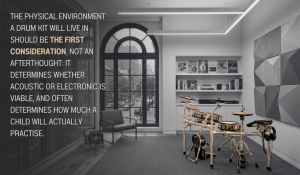
The single most important factor in choosing a first drum kit is not the brand, the number of pieces, or the shell material. It is where the kit will live.
This question determines almost everything else, and yet it is consistently the last thing families think about when the excitement of a child’s new passion takes over.
Acoustic drums produce extraordinary volume.
Not inconvenient volume, but genuinely loud volume that travels through walls, floors, and ceilings in ways that surprise even prepared households.
For families with a dedicated space, a basement, a garage, a soundproofed room, or the kind of property separation that makes acoustic practice viable, an acoustic kit is nearly always the right foundation.
It teaches dynamic control, develops genuine sensitivity to the instrument’s response, and prepares a young drummer for the ensemble and school band settings where acoustic instruments are the standard.
If you live in apartments, townhouses, or any living situation where sustained acoustic drumming is not realistic, an electronic kit is not a compromise. It is the correct choice, and in several respects a more musically rich one than many parents expect.
Modern mesh-head electronic kits from professional-tier brands offer realistic pad response, extensive sound libraries, direct recording connectivity, and the ability to practise through headphones without any audible disturbance to the household.
A child who practices consistently on a quality electronic kit will progress faster than one who practices occasionally on an acoustic kit because the volume problem is solved.
The mistake to avoid is buying a budget entry-level electronic kit to solve the space problem temporarily.
Low-quality pads and modules that do not respond accurately to velocity and dynamics actively teach poor habits. It is worth investing in a kit whose quality supports the learning from the first session.
Acoustic versus electronic: understanding the real trade-offs
The acoustic versus electronic debate in drum education is often framed as a question of authenticity versus convenience.
That framing understates what is actually at stake and misses the most important variable, which is the learning trajectory each format supports.
An acoustic kit teaches through physical feedback.
The rebound of a well-tensioned drumhead, the way a cymbal opens and closes across its dynamic range, the nuanced sensitivity required to control rim shots and ghost notes on a real snare: these are skills that transfer directly to performance and ensemble contexts.
School band programmes, live performance, and any situation where a young drummer will play alongside other musicians will almost certainly involve acoustic instruments. A student who has only ever played on electronic pads may find the transition to acoustic gear disorienting.
An electronic kit teaches through accessibility and variety.
The ability to dial in specific sounds, practise silently, record directly to a computer, and engage with a broad range of sonic contexts makes electronic drums particularly valuable for students whose interests extend toward home recording, production, or contemporary music styles.
The triggering accuracy of premium-grade electronic kits has advanced significantly, and the gap between the feel of a quality mesh-head electronic kit and an acoustic kit is narrower than it was a decade ago.
For families navigating this choice, the most useful resource is expert guidance from a specialist who understands both formats in depth.
Leading retailers like Drum Center of Portsmouth offer superb range of electronic drum set collections from quality beginner options to electric drum set for adults for professional recording at studio, giving families access to the kind of inventory depth and specialist guidance that makes it easier to choose the right instrument for their specific needs rather than simply defaulting to the most popular model.
For many serious young musicians, the ideal trajectory involves both: an electronic kit at home for daily practice, and access to acoustic drums through lessons or school programs.
The two formats complement each other, and a student who is fluent in both has a genuine advantage.
Sizing for a growing body: why ergonomics matter more than budget
A drum kit that does not fit a child’s body does not merely make practice uncomfortable. It actively teaches incorrect technique, because the student compensates physically for components that are out of reach or at the wrong angle.
Those compensations, repeated over thousands of practice hours, become ingrained habits that are genuinely difficult to correct later.
The key ergonomic considerations when sizing a drum kit for a young musician are: seat height, which should allow the thighs to be approximately parallel to the floor with feet flat on the pedals.
Snare drum height, which should allow the forearms to be roughly parallel to the playing surface with relaxed shoulders; tom positioning, which should require no awkward reaching or twisting; and bass drum pedal placement, which should allow the heel to sit naturally without strain.
For children under approximately nine or ten years of age, a full-size professional drum kit is often too large.
Adjustable hardware on quality junior or compact kits allows a proper setup for smaller players, and the better junior kits are genuinely not inferior instruments in terms of tone and response. They simply have a more compact footprint.
For older children and teenagers, a full-size kit with properly adjusted hardware will often fit from the outset.
Electronic kits have a significant advantage here: they are almost universally highly adjustable, with modular pad positioning and seat height that can be calibrated precisely. This makes them particularly well-suited to younger students and students who are growing quickly through adolescence, as the setup can be revised season by season without replacing any hardware.
The starter kit question: when to buy entry-level and when not to
The most common and most costly mistake in buying a first drum kit is treating it as a temporary investment.
The reasoning is understandable: the child is a beginner, their commitment is unproven, and it seems sensible to test the waters with something affordable before spending seriously. The problem is that genuinely cheap kits often do more harm than good.
- The biggest mistake is treating a first drum kit as only a temporary investment.
Many parents assume it makes sense to start with the cheapest option because the child is just beginning and their long-term commitment is still uncertain. - That logic feels practical, but very low-cost kits often create bigger problems.
A poorly made kit can make learning harder rather than easier. - Cheap kits can limit a student’s development in real ways.
If a kit cannot be tuned properly, has unstable hardware, or includes cymbals with little tonal range, the student does not get accurate feedback while playing. - Instead of building a clean technique, the student starts compensating for the instrument.
Over time, they may develop habits based on the kit’s flaws rather than proper playing fundamentals. - Those habits often carry over later.
When the student eventually upgrades to a better kit, they may bring those compensations with them. - A better approach is to aim for a minimum viable quality threshold.
In other words, choose the lowest-quality kit that is still good enough to support real learning without holding the student back. - For acoustic kits, that usually means a reliable beginner-to-intermediate model from a trusted manufacturer.
If bundled cymbals are poor, it is often smarter to buy better cymbals separately. - For electronic kits, quality matters just as much.
A good starter option usually includes mesh heads, responsive dynamics, and enough sound variety to keep practice engaging over time. - A well-chosen kit can last through the most important early years of learning.
If it is set up properly, it can support steady progress without needing to be replaced too soon. - That makes future upgrading a stronger investment decision.
When a student eventually outgrows a solid foundation-level kit, the move to professional-grade equipment feels earned, timely, and worthwhile.
The professional recording pathway: planning for where the journey goes
The most forward-thinking drum kit purchases are made with the student’s eventual ambitions in mind, not just their current level.
For a young musician who shows serious aptitude and whose interest in drums extends toward recording, production, or professional performance, the gear decisions made in the intermediate stage, typically ages twelve through sixteen, have significant implications.
For the recording pathway specifically, the advantages of a high-quality electronic kit become decisive.
This means a performance can be re-sampled with any drum library after the fact, edited and quantised with precision, and integrated into a full production without the complex microphone placement and acoustic treatment that acoustic drum recording requires. For a young musician developing production skills alongside their playing, this integration is transformative.
For families whose children have shown this level of seriousness, investing in a kit at this specification is not premature. It is the kind of considered, quality-led decision that the best educational investments always reflect, an instrument that does not limit the musician who has grown into it.
What to ask before you buy: a parent’s checklist
The difference between a drum kit purchase that sustains a young musician’s development for years and one that creates frustration and limitation within months often comes down to the quality of the pre-purchase conversation. These are the questions worth asking before committing:
- What is the realistic practice environment? Does the household situation allow acoustic drums, or does the volume and space question point toward electronic? Be honest here, because the answer shapes everything else.
- What is the child’s current age and body size, and what adjustability range does this kit offer? A kit that cannot be sized correctly for the player right now is not a viable option regardless of its quality.
- What is the child’s current skill level and realistic trajectory over the next three to five years? A beginner at eight will have different needs from a committed intermediate player at twelve, even if both describe themselves as ‘just starting out.’
- Does this kit have a realistic upgrade path? Quality hardware and shells can often be built upon as a student progresses. A kit that cannot be meaningfully upgraded may need full replacement sooner than expected.
- For electronic kits: what is the module’s triggering accuracy at varied velocity levels? Budget modules that respond inconsistently to soft and loud hits teach a student that dynamics do not matter. They do.
- Is there specialist advice available? The best drum kit decisions are made with the input of someone who plays professionally and understands how gear choices affect long-term development, not simply which kits sell best.
The investment in the instrument is an investment in the musician
A child who discovers a genuine passion for drumming will practise on whatever is in front of them. But the quality of that instrument, and how well it fits their body, their environment, and their aspirations, determines how far that practice takes them.
A well-chosen drum kit does not merely make noise. It responds to everything the student puts into it, giving back accurate feedback, honest dynamics, and a platform for the kind of accumulated skill that makes a real drummer.
The decisions outlined in this guide do not require an unlimited budget. They require thought, honest assessment of circumstances, and the willingness to seek specialist knowledge rather than defaulting to the most visible options.
Applied at the right moment in a young musician’s development, they are among the most meaningful investments a family can make in a child’s creative life.
Author

Written by
Recent Posts
How to Make Money 3D Printing: A Guide to Models, Costs, Channels, and Licensing
When an Injury Changes Everything: Building a Strong Durham Claim

Jetsetter Style: Castello del Sole

The First Decision After a Collision Can Be the Most Important One
Two Weeks in Rome and Beyond: Turkish Airlines Itineraries from Boston, Chicago and Onward to India
Categories
- Art
- Articles
- Business of Luxury
- Celebrities
- Culture
- Entertainment
- Events
- Faces of Summer 2026
- Fashion
- Fashion & Style
- Featured
- Finance
- Food, Spirits, Wine
- Hamptons
- Hamptons Celebrities
- Health
- Health & Beauty
- Lifestyle
- Luxury Lifestyle
- Press
- Profiles
- Real Estate
- Technology
- The Chronicles
- Travel
- Uncategorized
- Weddings