
Nobody reads the menu at Sant Ambroeus in Southampton. Not really. They look at it, yes. They discuss it with whoever is sitting across from them at the marble-top table by the window. But the decision of where to have lunch was made days ago, when they mentioned the name to someone whose opinion they trust, and that person’s expression told them everything they needed to know.
That expression is worth more than any ad Sant Ambroeus has ever run. And it is not an accident. It is the product of a perception environment so carefully constructed over so many years that the restaurant no longer markets itself. Its presence on the corner of Jobs Lane and Main Street in Southampton is the marketing. Its association with a certain kind of summer is the product. The actual food, which is excellent, is almost incidental.
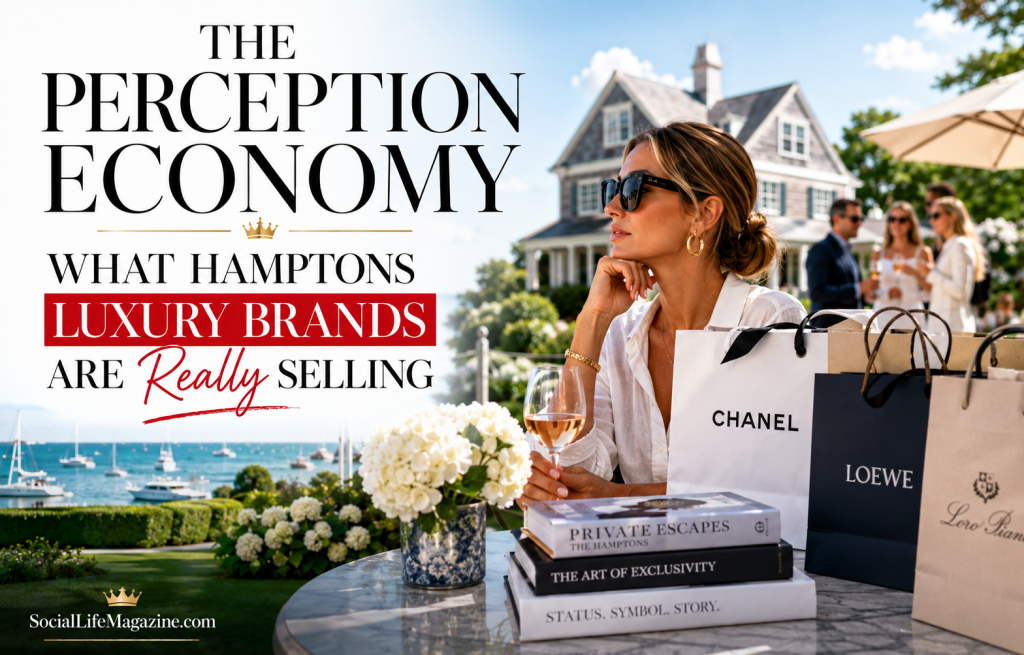
This is the perception economy. It is how every serious luxury brand in the Hamptons operates, whether they know it or not. And it is the reason why luxury brand perception in the Hamptons is not a soft metric or a brand sentiment score to be tracked quarterly. It is the operating infrastructure of the entire market.
What You Are Actually Selling
Rory Sutherland, vice chairman of Ogilvy and the behavioral scientist behind Alchemy, spent thirty years watching rational marketing logic produce irrational results. His central finding: the product is not the product. The feeling the product creates in the moment of encounter is the product.
This sounds like the kind of thing that gets written on whiteboards in creative agencies and then promptly ignored when the quarterly review comes around. But it is not a metaphor. It is a description of how the brain actually processes luxury goods.
High-net-worth consumers in the Hamptons, specifically, are not buying ingredients, thread counts, or ABV percentages. They are buying confirmation of a self-image. Brunello Cucinelli linen confirms that the wearer values understated craft over logo visibility. A bottle of Billecart-Salmon at a Polo Hamptons table confirms that the host understands the difference between champagne that announces itself and champagne that rewards the person who recognizes it. A Social Life Magazine feature in a boutique on the South Fork confirms that the brand earned vetting by an editorial standard that existed before most of its current readers graduated from college.
In each case, the perception is the point. The product is the delivery mechanism for the perception.
Because this is true, the brands that win the Hamptons summer are not the ones with the best products. They are the ones with the most precisely constructed perception environments. And the brands that lose — the ones that spend heavily, activate aggressively, and then wonder why the needle did not move — are almost always the ones that marketed the product instead of the feeling.
Understanding luxury brand marketing psychology in the Hamptons starts here, at the level of basic perception mechanics, before it reaches tactics, budgets, or media plans.
The Environment Is the Message
There is a concept in architecture called “legibility” — the degree to which a space communicates, before a single word is spoken, what kind of behavior is expected inside it. A cathedral is legible. Hospitals are legible. A boutique on Main Street in East Hampton is legible in a way that communicates price point, aesthetic position, and social permission within approximately four seconds of approaching the door.
Social Life Magazine is a legible object. A reader who picks it up from a counter in a boutique in Water Mill knows, before she reads a single word, what kind of publication she is holding. The paper stock tells her. Her eye goes to the cover image, which tells her more. Distribution environment confirms it. Her prior exposure to the publication, if she has had any, confirms what the object is communicating.
The Boutique as Perception Engine
When a luxury brand appears in that publication, it inherits the legibility of the object. It does not need to explain its positioning. The environment explains it. The brand is simply placed inside a perception architecture that has been built over twenty-three consecutive summers of editorial decisions, cover choices, distribution agreements, and event associations.
This is not available to a brand that buys a programmatic placement in an audience segment. A served ad has no legibility. It appears inside whatever context the viewer happens to be in — scrolling between a news article and a video of someone’s dog — and its perception environment is entirely determined by the mood of the moment, which is uncontrollable and frequently hostile. The brand has no authority there. It is a guest in an environment it did not choose and cannot curate.
In a print boutique placement, by contrast, the brand is a host. Someone selected this environment deliberately. The reader has self-sorted into it. Her attention is a choice, not an accident. And the perception transfer, when it happens, is clean.
The Boutique Counter as Perception Infrastructure
The 300-plus distribution points where Social Life Magazine reaches readers across the South Fork are not, in the first instance, marketing channels. They are perception environments. And the distinction matters enormously for any brand trying to understand why its Hamptons advertising is or is not working.
A boutique on Jobs Lane in Southampton is a curated perception environment. Everything inside it, from the spacing of the hangers to the scent to the music playing at a volume that communicates “background, not foreground,” has been selected to support a specific self-image in the consumer who enters. That environment is a form of brand communication that cost the boutique owner years of taste decisions to build. It is not replicable on demand.
When Social Life Magazine sits on the counter of that boutique, it becomes part of the environment. It is not an ad. In the deepest sense of that word, it is décor. The boutique owner placed it there because she believes it belongs there, which is itself a curation decision that transfers status from the boutique to the publication and, by extension, to every brand that appears in its pages.
The brands that understand this do not think about print placement in terms of impressions. They think about it in terms of adjacency. Who else is in this environment? What does my presence here say about what kind of brand I am? What does the reader’s encounter with my name in this specific context do to how she holds my brand in her mind the next time she encounters it?
These are the questions that lead to genuine brand equity. And they are, notably, questions that no media kit answers.
Why Digital Cannot Replicate This (And What It Can Do Instead)
This is not an argument against digital. It is an argument for understanding what digital is and is not capable of doing in a luxury market.
Digital is excellent at reach, frequency, targeting, and measurement. It is, in behavioral terms, extremely good at putting a message in front of a specific person at a specific moment. What it cannot do is control the perception environment of that moment. It cannot guarantee that the ad is encountered in a state of mind that is receptive to luxury positioning. Transferring the legibility of a trusted editorial object to the brand it advertises alongside is not something digital can do. It cannot create the experience of self-selection that a boutique reader brings to a magazine.
Because of this, digital and print in a Hamptons luxury strategy are not substitutes. They are not even complements in the conventional sense. They operate on different perceptual registers entirely.
Print creates the initial perception architecture. It builds the brand into the Hamptons summer as a presence with history, legitimacy, and curatorial credibility. Digital, used well, then activates that architecture. It reaches the same reader at a moment when she is already primed by the print encounter. The retargeting ad that follows a woman from Southampton to SoHo works significantly better when she already has a perception of the brand that was built in a context she trusted.
The Hamptons luxury advertising strategies that consistently outperform are almost always the ones that treat print and digital as a sequence, not a competition. Print first. Permission earned. Then digital, with the full weight of the prior encounter behind it.
The Placebo Principle and Luxury Brand Recall
Sutherland has a chapter in Alchemy about placebos that is, at first, counterintuitive. Expensive placebos, he notes, work better than cheap ones. Not because the pharmacology is different. Because the perception of quality changes the neurological response. The brain, encountering something it has already decided is high-value, processes it differently than something it has categorized as ordinary.
Luxury brand recall in the Hamptons works on exactly this mechanism. A reader who encounters a brand in Social Life Magazine has already decided, by the act of picking up the magazine, that she is engaging with a curated, high-value editorial object. Her perceptual state primes her for quality. When the brand appears in that state, it receives the quality categorization of the environment.
A brand that appears in a lower-quality environment, or in no editorial environment at all, does not receive this categorization by default. It has to earn it from a neutral starting point, which is significantly harder and more expensive. The Hamptons boutique counter, in this sense, is doing expensive perceptual work on behalf of every brand that appears in the publication sitting on it.
This is what Sutherland means when he says the product is the perception. The quality of the encounter is the quality of the brand in that moment. And in luxury markets, the quality of the encounter is determined almost entirely by the environment, not the product.
What This Means for Your Hamptons Strategy Right Now
The 2026 Hamptons summer season is not a campaign. It is a perception event. Every brand that activates on the East End this July is either building a perception architecture or failing to build one. There is no neutral.
If your brand is going to be in the Hamptons this summer, the first question is not “how many impressions will this generate?” The first question is “what perception environment am I entering, and what does my presence there communicate about what kind of brand I am?”
Social Life Magazine’s distribution footprint, specifically, places a brand inside perception environments that have been curated by some of the most taste-literate retail and hospitality operators on the East End. A boutique in East Hampton that stocks the magazine has made a decision about what belongs in its space. The hotel in Sag Harbor that places it in its lobby has made a curation decision. A spa in Southampton that has it in its waiting room has made a statement about the kind of client it serves and what that client expects to encounter.
When your brand appears in those pages, it is inside those decisions. It is not renting attention. Inclusion is the achievement.
That distinction is, in the end, the entire perception economy argument. You can rent attention anywhere. Earning inclusion in the right environment, in the right summer, by the right editorial institution — that is not available at scale. It is available at Social Life Magazine, in five summer issues, distributed to 25,000 readers from Westhampton Beach to Montauk.
Submit a paid feature at sociallifemagazine.com/submit-a-paid-feature.
For questions about full-page print placements, digital bundles, and Polo Hamptons event packages, Social Life Magazine’s business development team is available now. The summer is closer than your planning calendar thinks.
Where The Conversation Continues
The perception economy is the foundation. But perception is only one of six principles that separate the luxury brands winning the Hamptons from the ones running the same campaign year after year without understanding why it isn’t working.
The full analysis lives in the pillar piece: Why Luxury Brands That Ignore Psychology Lose the Hamptons Every Summer.
The five other hubs in this cluster examine the remaining principles in depth:
– How costly signaling creates luxury brand credibility in ways that reach metrics never can (FUTURE) – Why designing for the outlier buyer rather than the average demographic produces better results at lower cost (FUTURE) – The counterintuitive Hamptons marketing strategies that break the conventional playbook and consistently outperform it (FUTURE) – How removing friction from the sponsorship decision closes deals faster than any deck ever will (FUTURE) – What twenty-three summers of Hamptons trust actually compounds into, and why no media plan can replicate it (FUTURE)
Author

Written by
Recent Posts

World Cup Injury Attorney for Vancouver Events
What a 3-Carat Engagement Ring Actually Costs in 2026: The Real Numbers
The Skincare Habits That Make a Real Difference Over Time
Hamptons-Ready Beauty: Polished Makeup for Long Summer Days
Is Now a Good Time to Sell a Home in NJ?
Categories
- Art
- Articles
- Business of Luxury
- Celebrities
- Culture
- Entertainment
- Events
- Faces of Summer 2026
- Fashion
- Fashion & Style
- Featured
- Finance
- Food, Spirits, Wine
- Hamptons
- Hamptons Celebrities
- Health
- Health & Beauty
- Lifestyle
- Luxury Lifestyle
- Press
- Profiles
- Real Estate
- Technology
- The Chronicles
- Travel
- Uncategorized
- Weddings