
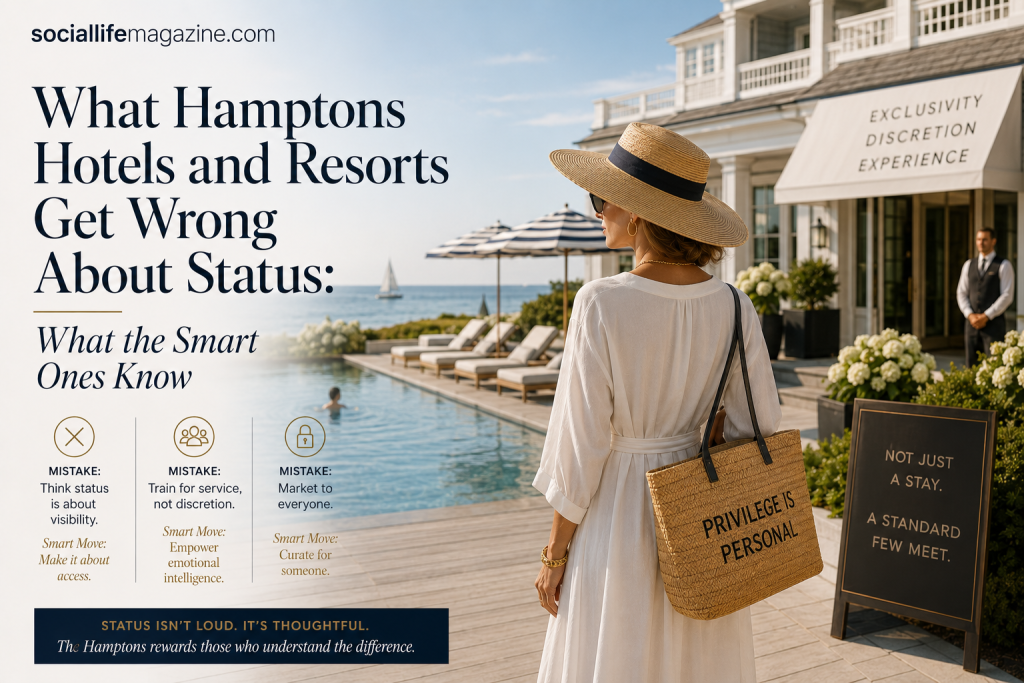
Every summer, two hotels within twenty minutes of each other on the East End run the same category of advertisement. Both show an aerial shot of a pool and mention the beach. Both use the word “escape.” One of them is fully booked by March. The other discounts its shoulder-season inventory on third-party booking platforms through July. The difference between them is not the pool. It is not the beach. And it has nothing to do with the word “escape.” The difference is that one of them understands luxury hotel marketing in the Hamptons and the other is applying generic hospitality logic to a status market that operates by entirely different rules.
The market operates by the rules that philosopher and cultural critic Camille Paglia spent her career mapping. Her argument, developed across “Sexual Personae” and three decades of cultural criticism, is that human beings are status animals driven by two distinct biological forces. The male drive toward conquest, accumulation, and public dominance. The female drive toward curation, refinement, and aesthetic gatekeeping. Both drives predate civilization. Both are operating at full volume in every luxury transaction on the East End from Memorial Day to Labor Day. And hotels that understand which one they are feeding at any given moment consistently outperform hotels that do not.
The Hamptons hospitality market operates as a status market, not a travel market. The guest paying $2,500 a night at a Montauk resort is purchasing a position inside the social field the Hamptons represents. That position is worth exactly what it signals to the people who will know about it. The marketing that gets him there, and keeps him coming back, has to speak to the status drive that brought him into this market in the first place.
Most Hamptons hotel marketing does not do this. Here is what the ones that do know that the others do not.
The Hotel as Status Arena
A hotel in the Hamptons is not a place to sleep. It is an arena where status gets performed, confirmed, and transacted. This is true of luxury hospitality everywhere, but it is concentrated on the East End in a way that has no precise equivalent in the American market.
The Hamptons social field compresses every form of status capital into a twenty-five-mile geography for twelve weeks every summer. Economic capital arrives from Manhattan finance and technology money. Cultural capital circulates through editorial coverage, gallery openings, and charity galas. Social capital is negotiated at every dinner table, every polo match, every party where the guest list matters more than the food. The hotel that a guest chooses, and is seen choosing, is a statement inside all of these registers simultaneously.
This is why the address of a Hamptons property is not just a location. It is a status claim. Montauk signals one kind of cultural authority, edgy and salt-sprayed, the conquest capital of the East End frontier. Bridgehampton signals another: old money adjacency, polo proximity, the quiet confidence of people who do not need to announce themselves. Southampton signals old-line social establishment. Each address speaks a different dialect of the same status language, and hotel marketing that ignores these dialects is speaking into the void.
Indeed, the smart Hamptons property understands its address as its primary capital asset, and everything in its marketing follows from that understanding. Its guests are not buying a room. They are buying the right to say they stayed there. The marketing has to be worth saying.
Male Capital at the Front Desk
The male status drive in hospitality expresses itself through conquest signals. Scale of the property. Exclusivity of the address. Difficulty of the reservation. Visible dominance of the physical position. These are not amenities. They are status declarations, and the guest making a booking decision is reading them as such.
In the Hamptons context, conquest capital at a hotel shows up in specific and legible ways. For example, the resort with the most dramatic physical position, the cliff-top acreage above the Atlantic at Gurney’s Montauk, communicates scale and dominance before the guest has looked at a single room. The property that is demonstrably difficult to book communicates exclusivity as a value. The hotel that charges what the market will bear without apology communicates confidence in its own position.
This is why scarcity marketing works for the top-tier Hamptons properties in a way it does not work for properties that have not first established their conquest capital credentials. Telling someone they cannot get a reservation is only an effective status signal if the property has already communicated that being unable to get a reservation there is a meaningful social fact. The conquest capital architecture has to be built before the scarcity language can do its work.
Male capital also shows up in the competitive arenas a hotel hosts or affiliates with. The Bridgehampton Polo Club draws the conquest capital class every July Saturday because polo is itself a conquest capital performance, athletic aggression and wealth display in the same arena simultaneously. A hotel whose marketing positions it inside the polo world is borrowing conquest capital that the sport has accumulated over a century. That adjacency is worth more than any poolside photography.
Female Capital in the Experience Layer
The female status drive in hospitality is where most Hamptons properties either win decisively or lose without understanding why. Specifically, curation capital in a hotel expresses itself through the aesthetic authority of every detail in the experiential layer. The design of the rooms, the quality of the food program, the selection of bath products, the taste level of the art on the walls: each is a curation signal the discerning guest reads before she unpacks.
These are not soft amenities. They are cultural signals that the curation-drive guest reads with the same precision that the conquest-drive guest reads the cliff-top address. A hotel with the wrong flowers in the lobby has made a curation error as significant as a hotel with a third-tier address. The guest with refined taste registers it immediately. She does not complain about it. She books somewhere else next summer and tells her friends.
The Topping Rose House in Bridgehampton is the clearest example in the Hamptons market of a property that has built its entire competitive position on curation capital authority. The food program, anchored by Tom Colicchio’s restaurant, signals taste-class membership at the highest level before the guest has checked in. The design of the property communicates old money refinement without the mustiness of actual old money. Every detail of the experience has been curated to communicate the same message: this is the property that the people who know belong to.
Still, curation capital in a hotel is fragile in a way that conquest capital is not. A cliff-top location does not get worse if the service dips for a season. A reputation for aesthetic authority can be damaged by a single season of declining food quality or a renovation that misjudges the taste level of the clientele. Indeed, the curation-capital hotel is always one bad season away from losing the endorsement of the taste-setters whose approval built the position in the first place.
Why the Pool Scene Is a Status Performance
The hotel pool in the Hamptons is the most misunderstood amenity in luxury hospitality. Most properties market it as a recreational feature. The best properties understand it as a status theater, the single most visible daily performance of the social hierarchy that the hotel’s clientele has assembled.
At a pool that is doing its job as a status arena, the scene communicates several things simultaneously. Who is here. What they look like. What they are wearing. Who they are talking to. Which cabana is theirs. What they ordered from the pool menu. Each of these is a status performance that the participants are directing at each other and, crucially, at anyone who will hear about it afterward. The social currency generated at a well-curated pool scene is not trivial. It is the mechanism by which a hotel’s social proof architecture self-replenishes every summer.
This is why cabana pricing at a top Hamptons property is not primarily a revenue calculation. It is a social calibration. The price of a cabana signals the quality of the social field the hotel has assembled. A cabana that is too cheap invites the wrong clientele and degrades the scene. A cabana priced correctly for the status level the hotel targets functions as a filter. It ensures the pool scene delivers the social proof the hotel’s marketing has promised.
Polo Hamptons operates this dynamic explicitly. The cabana program at the Bridgehampton Polo Club on July 18 and July 25 is not primarily a hospitality offering. It is a status-field access product, and sponsors who understand this invest in it as such. The pool scene and the polo field are running the same script in different settings.
How Three Hamptons Properties Play It Differently
Gurney’s Montauk Resort and Seawater Spa owns the most legible conquest capital position in the Hamptons hotel market. The cliff-top location above the Atlantic communicates scale and dominance before the guest arrives. The aggressive energy of the Montauk brand, and the seawater spa as conquest over the natural environment, speak directly to the male status drive. Gurney’s marketing has always worked best when it leans into this position without apology. The property communicates that it is the dominant physical presence at the far end of the East End. Guests who choose it are making a conquest capital statement about their own standing.
The Topping Rose House plays the opposite game, and plays it well. Curation capital is the entire product. The intimacy of the property communicates refinement. The Tom Colicchio food program signals taste-class membership. The garden aesthetic and the Bridgehampton address, sitting at the social center of gravity of the Hamptons field, complete the picture of curation authority at every touchpoint. The Topping Rose House guest is not claiming a dramatic conquest position. She is demonstrating refined taste and insider knowledge. Both positions are correct. Both require entirely different marketing voices.
Shou Sugi Ban House in Water Mill occupies a third position that is rarer and more difficult to hold: wellness as cultural capital. The property has built a curation capital position around the aesthetics of restorative luxury, the architecture, the programming, the silence as a designed experience. Its clientele is paying to affiliate with an aesthetic authority that is distinctly different from either conquest dominance or social-scene membership. In Paglia’s framework, this is the deepest female capital play available in the market, the curation of the interior experience rather than the social performance of the external one.
The Editorial Partnership Model
The hotel that wins over a decade manages its editorial presence with the same precision it manages its physical experience. A single strong summer does not build that kind of position. The social proof architecture of a Hamptons property is built not just in the property itself. It is built in the publications, the conversations, and the cultural context where the property gets discussed.
Social Life Magazine has covered Hamptons hospitality for twenty-three years. Its readership is not the mass travel audience. It is the social field itself: 25,000 print readers per issue who are participants in the East End status theater. Beyond that, 82,000 email subscribers are planning their Hamptons summers from Manhattan before Memorial Day arrives. When a Hamptons property appears in Social Life Magazine editorial, it is not buying a media impression. It is buying placement inside the cultural conversation that its target clientele uses to decide where to go.
This distinction matters enormously in a market where the quality of the social proof is as important as the quality of the property itself. A hotel that appears in Social Life Magazine has earned its position as a participant in the East End’s status culture. The publication has held that authority for twenty-three years. A hotel that buys programmatic digital advertising has bought an eyeball. The difference between those two outcomes is not a media measurement question. It is a status capital question. And in this market, the answer to that question is the entire game.
See also how curation capital operates for medspas and aesthetic practices on the East End, and how conquest capital drives decisions in the luxury real estate vertical.
Where The Conversation Continues
Social Life Magazine reaches the Hamptons luxury audience across five summer issues and 25,000 print copies per issue. Year-round digital distribution and 82,000 email subscribers extend that reach into the high-net-worth population that drives the East End hospitality market.
Editorial features, advertising partnerships, and sponsored content are available for the 2026 season. The season opens July 18. Space is limited.
Author

Written by
Recent Posts
The Hidden Work Behind a Seamless Hotel Weekend
Choosing Scratching Furniture for a British Shorthair
Bile Reflux vs. Acid Reflux: Why Your Antacid Isn’t Working
Annie Watt Photography Agency 20th Anniversary Celebration and Exhibition in NYC | New York, NY

Denise Fraile: Connecting People, Inspiring Purpose
Categories
- Art
- Articles
- Business of Luxury
- Celebrities
- Culture
- Entertainment
- Events
- Faces of Summer 2026
- Fashion
- Fashion & Style
- Featured
- Finance
- Food, Spirits, Wine
- Hamptons
- Hamptons Celebrities
- Health
- Health & Beauty
- Lifestyle
- Luxury Lifestyle
- Press
- Profiles
- Real Estate
- Technology
- The Chronicles
- Travel
- Uncategorized
- Weddings