
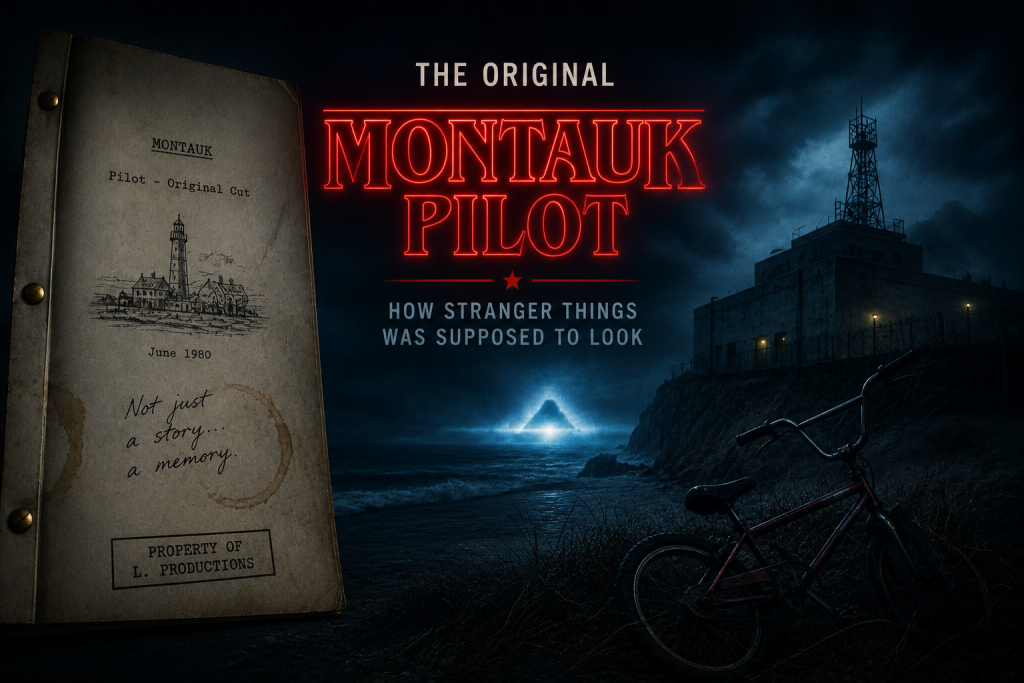
The Show That Almost Was
Before Hawkins, Indiana and the Upside Down. Before the Demogorgon, the Mind Flayer, Vecna, and 140 million views. There was a different show. It was set on Long Island. It was called Montauk. And if the Duffer Brothers had made the version they originally pitched, Stranger Things would have looked, felt, and sounded completely different.
The original Montauk pilot is one of the most discussed unmade scripts in recent television history. Fragments of the original concept have surfaced through interviews, podcast appearances, legal documents, and the Duffer Brothers’ own retrospective comments. What emerges is a portrait of a show that was darker, stranger, and more directly connected to the Montauk Project conspiracy than the version Netflix ultimately produced.
The DNA survived the transformation. But the bones changed. Here is the show that almost was.
The Original Concept: A Found-Footage Film
Matt and Ross Duffer didn’t initially conceive of their project as a television series. Their first concept was a found-footage film called The Montauk Experiment. The format drew from the Blair Witch school of horror filmmaking: shaky cameras, ambient dread, the suggestion that what the audience was watching might be real footage recovered from an actual event.
The film’s protagonist was based directly on Duncan Cameron, the young man who Preston Nichols described as the Montauk Project’s most gifted psychic subject. In Nichols’ account, Cameron could open portals through concentrated mental focus. As a result, the found-footage concept would have followed a group of investigators who discover evidence of Cameron’s experiments at Camp Hero and inadvertently trigger something they cannot control.
The Duffers eventually abandoned the found-footage format. In interviews, they’ve explained that the concept felt too limiting for the character development they wanted to explore. A shaky-camera film about a conspiracy investigation would have been atmospheric, but it wouldn’t have allowed the emotional depth that ultimately made Stranger Things resonate with a mass audience. Instead, the brothers pivoted to a serialized television pitch. The setting remained Montauk. Its mythology remained intact.
The Montauk-Era Pilot Script
Initially, the pilot script, written under the title Montauk, was set on the East End of Long Island in early October 1980. This is worth noting because the final show is set in November 1983. The three-year shift wasn’t arbitrary. Moving the timeline to 1983 aligned the show with specific touchstones. These included Red Dawn, Reagan-era Cold War anxiety, and the aesthetic of early Spielberg films like E.T.
In the original setting, the first episode took place during the week of Halloween. This gave the original Montauk pilot a seasonal horror flavor that the produced show only incorporated in its second season. The October setting also placed the story closer to the actual timeline of the Montauk Project conspiracy, which Nichols claimed ran through the early 1980s.
The geography mattered too. Montauk’s coastal landscape, with its dramatic Atlantic bluffs, fog-shrouded moors, and isolated position at the end of a peninsula, would have given the show a very different visual identity. Instead of the flat, tree-lined streets of suburban Indiana, the original Montauk pilot would have unfolded against a landscape that already looked like the setting of a horror story. Camp Hero’s radar tower would have been visible in establishing shots. The ocean would have been a constant presence. The sense of being trapped at the end of the world would have been literal rather than metaphorical.
A Very Different Hopper
The character who eventually became Chief Jim Hopper, played by David Harbour, looked dramatically different in the original concept. Early development notes describe the character as having “the looks of a serial killer” with “balding hair and big oval glasses.” He was not a police chief. He was a projectionist at a local movie theater.
In the original Montauk pilot, this character (then called Terry Ives in some early materials, a name later given to Eleven’s mother) had spent a decade investigating Camp Hero. He was obsessed with the conspiracy. Other characters initially dismissed him as a paranoid loner. But he ultimately became, in the Duffers’ words, “an unexpected, albeit reluctant, hero in the dark days ahead.”
The character arc was eventually split during the development process. The conspiracy-obsessed investigator became Chief Hopper. He was stripped of the paranoia and given the authority of a badge. The personal connection to the experiments was transferred to Terry Ives, who became Eleven’s biological mother and an MKUltra test subject. The splitting of one character into two allowed the show to explore both the investigation (Hopper) and the human cost (Terry Ives) without overloading a single protagonist.
David Harbour has spoken about the original concept in multiple interviews. In a 2025 podcast appearance, he revealed that he thought the original title “Montauk” was “so strong.” He also noted that the coastal setting would have changed the show’s entire atmosphere. “Montauk has this end-of-the-world feeling,” Harbour said. “Indiana feels safe. That’s what makes the horror work. Montauk already feels like something could happen there.”
Why It Changed
Several factors drove the transformation from Montauk to Stranger Things. The Duffers have discussed them openly across numerous interviews, podcast appearances, and promotional events.
First, the aesthetic shift. The brothers wanted to capture the specific visual and emotional tone of early Spielberg and Stephen King: suburban neighborhoods, kids on bikes, walkie-talkies, arcades, middle-school hallways. Montauk’s coastline didn’t match that template. Moving the setting to a fictional Indiana town gave them the canvas they needed for the nostalgic 1980s Americana that became the show’s signature visual style.
Second, a legal complication. Filmmaker Charlie Kessler filed a plagiarism lawsuit against the Duffer Brothers in 2018, alleging that they had stolen ideas from his 2012 short film The Montauk Project. Kessler claimed he had pitched his concept to the Duffers at a party in 2014 and that they subsequently developed a similar project. The lawsuit was dismissed in 2019 after a brief trial. But the legal exposure associated with the Montauk name during the show’s early development may have contributed to the decision to rebrand.
Third, production logistics. Filming in Montauk would have been significantly more expensive than filming in Georgia, where the show ultimately shot. Georgia offered generous tax incentives for film production. Atlanta’s northern suburbs provided the small-town Indiana look at a fraction of the cost.
What Survived
Despite the changes in setting, title, and character design, the narrative architecture of the original Montauk pilot remained remarkably intact in the produced series. The core elements transferred directly.
Hawkins National Laboratory is Camp Hero. Both are government facilities on the outskirts of small communities. Each conducts classified experiments. They share underground levels. And both serve as the origin point for interdimensional threats. The radar tower became a laboratory complex, but the function is identical.
Eleven is the Montauk Boys. A child raised in captivity, subjected to experiments that develop psychic abilities, used as a weapon. Her gender changed. So did her name. But the emotional arc (from asset to person, from number to name) remained exactly as the Duffers originally conceived it within the Montauk framework.
The Upside Down is the portal that Duncan Cameron allegedly opened at Camp Hero. In both the conspiracy and the show, a psychic subject pushes beyond safe limits and tears a hole in reality. A creature enters the physical world. The facility loses control. The mythology of Preston Nichols’ book provided the inciting incident that drives the entire series.
MKUltra provides the documented foundation. The Stargate Project provides the psychic research context. The Philadelphia Experiment provides the World War II origin story. All three threads were present in the original concept and survived the transition to Hawkins intact.
The Finale’s Callback
On New Year’s Eve 2025, the Stranger Things series finale closed the loop. In the epilogue, Hopper tells Joyce he’s been offered a job as Chief of Police in Montauk. He asks her to move there. She says yes. For fans who knew the show’s origin story, the moment was seismic. Those who didn’t simply saw a sweet romantic ending. For the Duffer Brothers, it was, in Ross Duffer’s words, “a wink to the fans.”
But it was also an acknowledgment. The show began as Montauk. It ended with Hopper choosing Montauk. The geography that the Duffers left behind in the development process was the geography they returned to in the final scene. The original Montauk pilot never got made. But the place it was set, the conspiracy it drew from, and the mythology it adapted are now permanently embedded in one of the most-watched series in streaming history.
Where the Conversation Continues
The original Montauk pilot is the ghost in the machine of Stranger Things. Social Life Magazine has covered the East End for 23 years. Five summer issues from Memorial Day through Labor Day. The stories that matter Out East land here first.
If you have a story, a brand, or a project that belongs in these pages, reach out at sociallifemagazine.com/contact.
For brands looking for premium editorial placement, our paid feature submission portal is open at sociallifemagazine.com/submit-a-paid-feature/.
Stay in the loop with our weekly email blast covering events, openings, and who’s doing what Out East. Sign up at enflyer.sociallifemagazine.com.
Polo Hamptons 2026 returns to Bridgehampton on July 18 and July 25 with BMW as title sponsor. For event details and sponsorship opportunities, visit polohamptons.com.
Never miss a feature, a profile, or a party recap. Subscribe to Social Life Magazine at sociallifemagazine.com/subscription.
If the work we do matters to you, you can support independent East End journalism directly via PayPal.
Author

Written by
Recent Posts
Sectional Sofa vs. Regular Sofa: Which One is Best for You?

Sober and Injured: How to Manage Pain Treatment After a Massachusetts Slip and Fall
Flexible Liquidity Options Are Reshaping How Modern Professionals Handle Unexpected Expenses
5 Best At-Home Teeth Whitening Kits for a Brighter Smile in 2026

From Spa Retreats to Aesthetic Care, the Luxury Travel Itinerary Is Changing
Categories
- Art
- Articles
- Business of Luxury
- Celebrities
- Culture
- Entertainment
- Events
- Faces of Summer 2026
- Fashion
- Fashion & Style
- Featured
- Finance
- Food, Spirits, Wine
- Hamptons
- Hamptons Celebrities
- Health
- Health & Beauty
- Lifestyle
- Luxury Lifestyle
- Press
- Profiles
- Real Estate
- Technology
- The Chronicles
- Travel
- Uncategorized
- Weddings