
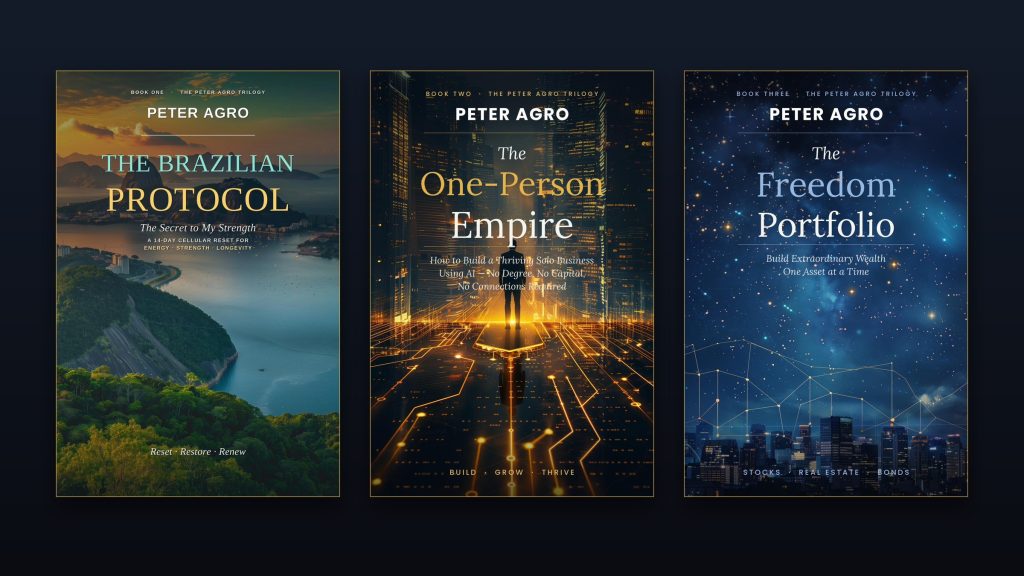
One Man, Three Books, One Map to the Good Life
Peter Agro’s new trilogy quietly reframes everything we thought we knew about wellness, work, and wealth.
There is a particular kind of person who seems to have figured something out. You meet them at a dinner on the Upper East Side or across a table in Rio, and you notice it before they say a word—the energy, the ease, the sense that they are not bracing against their own life. For two decades, people kept asking Peter Agro where his came from. For years, he gave them the wrong answer.
Discipline, he’d say. Genetics. Luck. It wasn’t until he stopped guessing and started paying attention—on the beaches of Copacabana, in the farm kitchens of Italy, in the salons of Manhattan and the spreadsheets of his own investment accounts—that the real answer emerged. And it turned out to be bigger than any single book could hold.
So he wrote three.
The Peter Agro Trilogy is not a series in the usual sense. It is an architecture. Three books that build on one another the way a life does: you start with the body, you build the income, and then you make the money work so that, eventually, you no longer have to. Health, then enterprise, then wealth. Reset, build, free.
Book One: The Brazilian Protocol: The Secret to My Strength
The trilogy opens where Agro’s own transformation did—in Rio de Janeiro, in the winter of 2008, on what was supposed to be an ordinary vacation. Instead, his body did something strange. The bloating he’d carried through New York and Fort Lauderdale vanished. His sleep deepened. A lightness arrived, and then, over months of returning, a real and unmistakable physical strength.
The Brazilian Protocol: The Secret to My Strength is his attempt to bottle that. It is not a fad diet or a punishing training split. At its core is something almost disarmingly simple: the sodium-potassium balance that governs how every cell in the body produces energy, recovers, and holds inflammation in check. Get that chemistry right, Agro argues, and the body does what it was built to do.
The book hands the reader a 14-day protocol—gluten-free meals he actually eats, Rio-style daily movement that can be done anywhere, and a clear-eyed tour through the science, from the Gerson sodium-potassium discovery to Linus Pauling’s work on optimal nutrition. It is wellness written by someone who tested it on himself for nearly twenty years before telling anyone else to try it. Reset. Restore. Renew.
Book Two: The One-Person Empire
If the first book rebuilds the body, the second rebuilds the question of what a single person can do with it. The One-Person Empire opens not with a CEO but with a kitchen table—the woman after a long shift who has ideas that keep her up at night, the barber in Manila, the retired teacher in Ohio, the young entrepreneur in Lagos. The book is written for the person who feels stuck and has been told, in a hundred quiet ways, that the door is for other people.
Agro’s argument is that the door just changed. Artificial intelligence, he writes, has collapsed the cost of starting, running, and growing a business to nearly nothing—work that once demanded a whole team can now be directed by one person who knows how to direct it. Drawing on twenty-five years of building businesses across industries and countries, starting from “a pair of scissors and a lease,” he lays out a five-part system: why this moment is genuinely different, what to offer and whom to serve, the AI toolkit that lets one person operate like a company, the growth engine, and finally the freedom layer—a business that eventually runs without your constant presence.
Every chapter ends with a single concrete action. The gap between people who read business books and people who build businesses, he insists, is almost always action, not information. Build. Grow. Thrive.
Book Three: The Freedom Portfolio
The third book completes the architecture—and it’s the one Agro says he never planned to write, but that came to feel inevitable. The Freedom Portfolio is the honest conversation about money that most of us never had: how money grows, how assets compound, how a portfolio of stocks and real estate can eventually replace a salary. None of it complicated, he argues—just deliberately kept out of reach.
The goal he names is precise. Not simply earning more, but reaching the point where your money earns money, and the gap between what you spend each month and what flows in passively grows wide enough that work becomes a choice. That gap is the Freedom Portfolio. The book offers a plan a reader doesn’t have to overthink—income-generating property in cities that are alive and in demand, growth investments compounding quietly in the background, and a map from where you are to where you want to be.
Agro is candid that he is not a financial advisor but an entrepreneur and investor who has made money, lost it, and learned from both. He’s fond of quoting Peter Lynch: the most powerful force in wealth building is time—and most readers, he reminds them, still have it. Stocks. Real Estate. Bonds.
The Through-Line
Read separately, each book stands on its own. Read together, they reveal Agro’s quiet thesis: that the free and fully lived life is not the product of one breakthrough but of a sequence, and that the sequence is learnable. You cannot build an empire from a depleted body, and you cannot build lasting freedom from income alone. Strength, enterprise, wealth—in that order.
It is an unfashionably patient idea in an age of overnight everything. But spend a little time with Agro, on the page or in person, and you start to suspect he might be onto something. After all, people have been asking him for years where it all comes from.
Now he’s finally answering—in three volumes.
The Peter Agro Trilogy—The Brazilian Protocol: The Secret to My Strength, The One-Person Empire, and The Freedom Portfolio—is available now.
Author

Written by
Recent Posts
The New York Women’s Foundation’s 2026 Neighborhood Dinner

Marco Maranghello
The Baker House 1650

MvVO ART Show
Casita Maria Center for Arts and Education
Categories
- Art
- Articles
- Business of Luxury
- Celebrities
- Culture
- Entertainment
- Events
- Faces of Summer 2026
- Fashion
- Fashion & Style
- Featured
- Finance
- Food, Spirits, Wine
- Hamptons
- Hamptons Celebrities
- Health
- Health & Beauty
- Lifestyle
- Luxury Lifestyle
- Press
- Profiles
- Real Estate
- Technology
- The Chronicles
- Travel
- Uncategorized
- Weddings