
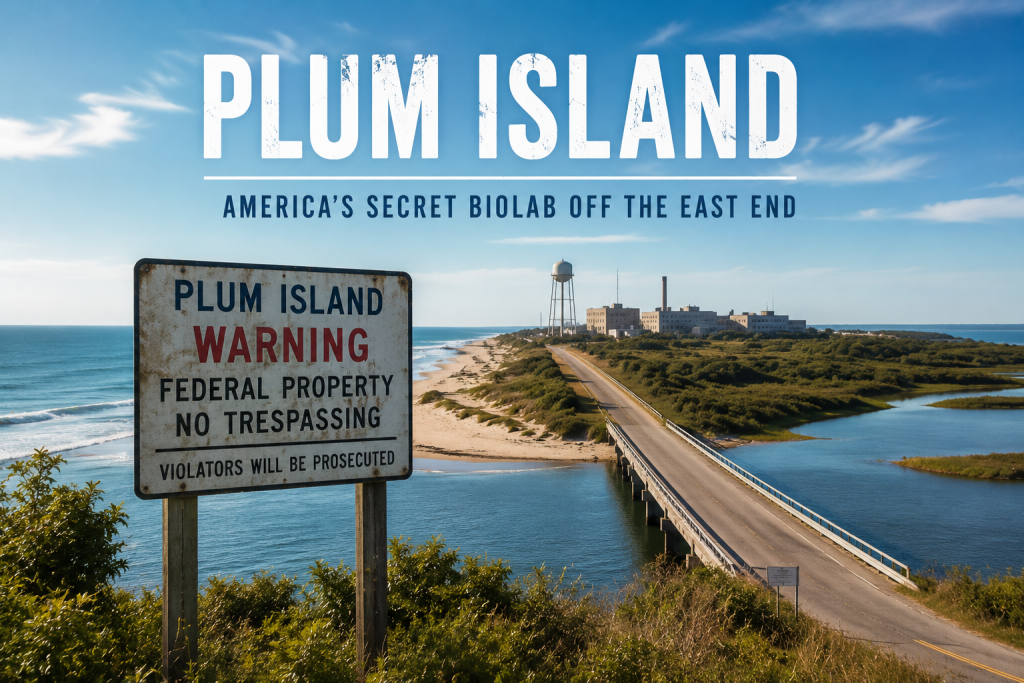
The Island Nobody Is Allowed to Visit
There is an island in Long Island Sound, roughly a mile and a half off the North Fork, where every wild mammal that sets foot on shore is killed. Not relocated. Certainly not tagged and monitored. Killed. This has been the official policy of the Plum Island Animal Disease Center for decades, because the facility studies diseases so contagious that a single infected raccoon swimming to the mainland could theoretically devastate the American livestock industry.
Large signs along the shoreline read “U.S. Property. NO Trespassing.” The island has its own fire department, its own power plant, its own water treatment system, and its own security force. For over 70 years, the federal government has operated one of the most restricted research facilities in the country on these 840 acres. And for almost as long, conspiracy theorists have alleged that the official mission is a cover story for something far darker.
The official version: Plum Island protects American agriculture by studying foreign animal diseases like foot-and-mouth disease and African swine fever. The conspiracy version: Nazi scientists conducted biological warfare experiments on the island after World War II, Lyme disease escaped from a tick research program, and the Montauk Monster (which washed ashore at Ditch Plains in 2008) was a mutant that swam from Plum Island’s laboratories to the South Fork.
Both versions agree on one thing. Indeed, something very serious has been happening on that island since 1954. In fact, the question is what.
The Official History
Plum Island’s military history predates the biolab. During the Spanish-American War, the U.S. government purchased the island and built Fort Terry as a coastal defense installation. The fort was later deactivated after World War II, then reactivated in 1952 for the Army Chemical Corps. In 1954, the U.S. Department of Agriculture took control and established the Plum Island Animal Disease Center (PIADC).
The facility’s stated purpose has always been defensive. Specifically, the PIADC studies foreign animal diseases that do not naturally occur in the United States. It develops vaccines and diagnostic tools to prevent outbreaks that could cripple American agriculture. Foot-and-mouth disease, which is endemic in parts of Africa, Asia, and South America, is the primary focus. The disease is so contagious that working with live virus samples is prohibited on the U.S. mainland. Plum Island’s geographic isolation is, of course, the containment strategy.
The center comprises approximately 70 buildings (many of them now dilapidated) spread across the island’s 840 acres. At its peak, hundreds of scientists and support staff also commuted daily via government ferry from Orient Point on the North Fork. Research papers obtained through the Freedom of Information Act carry dry, technical titles. They read like the output of an agricultural lab, not a bioweapons facility. But the conspiracy theorists have never been particularly persuaded by the paperwork.
Erich Traub and Operation Paperclip
This is where the story gets uncomfortable. Not conspiracy-theory uncomfortable, but documented-history uncomfortable.
After World War II, the United States recruited over 1,600 German scientists, engineers, and technicians through a program called Operation Paperclip. Recruits included rocket scientists (most famously Wernher von Braun), aviation engineers, and specialists in chemical and biological warfare. The program’s purpose was to prevent these experts from falling into Soviet hands. Its moral calculus was blunt: better to have Nazi scientists working for America than against it.
Among the recruits, according to investigative journalist Michael Christopher Carroll’s 2004 book Lab 257: The Disturbing Story of the Government’s Secret Germ Laboratory, was a virologist named Erich Traub. Before the war, Traub had studied at the Rockefeller Institute in Princeton, New Jersey. During the war, he ran the Nazi biological weapons program on Insel Riems, a small island in the Baltic Sea. His specialty was weaponizing animal diseases.
Carroll’s research indicates that Traub worked at Plum Island in the 1950s before returning to Germany in 1953. According to Carroll, “Traub experimented with over 40 lethal viruses on large test animals” during his time in the Nazi program. The implication is stark: the man who ran Hitler’s bioweapons island was brought to America and installed at another island where the government studied the exact same diseases he had previously weaponized.
The PIADC has consistently denied that any weapons research has taken place at the facility. Dr. Luis Rodriguez, one of the lead researchers, has stated publicly: “I think the biggest misconception is that we work on secrets and that our research is secret.” But the Traub connection, which is documented in declassified records and Carroll’s extensively sourced book, gives the conspiracy narrative a foundation that extends well beyond speculation.
The Lyme Disease Theory
In 1975, a cluster of children and adults in Lyme, Connecticut, began presenting with an unusual form of arthritis. Investigators eventually identified the cause as a tick-borne spirochete bacterium, later named Borrelia burgdorferi. Eventually, the disease was called Lyme disease after the Connecticut town where the outbreak was first documented.
Lyme, Connecticut, sits directly across Long Island Sound from Plum Island. The distance is approximately 10 miles. For conspiracy theorists, this proximity was deeply significant. Their theory: weaponized ticks carrying the Borrelia bacteria escaped from Plum Island (either through negligent containment or infected birds) and established themselves in the Connecticut shoreline, triggering the initial outbreak.
The theory gained enough traction that in 2019, the U.S. House of Representatives actually passed an amendment requiring the Department of Defense Inspector General to investigate whether the Pentagon experimented with weaponized ticks at Plum Island or other facilities between 1950 and 1975. The amendment was sponsored by New Jersey Representative Chris Smith, who cited Kris Newby’s book Bitten: The Secret History of Lyme Disease and Biological Weapons as supporting evidence.
The scientific consensus, however, does not support the bioweapon theory. Studies of preserved tick specimens have found Borrelia burgdorferi in ticks dating back well before the Plum Island facility existed, suggesting the bacterium has been present in North America for centuries. Still, the investigation was authorized. And the fact that Congress considered the theory credible enough to demand an official inquiry tells you something about the cultural weight of the Plum Island mythology.
Lab 257
Michael Christopher Carroll’s book Lab 257 is the single most influential document in the Plum Island conspiracy canon. Published in 2004, the book combines Freedom of Information Act records, interviews with former employees, and investigative reporting to argue that the facility’s safety record was far worse than the government acknowledged.
According to Carroll, Lab 257 was the oldest laboratory building on the island. It received no major modernization until the 1990s, despite aborted renovation attempts in the mid-1970s. Over the decades, the facility experienced several containment failures. In 1991, Hurricane Bob knocked out power to the facility. Carroll reported that the underground emergency power supply had been inoperative for some time, forcing reliance on exposed overhead lines meant as backup. When the storm destroyed those lines, the understaffed facility faced a potential containment breach.
Carroll also documented incidents of workers being accidentally exposed to pathogens, equipment failures in the containment zones, and aging infrastructure that critics described as dangerously inadequate for a BSL-3 (Biosafety Level 3) facility. Whether these issues ever resulted in an actual release of dangerous pathogens to the mainland remains unconfirmed. But the portrait Carroll painted of institutional neglect gave the conspiracy community all the ammunition it needed.
The Montauk Monster Connection
In July 2008, when a mysterious carcass washed ashore at Ditch Plains beach in Montauk, the first theory that gained traction in conspiracy circles pointed directly at Plum Island. The creature (hairless, bloated, with what appeared to be a beak and elongated claws) washed up approximately 10 miles from the island’s shore. For believers, the proximity was too perfect to dismiss.
The theory held that the Montauk Monster was an escaped experiment, a biological anomaly produced by Plum Island’s research programs. Jesse Ventura’s television show Conspiracy Theory dedicated an entire episode to the connection. Multiple documentaries explored the link. The carcass was eventually identified by most experts as a decomposed raccoon, but the body vanished before any definitive analysis could be performed, and the Plum Island theory persisted.
Whether the Montauk Monster actually came from Plum Island is almost beside the point. What matters is that the theory was instantly credible to millions of people. Because Plum Island had been operating in secrecy for over 50 years. A Nazi scientist had worked there. Lyme disease emerged across the Sound. And the government’s track record of transparency about the facility was, by any reasonable assessment, poor. The Montauk Monster didn’t need to be a Plum Island escapee. The island’s reputation had already done the work.
The Island Is for Sale
In 2009, Congress ordered that the PIADC program be transferred to a new facility: the National Bio and Agro-Defense Facility in Manhattan, Kansas, closer to the center of the nation’s livestock industry. The transition has been a slow process, taking over a decade, but the transfer is now underway. When the move is complete, Plum Island will become one of the largest parcels of available real estate on Long Island Sound.
The government has recently begun allowing limited tours of the island, partly to counter decades of conspiracy narratives by showing the public what the facility actually looks like. Tours depart from Orient Point and include a presentation covering the PIADC’s history, mission, and future. A public affairs officer leads each group. The messaging is straightforward: nothing sinister happened here. We study animal diseases. The conspiracy theories are unfounded.
Yet the question of what happens to the island after the government leaves remains genuinely fascinating. An 840-acre island with 70 buildings, its own infrastructure, deep-water access, and a mythology that connects to the Montauk Project, the Montauk Monster, and Lyme disease. That is not a typical real estate opportunity. Development proposals have ranged from conservation preserve to luxury resort to research campus. Each proposal carries its own complications, including extensive environmental remediation that will likely be required before any civilian use.
For the East End real estate market, Plum Island represents something unprecedented. Not just acreage, but narrative. Whoever buys this island buys the conspiracy along with it.
The Conspiracy Corridor
Plum Island doesn’t exist in isolation. It belongs to a geographic cluster of government facilities and unexplained events that stretches across Long Island’s eastern reaches. Camp Hero (the decommissioned Air Force station in Montauk where the Montauk Project allegedly took place) sits 10 miles to the south. Tesla’s Wardenclyffe Tower (where Nikola Tesla attempted to transmit free wireless energy before J.P. Morgan shut him down) stood 70 miles to the west in Shoreham. Brookhaven National Laboratory (a Department of Energy facility with its own conspiracy mythology) sits roughly 50 miles southwest.
Each of these sites reinforces the others in the cultural imagination. Plum Island gives Camp Hero’s conspiracy a biological dimension. Camp Hero gives Plum Island’s conspiracy an electromagnetic dimension. The Montauk Monster physically connects the two. And all of it gave the Duffer Brothers the raw material for Stranger Things, a show that turned Long Island’s conspiracy corridor into the most successful Netflix franchise in history.
The facilities are real. So are the diseases. A Nazi scientist is documented in declassified records. Lyme disease proximity is geographic fact. And the containment failures are reported in a sourced, published book. What’s not established is whether any of these elements connect in the way conspiracy theorists claim. But on the East End, certainty has never been the point. The story is the point. And Plum Island has one of the best stories on the South Fork.
Where the Conversation Continues
Plum Island is one chapter in the East End’s ongoing mythology, a story that runs from Camp Hero’s radar tower to Ditch Plains beach to the Sound. Social Life Magazine has covered this territory for 23 years, and the stories that define the South Fork land here before they land anywhere else.
If you have a story, a brand, or a project that belongs in these pages, reach out at sociallifemagazine.com/contact.
For brands looking for premium editorial placement, our paid feature submission portal is open at sociallifemagazine.com/submit-a-paid-feature/.
Stay in the loop with our weekly email blast covering events, openings, and who’s doing what Out East. Sign up at enflyer.sociallifemagazine.com.
Polo Hamptons 2026 returns to Bridgehampton on July 18 and July 25 with BMW as title sponsor. For event details and sponsorship opportunities, visit polohamptons.com.
Never miss a feature, a profile, or a party recap. Subscribe to Social Life Magazine at sociallifemagazine.com/subscription.
If the work we do matters to you, you can support independent East End journalism directly via PayPal.
Author

Written by
Recent Posts

How to Choose Useful Tech Gifts for Employees and Clients in 2026
The Garage Question: Which Car Goes South for the Season?

VandS Clinic Review Treatment: How Seoul Injectable and Laser Options Compare for US Patients
Before Buying a View Home: What a Sloped Lot Means for the Purchase

Powerful Strategies to Stay Ahead in a Fast-Moving Real Estate Market
Categories
- Art
- Articles
- Business of Luxury
- Celebrities
- Culture
- Entertainment
- Events
- Faces of Summer 2026
- Fashion
- Fashion & Style
- Featured
- Finance
- Food, Spirits, Wine
- Hamptons
- Hamptons Celebrities
- Health
- Health & Beauty
- Lifestyle
- Luxury Lifestyle
- Press
- Profiles
- Real Estate
- Technology
- The Chronicles
- Travel
- Uncategorized
- Weddings