
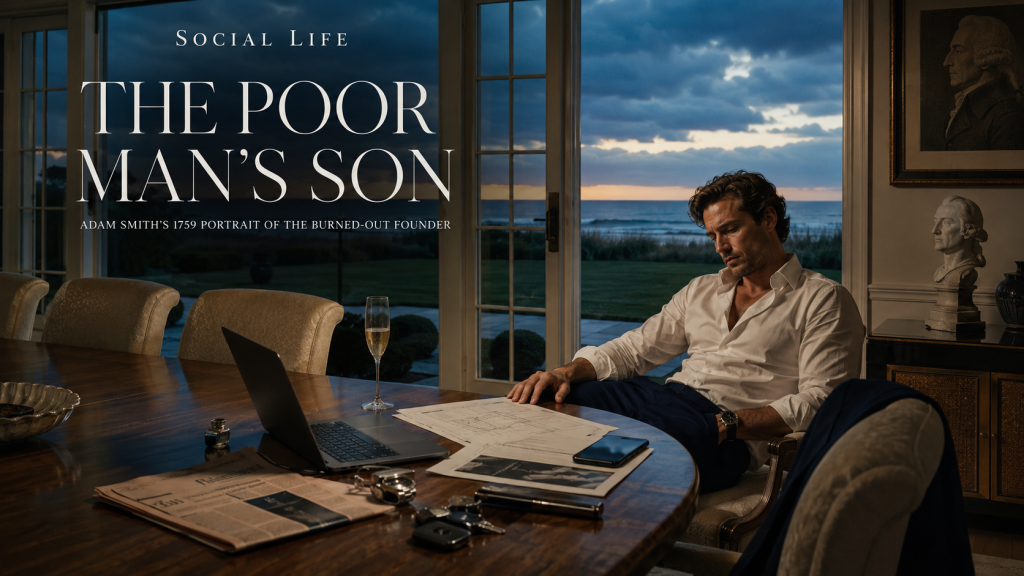
At six forty in the morning on Montauk Highway, a man who sold his company for nine figures is driving to a cold plunge. He is forty-one. He has not slept properly since the wire cleared in March. Adam Smith’s poor man’s son, written in 1759, is riding in the passenger seat.
The parable runs about two pages, tucked into Part IV of The Theory of Moral Sentiments. Smith is not warning anyone off ambition. Instead he describes, with clinical patience, what ambition costs the person carrying it, and why the reward tends to arrive in the wrong shape.
Out here the parable has a specific address. It lives in the founder who bought in Sagaponack after the exit and cannot work out why Saturday now feels like a scheduling problem. It also lives in the wellness economy that arrived to treat him, which is currently one of the fastest-growing categories on the East End.
Smith saw the whole arc. Even better, he saw why nobody stops.
The Parable Nobody Assigns You
Smith opens on a young man of modest birth whom heaven, in its anger, has visited with ambition. That is his phrase, and the anger in it is doing real work. The young man looks around, studies the rich, and concludes that their lives run more smoothly than his own.
He notices the palaces, the carriages, the servants standing by. Because that situation looks orderly, he decides ease is what wealth delivers. So he commits himself, permanently, to the pursuit of the money and the standing that buy it.
Then Smith does the cruel part. In the first year of that pursuit, the young man suffers badly. He endures more fatigue and unease in twelve months than a lifetime of doing without would have cost him. The bargain goes bad in the opening month, yet he cannot see it, since the payoff lives permanently in the future.
Anyone who has raised a Series B recognizes the shape. This piece sits inside a larger account of why status runs eight miles of the South Fork. Of course the poor man’s son is its sharpest single case.
He Serves Those He Hates
One line gets quoted more than the rest, and correctly. Smith writes that the young man serves those whom he hates and is obsequious to those whom he despises. That was 1759. Nobody has improved on the observation since.
Consider the board seat handed to a fund partner nobody at the company enjoys. Consider also the dinner in Water Mill that exists mainly so a check clears in October. Once you see the pattern, a calendar stops looking like work and starts looking like tribute.
Smith is not sneering here, which is exactly why the passage survives. He thinks the young man is doing something rational and even admirable, because ambition builds real things. Still, he wants the reader to look at the invoice, since nobody else in that young man’s life will ever itemize it.
Notably, the largest cost is not money. It is attention, sleep, and the slow conversion of a personality into a negotiating posture.
Trinkets of Frivolous Utility
At the end of the arc, the young man gets everything. Smith grants him the fortune, the position, the enormous house. After that he lets him grow old inside it.
Only in the last stretch of life does the man look at what he bought. By then his body is worn and his mind rubbed raw by a thousand remembered slights. Smith’s verdict is famous and brutal. Wealth and greatness turn out to be trinkets of frivolous utility. They are no better at producing peace of mind than a collector’s case of tiny tools.
That judgment deserves a hearing of its own, and this cluster gives it one in the case for taking beautiful unnecessary objects seriously. Smith is far harder on the fantasy than he is on the objects.
Because the watch is not the villain. The villain is the story a man told himself about what the watch would do for him once it arrived.
The Machine That Must Be Maintained
Smith then supplies the image that lands hardest on anyone with a large property. Power and riches, he writes, are enormous and elaborate machines, assembled from the most delicate springs, producing a few small conveniences for the body.
They must be kept in order with anxious attention. Even so, they stand ready at any moment to burst apart and crush the owner in the wreckage. A man with a staff of nine understands that paragraph without translation.
On Further Lane the image stops being metaphorical. There is the pool system, the generator, the irrigation, the alarm that wakes a monitoring center in Nevada at two because a raccoon crossed the deck. Each component requires a vendor. Every vendor requires a relationship, and relationships require Sundays.
Smith adds that these machines keep off the summer shower but never the winter storm. Ultimately they leave their owner as exposed as before to fear, to illness, and to death, while adding a maintenance schedule to the arrangement.
Then Smith Turns The Whole Thing Over
Here the passage stops being a warning and becomes something rarer. Smith announces that it is well nature deceives us in this manner. That deception, in his account, is precisely what rouses and keeps in motion the industry of mankind.
Because we overestimate how wealth will feel, we build. Cities exist due to that error. So do roads, ships, harbors, sciences, and every art requiring surplus and patience.
Nobody drains a marsh for a clear-eyed and modest return. Rather, people do it once they have persuaded themselves the result will finally make them content. The mistake stays productive even though it remains a mistake.
Hold that sentence while driving past a framed-out spec build in Bridgehampton. The framing is generous instead of cynical. Smith is saying the error carries load, and that pulling it out would drop the building.
The Exit, and Then the Tuesday
Founders describe the same week with eerie consistency. The wire lands on a Thursday. Friday is euphoric. By Tuesday the euphoria has been replaced by a flat, unfamiliar quiet nobody thought to warn them about.
Smith predicted the quiet. He located happiness in tranquillity, and he argued that without tranquillity there can be no enjoyment at all. What an exit removes is not stress. Instead it removes the structure that made the stress legible.
Meanwhile the identity keeps running on its old schedule. For eleven years the answer to what do you do was a company name. Now it is a longer sentence about a company that no longer needs him. Even the healthy version of this transition takes roughly eighteen months.
Out here the quiet arrives with a view of a pond. Surely that should help, although it generally makes things worse, since a beautiful setting removes the last available excuse.
The Friend Audit Comes Next
Around month four, a second thing happens. The founder starts sorting his contacts. Some of those people were colleagues. Others, it turns out, were vendors with excellent manners.
Smith is useful here as well. Once the obsequiousness stops being necessary, the relationships built on it quietly expire. Nobody sends a notice. The texts simply thin out over a summer.
Out here that sorting happens fast, because the season compresses everything. A man who took nine calls a day in April can find August strangely open. Invitations still arrive, although several of them now come from people selling something.
Not all of it is loss. Real friendships survive the transition, and they tend to be older than the company. Ultimately the audit is clarifying, even while it stings, since it tells a man exactly what he built and what he merely rented.
An Industry Grew Up To Sell Him Back His Mornings
Something had to fill that gap, and the East End market noticed early. Consider the longevity clinics around Southampton and Water Mill, the executive physical priced like a used sedan, the infusion suite behind an unmarked door off Jobs Lane.
The offer stays consistent across all of it. Come in, get measured, and receive a number telling you whether you are winning. For a particular kind of buyer, that is not wellness at all. It is a dashboard, and the dashboard is the actual product.
Smith would find this funny without finding it stupid. In fact he would say the poor man’s son has merely changed asset classes. Rather than buying the carriage, he is buying VO2 max, biological age, and a sleep score his watch reports each morning like a small severe accountant.
Whether every protocol works is a separate question from whether the demand is real. The demand, obviously, is real.
Why the Prices Look The Way They Do
Ask what a full executive panel costs between Memorial Day and Labor Day. After that, ask what the identical panel costs in February. The spread is not medical.
Given few providers and a compressed season, pricing behaves the way Smith said it behaves. Buyers whose hours cost more than the invoice rarely shop around. He wrote about that too, particularly in his warning about what happens when everyone in one trade already knows each other.
None of which makes the category dishonest. Practitioners out here are frequently excellent, and several will tell a patient plainly that he needs sleep and a purpose rather than another drip.
Still, a buyer should know what he is paying for. Part of the bill covers medicine. Another part covers reassurance, and reassurance has always priced beautifully in a market full of anxious people.
The House as Prescription
Wellness real estate is the same instinct with a certificate of occupancy. Cold plunge off the primary suite, sauna in the pool house, circadian lighting on a schedule, an air system carrying its own service contract.
A builder in Amagansett will tell you the spa program is now the first conversation, well before the kitchen. Buyers are not asking for somewhere to entertain three hundred people. Rather, they are asking for a house that will regulate them.
Smith’s beggar sunning himself beside the highway had that regulation for nothing, which is the entire point of the comparison. Yet the modern version is hardly absurd. A house making sleep easier is doing genuine work, even if it cannot do the work its owner quietly hopes for.
The error sits in the ratio. Two million in construction cannot outperform one honest conversation about what the next decade is supposed to be for.
Smith Was Not Telling Anyone To Quit
A careless reading turns this parable into a lecture about slowing down. Smith never wrote that lecture. He would have been bored by it too.
Industry impressed him. Prudence, in his ranking of the virtues, is a genuine good rather than a consolation prize. He treated the careful building of security as an honorable use of a life. That whole ranking gets worked out in the order of virtues old families follow without ever naming it.
What Smith objects to is the forecast, not the effort. The young man is wrong about how the summit will feel, although he is not wrong to climb it.
So the useful takeaway stays small and unglamorous. Keep the ambition. Also keep an accurate model of what it will and will not deliver, because the gap between those two numbers is where burnout actually lives.
Where The Conversation Continues
Social Life Magazine reaches 25,000 print readers each summer as well as 82,000 email subscribers. Most of them are the man in this article, or else married to him.
For a longevity practice, an executive health group, or a builder selling restoration as architecture, that is not a media buy. It is the room itself. Ideally your name appears inside a piece a reader finishes, rather than beside one he scrolls past on a phone.
Placement in the July issue stays limited by design, since the section only works while it remains thin. Categories generally go to one partner per season, and the calendar around Polo Hamptons in Bridgehampton closes earlier than most brands expect.
The brands doing this well rarely announce anything. Instead they turn up inside the conversation their buyer is already having at seven in the morning. After that, the sales lift follows the credibility rather than the other way around.
If your category is still open, it will not stay open. Someone in your competitive set is reading this paragraph too.
Author

Written by
Recent Posts

The New York Women’s Foundation’s 2026 Neighborhood Dinner

Marco Maranghello

The Baker House 1650
MvVO ART Show

Casita Maria Center for Arts and Education
Categories
- Art
- Articles
- Business of Luxury
- Celebrities
- Culture
- Entertainment
- Events
- Faces of Summer 2026
- Fashion
- Fashion & Style
- Featured
- Finance
- Food, Spirits, Wine
- Hamptons
- Hamptons Celebrities
- Health
- Health & Beauty
- Lifestyle
- Luxury Lifestyle
- Press
- Profiles
- Real Estate
- Technology
- The Chronicles
- Travel
- Uncategorized
- Weddings