
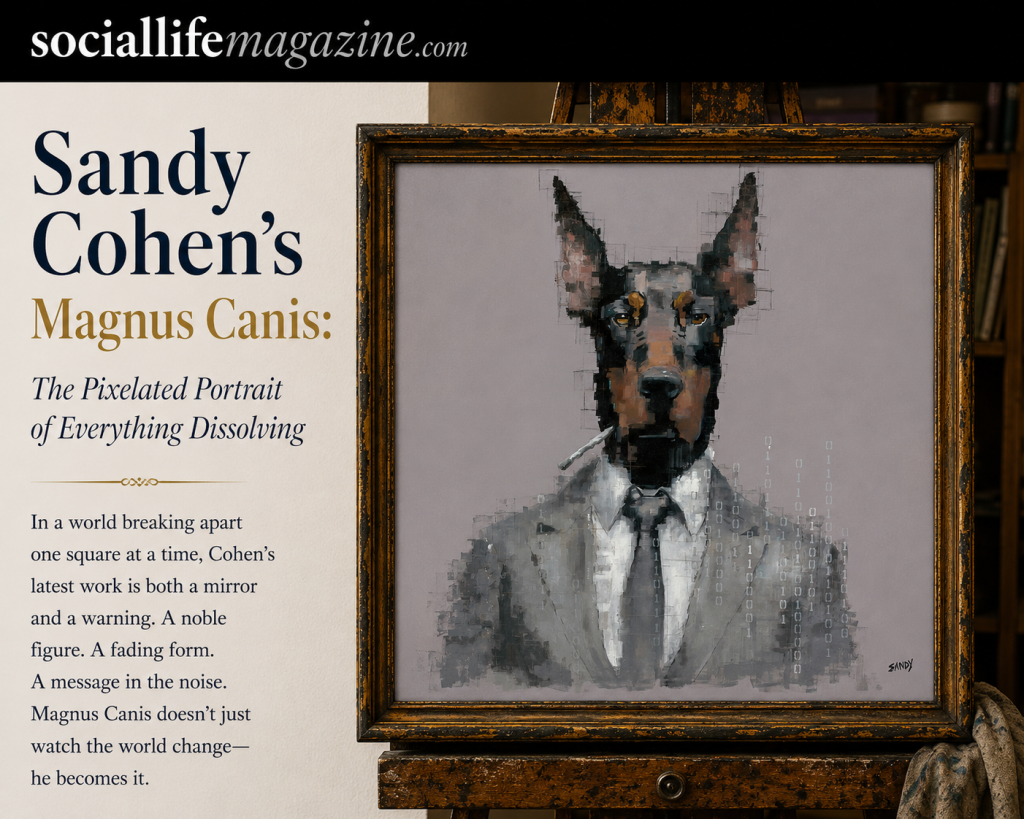
You see him before you are ready to see him. That is how it always goes in this city. The thing that matters arrives in your peripheral vision before you have had time to compose yourself into someone capable of handling it properly. You are at the opening, the kind of opening where the wine is better than the crowd pretends not to notice. You have been moving through the room at the exact speed that signals you belong without signaling you are trying. Then you turn. He is there: seventy-two inches by sixty inches of Doberman in a suit staring directly at you. The canvas has no background worth hiding in, just a pale gray field that offers no shelter, no context, no permission to look away.
The Doberman stares. You stare back. Neither of you blinks, but you are the one who will eventually have to.
Sandy Cohen painted this. She called it Magnus Canis. Oil and acrylic on canvas, 2025, $49,000. The most urgent piece in the current available collection. A portrait of right now, not as metaphor but as literal condition.
The Suit That Is Dissolving
You know the suit. Of course you know the suit. You have owned versions of that suit at various price points across the decade-plus you have been moving through rooms like this one. You started with the version you bought on credit. Eventually you worked your way up through the versions that required appointments and the versions that required relationships with the person who required appointments. At each upgrade you believed, with the specific sincerity that only the upwardly mobile can sustain, that this was the suit that would finally complete the picture. You were wrong each time. The Doberman’s suit is past all of that. His suit is the suit you buy when you have stopped thinking about suits.
Binary Beneath the Fabric
But something is wrong with the suit in a way that takes a moment to name. The fabric is disintegrating at the edges, pixelating outward into the gray field. It degrades the way a digital image degrades when you push the resolution past what the file can support. Crisp weave dissolves into blocks of information. Still technically the suit, but no longer quite cloth, no longer quite real in the tactile sense that suits need to be real. The cigarette in his mouth is still analog. This seems important.
The binary code running down his chest, when translated, reads: DOG EAT DOG. You can translate it yourself, which Cohen wanted you to do, which required you to either know binary or look it up. Either way, you have done the work of discovering something. The suit you admired, the suit that codes as power and composure and the kind of authority that doesn’t need to raise its voice: made entirely of the oldest most honest description of the system that produced it.
The 2025 Condition
You have been in the city long enough to remember when the anxiety was different. The thing that kept you up was simpler then, more navigable: whether you would get the apartment, whether you would keep the job, whether the person would call back. Those anxieties had edges. They were bounded. You could work them like a problem with a solution you hadn’t found yet rather than a problem with no solution category available. That version of anxiety was almost comfortable by comparison.
The Composed and Continuous Dread
The anxiety in the Doberman’s eyes is not that anxiety. His amber eyes are direct and focused and not at all panicked, which is the worst kind of unease, the kind that has already metabolized the bad news into baseline. It has done the work of processing and arrived not at peace but at a very composed and continuous dread. This is the dread that wears a good suit and keeps its appointments. It knows exactly what the binary columns running down the chest of that suit spell out when you stop reading them as decoration.
This is what 2025 feels like from the inside. Cohen is not making a prediction here. She is making an observation, which is harder and more useful. The dissolution is already happening. Already visible at the edges, already running in the binary beneath the fabric of every professional identity currently trying to hold its shape in the digital field. The intelligence that used to distinguish you from automated systems is now what those systems do best. That is the condition. Cohen saw it coming before most people were willing to name it. She painted it in a suit and called it Magnus Canis. Latin for Great Dog. Also what every professional in every room thinks he is until the pixels start showing.
What the Stare Asks
Everything in your life wants something from you. Your phone wants your attention. Each platform wants your content. The algorithm wants your data. Meanwhile the room wants your performance. But the Doberman simply stares. Binary code runs down his chest. The cigarette is held loosely in the corner of his jaw. The stare asks nothing. Such complete absence of demand is so unusual. You have been standing in front of this painting for eleven minutes. The opening is almost over and you have not spoken to a single person you came here to speak to.
What the Dissolution Looks Like
Pixelation is spreading. The boundary between the Doberman and the gray field is not fixed but approximate. Both the suit and the body inside it are in the process of becoming something that the canvas will eventually have to decide whether to hold or release. His ears have already gone mostly geometric. Yet the eyes are still amber and still direct, and he holds the cigarette with the assurance of someone who has decided that certain transitions are beneath his concern. He was here before the binary. He will be here after it resolves into whatever it resolves into.
For the soul-level companion to this digital-age portrait, Many Lives, Many Masters is the question of what persists when the pixelation is complete. For the power-and-substitution argument that precedes this dissolution, see I’m a Self Made Dream. The full collector context for Cohen’s work is documented in Sandy Cohen: The Hamptons Artist Whose Collectors Are Already the Canon.
Where to Find the Work
Magnus Canis is available at SandyCohenArt.com. Follow Cohen at @sandycohensart on Instagram. To feature your collection, practice, or brand in Social Life Magazine, visit sociallifemagazine.com/submit-a-paid-feature. Twenty-five thousand print copies, Westhampton to Montauk, Memorial Day through Labor Day.
Author

Written by
Recent Posts

AI for personal finance: where PennyGuard fits

How to Pick a Homecoming Dress for Your Body Type (and Feel Amazing in It)

World Cup Injury Attorney for Vancouver Events
What a 3-Carat Engagement Ring Actually Costs in 2026: The Real Numbers
The Skincare Habits That Make a Real Difference Over Time
Categories
- Art
- Articles
- Business of Luxury
- Celebrities
- Culture
- Entertainment
- Events
- Faces of Summer 2026
- Fashion
- Fashion & Style
- Featured
- Finance
- Food, Spirits, Wine
- Hamptons
- Hamptons Celebrities
- Health
- Health & Beauty
- Lifestyle
- Luxury Lifestyle
- Press
- Profiles
- Real Estate
- Technology
- The Chronicles
- Travel
- Uncategorized
- Weddings