
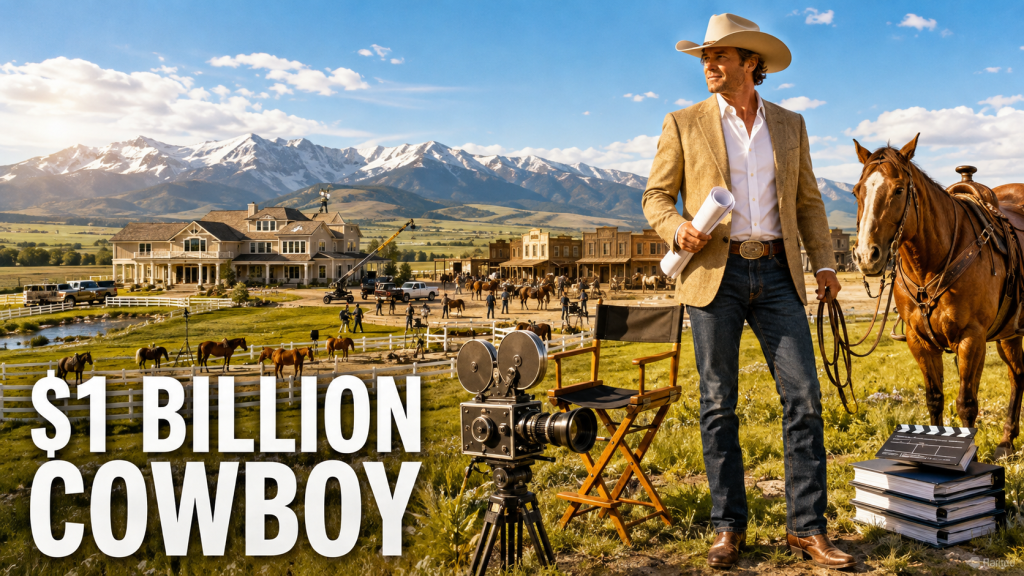
On October 27, 2025, Deadline broke the story that rearranged television’s org chart. Taylor Sheridan was leaving Paramount for NBCUniversal. The reported price: north of $1 billion. In one afternoon, the Taylor Sheridan universe stopped being a content library and became an asset class. You appraise an asset class. Then you insure it, and eventually you fight over it on earnings calls.
Nobody else in television could have moved that number. Sheridan is the sole supplier of his own shelf. He writes the shows himself, and he casts movie stars other showrunners cannot reach. Also, he shoots on ranches he partly owns.
So when he walked, everything walked with him. That includes the fortunes of two dozen actors, a 266,000-acre Texas ranch, and a streaming platform’s growth story. What follows is the full map: every wing, every fortune, and the machine underneath.
The One-Man Studio Model and the $1 Billion Walk to NBCUniversal
Television runs on writers’ rooms, but Sheridan runs on Sheridan. He writes nearly every episode of his series alone, an output no working showrunner matches. Because he is the single source of the product, he sets the price. That fact explains everything else in the Taylor Sheridan universe, including the exit.
From Failed Actor to Sole Supplier
The origin story matters, because it explains the pricing. Sheridan spent two decades as a midlist actor, playing cops on Veronica Mars and Sons of Anarchy. In 2010 he quit over money, since the fees barely covered rent. Then he wrote his way out. Sicario landed in 2015, and Hell or High Water earned him an Oscar nomination the next year. Wind River followed, so the trilogy rebranded him as the poet of the American margins. Hollywood pays poets badly, though, until one of them builds a franchise.
How One Writer Became a Studio
Yellowstone began as a rejected pitch. HBO passed, so Paramount Network took it as a flagship bet in 2018. The show became the most watched drama on cable, and Sheridan converted the hit into a slate deal. By 2025 he had roughly ten series running across Paramount platforms. He directs when he wants. Acting happens on his terms too; he cast himself as horse trainer Travis Wheatley. The billing follows accordingly.
The volume alone breaks industry math. While a typical prestige showrunner delivers one season every two years, Sheridan has shipped multiple series a year since 2021, writing from his Bosque Ranch compound in Texas. Since the scripts come from one keyboard, there is no committee drag, and no notes process worth the name. Paramount executives reportedly learned to read the drafts and order the horses.
Readers tracking Taylor Sheridan’s net worth will find the figure at $200 million. That number predates a single dollar of NBCUniversal money, so consider it a floor.
The Deal Paramount Never Countered
Deadline first reported the NBCUniversal move, and The Hollywood Reporter later detailed the strangest part. Paramount, newly under Skydance ownership, reportedly never made a formal offer to keep him. His television contract runs through 2028, so the new pact takes effect in 2029. His film work shifts to Universal sooner. Reports peg the package above $1 billion, covering as many as 20 shows.
NBCUniversal already had the receipts, of course. Yellowstone streamed on Peacock through a licensing quirk Paramount regretted for years. The show built Peacock’s drama audience, so Comcast knew exactly what Sheridan’s pages were worth before writing the check. One writer held a studio’s streaming future in a Word document. Then he priced it like real estate, which in his case it partly is.
What does NBCUniversal actually get? A slate reported at up to 20 series, feature films, and the only creator whose name alone opens a Sunday night. Above all, it gets the audience Paramount spent seven years assembling: red-state affluent, brand loyal, and allergic to everything else prestige TV makes. Comcast paid for a universe, but it also bought a demographic.
Yellowstone Proper: Where the Taylor Sheridan Universe Money Lives
Every empire has a home ranch. Yellowstone premiered in June 2018 and ended in December 2024, after five seasons and a cultural annexation of Sunday night. Along the way, it turned a payroll of working actors into a nine-figure balance sheet. In fact, the combined Yellowstone cast net worth now totals a reported $350 million. Most of that appreciation happened on Sheridan’s watch, and on Sheridan’s dirt.
The audience numbers explain the paychecks. By its fifth season, the premiere reportedly drew north of 12 million viewers, a broadcast-era figure landing on basic cable. Because streaming shows guard their data, those public ratings became the cast’s best negotiating document. Every renewal repriced everybody.
Kevin Costner’s Exit and the $250 Million Anchor
Costner arrived as the marquee and left as the franchise’s most expensive breakup. At his peak, he reportedly earned $1.5 million an episode as John Dutton. That is a movie-star fee smuggled onto basic cable. But the scheduling war over his Horizon film saga ended the marriage midway through Season 5. Sheridan responded the way landowners respond, and wrote John Dutton into a grave.
The aftermath sharpened the lesson. Costner spent a reported $38 million of his own money on Horizon, which stumbled at the box office while his old show thrived without him. Leaving the Taylor Sheridan universe, in other words, carried a price the market could measure.
Kevin Costner’s $250 million fortune hardly needed the paycheck. Still, the exit proved a point that now defines the Taylor Sheridan universe. The world is the star, so even the anchor face is replaceable.
Beth, Rip, and the Power Couple Premium
Beth and Rip became the show’s true power couple, on screen and on invoices. Kelly Reilly’s net worth sits at a reported $20 million. Cole Hauser’s fortune runs about $10 million, and both figures climbed almost entirely on Dutton money. A Beth and Rip continuation remains in reported development, which would extend the annuity again.
Notably, both actors spent decades as reliable ensemble players before the ranch. Television used to pay people like them a living. Sheridan’s version pays them like principals, because the audience treats their marriage as appointment viewing. Reilly’s Beth Dutton, in particular, became the franchise’s most quoted export, and quotability is a royalty that never stops accruing. Expect both fortunes to look quaint within two contract cycles.
The Bunkhouse Payroll: Supporting Fortunes That Compounded
Further down the call sheet, the compounding is just as instructive. Wes Bentley’s comeback economics turned a stalled film career into steady prestige income as Jamie Dutton. Kelsey Asbille’s earnings grew season over season as Monica. In addition, Gil Birmingham’s balance sheet benefited from playing Chief Rainwater across all five seasons.
Even the cowboys cashed in. Forrie J. Smith’s payday as Lloyd took an actual working cowboy from day rates to autograph lines. Those appearances reportedly pay better than ranch work ever did. That is the Sheridan effect in miniature: authenticity, priced retail. The show minted a merchandise economy around its supporting players, from rodeo appearances to bourbon endorsements. In the Taylor Sheridan universe, even the fourth lead gets a second income.
The Prequels: 1883, 1923, and the Legend Premium
Sheridan’s prequels solved a problem streaming could not crack. How do you get movie stars who never did television? His answer was money, a limited run, and the dignity of a period saga. Both shows exist to make a Paramount+ subscription feel like a heritage purchase.
1883: Country Royalty Goes West
1883 arrived on Paramount+ in December 2021, with Tim McGraw and Faith Hill as the original Duttons. Sam Elliott rode point as a broken wagon master. Casting Nashville’s first couple was a status play, not a stunt. Their fans buy trucks, tour tickets, and streaming subscriptions in bundles, so the series reportedly drove record sign-ups for the platform. For McGraw and Hill, already a nine-figure household on touring money, the show added a prestige acting chapter neither had on the resume. That chapter has its own resale value in endorsements and Vegas residencies.
Isabel May’s narration became the connective tissue of the whole timeline, and her casting cost a fraction of the leads. One season, no fat, maximum scarcity. Scarcity, as every Hamptons broker knows, converts directly to price.
1923: Harrison Ford, Helen Mirren, and the Eight-Figure Prestige Trade
1923 escalated the casting arms race. Harrison Ford and Helen Mirren took the ranch through Prohibition and the Depression, across two seasons ending in April 2025. Neither career had ever needed episodic television. Ford’s fortune is reported around $300 million, while Mirren’s sits near $100 million, so nobody came for grocery money.
They came because Sheridan repriced television for movie stars. Under the old model, TV was a demotion. Under his, it is exit liquidity for a legendary career. Our movie star legends net worth index tracks that repricing across generations, and the 1923 leads sit near the top of it.
The prequel machine also seeded the wider franchise map. Lawmen: Bass Reeves, which Sheridan executive produced, extended the period formula to a new lead in David Oyelowo. More timeline chapters keep surfacing in trade reports, because the Dutton century is a mineral right Sheridan can keep drilling. Each era means a new prestige cast, and each new cast means another round of late-career paydays.
The Spinoff Era: Y: Marshals on CBS and The Madison
Yellowstone’s finale ended nothing. Instead, it split the audience into two products. One is a broadcast procedural for the network crowd. The other is a grief-soaked Montana drama for the prestige crowd. Both launched within two weeks of each other in March 2026, which shows how deliberately the Taylor Sheridan universe manages its shelf space.
Y: Marshals: Kayce Dutton Rides to Broadcast
Y: Marshals premiered March 1, 2026 on CBS, moving Kayce Dutton from cable to network scale. Luke Grimes leads as Kayce, now attached to a US Marshals task force in Montana. The CBS platform puts him in front of the largest audience of his career.
Luke Grimes’s net worth stands at a reported $4 million. That makes him the cheapest lead in the franchise, and arguably the best positioned. Broadcast money is boring money, but boring money compounds through syndication. Grimes also fits the Sheridan hiring pattern: an actor priced below his screen value, then repriced by the brand. Watch that $4 million figure over the next three years.
The CBS berth matters strategically, too. Paramount kept the Yellowstone name in-house even as its author packed for NBCUniversal, so the network needs Marshals to prove the brand outlives the brander. A weekly procedural is the safest instrument for that test. It ages into reruns, and reruns are where television fortunes quietly finish compounding.
The Madison: Pfeiffer, Russell, and Late-Career Exit Liquidity
The Madison premiered March 14, 2026 on Paramount+. Michelle Pfeiffer stars as a New York City matriarch moving her family’s grief to Montana’s Madison River valley. Kurt Russell co-stars, and Paramount+ has already renewed the series through a third season, per The Hollywood Reporter.
Reported figures put Michelle Pfeiffer’s net worth around $250 million. Kurt Russell’s fortune is reported near $100 million. Neither needed the work, and that is exactly the point. A Sheridan series is where A-list careers convert prestige into premium one more time. For the full ensemble ledger, our Madison cast net worth breakdown runs every number. The show is also the purest expression of the whole pitch: new money, old land, tuition paid in grief.
Consider what the early renewals signal. Paramount has committed to three seasons of two Hollywood royals. That is not just programming confidence, it is asset protection. With Sheridan leaving in 2029, The Madison is the library Paramount gets to keep, so the studio locked its stars early and reportedly paid accordingly.
The Non-Western Wing of the Taylor Sheridan Universe
Strip out the horses and the model still works. Sheridan applies the same formula to oil fields, mob turf, and black-ops espionage. Take one writer, add one movie star who never did TV, then render an American industry as tribal warfare. The non-Western wing now earns like a second studio. For Paramount+, these shows carried subscriber growth quarters that Wall Street actually noticed. For the stars, they perform the same trick the Westerns do, converting decades of accumulated fame into present-day fees.
Landman: Oil Patch Money and the Billy Bob Thornton Trade
Landman premiered in November 2024, with Billy Bob Thornton as Tommy Norris, a West Texas crisis manager for an oil fortune. Demi Moore and Ali Larter fill out the ensemble. Jon Hamm played M-Tex owner Monty Miller in the first season, a short arc with long implications.
Jon Hamm’s $45 million net worth did not need a supporting role, yet he took it anyway. That is the tell. When wealthy actors accept small Sheridan parts, they are buying exposure to the brand, not a paycheck. Season 2 arrived in November 2025 with Sam Elliott joining, and a third season is reportedly on the way. Thornton, meanwhile, collects a reported seven-figure fee per episode for the role of his late career. After three decades of character work, the oil patch pays him like a lead, because in this universe he finally is one. Oil money, it turns out, streams beautifully.
Tulsa King: Stallone’s Streaming Annuity
Tulsa King gave Sylvester Stallone his first scripted series lead, at a reported seven-figure fee per episode. The bet keeps paying. Season 3 premiered in September 2025, and a fourth season is ordered. A Samuel L. Jackson spinoff, NOLA King, is reportedly in the works as well. Stallone’s mob-boss-in-exile premise sounded like a punchline, yet it became one of Paramount+’s most watched originals. The show proves the formula travels: swap the ranch for a casino, but keep the patriarch.
Mayor of Kingstown: Renner’s Grim Franchise
Mayor of Kingstown returned for its fourth season in October 2025, with Edie Falco joining Jeremy Renner’s prison-town drama. Renner’s recovery from his 2023 snowplow accident made the return itself a headline. The series is the wing’s darkest asset, yet it keeps getting renewed. Prestige misery, reliably delivered, is still inventory. For Renner, the franchise doubled as career insurance during two years of rehabilitation, since the role waited while he healed. Few studios hold a chair that long. A one-man studio can, because the writer decides what time means.
Lioness: Kidman’s Espionage Dividend
Lioness rounds out the wing with Zoe Saldana leading a CIA operative drama. Nicole Kidman and Morgan Freeman flank her, and a third season is reportedly greenlit at Paramount+. Reported estimates put Nicole Kidman’s net worth around $250 million, built on exactly this kind of portfolio thinking. Prestige film, premium television, producer points, repeat. For Kidman, a Sheridan series is not a job. It is an allocation, and espionage diversifies her holdings away from the ranch. Saldana, fresh off an Oscar, treats the series the same way. Both women produce as well as star, which means backend, and backend is where television money stops being salary and starts being wealth.
The 6666 Ranch and What the Wealth Machine Actually Sells
In 2021, Sheridan led the investor group that bought the historic 6666 Ranch in Guthrie, Texas. Roughly 266,000 acres changed hands at a reported price north of $300 million. The ranch is not a trophy. It is vertical integration: filming location, horse program, lifestyle brand, and a supporting character in the shows themselves. Yellowstone’s fourth season even wrote it into the plot, sending Jimmy there to become a man.
The Four Sixes brand now sells beef, merchandise, and a whiskey line to the same audience that watches the shows. A standalone 6666 series has been announced for years and still waits in the queue, like land held for appreciation. Meanwhile, the ranch functions as proof of concept. Sheridan does not play a cattleman on television, because he is one, and the audience can smell the difference.
Charging the Studio Rent
The Wall Street Journal reported that Paramount paid Sheridan-connected operations for production services. One line item: a cowboy camp for actors, billed at a reported $50,000 a week. Read that again as a business model. He writes the show, supplies the horses, owns the dirt, and invoices the studio for authenticity itself. No other creator in television collects on that many lines of the budget. Paramount grumbled, according to the reporting, but it kept paying. Authenticity has no substitute supplier.
What the Taylor Sheridan Universe Actually Sells
Here is the quiet part. The Taylor Sheridan universe sells ranch aristocracy to an audience that mostly lives nowhere near a ranch. A Bridgehampton hedge works the same way, selling privacy to people who moved east to be seen. Land that cannot be bought, names that run back generations, work that stains the hands: the shows package all of it as the last honest status symbol.
Look at who actually watches. The founder streaming Landman from a Gulfstream, the private wealth advisor quoting Beth Dutton at dinner, the brand marketer studying the Four Sixes merchandise line for lessons. Each of them is buying a costume, specifically the costume of people who never had to buy one. Sheridan understands that trade better than any showrunner alive, because he made it himself, one ranch at a time.
For the casts, each series is a wealth-transfer event. Studio money moves into actor fortunes at rates our Hollywood actor net worth rankings keep revising upward. For Sheridan, every show is another paddock on the same property. NBCUniversal did not buy a producer in 2025. It bought the whole ranch, brand included, for a reported billion-plus. The cowboy priced it himself.
Where The Conversation Continues
The Sheridan economy is a season-long conversation, and Social Life Magazine keeps the ledger. Our 2026 celebrity net worth rankings track every fortune in this universe as the NBCUniversal era begins. The print issue circulates through the houses south of the highway all summer. Also, the same names surface at Polo Hamptons in Bridgehampton, where the field-side crowd debates these numbers between chukkers. Some readers follow the money from a screen. Others stand next to it in July. There is room at the rail, for now.
Author

Written by
Recent Posts
The Two-House Year: What Seasonal Residents Learn After the First Season
Trade Show Booth Decisions: What to Rent, What to Build, and What to Skip
Find Your Ideal Solar Battery Size in Minutes

How to Explore Rome Comfortably Between Check-In and Departure

Beyond the Beauty Template: Why Modern Cosmetic Surgery Is Moving Beyond the One-Size-Fits-All Face
Categories
- Art
- Articles
- Business of Luxury
- Celebrities
- Culture
- Entertainment
- Events
- Faces of Summer 2026
- Fashion
- Fashion & Style
- Featured
- Finance
- Food, Spirits, Wine
- Hamptons
- Hamptons Celebrities
- Health
- Health & Beauty
- Lifestyle
- Luxury Lifestyle
- Press
- Profiles
- Real Estate
- Technology
- The Chronicles
- Travel
- Uncategorized
- Weddings