

The first day of work, he reported to Clinique’s regional marketing office in the New York metro area. His title: Regional Marketing Director. The pedigree: grandson of Estée Lauder, son of Leonard Lauder, heir to a beauty empire then approaching $2 billion in annual sales. The task: proving he belonged there anyway.
William Philip Lauder had every advantage birth could provide. What it couldn’t provide was the respect of colleagues who’d wonder, every day, whether their boss earned his position or inherited it. The question would follow him for decades. His answer would be written in company performance: from CEO to Executive Chairman, from family scion to industry statesman, from questioned heir to undisputed leader.
His estimated net worth of $1.5 billion in 2025 reflects his stake in one of the world’s dominant beauty conglomerates. More significantly, it represents the value created during his tenure at the company’s helm. His cousins Aerin and Jane Lauder would forge their own paths within the family enterprise.

The Wound: Leonard’s Son
Born April 11, 1960, William grew up as the eldest son of Leonard Lauder—the man who transformed his mother’s kitchen-stove cosmetics operation into a global powerhouse. Leonard had joined Estée Lauder Companies in 1958, creating the first R&D laboratory, acquiring MAC, Bobbi Brown, and Aveda, taking the company public in 1996. By any measure, Leonard was the architect of modern Estée Lauder Companies.
The Weight of Expectation
Being Leonard’s son meant something specific. Your grandmother started with nothing—face cream and determination. Your father built that into billions. What could you possibly add?
William attended Trinity School in New York City, then followed family tradition to the Wharton School at the University of Pennsylvania, graduating in 1983 with a degree in economics. The education was impeccable. The question remained: was he ready, or merely prepared?
The Macy’s Training
Before joining the family company, William completed Macy’s executive training program—a deliberate choice to learn retail from outside the Lauder ecosystem. He became associate merchandising manager of the New York Division/Dallas store. The experience taught him how department stores actually operated, knowledge that would prove valuable when negotiating counter space and promotional arrangements for Lauder brands.
The Chip: Building Credentials from the Ground Up
William joined Estée Lauder Companies in 1986, starting in regional marketing. The entry-level positioning was intentional. He needed to understand the business from the counter up, to earn credibility that couldn’t be dismissed as nepotism.
Creating Origins
His breakout came in 1990 when he led the creation of Origins, the company’s natural beauty brand. More innovatively, he developed the store-within-a-store concept that would become industry standard. The idea positioned Origins products in dedicated spaces within department stores, creating distinct brand experiences without requiring standalone retail locations.
Origins succeeded because William understood something his grandmother had known instinctively: beauty retail is theater. The customer experience matters as much as the product. His innovation wasn’t just a new brand but a new way of presenting brands.
The Rise Through Ranks
He subsequently led worldwide businesses for both Clinique and Origins, overseeing the company’s freestanding stores and internet business. In 2003, he became Chief Operating Officer, responsible for all global operations plus nine specialty brands and retail operations. Each promotion represented expanded scope and validated capability.
The Rise: CEO and Beyond
On July 1, 2004, William succeeded Fred H. Langhammer as Chief Executive Officer. The appointment made official what insiders had long anticipated: the third generation would lead the company forward.
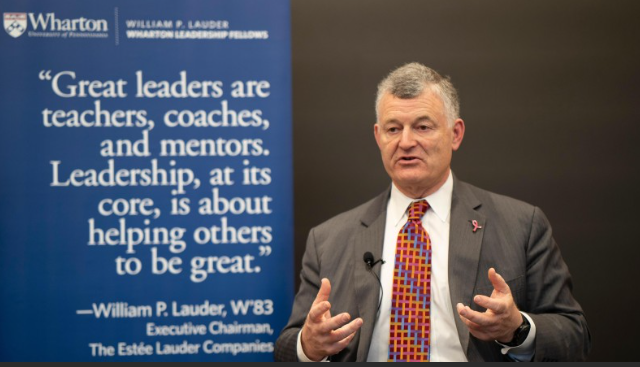
The CEO Years
His five-year tenure as CEO (2004-2009) expanded the company’s international presence, strengthened distribution channels, and greatly enhanced the brand portfolio. Under his leadership, Estée Lauder Companies navigated the 2008 financial crisis while maintaining its premium positioning.
The acquisition strategy continued. New brands joined the portfolio. Existing brands expanded globally. Revenue grew. The skeptics who’d questioned whether Leonard’s son could actually run the company found their answer in quarterly earnings reports.
Executive Chairman
In July 2009, William transitioned to Executive Chairman and Chairman of the Board of Directors. The move wasn’t retirement but repositioning—shifting from operational management to strategic oversight while remaining central to major decisions. The arrangement allowed professional managers to handle day-to-day operations while family leadership maintained long-term vision. Understanding the full Lauder family legacy reveals why this governance structure matters.
The Tell: The Professor
In 2012, William received a lecturer appointment at Wharton, his alma mater. He designed and teaches “Decision Making in the Leadership Chair,” a course for second-year MBA students. The appointment reveals something about his self-conception: not just an executive but a teacher, someone whose experience holds lessons worth transmitting.
Philanthropy and Boards
His board positions span the expected and the revealing. He serves on the Board of Trustees of the University of Pennsylvania and as Emeritus Trustee of Trinity School—his educational foundations. The Fresh Air Fund claims his chairmanship, supporting New York City youth. Board seats include the Breast Cancer Research Foundation (continuing his mother Evelyn’s legacy), the 92nd Street Y, the Partnership for New York City, and the Advisory Board of Zelnick Media.
The Breast Cancer Research Foundation connection carries particular weight. His mother Evelyn Lauder, who died of nongenetic ovarian cancer in 2011, created the pink ribbon symbol for breast cancer awareness and founded the foundation bearing the disease’s name. William’s continued involvement honors her memory while addressing a cause close to family history.
The Location: Hamptons Heritage
The Lauder family’s Hamptons presence spans generations. Estée established the original East Hampton compound. His uncle Ronald maintains significant Wainscott holdings. William’s brother Gary, managing director of Lauder Partners LLC, also maintains East End property.
The Family Compound Tradition
For William, the Hamptons represents continuity—summers spent at family gatherings, relationships maintained across generations, the particular rhythm of Long Island weekends. His father Leonard died at his Manhattan home in June 2025 at age 92, but the family’s East End connections endure.
The properties themselves tell the family story. Estée’s original house, now Aerin’s, preserves mid-century taste. Ronald’s preserved farmland reflects philanthropic priorities. William’s own Hamptons presence, while less publicized than his cousins’, maintains the family’s traditional summer rhythms.
A Private Life
William married Karen Jacobs. Together they raised their family with relative privacy, avoiding the magazine features that documented his cousin Aerin’s homes. The discretion reflects his preference for professional recognition over social celebrity.
Closing Reflection: The Third Generation’s Burden and Gift
Estée started with nothing—immigrant parents, Queens tenements, face cream cooked on stoves. Leonard transformed ambition into empire. William’s task was different: stewardship. Not building from scratch, not dramatic transformation, but the careful work of sustaining momentum across decades.
His $1.5 billion net worth pales against his late father’s estimated $9.7 billion. The comparison misses the point. William’s value lies in what he preserved and extended: a company culture, a brand portfolio, a family legacy that could have dissipated under less capable third-generation leadership.
The boy who started in regional marketing proved he belonged there. The man who now chairs the board proved something more: that family companies can professionalize without losing family character, that heirs can be leaders, that the question “did he earn it?” can be answered definitively by decades of performance.
Learn more about the Lauder legacy and Hamptons lifestyle at sociallifemagazine.com/contact. Explore exclusive events at polohamptons.com and join our community through email subscription or print membership.
Related Articles
Author

Written by
Recent Posts
The New York Women’s Foundation’s 2026 Neighborhood Dinner

Marco Maranghello
The Baker House 1650
MvVO ART Show
Casita Maria Center for Arts and Education
Categories
- Art
- Articles
- Business of Luxury
- Celebrities
- Culture
- Entertainment
- Events
- Faces of Summer 2026
- Fashion
- Fashion & Style
- Featured
- Finance
- Food, Spirits, Wine
- Hamptons
- Hamptons Celebrities
- Health
- Health & Beauty
- Lifestyle
- Luxury Lifestyle
- Press
- Profiles
- Real Estate
- Technology
- The Chronicles
- Travel
- Uncategorized
- Weddings