

Appleton, Wisconsin, 1961. A seven-year-old William sits in a darkened theater watching a French film he doesn’t understand a single word of. His mother brought him. She was different from the other mothers in this paper mill town—the one who played Debussy while the neighbors blasted country radio, who subscribed to obscure literary magazines while everyone else read Life. The boy watches the screen, transfixed not by plot but by feeling. Something shifts in his chest. He doesn’t know it yet, but he’s just decided to spend the rest of his life refusing to fit in.
Today, Willem Dafoe’s net worth sits at approximately $40 million. However, the number tells you almost nothing about the man. This is someone who walked away from blockbuster franchise money, repeatedly chose poverty-wage experimental theater over studio paychecks, and eventually landed in Rome—not as an expatriate escaping fame, but as someone who never wanted the American version of success in the first place.
Willem Dafoe Net Worth Quick Facts
| Net Worth (2026) | $40 million |
| Per-Film Salary Range | $500,000 to $5 million+ |
| Born | July 22, 1955, Appleton, Wisconsin |
| Career Span | 1980 to present (45+ years, 100+ films) |
| Academy Award Nominations | 4 (Platoon, Shadow of the Vampire, The Florida Project, At Eternity’s Gate) |
| Notable Recent Films | Nosferatu (2024), Poor Things (2023), Spider-Man: No Way Home (2021) |
| Spouse | Giada Colagrande (married 2005) |
| Primary Residences | Rome, Italy and New York City |

The Seventh of Eight: Growing Up Invisible in the Midwest
Born William J. Dafoe on July 22, 1955, he arrived as the seventh of eight children in a household where being noticed required either excellence or trouble. His father was a surgeon; his mother, a nurse who abandoned the profession to raise children. Meanwhile, the household hummed with ambition—siblings excelling, competing, achieving.
Willem chose neither excellence nor trouble. Instead, he chose strangeness. While his brothers pursued medicine and law, the young Dafoe retreated into a private world of art films and avant-garde theater. His mother’s European cultural sensibilities had planted a seed that would never grow in Midwestern soil. Consequently, he felt like a tourist in his own family—present but not belonging.
The Outsider’s Education
At the University of Wisconsin-Milwaukee, Dafoe lasted exactly one year in their traditional theater program before walking out. The curriculum bored him—too safe, too commercial, too focused on becoming employable. Then he heard about Theatre X, an experimental company in Milwaukee that made work nobody would pay to see. Perfect.
He joined immediately. The company lived communally, survived on grants and determination, and created pieces that critics called “challenging” when they meant “unmarketable.” For five years, Dafoe earned almost nothing. Yet he was learning something no drama school could teach: how to make art without needing approval.
The Wooster Group: Choosing Obscurity Over Fame
In 1977, Dafoe moved to New York and joined what would become the Wooster Group, one of the most aggressively uncommercial theater companies in American history. Founded by Elizabeth LeCompte—who would become his partner and the mother of his son—the company made work that actively alienated mainstream audiences.
For over fifteen years, Dafoe commuted between experimental theater for almost no money and Hollywood films that actually paid. Most actors would have eventually chosen one path. Instead, he refused. The Wooster Group remained his artistic home even as his film career exploded, even as directors offered him more lucrative theater work.

The Name Change That Said Everything
Somewhere in those early years, William became Willem. The story varies depending on who tells it—childhood nickname, mispronunciation that stuck, deliberate artistic rebrand. Regardless of origin, the choice reveals everything. He didn’t become a stage name like other actors. He simply became slightly foreign in his own country, slightly unpronounceable, slightly other.
Breaking Through by Refusing to Break
His film breakthrough came in 1986 with Platoon, Oliver Stone’s Vietnam War masterpiece. Dafoe played Sergeant Elias, the Christ-like soldier who becomes a moral compass in hell. The performance earned him his first Oscar nomination and established his screen presence: intense, angular, capable of radiating either menace or grace.
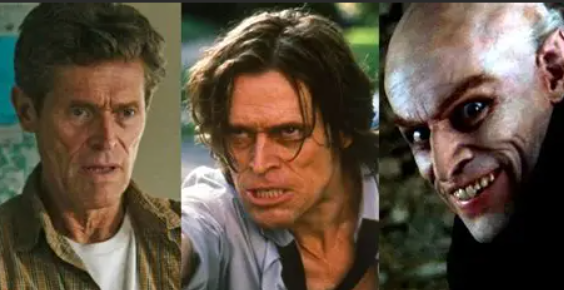
Then came The Last Temptation of Christ (1988), where Scorsese cast him as Jesus—a controversial choice that sparked protests and cemented his reputation for taking risks no other actor would touch. Following that, roles in Wild at Heart, Shadow of the Vampire, and Spider-Man demonstrated his range: from Lynch’s nightmares to comic book villainy.
Blockbusters As Funding for the Work That Matters
According to reporting from Forbes, Dafoe’s earnings from the Spider-Man franchise alone approached $10 million. Yet he never pursued blockbuster sequels or leveraged that visibility into leading-man status. The pattern became clear: take the studio money, then immediately pour it back into films like Lars von Trier’s Antichrist or Abel Ferrara’s barely-released projects.
His four Oscar nominations (Platoon, Shadow of the Vampire, The Florida Project, At Eternity’s Gate) came not from career calculation but from directors who saw in him something Hollywood rarely rewards: an actor genuinely uninterested in being liked.
What the Interviews Reveal
“I’ve never been interested in being a star,” Dafoe told The Guardian in 2018. “I’m interested in the work. The other stuff—the fame, the money, the lifestyle—that’s a byproduct. Sometimes it helps the work. Usually it doesn’t.”
His choices bear this out. He’s turned down films that would have tripled his net worth, taken roles for scale in projects he believed in, and maintained a work rate that suggests money matters less than keeping busy. At 69, he still releases three to four films annually. Furthermore, he still performs experimental theater when the opportunity arises.

Rome: The Exile That Was Always Home
Since 2005, Dafoe has lived primarily in Rome with his wife, Italian actress and director Giada Colagrande. The choice feels less like expatriate escape than inevitable arrival. He was always more European than American—in taste, in temperament, in his understanding of what art is for.
Their apartment reportedly sits in the historic center, far from any compound or estate. No oceanfront, no acreage, no staff. The man who could afford Beverly Hills chose to live like a working artist in a city that understands what that means. Meanwhile, his mother’s influence echoes across sixty years: the Debussy, the foreign films, the sense that beauty matters more than comfort.
The Economics of Artistic Integrity
Analysis from Bloomberg suggests that actors who choose commercial projects strategically can multiply their earnings five to ten times compared to those who prioritize artistic work. Dafoe’s $40 million, then, represents perhaps one-fifth of what was available to him. This is the anti-Hollywood strategy in financial terms: enough money to work freely, not enough to change who you are.
Willem Dafoe’s net worth is $40 million. Yet the number contains a paradox: it’s both enormous for someone who never pursued wealth, and modest for someone of his stature. The boy who watched French films in a Wisconsin movie theater grew into a man who’d rather live in Rome on an artist’s budget than rule Hollywood from a throne of compromise.
His face—that extraordinary, unsettling, beautiful face—has aged into something even more compelling. It still carries the wound: the middle child who never fit in, the American who was always European, the star who refused to be one. That’s what $40 million buys when you’ve spent sixty years refusing to be bought.
Frequently Asked Questions
What is Willem Dafoe’s net worth in 2026?
Willem Dafoe’s net worth in 2026 is approximately $40 million. The figure reflects forty-five years of consistent film and theater work across more than 100 film appearances, four Academy Award nominations, and his deliberate strategy of balancing major studio paychecks against avant-garde theater work that paid almost nothing.
How much does Willem Dafoe make per film?
Dafoe’s per-film salary ranges from $500,000 for independent and arthouse projects to $5 million or more for major studio franchises. His Spider-Man franchise appearances, particularly his return as Norman Osborn in Spider-Man: No Way Home (2021), are believed to be among his highest-paid roles.
Where does Willem Dafoe live?
Dafoe and his wife, Italian filmmaker Giada Colagrande, divide their time primarily between Rome, Italy and New York City. The Rome residence has been his primary base since his marriage to Colagrande in 2005.
Why did Willem Dafoe choose theater over Hollywood?
Dafoe has consistently described his career as a deliberate refusal to choose between commercial film and experimental theater. For more than fifteen years he commuted between The Wooster Group, the avant-garde theater company he co-founded, and Hollywood productions that paid significantly more.
Related Articles
- Character Actor Elite Net Worth 2025: The $145 Million Club That Refused to Play the Game
- Jeff Goldblum Net Worth 2025: The $45 Million Eccentric Who Made Weird Bankable
- Stanley Tucci Net Worth 2025: From Katonah to CNN, the $25 Million Reinvention
- Mark Ruffalo Net Worth 2025: The $35 Million Crusader of Keene Valley
For exclusive profiles of the actors, artists, and architects shaping luxury culture, subscribe to Social Life Magazine. Join the conversation at Polo Hamptons, where creative excellence meets social connection.
Author

Written by
Recent Posts
Best Folding Tables for Community Halls and Function Centres

From the Hamptons to Mykonos for a September Encore

Is Business Class Worth It on a Short-Haul Flight?
Failure to Disclose Finances in Divorce
Columbus Car Accident Attorney: Protecting Your Rights After a Georgia Crash
Categories
- Art
- Articles
- Business of Luxury
- Celebrities
- Culture
- Entertainment
- Events
- Faces of Summer 2026
- Fashion
- Fashion & Style
- Featured
- Finance
- Food, Spirits, Wine
- Hamptons
- Hamptons Celebrities
- Health
- Health & Beauty
- Lifestyle
- Luxury Lifestyle
- Press
- Profiles
- Real Estate
- Technology
- The Chronicles
- Travel
- Uncategorized
- Weddings