
Why Salary Never Builds Dynasties
Tom Cruise has earned $20M per film for four decades. His net worth sits at $600M. Tyler Perry owns every frame he produces and crossed $1.4B in half the time. Same industry. Same talent tier. One structural decision separates them, the ownership inflection point.
It is the moment a celebrity stops selling time and starts owning equity. Across five case studies tracked in The Chronicles at Social Life Magazine, this single variable is the only consistent predictor of celebrity ownership wealth at the billion-dollar level. Not talent, not connections, not a lucky break. Ownership.
What follows is a management consulting-grade breakdown of how the inflection point works, who executed it best, and how it applies at every wealth level—from the $1M influencer negotiating a first equity clause to the $5B dynasty built on perpetual royalty structures. The data is drawn from our celebrity net worth library. The pattern is irrefutable.
Five Case Studies That Prove the Ownership Equation
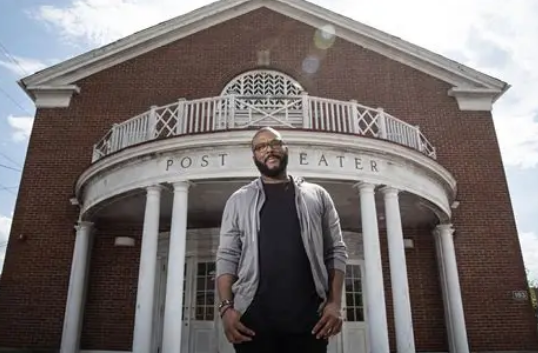
Tyler Perry: $1.4B Through 100% Studio Ownership
Tyler Perry built a 330-acre studio lot in Atlanta that he owns outright. No studio overhead. No profit participation owed to distributors, financiers, or legacy partners. When a Tyler Perry production earns $100M, Tyler Perry keeps $100M minus production costs. Compare that to the traditional Hollywood model: Cruise earns $20M per film but hands most of the backend to Paramount, his agents, managers, and lawyers. After the chain of intermediaries takes its cut, Cruise retains roughly 15% of a film’s total revenue. Perry retains 100%.
Multiply that structural gap across 30 films, a decade of television output, and a growing licensing portfolio. As a result, the $800M difference in net worth stops being surprising. It becomes simple arithmetic. According to McKinsey’s research on the creator economy, vertical integration of content creation, production, and distribution is the single highest-value strategy available to media entrepreneurs. Perry understood this before the consulting firms named it.
Oprah Winfrey: $3.2B from One Contract Clause
In 1988, Oprah Winfrey demanded ownership of her daytime talk show through Harpo Productions. Every other host in the landscape took a salary. Phil Donahue took a salary. In turn, Sally Jessy Raphael took a salary. Regis Philbin followed suit. Oprah took equity.
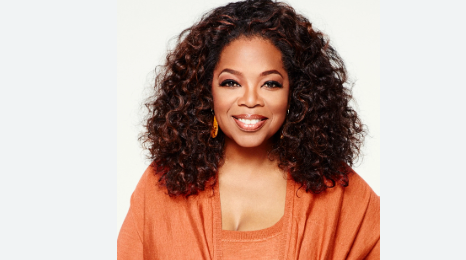
That single contract clause produced $3.2B in personal wealth over the following three decades. The show became the engine, but ownership was the fuel. When Oprah launched OWN, her cable network, she already controlled the content library that would populate it. When she negotiated distribution deals with Apple TV+, she negotiated as an owner with leverage, not an employee with a request. Every subsequent revenue stream traces back to one decision made in a Chicago office in 1988. In other words, the lesson is not that Oprah was more talented than Donahue. The lesson is that she understood contract structure better.
Steven Spielberg: $5.3B and the Perpetual Royalty
Most entertainment coverage overlooks the deal that made Steven Spielberg wealthier than any other filmmaker in history. In the early development of Universal Studios theme parks, Spielberg negotiated a 2% perpetual royalty on all theme park ticket revenue. Not a one-time consulting fee. Not a ten-year licensing deal. Instead, a perpetual cut of every ticket sold, from the first day of operation until the end of time.
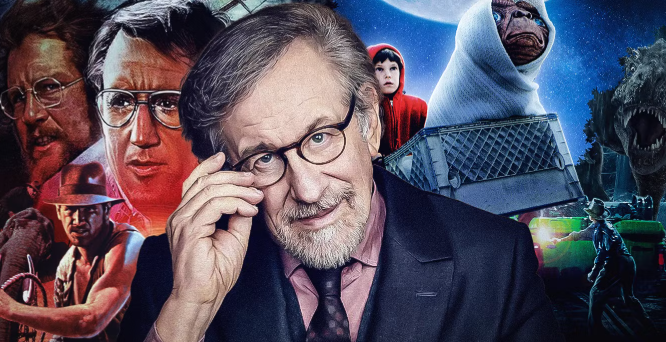
Universal’s theme parks generate billions annually across Orlando, Hollywood, Osaka, and Beijing. Spielberg’s 2% flows whether he directs another film or not. The word “perpetual” carries the entire weight of this insight: the revenue continues after his death, passing to his estate as an inheritable asset. While most directors trade time for project fees, Spielberg embedded himself into the permanent infrastructure of an industry. As a result, his $5.3B fortune is built less on box office hits than on a royalty structure that most people do not know exists. That information asymmetry is itself a lesson in how ownership wealth operates quietly while salary wealth makes headlines.
Jerry Seinfeld: $1.1B from a Show That Ended in 1998
Jerry Seinfeld negotiated 15% of all syndication revenue for a show that aired its final episode over 25 years ago. Seinfeld still generates an estimated $400M+ annually in syndication and streaming licensing fees. Fifteen percent of that flows directly to Seinfeld every year, regardless of whether he performs, produces, or even picks up the phone.
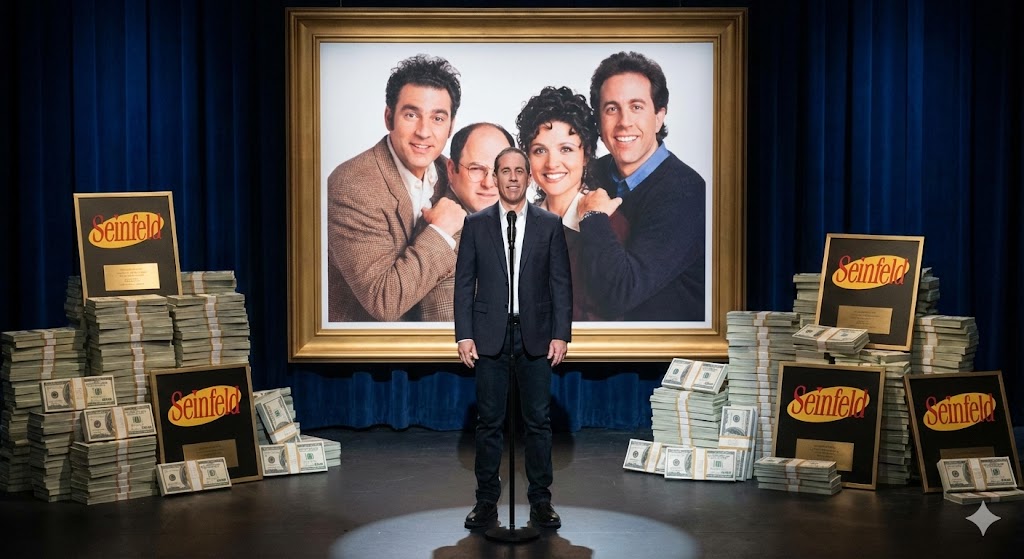
This is the catalog multiplier in its purest form: an intellectual property asset that appreciates while its owner sleeps. Furthermore, the ownership inflection for Seinfeld was not becoming a better comedian. It was understanding that a 15% backend on a hit show would outperform every future project he could possibly create. According to Harvard Business Review’s analysis of entertainment economics, residual ownership structures now account for more cumulative wealth among top entertainers than active performance income. Seinfeld proved the thesis a generation early.
Gisèle Bündchen: $400M by Choosing Equity Over Fees
While peer supermodels collected $500K flat fees per campaign, Gisèle Bündchen negotiated smaller upfront payments plus equity positions in the brands she endorsed. Her stakes in Ipanema sandals and Under Armour compounded over a decade, while competitors earned once, spent once, and moved on to the next campaign.
The endorsement model is a salary. The equity model is ownership. Gisèle chose ownership, and her $400M fortune reflects the compound interest of that structural decision repeated across dozens of partnerships. She retired from runway modeling at 34. Her net worth subsequently tripled—because equity does not require you to show up. It requires you to have shown up at the right time, with the right contract language, and with enough leverage to demand a piece of the upside rather than a flat check.
How the Ownership Inflection Applies at Every Wealth Level
The ownership inflection point is not reserved for billionaires. The $1M influencer negotiating a first equity clause is making the same structural decision as Spielberg negotiating 2% of Universal. Scale differs. The principle is identical. Similarly, here is how it maps across four wealth tiers that define the Social Life Magazine readership.
Tier 1: Emerging ($1M–$10M)
Negotiate the first ownership clause. Specifically, even 2–5% equity in a small brand deal compounds faster than a flat $10K fee paid once and forgotten. Chappell Roan’s $10M came from controlled touring and merch ownership, not label advances. She retained her masters while controlling distribution entirely. At this tier, the inflection is not about millions—it is about establishing the contractual precedent that equity is always on the table. Every deal from this point forward should include an ownership conversation.
Tier 2: Established ($10M–$100M)
Transition from fee-based to equity-based deals across the board. Lisa Vanderpump retained ownership of all her beverage brands instead of selling early like Bethenny Frankel. Frankel made $100M from the Skinnygirl exit—a life-changing sum by any measure. In contrast, Vanderpump built a portfolio of owned assets generating recurring revenue that may ultimately surpass that single payday. Long-term revenue streams over one-time windfalls. According to Bain & Company’s luxury market analysis, recurring revenue from owned brand portfolios now commands 2–3x valuation multiples over single-product exits in the premium consumer space.
Tier 3: Mogul ($100M–$500M)
Vertical integration becomes the imperative. Consider the Tyler Perry model executed at full scale: write, produce, direct, distribute. Every dollar stays in-house. At this tier, however, the inflection point is not negotiating better deals with existing partners. It is eliminating partners entirely—owning the studio, the distribution channel, and the licensing pipeline outright. The margin expansion from cutting out intermediaries is where $100M fortunes become $500M fortunes, and where the social dynamics of the Hamptons start to shift in your direction.
Tier 4: Dynasty ($500M–$5B+)
Perpetual royalty structures that generate income regardless of future creative output. Spielberg’s 2% of Universal parks. George Lucas sold Lucasfilm to Disney for $4B because he owned the characters, not the job title. At this tier, meanwhile, the ownership question is generational: will the asset produce revenue for your grandchildren? If the answer is no, it is not dynasty wealth. It is an expensive career. The private equity premium now accelerates this trajectory—PE firms pay 2–3x multiples for celebrity-attached brands, making the exit math more favorable than at any previous point in entertainment history.
Why the Ownership Shift Is Accelerating in 2026
Three converging forces make the ownership inflection point more accessible and more valuable than ever before.
First, private equity has permanently changed the exit math. As a result, PE firms now pay 2–3x financial buyer multiples for celebrity-attached brands because the famous face functions as embedded marketing infrastructure worth $50M+ annually in avoided customer acquisition costs. George Clooney’s Casamigos tequila sold to Diageo for $1B—not because the tequila justified that price on revenue alone, but because Clooney’s name attachment reduced customer acquisition costs permanently. Consequently, the brand extension ladder that converts personal fame into portfolio companies now has a PE-funded escalator at the top.
Second, the creator economy has democratized the inflection point. According to McKinsey research, over 50 million people globally now identify as content creators. The ownership inflection that once applied only to A-list celebrities now applies to anyone with an engaged audience above 100K followers and the contractual sophistication to demand equity over fees.
Third, once ownership is established, consequently the entire brand extension pipeline opens. Talent revenue converts to brand licensing, which converts to equity ownership, which converts to portfolio company. Ownership is not just one strategy among many. It is the prerequisite for every subsequent wealth tier. Without it, the ladder has no rungs.
What This Means for Your Next Move
You already know which side of this equation you sit on. The question is whether your next deal moves you from the salary column to the ownership column.
The people who attend Polo Hamptons, who read Social Life Magazine, who operate in the Hamptons ecosystem understand the ownership inflection point instinctively. It is not theory here. It is the baseline expectation. In contrast, the conversations at Further Lane dinners and Meadow Lane benefits are not about who earned the biggest fee last quarter. They are about who owns what, who structured the deal correctly, and what that celebrity ownership wealth will compound to in ten years.
The next article in The Chronicles explores what happens after the ownership decision is made: how personal fame converts into a portfolio company through the brand extension ladder. Rihanna, Kim Kardashian, and Dwayne Johnson each climbed it differently. All of them started at the same place you are right now—deciding that celebrity ownership wealth is not a ceiling. It is a floor.
Continue Reading The Chronicles
→ Tyler Perry Net Worth: How 100% Studio Ownership Built $1.4 Billion
→ The Brand Extension Ladder: From Personal Fame to Portfolio Company
The brands that appear in Social Life Magazine are not advertisers. They are curated partners. For features, advertising, and strategic collaborations: sociallifemagazine.com/contact
Polo Hamptons is where the social calendar begins. Tickets go to those who plan ahead. Sponsorships go to those who think bigger: polohamptons.com
The best deals in the Hamptons happen before they are announced. Our list hears first. Subscribe to the Social Life insider briefing.
25,000 copies per summer issue reach every boutique from Westhampton to Montauk. 15,000 fall/winter editions land in Upper East Side doorman buildings. Print subscription →
Independent media covering celebrity ownership wealth, answers to readers, not algorithms. Support The Chronicles — $5 keeps it free for everyone.
Author

Written by
Recent Posts

AI for personal finance: where PennyGuard fits
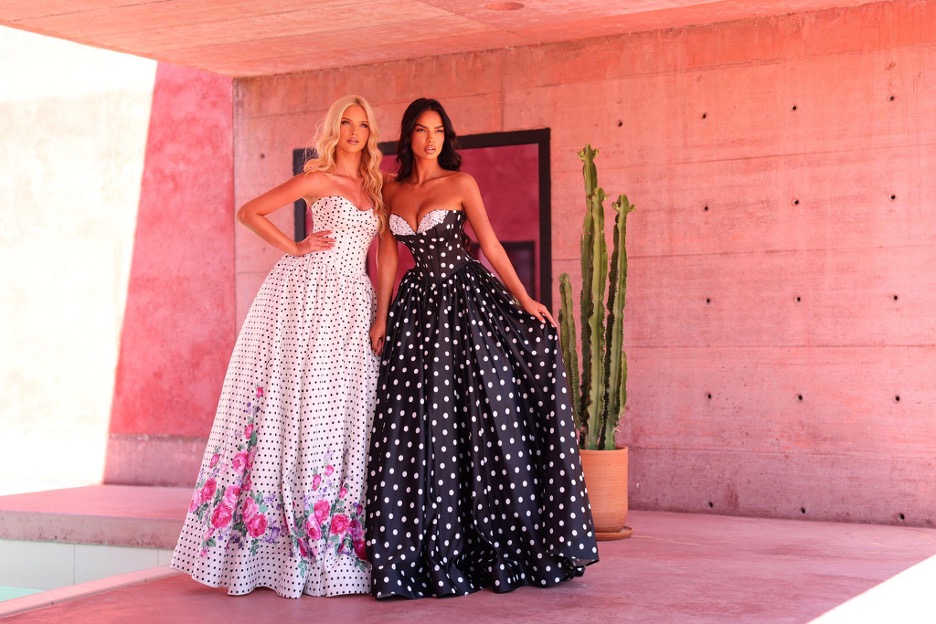
How to Pick a Homecoming Dress for Your Body Type (and Feel Amazing in It)

World Cup Injury Attorney for Vancouver Events
What a 3-Carat Engagement Ring Actually Costs in 2026: The Real Numbers
The Skincare Habits That Make a Real Difference Over Time
Categories
- Art
- Articles
- Business of Luxury
- Celebrities
- Culture
- Entertainment
- Events
- Faces of Summer 2026
- Fashion
- Fashion & Style
- Featured
- Finance
- Food, Spirits, Wine
- Hamptons
- Hamptons Celebrities
- Health
- Health & Beauty
- Lifestyle
- Luxury Lifestyle
- Press
- Profiles
- Real Estate
- Technology
- The Chronicles
- Travel
- Uncategorized
- Weddings