

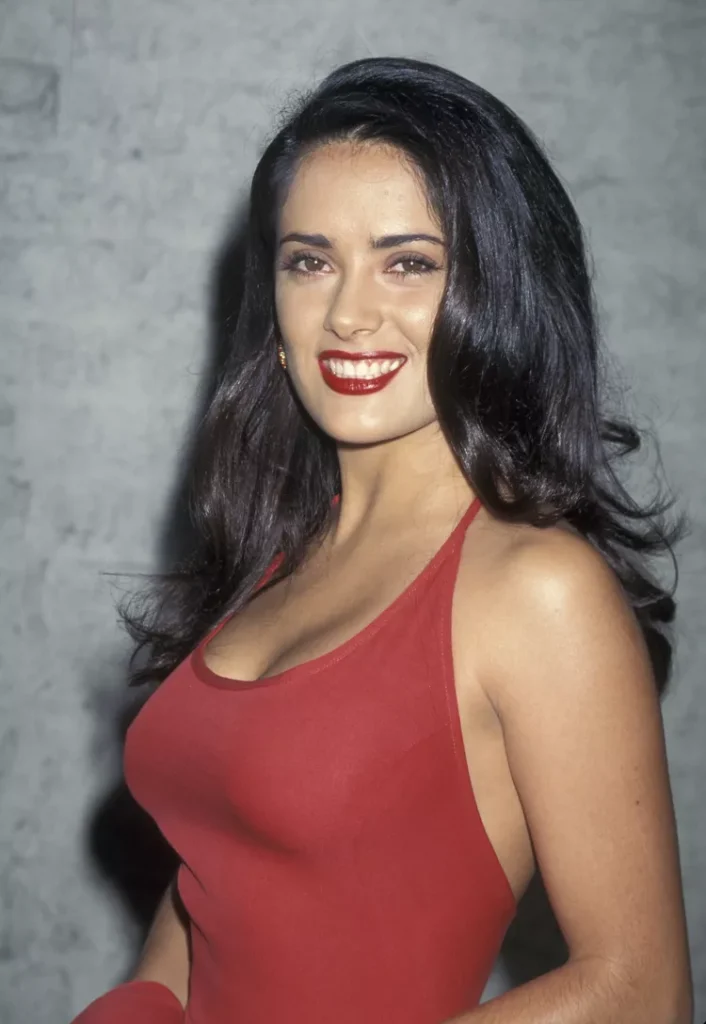
She turned 58 on a boat. Posted the photos herself. No publicist statement. No brand partnership. Nothing managed, nothing positioned. Just the body, the light, and the absolute refusal to apologize for either.
Salma Hayek Net Worth Quick Facts
| Net Worth (2026) | $200 million (personal; Kering family fortune separate) |
| Born | September 2, 1966, Coatzacoalcos, Veracruz, Mexico |
| Spouse | François-Henri Pinault (married 2009, ~$7B personal net worth) |
| Family Empire | Kering (Gucci, Saint Laurent, Balenciaga, Bottega Veneta, Alexander McQueen) |
| Production Company | Ventanarosa (founded 1999; produced Ugly Betty) |
| Oscar Nomination | Best Actress, Frida (2002) — first Mexican actress nominated |
| Daughter | Valentina Paloma Pinault (born 2007) |
| Recent Work | Without Blood (Jolie, 2025), Black Mirror, SI Swimsuit cover at 58 |
Salma Hayek’s net worth is $200 million. Furthermore, she is married to François-Henri Pinault, the chairman of Kering, the holding company that owns Gucci, Balenciaga, Saint Laurent, Alexander McQueen, and Bottega Veneta. Consequently, the $200 million is almost certainly a floor rather than a ceiling. Indeed, the real number belongs to a tax structure in three countries that no celebrity profile will ever fully document.
Yet none of that is the story. Notably, the story is that she arrived at 58 without a comeback narrative, without a redemption arc, without a press campaign. Instead, she simply showed up, dangerously alive, and the internet could not look away.
The Before: Coatzacoalcos, Lebanese Oil Money, and the Opera Singer
Salma Valgarma Hayek Jiménez was born September 2, 1966, in Coatzacoalcos, Veracruz, a coastal city in southern Mexico that oil built and the Gulf of Mexico frames. Her father, Sami Hayek Domínguez, was a Lebanese-Mexican oil executive who ran an industrial equipment firm and once campaigned for mayor of the city. Her mother, Diana Jiménez Medina, was an opera singer and talent scout. Together, they produced someone who understood both the mechanics of business and the architecture of performance before she ever stepped in front of a camera.
Furthermore, the household was wealthy, devout, and culturally layered, Lebanese heritage from her father’s side, Spanish and Mexican from her mother’s. Additionally, four live-in maids marked the family’s position. Salma grew up understanding that comfort was not guaranteed. Her father’s business would later collapse, sending her to Los Angeles as a struggling actress wiring money back to Mexico. Ultimately, that distance between the Coatzacoalcos childhood and the Hollywood auditions would become the engine of everything that followed.
The Sending Away
At twelve, her parents sent her to the Academy of the Sacred Heart in Grand Coteau, Louisiana. Indeed, the displacement was total, new country, new language, new social codes. Rather than retreating, she responded with the pattern that would define her career: she found the obstacle and walked directly toward it. She later studied international relations at the Universidad Iberoamericana in Mexico City, leaving before graduation when the telenovela Teresa offered her the title role in 1989. That degree could wait. That role could not.
The Wound: Hollywood’s Closed Door
She arrived in Los Angeles in 1991 speaking limited English, with no industry contacts and no American credits. The industry had already decided her physicality didn’t belong in the roles she wanted. Specifically, discrimination was structural and explicit. Director Ivan Reitman refused to let her audition for Six Days, Seven Nights because the part, he said, wasn’t written Latin. Agents told her the accent was too thick. Casting directors told her the look was too specific. The industry had a precise idea of where Latinas belonged in American cinema, and it wasn’t where Salma Hayek intended to go.
Moreover, the dyslexia complicated everything. She has spoken rarely about it in career terms. The condition means she processes text differently than most, in an industry that runs on script revisions and cold readings, dyslexia is a disadvantage neither acknowledged nor accommodated. Instead, she managed it the same way she managed everything else: by working harder than the people who didn’t have to.
The Thing Nobody Mentioned
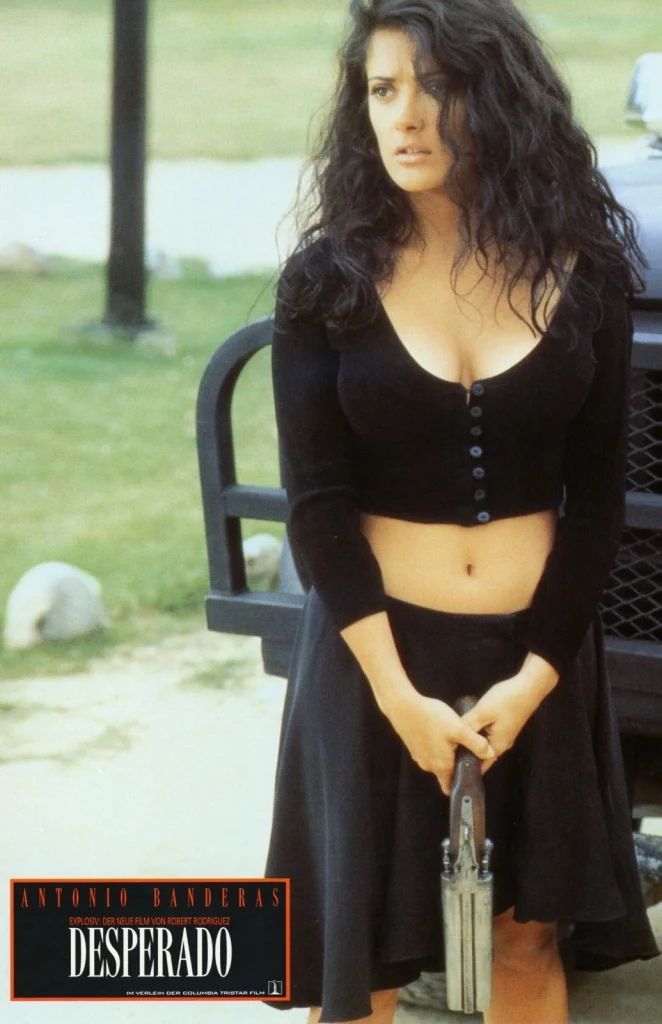
Robert Rodriguez cast her in Desperado in 1995 after seeing her on a Mexican talk show. The film worked. Indeed, Hollywood noticed she could carry a scene opposite Antonio Banderas and make it look effortless. What Hollywood did not fully register was the depth of what she already had. She had built and run a production company in Mexico. She had starred in one of the most-watched telenovelas in Latin American history. Moreover, she had spent four years in Los Angeles taking acting classes with Stella Adler while everyone around her was being cast in the roles she couldn’t reach. Indeed, the overnight success was twenty years in the making. Furthermore, it arrived while she was simultaneously raising money for a project nobody wanted to fund.
The Rise: Desperado, Frida, and the Eight-Year War
Frida Kahlo had been Hayek’s obsession since she arrived in Hollywood. She spent eight years trying to get the biopic made. She developed the script, pitched studios, and was turned down repeatedly by an industry that saw limited commercial value in a story about a Mexican artist. When Miramax finally agreed to produce it, the cost of that agreement became clear immediately. Harvey Weinstein, who ran Miramax, began harassing her from the moment production began.
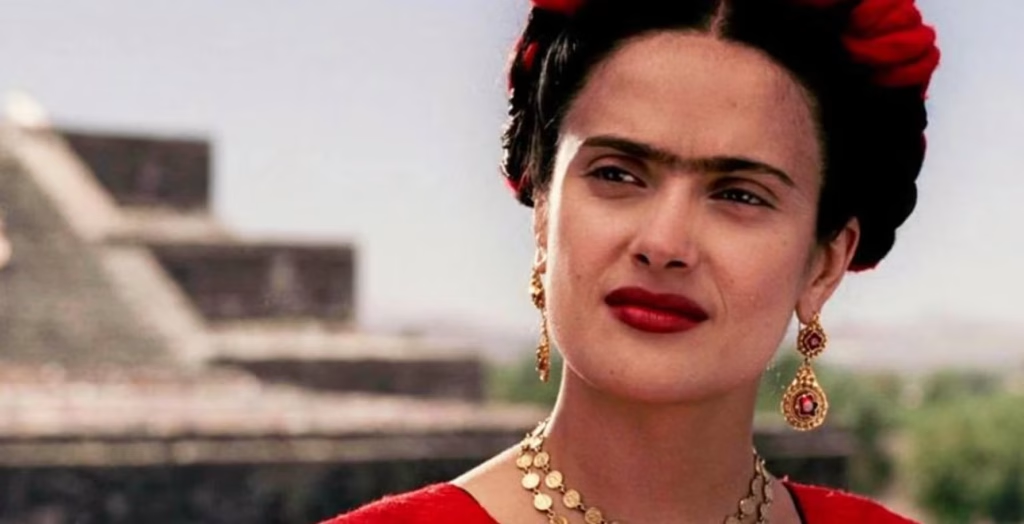
In a 2017 New York Times op-ed, Hayek documented what followed: years of sexual harassment, hotel rooms at all hours, demands she refused repeatedly. She wrote: she said no to showers, no to massages, no to oral sex, no no no no no. In retaliation, Weinstein threatened to shut down the film. He demanded rewrites that raised the budget to $10 million she had to source herself. He required a nude scene she had to take a tranquilizer to film. Additionally, he screamed at her about the Frida Kahlo monobrow she was wearing for the role, demanding to know why she looked ugly. She reminded him that Frida Kahlo had looked like Frida Kahlo. Unsurprisingly, the argument did not land.
What the War Cost
Frida received six Academy Award nominations and won two Oscars. Hayek received a Best Actress nomination, the first Mexican actress ever nominated in that category. Weinstein, having profited substantially from the film, never offered her another starring role under her Miramax contract. She told Oprah Winfrey that she left the production depressed and paranoid, and spent years telling herself she had survived in order to keep functioning. Notably, she has said she doesn’t hold grudges. Indeed, she believes people can change. Simply put, she wants the system to stop. In fact, that discipline is the clearest indicator of who Salma Hayek actually is. She refused to let rage consume the architecture she was still building, beneath the image the industry constructed around her.
Wealth Breakdown: Kering, Valentina, and the Life Nobody Photographed
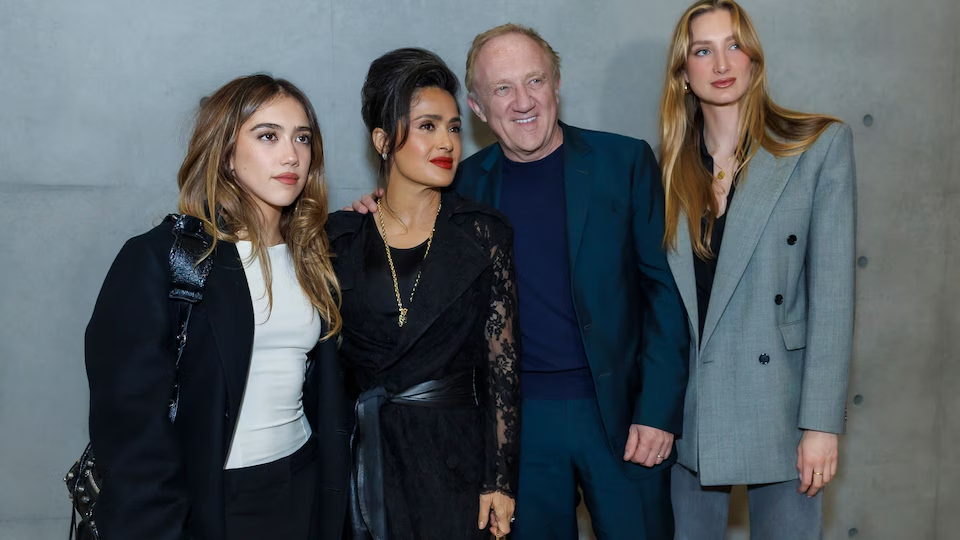
In 2009, Hayek married François-Henri Pinault. Their daughter, Valentina Paloma Pinault, had been born two years earlier. The marriage embedded her in one of the most powerful dynasties in global luxury. The Pinault family controls Kering, which owns the brands that define what the wealthiest people on earth wear and carry. François-Henri’s personal net worth is approximately $7 billion. His father’s fortune has ranged between $20 and $40 billion. They do not have a prenuptial agreement.
Consequently, Hayek’s financial position is considerably more complex than the $200 million figure suggests. Furthermore, it is structured across multiple jurisdictions in ways that celebrity net worth estimates cannot capture. What is visible is Ventanarosa, the production company she founded in 1999. It produced Ugly Betty, a Golden Globe and Emmy-winning network series, and has continued generating projects since. Additionally, she serves as executive producer on the television adaptation of Like Water for Chocolate. Crucially, the business infrastructure she built before the Pinault marriage did not disappear into it. Instead, it became one layer of a considerably more sophisticated financial architecture.
The Architecture of Real Wealth
The Kering connection is worth understanding precisely. The portfolio includes Gucci, Balenciaga, Saint Laurent, Alexander McQueen, Bottega Veneta, Brioni, and Pomellato, among others. These are not brand names. They are cash-generating machines with decades of equity and global distribution networks. Moreover, Hayek’s position within that family is not decorative. She is a public face for a private empire that operates across fashion, art collecting, and philanthropy at a scale most celebrity fortunes cannot approach. The $200 million estimate for her personal net worth is real. However, the actual financial environment she operates within is categorically different from any figure a single number can represent.
The Hamptons Chapter: The Crowd Her Husband’s Labels Dress
Hayek does not have a documented Hamptons property or a summer presence the East End social calendar tracks. What she has is considerably more powerful: her husband’s brands dress the people who do. The woman carrying a Saint Laurent bag to Nick and Toni’s is a Kering customer. So is the man in Brioni at a Bridgehampton polo event, and the guest in Gucci at the Parrish Art Museum gala. Hayek is not adjacent to Hamptons money. She is married into the infrastructure that supplies it.
Additionally, the Hamptons International Film Festival draws serious film culture to the East End each October. That audience is precisely the one Hayek has been producing for through Ventanarosa, Latin-focused, female-driven, prestige storytelling that crosses language and geography. For more on the women reshaping what forty-plus looks like in this cultural moment, see our full hub on female celebrities over 40 and the glow-up generation. For the real estate context of the world she moves through, see our Hamptons luxury real estate guide.
Why the Dark Horse Wins Here
The East End’s most durable social tier has always valued the same thing Hayek represents: real money, real art, real story, no performance required. The Hamptons crowd that matters isn’t chasing celebrity. Furthermore, it recognizes the difference between someone who built something and someone who was built by someone else’s machine. Hayek built Frida over eight years against active opposition. She founded a production company that generated network television, married into one of the world’s most powerful luxury empires, and arrived at 58 looking like the boat photo. The Hamptons dining rooms that host this tier know exactly what that represents.
What She Built: 58 and Zero Notes
The birthday boat photos generated coverage across every major outlet. She posted them without statement, without context, without the careful positioning language that surrounds most celebrity image moments. The internet’s response was uniform: she looks extraordinary. Moreover, the conversation had a different texture than typical celebrity body coverage, less surveillance, more genuine astonishment. Something had shifted. The woman who spent her thirties fighting an industry that told her she was too Latin, too accented, too specific, she arrived at fifty-eight and rendered those objections incoherent.
In 2025, she appeared in Without Blood, directed by Angelina Jolie, earning praise for a powerful and understated performance. Additionally, she appeared in Black Mirror and in Sacrifice alongside Chris Evans and Anya Taylor-Joy. Furthermore, in 2025, Sports Illustrated put her on the Swimsuit Issue cover at 58. Not a legacy tribute. The cover. Indeed, the selection was the statement. No caption required.
The Sports Illustrated Moment Nobody Expected
The Gladwell reveal in the Salma Hayek story is this: the dark horse wins not by competing harder. She wins by refusing to compete at all on terms the industry set. She did not chase youth or the American archetype. Nor did she sand down the accent, the specificity, or the heritage that casting directors told her was the obstacle. Consequently, at 58, she has become the aspirational image while the women who conformed to the template have become the cautionary tale. As a result, the thing that was supposed to limit her became the thing that made her irreplaceable. That is not luck. Moreover, it is not beauty, though she has that too. It is the specific result of thirty years spent refusing to apologize for being exactly who she was.
The Soft Landing: Without Blood and What Comes Next
At 58, Hayek is doing what she has always done: working on projects she selected, from a position of financial independence the Weinstein years could have destroyed and didn’t. A daughter, a marriage, and a life structured around her actual values, not the industry’s preferences for her. Additionally, Ventanarosa continues developing Latin-focused content for streaming platforms at a moment when those platforms have finally acknowledged the audience Hayek spent three decades insisting existed.
Ultimately, the dark horse doesn’t announce herself. She simply keeps moving while everyone watches the horses they expected to win. By the time the field catches up, she’s already somewhere else entirely, on a boat, in the Mediterranean, posting photographs without comment, absolutely fine.
The Verdict at 58
Two continents. One Oscar nomination built over eight years of war. A production company and a Kering marriage. One daughter. A $200 million net worth that understates the actual financial environment by a factor nobody outside the Pinault tax structure can calculate.
Salma Hayek’s net worth is the number that appears in the searches. Furthermore, the real number exists in the space between what she built and what she married into, two separate fortunes, both real, both earned by choosing correctly under pressure. She was told she was too much. Ultimately, it turned out she was exactly enough and everyone else was running short.
Frequently Asked Questions
What is Salma Hayek’s net worth in 2026?
Salma Hayek’s personal net worth in 2026 is approximately $200 million, built across her acting career, the production company Ventanarosa (founded 1999), and her business interests. The figure does not include her connection through marriage to the Pinault family, whose Kering empire and personal fortune extend into multiple billions across separate legal and tax structures.
Who is Salma Hayek married to?
Salma Hayek has been married since 2009 to François-Henri Pinault, the chairman of Kering, the luxury holding company that owns Gucci, Saint Laurent, Balenciaga, Bottega Veneta, Alexander McQueen, and Brioni. His personal net worth is approximately $7 billion. They have one daughter, Valentina Paloma Pinault, born in 2007.
Did Salma Hayek win an Oscar for Frida?
Salma Hayek was nominated for Best Actress for Frida (2002), making her the first Mexican actress ever nominated in that category. She did not win. The film won two Oscars (makeup and original score) out of six nominations. Hayek developed the project over eight years against active resistance from the industry, including documented harassment from producer Harvey Weinstein.
What is Ventanarosa?
Ventanarosa is the production company Salma Hayek founded in 1999. Its most notable project was Ugly Betty (2006-2010), the Golden Globe and Emmy-winning ABC series. Ventanarosa continues producing Latin-focused content including the recent television adaptation of Like Water for Chocolate, with Hayek serving as executive producer.
Related Reading
- The Glow-Up After 40: Women Who Peaked When Everyone Thought They Were Done
- Nicole Kidman Net Worth: $250M and Zero Regrets
- Jennifer Lopez Net Worth: The $400M Warning Nobody Heeded
- Celebrity Body Transformations: The Ozempic Era and What It Costs
Place your brand inside the conversation: A select number of feature partnerships, print placements, and digital sponsorships are available each season, reserved for brands that belong in the room. Inquire at sociallifemagazine.com/contact
Join us at Polo Hamptons 2026: One afternoon. The right 2,000 people. Deals that don’t happen in conference rooms. polohamptons.com
The print edition arrives where it matters: 25,000 copies distributed Memorial Day through Labor Day, from Westhampton to Montauk, and 15,000 more delivered to Upper East Side doorman buildings each fall. Subscribe at sociallifemagazine.com/subscription
Author

Written by
Recent Posts
4th Annual Catwalk Furbaby
Thomas J. Henry and Dr. Elena Alvarez-Henry Join Forces for Cancer Care
How an Emergency 24/7 Plumber Resolves Sudden Drain Backups Fast
Best Free Location Tracking Apps for Everyday Family Safety: iSharing and HeyPolo Compared
How Disney Channel Stars Become Pop Powerhouses: The Sabrina Carpenter Blueprint
Categories
- Art
- Articles
- Business of Luxury
- Celebrities
- Culture
- Entertainment
- Events
- Faces of Summer 2026
- Fashion
- Fashion & Style
- Featured
- Finance
- Food, Spirits, Wine
- Hamptons
- Hamptons Celebrities
- Health
- Health & Beauty
- Lifestyle
- Luxury Lifestyle
- Press
- Profiles
- Real Estate
- Technology
- The Chronicles
- Travel
- Uncategorized
- Weddings