
The Bellboy Who Studied the Rich
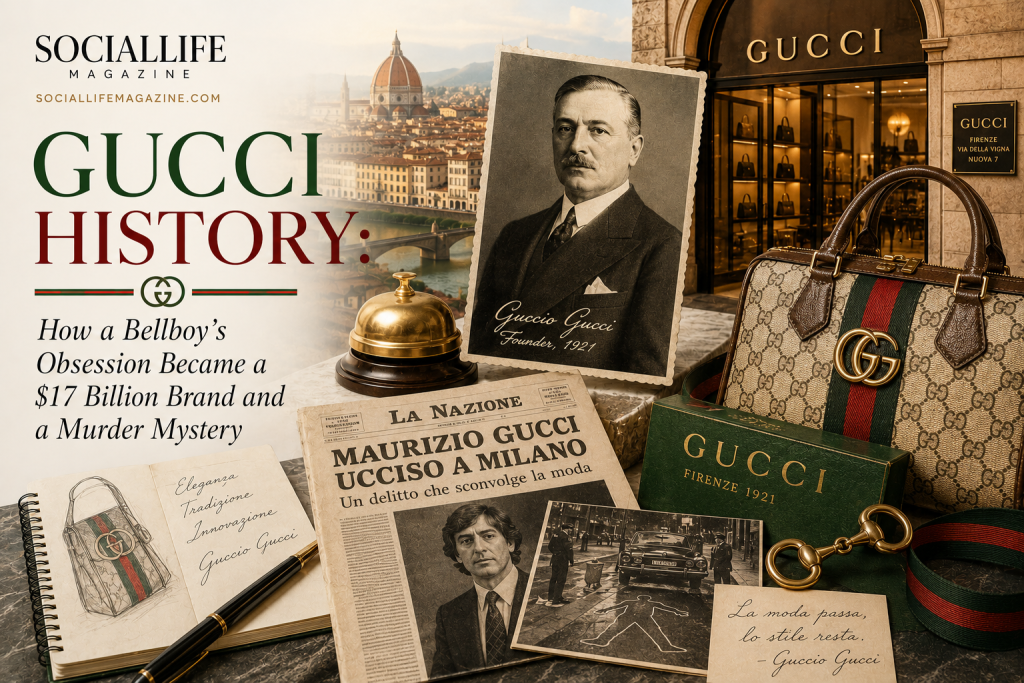
In 1897, a sixteen-year-old Florentine named Guccio Gucci arrived in London and found work at the Savoy Hotel. His job was to carry luggage. For the next few years, he loaded and unloaded suitcases for the wealthiest people in Europe. He watched what they carried, how they carried it, and what the luggage itself communicated about its owner before a single word was spoken. This was not education in any formal sense. It was apprenticeship by observation, and it would define every piece of Gucci history that followed.
Guccio returned to Florence, apprenticed at the leather goods firm Franzi, learned the craft, and in 1921 opened a small shop at Via della Vigna Nuova. He was forty years old. His wife Aida provided the savings. A loan covered the rest. The shop sold leather luggage, saddles, and equestrian accessories. The connection to horse riding was deliberate. At the Savoy, the guests who carried the finest luggage were often the same guests who attended horse racing at Ascot and Epsom. Guccio understood that luxury and equestrian culture were intertwined, and he embedded that connection into his brand from the first day.
That small leather shop now generates €7.65 billion in annual revenue, operates 529 stores across six continents, and employs over 20,000 people. But the Italian fashion houses that survived the twentieth century did so by adapting. Those that did not survive were destroyed by the same thing that built them: family.
The Codes That Built the Brand
Every iconic Gucci product traces its origin to either equestrian culture or material scarcity. The horsebit motif (a double-ring metal decoration referencing riding equipment) appeared on the first Gucci loafer in 1953 and remains the house’s most recognizable hardware. Its companion, the green-red-green web stripe, derives from the traditional saddle girth. These were not arbitrary design choices. They connected the brand to the aristocratic world Guccio had observed at the Savoy, giving his leather goods an inherited prestige that money alone could not buy.
Material scarcity generated the second wave of innovation. When Mussolini’s invasion of Ethiopia prompted a League of Nations trade embargo against Italy in 1935, leather became scarce. Guccio improvised by developing a specially woven hemp fabric from Naples, printed with a diamond pattern that became known as the Diamante motif. During World War II, continued shortages led to another breakthrough. Gucci imported Japanese bamboo to create lightweight handles for handbags. The Bamboo bag, born from necessity in 1947, became one of the most coveted accessories of the 1950s.
Celebrity as Currency
Guccio Gucci died on January 2, 1953, just two weeks after his sons opened the first American store at the Savoy Plaza Hotel in New York. He never saw what happened next. Under the direction of his son Aldo, Gucci became the accessories brand of postwar celebrity culture. Jacqueline Kennedy was photographed carrying a Gucci shoulder bag so frequently that the house renamed it the Jackie. Princess Grace of Monaco received a custom Flora scarf in 1966, and Gucci turned the floral print into a permanent collection.
By the 1960s, the double-G logo (designed by Aldo as a tribute to his father’s initials) appeared on canvas bags, belts, and small leather goods. Stores opened in London, Palm Beach, Paris, and Tokyo. Gucci history in this period reads like a guest list at a permanent cocktail party. Elizabeth Taylor, Audrey Hepburn, Peter Sellers, and Samuel Beckett all carried Gucci. The brand had achieved something remarkable: it was simultaneously Italian and international, equestrian and cosmopolitan, aristocratic and accessible.
The Family War
Then the family started destroying it. Guccio had divided ownership among his three biological sons (Aldo, Vasco, and Rodolfo), allegedly excluding his adopted son Ugo. By the 1980s, the grandchildren had entered the business, and the internal politics made the Medici court look restrained. Aldo Gucci was convicted of tax evasion in 1986 and served a year in prison. His son Paolo sued the family repeatedly. Cousins feuded over control of regional operations. The brand diluted itself across more than 22,000 products and over 1,000 stores, many of them selling cheap leather goods that would have made Guccio weep.
When Rodolfo died in 1983, his son Maurizio inherited the largest single stake. Maurizio was elegant, ambitious, and financially reckless. He spent lavishly on renovating the Florence and Milan headquarters, burned through cash reserves, and eventually lost control to Investcorp, a Bahrain-based investment firm that bought out the family’s remaining shares by 1993. For the first time in 72 years, no Gucci family member owned a piece of Gucci.
The Murder
On March 27, 1995, Maurizio Gucci was shot dead in the lobby of Gucci’s Milan office at Via Palestro 20. He was 46 years old. Three years later, his ex-wife Patrizia Reggiani was arrested and charged with hiring the hitman. At trial, she famously remarked that she had considered killing him herself but decided against it because her aim was poor. She was sentenced to 29 years, served 18, and was released in 2016.
The murder transformed Gucci history into mythology. Lady Gaga played Reggiani in Ridley Scott’s 2021 film “House of Gucci.” Adam Driver played Maurizio. Al Pacino played Aldo. The movie grossed $156 million worldwide and introduced the Gucci family saga to an audience that had never heard of a horsebit loafer. For the brand, the film was free advertising wrapped in a true crime story. Every viewing reinforced the idea that Gucci was not just a fashion label. It was a dynasty, a drama, and a cautionary tale about what happens when a family’s ambition outpaces its capacity for trust.
Tom Ford’s Resurrection
While the family was imploding, the brand was being rebuilt by outsiders. Dawn Mello, the former president of Bergdorf Goodman, was hired in 1989 to restore Gucci’s credibility. She reduced the store count from over 1,000 to 180. The product range shrank from 22,000 items to 7,000. She moved the headquarters back to Florence and revived the Bamboo bag and the loafer. Her most consequential decision was hiring a young Texan designer named Tom Ford in 1990.
Ford became creative director in 1994 and immediately rewired the vocabulary of luxury fashion. His Gucci was dark, sexual, confident, and unapologetically commercial. Consider the signatures: the velvet hipster suit, the unbuttoned silk shirt, the Gucci G-string visible above low-rise trousers. Ford understood that sex sells in fashion the way that earnestness does not, and he applied that understanding with a precision that generated billions.
The Revenue Rocket
Under Ford and CEO Domenico De Sole, Gucci’s revenue grew from roughly $230 million in 1994 to over $3 billion by 2004. The stock price increased by 1,000 percent after the company went public in 1995. Ford turned the runway show into a cultural event. His Fall 1995 collection (the one with the blue velvet suit) is still cited as one of the ten most influential shows in fashion history.
In 1999, a hostile takeover attempt by LVMH’s Bernard Arnault pushed Gucci into the arms of Pinault-Printemps-Redoute (later renamed Kering). François-Henri Pinault invested €3 billion for a 42 percent stake, and Gucci became the cornerstone of what is now the second-largest luxury conglomerate in the world. Ford and De Sole departed in 2004 after disagreements with Pinault over creative control. Their exit ended the most commercially successful creative partnership in modern fashion.
The Kering Machine
Gucci’s relationship with Kering is the defining structural reality of modern Gucci history. Kering is not a passive holding company. It provides shared services (logistics, real estate, digital infrastructure) across its portfolio, which also includes Saint Laurent, Bottega Veneta, Balenciaga, and Alexander McQueen. Gucci accounts for roughly half of Kering’s total revenue and two-thirds of its operating profit. When Gucci performs well, Kering’s stock rises. When Gucci stumbles, Kering’s market capitalization contracts by billions.
This codependency creates pressure that independent houses do not face. Chanel can absorb a bad year because no shareholders demand quarterly explanations. Gucci cannot. Every creative director appointment, every product launch, every store opening is evaluated through the lens of its impact on Kering’s Paris-listed stock price. François-Henri Pinault’s decision to move Demna from Balenciaga to Gucci was not just a creative choice. It was a capital allocation decision that affected a publicly traded company worth approximately €30 billion.
The Alessandro Michele Revolution
After Ford, Gucci spent a decade searching for its next identity. Frida Giannini held the creative director role from 2006 to 2014, delivering competent but unremarkable collections that failed to generate cultural heat. Revenue grew modestly. Critical engagement flatlined. The brand was profitable but boring, which in luxury fashion is worse than being provocative and unprofitable.
In January 2015, newly appointed CEO Marco Bizzari promoted accessories designer Alessandro Michele to creative director. Michele had been at Gucci for over a decade, working quietly in the accessories department. His first show, produced in five days with no budget, looked like nothing anyone in Milan had ever seen. Models walked out in fur-lined loafers, pussy-bow blouses, embroidered bomber jackets, and geek-chic glasses. The aesthetic was maximalist, gender-fluid, historically referential, and deliberately overwhelming.
The Billion-Dollar Maximalism
Michele’s Gucci was the most commercially successful creative reinvention since Ford. Revenue surged from €3.9 billion in 2014 to a peak of over €10.5 billion in 2022. Operating margins expanded. The brand’s Instagram following exploded to over 50 million. Michele collaborated with artists, filmmakers, and musicians. He created the Gucci Garden in Florence (part museum, part store, part restaurant). He staged shows that referenced Renaissance art, 1970s disco, and David Lynch simultaneously.
Perhaps most significantly, Michele pioneered the luxury collaboration as a marketing strategy. His “hacking” partnership with Balenciaga (the “Gucci x Balenciaga” collection shown in 2021 for the brand’s centennial) blurred the boundaries between competing houses in a way that generated massive media coverage and reframed competition as creative dialogue. Collaborations with The North Face, Adidas, and Harry Styles followed, each one expanding Gucci’s cultural footprint beyond the traditional fashion audience.
But the Michele aesthetic had a half-life. By 2022, growth had slowed. Younger consumers, who had driven the initial wave of enthusiasm, were rotating to quieter brands like Bottega Veneta and The Row. Michele’s maximalism, once thrilling, had become predictable. Kering replaced him in November 2022, and Michele moved to Valentino (where he would also depart by 2025). In eight years, he had taken Gucci history from stagnation to stratosphere and back to earth.
The Demna Gamble
Michele’s successor, Sabato De Sarno, was hired to calm things down. A veteran of Valentino’s design team, De Sarno proposed a quieter, more wearable Gucci built around wardrobe essentials and restrained color palettes. The fashion press praised the reset. Consumers did not respond. Gucci’s revenue dropped to €7.65 billion in 2024, and Q1 2025 saw another 25 percent decline. Kering fired De Sarno in February 2025 and closed 50 stores to adapt to a slower market.
In March 2025, Kering made the move that defines Italian fashion’s current moment. They appointed Demna (previously creative director of Balenciaga) as Gucci’s artistic director, effective July 2025. Demna had grown Balenciaga’s revenue from $350 million to over $2 billion during his tenure. His aesthetic (oversized silhouettes, deconstructed tailoring, ironic luxury) had made Balenciaga one of the most talked-about brands in fashion, though it had also produced controversies including a 2022 campaign scandal.
The Open Question
Whether Demna can rescue Gucci is the most consequential question in luxury fashion right now. His counter-cultural, often confrontational approach is the opposite of Gucci’s heritage as a brand built on Italian elegance and equestrian refinement. Kering CEO François-Henri Pinault called Demna’s creative power “exactly what Gucci needs.” But analysts have been cautious, noting that Kering’s stock dropped on the announcement.
Demna’s first collection for Gucci is expected in September 2025. Kering’s deputy CEO Francesca Bellettini has said he will “build on the vision of the brand” rather than pursue a scorched-earth reset. Whether that means reinventing Gucci’s icons (the horsebit, the bamboo handle, the GG monogram) through Demna’s provocative lens, or moderating his own aesthetic to fit the house’s codes, remains to be seen. Both approaches carry enormous risk. Either way, Gucci history is about to get another chapter that nobody predicted.
The East End Boutique
Gucci operates a boutique on Newtown Lane in East Hampton, positioned on the same luxury corridor as Prada, Zimmermann, and Veronica Beard. The store first appeared as a seasonal pop-up before becoming a permanent fixture in 2021, coinciding with the brand’s centennial. It carries ready-to-wear, handbags, shoes, and accessories, along with Hamptons-exclusive items (the “Gucci Lovelight” collection during the 2023 season was typical of the localized product drops that generate social media coverage).
For the consumer walking into the East Hampton store, Gucci occupies a specific position within the Italian fashion houses represented on the East End. It is more visible than Chanel (which has no Hamptons boutique). More accessible than Louis Vuitton (whose East Hampton store skews toward the monogram-heavy tourist purchase). More playful than Dior. And more status-forward than Prada, whose intellectualism appeals to a different register.
What Gucci sells in the Hamptons is not just product. It is the mythology. A bellboy who became a brand. A family that tore itself apart. Murder that became a movie. Creative directors revolving through Milan, each one rewriting the codes for a new generation. Every person who carries a Gucci bag on Further Lane is carrying 104 years of drama, ambition, and reinvention. That story is worth more than the leather.
Where the Conversation Continues
Gucci history is the most chaotic success story in luxury fashion. It begins with a bellboy’s observation at the Savoy Hotel. Family ambition turned a leather shop into a global empire. Family greed nearly destroyed it. Tom Ford resurrected it. Alessandro Michele made it the hottest brand on earth. And now a Georgian provocateur is being asked to do it again. The through-line is not stability. It is the conviction, tested repeatedly and sometimes fatally, that reinvention is the only strategy that compounds.
Social Life Magazine covers the brands, families, and power plays that shape luxury culture from Manhattan to Montauk. Reach our editorial team to discuss features, partnerships, or story leads. Explore Polo Hamptons 2026 for the summer’s defining luxury event. Subscribe to the print edition for coverage delivered to your door. Join the email list for weekly insider intelligence. And if this piece sharpened your understanding of how luxury actually works, a $5 contribution keeps independent journalism alive.
Author

Written by
Recent Posts

Planning an Arizona Road Trip? Practical Details to Handle Before You Leave
Short Homecoming Dresses That Feel Polished, Not Overdone
Men’s Health After 40: Important Changes to Pay Attention To
What You Need to Know About Spray Tanning

Simple Ways to Upgrade Your Summer Drink Routine
Categories
- Art
- Articles
- Business of Luxury
- Celebrities
- Culture
- Entertainment
- Events
- Faces of Summer 2026
- Fashion
- Fashion & Style
- Featured
- Finance
- Food, Spirits, Wine
- Hamptons
- Hamptons Celebrities
- Health
- Health & Beauty
- Lifestyle
- Luxury Lifestyle
- Press
- Profiles
- Real Estate
- Technology
- The Chronicles
- Travel
- Uncategorized
- Weddings