

John Turturro Net Worth Origins: Brooklyn, Queens, and the Italian-American Foundation
The Family That Made Him
John Michael Turturro was born on February 28, 1957, in Brooklyn, New York. His father Nicholas emigrated from Giovinazzo, Italy at age six. He worked as a carpenter and construction worker before joining the US Navy. His mother Katherine was born in the United States to Sicilian parents. She was an amateur jazz singer who had worked in a naval yard during World War II. When Turturro was six, the family moved to the Rosedale section of Queens.
Notably, the family carried loss in its history. His maternal grandmother died from a failed at-home abortion. This left his mother in an orphanage at age six. His father died of lung cancer in 1988, during the years when Turturro’s career was just beginning its ascent. Furthermore, his brother Nicholas became a professional actor. So did his cousin Aida Turturro — best known as Janice Soprano on The Sopranos. Notably, acting in the Turturro family was not an industry. It was a language.
Queens, Yale, and the Decision to Train Properly
Subsequently, Turturro graduated from SUNY New Paltz in 1979 with a BA in theater studies. He then enrolled at the Yale School of Drama, earning a Master of Fine Arts degree. Notably, Yale Drama is the institutional bottleneck through which some of the best American stage actors pass. Meryl Streep graduated the year before Turturro arrived. Indeed, the training is demanding and classical. It produces actors who sustain a performance across an entire play rather than optimize for a single scene.
Specifically, that training shows in everything Turturro has done since. His performances do not peak — they accumulate. The meaning of any scene arrives through what has been built in all the scenes before it. That quality rewards sustained attention. It also distinguishes actors trained for the stage from those trained purely for the camera.
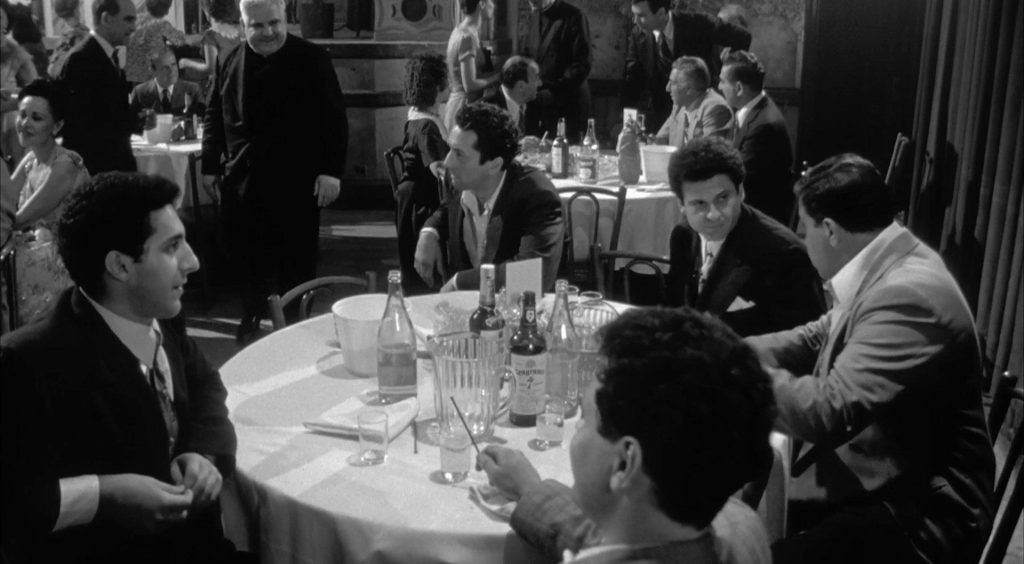
Specifically, his first film appearance was a non-speaking extra role in Martin Scorsese’s Raging Bull in 1980. He moved from there through supporting roles and theater work, winning an Obie Award for his off-Broadway performance in John Patrick Shanley’s Danny and the Deep Blue Sea in 1984.
The Breakthrough: Spike Lee, Five Corners, and the Making of a Collaboration
Five Corners and the Director Who Noticed
Consequently, Turturro’s career breakthrough arrived with Five Corners in 1987, a film set in the Bronx in 1964. He played a dangerous, unstable ex-convict released from prison and immediately fixated on the woman whose testimony helped put him there. Notably, Spike Lee saw the performance. Lee was sufficiently impressed to cast Turturro immediately in Do the Right Thing (1989) as Pino — the older son of the Italian-American pizzeria owner, resentful and volatile, a man whose racism is inseparable from his specific class anxiety and his specific sense of displacement.
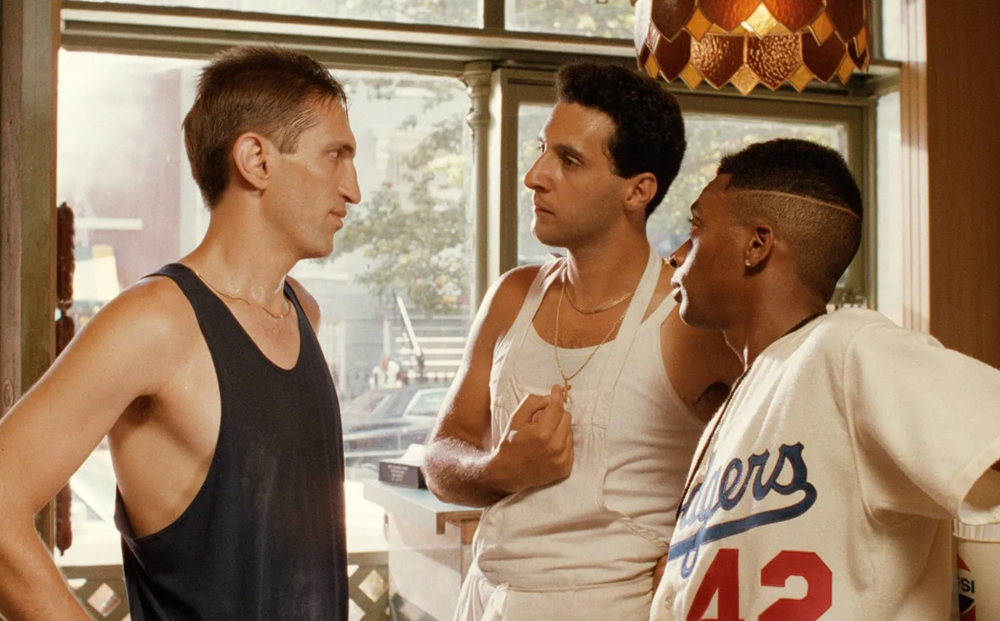
The role required Turturro to make a character comprehensible without making him sympathetic. He had to show the logic of Pino’s worldview without endorsing it, and present the damage without excusing the behavior. Indeed, it is the kind of technically precise ethical tightrope that film actors rarely get asked to walk. Yet Turturro walked it without losing his footing.
Moreover, Do the Right Thing inaugurated one of American cinema’s most sustained director-actor relationships. Turturro ultimately appeared in nine Spike Lee films — more than any other actor in Lee’s filmography. The list runs from Mo’ Better Blues (1990) through Jungle Fever, Clockers, Summer of Sam, and Miracle at St. Anna. Ultimately, each collaboration found a different register of what Turturro was capable of producing.
Barton Fink and the Cannes Win That Should Have Changed Everything
The Coen Brothers and the Role of a Career
In 1990, the Coen Brothers cast Turturro in Miller’s Crossing as Bernie Bernbaum — a small-time bookie whose particular combination of cowardice and cunning is both contemptible and, in the film’s final scene, genuinely affecting. The performance established the Turturro-Coen creative relationship that would produce some of the best American film acting of the decade.
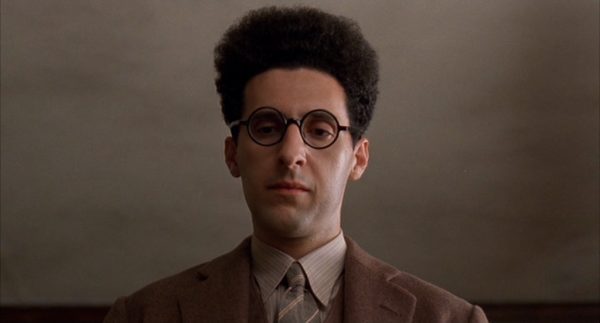
In 1991, Turturro played the title role in Barton Fink. Barton is a New York playwright transplanted to a Hollywood hotel to write a wrestling picture. He slowly dissolves under the pressure of his pretensions, his writer’s block, and something genuinely wrong with the building. Barton Fink won the Palme d’Or at Cannes. Additionally, Turturro won the Best Actor prize. Indeed, no film in Cannes history has ever won both the Palme d’Or and Best Actor in the same year.
What Cannes Means When Hollywood Doesn’t Follow
The Cannes prize should have restructured Turturro’s career. Instead, it confirmed something clear to anyone paying attention. He was the best actor in any room he entered. The industry would use him however it liked regardless of what the French thought.

Subsequently, Robert Redford’s Quiz Show (1994) came next — Turturro as Herb Stempel, the working-class champion unseated by the more presentable Charles Van Doren. The performance packed more American class anxiety per frame than almost any film of that decade. Furthermore, Jesus Quintana followed in The Big Lebowski (1998), seven minutes of screen time that remain among the most quoted in Coen Brothers history. O Brother, Where Art Thou? (2000) then cemented the partnership while reaching the widest mainstream audience of his career.
Subsequently, in the late 1990s and 2000s, Turturro made choices that the serious film press found occasionally baffling. Eventually, Adam Sandler comedies appeared on his resume. Seymour Simmons in the Transformers franchise followed across four films. Specifically, these were roles that paid well and required relatively little of the full Turturro apparatus — freeing up resources, financial and creative, for the projects that required everything.
The Night Of, The Batman, and the Return to Center

John Stone and the HBO Miniseries That Reminded Everyone
In 2016, Turturro played defense attorney John Stone in the HBO miniseries The Night Of — a man who takes a seemingly hopeless murder case partly because it is the right thing to do and partly because no one else will take it. Specifically, Stone has chronic eczema, an ex-wife, and a practice that operates on the margin of what could reasonably be called a practice. Indeed, his decency is so unpretentious the show almost hides it. Turturro received an Emmy nomination for Outstanding Lead Actor in a Limited Series for the performance.
Notably, it reminded critics who had spent a decade associating his name with franchise films that the Cannes winner was still present. He was still working, still capable of sustained performances that most actors cannot access at any career stage. The Night Of reestablished Turturro’s position in the critical conversation without him having changed anything about how he worked. He had simply been waiting for the right room.
Carmine Falcone in The Batman
In 2022, he played Carmine Falcone in Matt Reeves’ The Batman — Gotham’s mob patriarch, operating with the particular stillness of a man who has been the most dangerous person in the room for so long that he no longer needs to demonstrate it. The casting was precise. Turturro brought what Falcone required: the weight of accumulated real power. Furthermore, he brought the attention that power produces in a man who earned it rather than inherited it.
Irving Bailiff: Severance and the Role He Spent Sixty Years Building Toward
What Irving Requires
In Severance, Turturro plays Irving Bailiff — the most senior refiner in Lumon’s MDR department. Irving has memorized the company handbook and believes in the procedure’s validity. He has found, inside Lumon’s rigid structure, a peace that the outside world apparently could not provide. Irving, consequently, is the character who has the most to lose from discovering that the institution he trusts is not trustworthy.
Furthermore, the role also carries one of the season’s most unexpected and quietly radical story developments. Irving falls in love with Burt Goodman from the Optics and Design department. The love story — conducted entirely within a building that has eliminated most voluntary human connection — requires Turturro to play desire with decades of restraint behind it. Furthermore, it requires tenderness from someone who has not quite known how to express it until now.
Why Turturro Plays Irving Differently Than Anyone Else Could
Notably, the specific genius of Turturro’s Irving is the relationship between structure and feeling. Specifically, Irving believes in the rules — genuinely, not ironically — and Turturro plays that belief with the seriousness it deserves rather than the condescension it would invite from a less careful actor. Consequently, when the rules begin to fail Irving, the audience feels the collapse of something real rather than the exposure of a fool.
Additionally, the oil paintings matter. Irving’s innie unconsciously reproduces a single image at home — a dark corridor, painted over and over. His subconscious bleeds through the severance barrier. Turturro plays that moment with the quality that has characterized his best work since Barton Fink. A man receives information his identity cannot accommodate. Somehow, he has to find somewhere to put it.
Read more: Severance Season 1, Episode by Episode: The Most Honest Show About Work Ever Made
John Turturro Net Worth: The Full Accounting
Where the $14 Million Comes From
John Turturro net worth of $14 million reflects the specific economics of a career built primarily in independent film, prestige television, and theater, with periodic forays into the commercial mainstream. The independent film sector pays its best actors significantly less than the studio system. Turturro’s repeated work with Spike Lee, the Coen Brothers, and Pedro Almodóvar — whose 2024 film The Room Next Door featured him — represents a consistent prioritization of artistic weight over financial gain.
Notably, the commercial work subsidizes the serious work. The Transformers franchise, the Adam Sandler comedies, and similar projects generated income that funded the independent films, the theater productions, and the directing career. Mac (1992), his directorial debut, won the Caméra d’Or at Cannes. Consequently, Turturro became the only person in history to win both the Best Actor prize and the Best First Film prize at Cannes. Fading Gigolo (2013), which he wrote, directed, and starred in alongside Woody Allen and Sharon Stone, reflected the same pattern. A personal project made possible by commercial work done elsewhere.
The Career as an Asset
Furthermore, residuals from films that remain in active cultural circulation — The Big Lebowski has never stopped being watched — represent an ongoing income stream that compounds quietly alongside new work. His Emmy win for Monk and his nomination for The Night Of added television market value. That value contributed directly to the Severance casting.
Additionally, he has been married to actress Katherine Borowitz since 1985. They have two sons, Amedeo and Diego. He maintains a home in New York City and has remained, throughout his career, embedded in the city where he grew up — resident in the same cultural ecosystem that produced him, rather than migrating to Los Angeles or the increasingly rootless geography of the streaming era.
The Hamptons Chapter: What This Career Arc Means Here
The Turturro Model and the East End
There is a specific quality to Turturro’s career that the Hamptons crowd — the people who built real things over long periods of time, in fields where the market did not always reward what was actually best — tends to recognize immediately. He did not optimize for the category the industry assigned him. He worked with the directors whose work mattered to him and accepted that the financial return on that choice would be modest. Meanwhile, he took the commercial jobs that paid the bills without allowing them to define him.
Consequently, the body of work that resulted is something no purely commercially-oriented career produces: a filmography that contains both Barton Fink and Transformers, both the Palme d’Or and an Emmy for a comedy show about a detective, both Pedro Almodóvar and Adam Sandler. Indeed, that range is not a failure of focus. It is a portrait of a man who took the work seriously enough not to take the category seriously at all.
John Turturro net worth of $14 million is, ultimately, the financial expression of that philosophy. The actual asset — the Cannes prize, the Coen Brothers collaboration, the Night Of performance, Irving Bailiff’s painted corridors — is not measurable in the same currency. It is the kind of thing that appreciates differently than real estate, and that the right audience values more than the market currently reflects.
Where John Turturro Is Now
Severance Season 3 and the Work That Continues
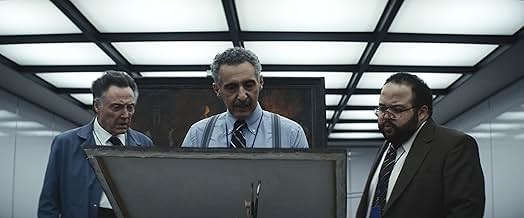
Currently, as of 2026, Turturro remains a principal cast member on Severance, with Season 3 entering production in mid-2026. He appeared in Pedro Almodóvar’s The Room Next Door in 2024. He holds dual American and Italian citizenship and has served on festival juries, maintaining his engagement with international cinema well into his late sixties.
Specifically, Turturro does not appear to be winding down. Specifically, he recently joined the cast of Severance at an age when many actors are moving toward legacy retrospectives and reduced output. Furthermore, the Irving Bailiff arc has significant unresolved threads — the paintings, the relationship with Burt, the reintegration possibility — that Season 3 will need to address. He has unfinished business with the role, and the role has unfinished business with him.
Still, the oil paintings in Irving’s home keep appearing. The corridor keeps being reproduced. Ultimately, something from the severed floor is bleeding through the barrier and arriving on canvas in a house a man cannot consciously remember entering. Ultimately, that is also a reasonable description of what John Turturro has been doing with every role for forty-five years. He reaches through the barrier between what the part asks for and what the actor has. He lets what’s underneath arrive on screen.
The people who built something real over a long period of time — who understood that the financial return on doing the right work is different from the financial return on doing the popular work, and who made the choice anyway — tend to find their way to the Hamptons eventually. Social Life Magazine is where those people tell their stories. Our writers, strategists, and luxury-market analysts place your brand, your story, or your business inside the cultural conversation at the exact moment it matters. Start the conversation here.
82,000 readers receive our exclusive email briefings on the Hamptons market, luxury culture, and the people who move between both. Join the list here.
Polo Hamptons 2026 is where the conversations from the magazine become the relationships that close deals. Two events. One summer. The exact demographic your brand needs in a tent with your logo on it. Sponsorship details here.
The print edition of Social Life Magazine reaches 25,000 households in the Hamptons corridor and 15,000 doorman buildings on the Upper East Side. It sits on the coffee table when the right person picks it up. Subscribe or advertise here.
If this piece was worth your time, the most direct way to keep independent luxury media that takes the culture seriously alive is a contribution here — any amount, no obligation.
Author

Written by
Recent Posts
Getting the Size Right on a Valley Dreams Zip Hoodie
The Traffic Patterns Hiding Inside the Accident Data
The Smart Way to Give Your Unused Jewelry a Second Life
Katsuya Brentwood and Haute Living Honor NBA Star Kawhi Leonard at Private Dinner

The Accountability System Quietly Protecting Your Parents’ Care
Categories
- Art
- Articles
- Business of Luxury
- Celebrities
- Culture
- Entertainment
- Events
- Faces of Summer 2026
- Fashion
- Fashion & Style
- Featured
- Finance
- Food, Spirits, Wine
- Hamptons
- Hamptons Celebrities
- Health
- Health & Beauty
- Lifestyle
- Luxury Lifestyle
- Press
- Profiles
- Real Estate
- Technology
- The Chronicles
- Travel
- Uncategorized
- Weddings