
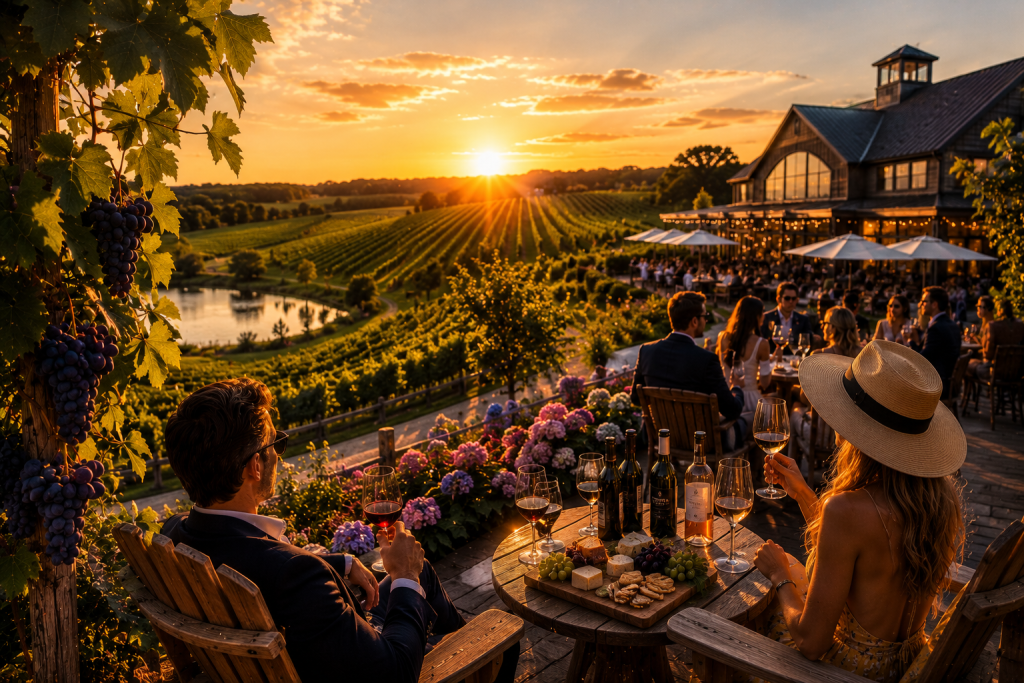
The Vineyard That Used to Be a Potato Farm
Every conversation about Bridgehampton wineries starts with soil. Bridgehampton loam, specifically: the same earth that grew potatoes for two centuries, now responsible for some of the most interesting wines produced east of the Hudson. The Atlantic Ocean sits 2.6 miles from the nearest vines, providing cool maritime breezes that critics have compared to Bordeaux. Three wineries operate in the Bridgehampton corridor. Each tells a different version of the same conversion story: agricultural land becoming cultural capital without losing the agricultural character that made it valuable in the first place.
The North Fork has fifty-plus wineries, organized trail maps, and tour buses. The South Fork has three, clustered around Bridgehampton, with no tour bus in sight. That scarcity is the point. Drinking wine in Bridgehampton is not an activity on an itinerary. It is a posture. Drive to a vineyard on a former potato farm. Sit on a terrace overlooking vines that did not exist forty years ago. Drink a glass of rose that accounts for 70 percent of the estate’s production because someone figured out that Long Island summers and pink wine are the same proposition. Then you drive to dinner.
Wolffer Estate Vineyard: The Standard
139 Sagg Road, Sagaponack. Tasting room open by reservation. Wine Stand walk-in daily.
Christian Wolffer was born in Hamburg. In 1988, he bought a potato farm on the South Fork and planted 55 acres of vines. The soil was Bridgehampton loam. The ocean was close enough to moderate temperatures year-round. Winemaker Roman Roth arrived and has been crafting the wines for three decades. Today, Wolffer Estate produces over 50,000 cases annually across wines, ciders, and spirits. Holdings extend beyond Sagaponack to 28 acres on the North Fork, 200 acres in Mendoza, Argentina, and 2.5 acres in Mallorca, Spain.
Summer in a Bottle and the Rose Renaissance
Summer in a Bottle rose is the product that changed everything. It accounts for over 70 percent of Wolffer’s production and ignited the East End’s rose renaissance, the moment when South Fork wine stopped being a curiosity and became a lifestyle marker. The label itself is a status object. Spotted on a table at Polo Hamptons, at a cabana at the Hampton Classic, at an outdoor dinner in Sag Harbor, Summer in a Bottle communicates a specific fluency with Hamptons culture that no California rose can replicate.
Bottles start at $34 and climb past $120 for the reserve wines. The Grapes of Roth Virgin Berry Dry Riesling earned the top Long Island score from James Suckling. This is not a novelty operation selling pink wine to tourists. It is a serious winery that happens to have figured out, before anyone else on the East End, that rose and summer are the same business.
The Tasting Room
Wolffer’s tasting room overlooks vines to the east and rolling Hamptons landscape to the west. Seated tastings are reservation-only, released in batches (the next release dropped May 24, 2026, at 2 p.m.). Flights include wines, seasonal small plates, and room tours. Expect to spend $15 to $20 per person for the guided experience. Wine club members receive complimentary tastings, 15 percent off bottles, exclusive releases, and event invitations.
The Cobble Hill couple booked a Saturday tasting three weeks in advance because someone at a dinner party mentioned that Wolffer reservations are harder to get in July than Almond reservations in August. They arrived at 1 p.m. She ordered the rose flight. He ordered the red flight because he maintains that rose is a marketing phenomenon rather than a wine category, a position he will quietly abandon by the third pour. By 2 p.m. they had bought a case. By 3 p.m. they were at the Wine Stand. By 4 p.m. they were discussing whether the house on Parsonage Lane was actually overpriced or just correctly priced for Sagaponack.
The Wine Stand: The Pre-Game for Every Saturday
At 3312 Montauk Highway in Sagaponack, Wolffer operates the Wine Stand: a walk-in counter with wines by the glass, charcuterie boards, and sunset views across the vineyard. No reservation required. Summer in a Bottle by the pour. This is the single most important pre-dinner destination in the Bridgehampton corridor from June through September.
The West Village couple who drove east on Friday afternoon and do not have dinner reservations until 8 p.m. spends golden hour here. The FiDi wealth advisor brings his Saturday Polo Hamptons clients here first, because thirty minutes of rose on a vineyard terrace lowers conversational defenses more efficiently than any conference room in Midtown. The Wine Stand is not a winery experience. It is a social lubricant with a Sagaponack address.
Channing Daughters Winery: The Experimenter
1927 Scuttle Hole Road, Bridgehampton. Open daily, 11 a.m. to 5 p.m. year-round. Reservations encouraged; walk-ins welcome for groups under six.
If Wolffer is the polished establishment, Channing Daughters is the artist who showed up without an invitation and made everyone glad they came. Walter Channing founded the winery on 28 acres of Bridgehampton farmland. Twenty-four grape varieties grow here, making it the most diverse planting on the East End. White varieties include Chardonnay, Pinot Grigio, Tocai Friulano, Sauvignon Blanc, Muscat Ottonel, Malvasia, Gewurztraminer, Ribolla Gialla, and Pinot Bianco. Red varieties include Merlot, Blaufranisch, Dornfelder, Syrah, and Teroldego, among others.
Orange Wine and Vermouth in a Sculpture Garden
Channing Daughters makes orange wines (white grapes fermented with skin intact, producing nutty, citrusy, dry flavors). They produce six different vermouths, each with seasonal herbs, spices, fruits, and botanicals. All grapes are hand-picked. White grapes are whole-cluster pressed. Red grapes are stomped by foot and punched down by hand. Wine is gravity-bottled. About 50 percent of grapes are sourced from the North Fork. These are not industrial methods. These are decisions that cost money and produce character.
Channing also founded the Sculpture Garden, featuring his own carved-wood pieces amid the vines. The tasting room is decorated with antique wine barrels and Channing’s sculptures. Flights of five wines run $28 and can be shared by two. Live music fills weekend evenings during summer. ARF (Animal Rescue Fund of the Hamptons) brings adoption vans to the property.
The NoHo gallery director discovered Channing Daughters in 2019 and has not returned to the North Fork since. She comes for the Meditazione (a skin-contact white that nobody at the Chelsea Wine Vault stocks yet) and for the conversation with Anthony, who greets every visitor with an enthusiasm that cannot be manufactured. She buys two bottles of the Pet-Nat and one vermouth every visit. Her friends in Manhattan have started ordering Channing at restaurants. She does not tell them she knows the winemaker. She lets the wine do the work.
Channing vs Wolffer: How to Choose
Wolffer is where you go when you want the Hamptons wine experience: vineyard views, rose, polished service, a brand you can photograph and post. Channing Daughters is where you go when you want to learn something. Both are five minutes from Bridgehampton’s Main Street. Most visitors who know the area do both in the same afternoon, starting at Wolffer’s Wine Stand for the pre-game and finishing at Channing for the education.
Duck Walk Vineyards: The Chateau on Montauk Highway
231 Montauk Highway, Water Mill. Open Thursday through Monday. Tastings $16 for four pours. Dog-friendly.
Dr. Herodotus “Dan” Damianos, founder of Pindar Vineyards on the North Fork, established Duck Walk in 1994. The 11,000-square-foot Normandy Chateau-style building on Montauk Highway is a Hamptons landmark visible from the road. Across the street sits the Parrish Art Museum, making this corner of Water Mill a two-stop afternoon: art then wine, or wine then art, depending on your priorities.
Approachable Wines and Weekend Live Music
Duck Walk’s strength is accessibility. Tastings run $16 for four pours, the most affordable entry point among Bridgehampton wineries. The Riesling and the Windmill White are visitor favorites. Live music fills the patio every Saturday and Sunday from May through October. Leashed dogs are welcome, making Duck Walk the most pet-friendly winery on the South Fork.
The Park Slope family renting in Bridgehampton for two weeks brings the golden retriever to Duck Walk on Sunday afternoon because the kids can run on the lawn, the dog can sit under the table, and the parents can drink wine that costs less than parking in Southampton Village. Duck Walk does not compete with Wolffer on prestige or with Channing on experimentation. It competes on friendliness. For the first-time Hamptons visitor who wants a wine experience without a reservation, a dress code, or a sommelier’s lecture, Duck Walk is the answer.
The South Fork vs the North Fork: A Note on Geography
Long Island wine country is divided by a body of water and a cultural chasm. The North Fork (Cutchogue, Mattituck, Southold) has fifty-plus wineries organized along Route 25, with tour buses, bachelorette parties, and a winemaking infrastructure that dwarfs the South Fork. North Fork wines are, on average, less expensive and more accessible. The tasting experience is oriented toward volume.
Why the South Fork Is Different
The South Fork has three wineries and no tour bus. What it has is Bridgehampton loam soil, proximity to the Atlantic, and a clientele that does not need a map to find a vineyard. South Fork wine is positioned as a luxury experience within a luxury geography. Wolffer’s tasting room reservations sell out. Channing Daughters’ Saturday live music draws a crowd that stays. Duck Walk’s chateau sits next to one of the most important art museums in the Hamptons. Context elevates everything.
For the visitor deciding between a North Fork wine tour and a South Fork wine afternoon, the question is not which wines are better. It is which experience fits. A North Fork wine tour is a full-day commitment with multiple stops. The South Fork alternative is a two-hour interlude between the beach and dinner, and the two hours may be the best two hours of your weekend.
The Wine Trail Itinerary: Three Stops, One Afternoon
3:00 p.m. Start at Wolffer Wine Stand (3312 Montauk Highway, Sagaponack). Walk-in. Summer in a Bottle by the glass. Charcuterie. Sunset views. Thirty minutes.
4:00 p.m. Drive five minutes to Channing Daughters (1927 Scuttle Hole Road, Bridgehampton). Flight of five wines, $28. Orange wine. Vermouth. Sculpture garden. Live music if it is a summer weekend. Forty-five minutes.
5:00 p.m. Drive eight minutes to Duck Walk (231 Montauk Highway, Water Mill). Four pours for $16. Bring the dog. Walk the Parrish Art Museum grounds next door if time permits. Thirty minutes.
6:00 p.m. Drive back to Bridgehampton for dinner at Almond, Bobby Van’s, or Jean-Georges at Topping Rose House. Reservation recommended.
Driving time: approximately twenty minutes. Tasting time: approximately two hours. Cost per person: roughly $60 to $80 including one glass at the Wine Stand, one flight at Channing, and one tasting at Duck Walk. In Hamptons terms, that is less than dinner for one at Bobby Van’s.
Where the Conversation Continues
Social Life Magazine has covered Hamptons wine for 23 years. Five summer issues, 25,000 copies each, distributed to the restaurants, hotels, and beach clubs where these bottles land on tables. Our Hamptons restaurant guide pairs with this wine trail across every village on the South Fork.
If your brand operates in wine, spirits, hospitality, or luxury food and beverage, editorial positioning in Social Life Magazine reaches the audience that drinks these wines and attends the events where they are poured. Submit a Paid Feature here.
Polo Hamptons 2026 runs July 18 and July 25 at 900 Lumber Lane. Open bar flows throughout the event. Sponsorship opportunities for beverage brands are available at polohamptons.com.
Subscribe to Social Life Magazine here.
Three Bridgehampton wineries. Three conversion stories. One soil. The potatoes are gone. The vines are here. And the glass of rose in your hand at sunset on a Sagaponack terrace is the most concise summary of what happened to this village that anyone has ever poured.
Related Reading
- Bridgehampton: The Village That Turned Farmland Into a Stage
- Best Restaurants in Bridgehampton 2026
- Sagaponack: The Most Expensive Zip Code in America
- The History of Bridgehampton
- 72 Hours in Bridgehampton
- Polo Hamptons 2026
- Hampton Classic 2026
- Best Restaurants in the Hamptons 2026
- Sag Harbor Village Dossier
- Southampton Village Dossier
Author

Written by
Recent Posts

Powerful Strategies to Stay Ahead in a Fast-Moving Real Estate Market
How Latino Players Have Helped Shape Modern Basketball Culture
10 Best Designer iPhone 18 Pro Cases to Choose From

AI for personal finance: where PennyGuard fits

How to Pick a Homecoming Dress for Your Body Type (and Feel Amazing in It)
Categories
- Art
- Articles
- Business of Luxury
- Celebrities
- Culture
- Entertainment
- Events
- Faces of Summer 2026
- Fashion
- Fashion & Style
- Featured
- Finance
- Food, Spirits, Wine
- Hamptons
- Hamptons Celebrities
- Health
- Health & Beauty
- Lifestyle
- Luxury Lifestyle
- Press
- Profiles
- Real Estate
- Technology
- The Chronicles
- Travel
- Uncategorized
- Weddings