
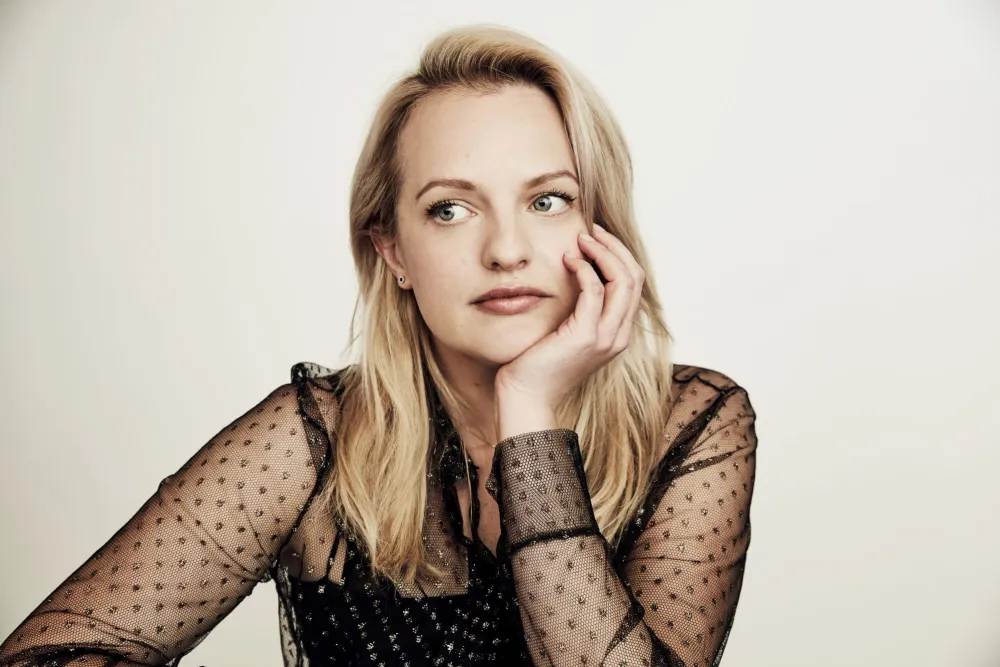
The Before: Los Angeles, Ballet, and the First Career That Ended
The Body That Changed Everything
Elisabeth Singleton Moss was born July 24, 1982, in Los Angeles, California. Her father, Ronald Moss, was an Englishman from Birmingham who had settled in the United States. Her mother, Linda, played jazz and blues harmonica professionally. Both parents were musicians. The household ran on the logic of artistic discipline — the understanding that a craft requires a life organized around it, that talent without structure is merely potential.
From early childhood, Moss wanted to dance. Specifically, she wanted to be a professional ballet dancer. She trained seriously, traveled to New York City as a teenager to study at the School of American Ballet, and subsequently studied under Suzanne Farrell at the Kennedy Center in Washington, D.C. By every account, she was committed entirely. Then her body changed. Growth spurts shifted her proportions in ways that made a professional ballet career structurally unavailable. She was approximately ten years old. Her first ambition ended before adolescence.
What Ballet Left Behind
The ballet years matter to this story in a specific way. Professional dance training, at the level Moss pursued it, does not simply teach technique. It instills a particular relationship to discipline — the understanding that the work requires total commitment, that the gap between good and extraordinary closes only through repetition performed at a standard most people decline to maintain. When that training has nowhere to go, the discipline remains. It simply finds another container.
Acting became that container. To manage her career alongside her education, Moss began homeschooling and graduated in 1999. Her first screen role came in 1990, in the NBC miniseries Lucky/Chances, when she was eight years old. Throughout the early 1990s, she accumulated credits in animated series — Animaniacs, Batman: The Animated Series, Frosty Returns — and appeared in television films and supporting roles. The child actress pipeline is reliably treacherous. Moss navigated it by doing what the ballet training had prepared her to do: keep working, maintain the standard, do not confuse early exposure with arrival.
The Excedrin Commercial That Paid the Bills
In 2002, during the years between her West Wing breakthrough and the consistent work that followed, Moss appeared in an Excedrin commercial that ran for several years and generated residual income through a period when the acting work was inconsistent. That commercial is a footnote in most profiles. It belongs in this one, because it represents the practical reality that sustains careers between the visible milestones — the unglamorous infrastructure of a working actor building toward something that has not yet revealed its shape.
The Pivot: The West Wing and the Education It Provided
Zoey Bartlet, 1999 to 2006
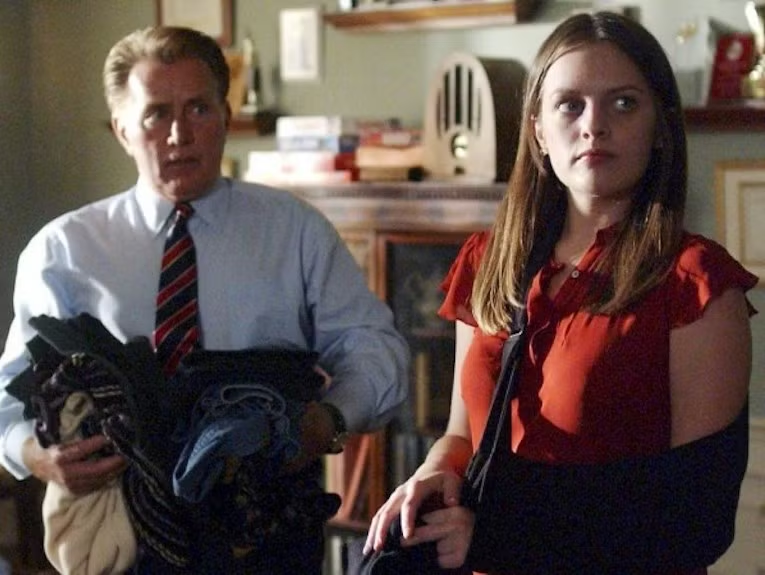
In 1999, Moss joined the cast of NBC’s The West Wing as Zoey Bartlet — the youngest daughter of President Josiah Bartlet, played by Martin Sheen. She held the role for 25 episodes across the show’s full seven-season run. Technically, Zoey was a supporting character. In practice, Aaron Sorkin used her as the pivot point of the show’s most structurally ambitious sequence: the Season Four finale, which built to a kidnapping cliffhanger that required the character to carry the weight of an entire season’s dramatic architecture.
Consequently, Moss spent seven years inside one of the best-written political dramas in American television history, learning — at the level of daily professional practice — what it meant to work with writers, directors, and a cast of exceptional technical ability. That education did not appear on her résumé as a line item. Nevertheless, it is present in every performance she gave afterward.
The Gap Between Supporting and Central
During the West Wing years, Moss also appeared in Law & Order: Criminal Intent, Grey’s Anatomy, Medium, and other projects. She worked consistently without breaking through to the kind of attention that changes a career’s trajectory. In 2002, she received an Independent Spirit Award nomination for the film Virgin. Industry attention followed in the form of further opportunities, none of which were the right one yet.
The gap between supporting player and central force is the most consequential distance in an actor’s career. It is crossed either by luck — the right role appearing at the right moment — or by the accumulated preparation that makes the actor capable of doing something extraordinary when the right role finally arrives. Moss crossed it through the second mechanism. By the time Matthew Weiner cast her as Peggy Olson in 2007, she had been professionally preparing for that role, without knowing it existed, for seventeen years.
The Mad Men Chapter: Peggy Olson and the Long Game
The Character and What It Required
Peggy Olson arrives in the first episode of Mad Men as Don Draper’s new secretary — young, eager, and equipped with an intelligence the show’s world has no official category for. Over seven seasons and 88 of the show’s 92 episodes, she becomes a copywriter, a creative director, and finally a figure of genuine authority in an industry that spent the entire run of the show attempting to locate her in its support structure rather than its leadership one. Playing that arc required Moss to make imperceptible changes visible across years rather than scenes — to build a character in increments so small that the audience, like Peggy’s colleagues, didn’t notice the accumulation until it had already become something irreversible.
That is among the hardest technical demands in dramatic acting. Running in structural counterpoint to Peggy’s entire arc is January Jones’s Betty Draper — the show’s argument about what happens to the same intelligence when the institution offers it no path forward at all. Moss executed it with the precision of someone who had spent her childhood inside a discipline that demanded exactly that quality: incremental improvement, daily, at a standard that compounds over time.
The Salary and the Emmy Count
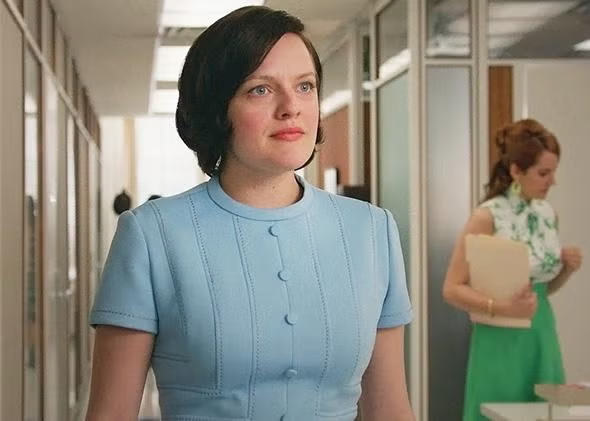
At her peak salary on Mad Men, Moss earned $75,000 per episode. The show nominated her for five Primetime Emmy Awards for Outstanding Lead Actress in a Drama Series. She did not win any of them during the show’s run — a parallel to Jon Hamm’s eight nominations that speaks to something specific about how the industry calibrates recognition against the performances it is actually receiving. Furthermore, she received an Emmy nomination for Outstanding Supporting Actress in 2010, in addition to the lead nominations. The total nomination count for Peggy Olson is six.
In 2013, midway through the Mad Men run, she starred in the BBC miniseries Top of the Lake as Detective Robin Griffin. That performance won her a Golden Globe Award for Best Actress in a Television Series — Drama. The industry’s recognition arrived first for a British production. It was not the last time the room running fastest to catch up with Moss was not the American one.
What Peggy Built Beyond the Salary
The most significant thing Mad Men built for Moss was not the Emmy nominations or the critical reputation. It was the demonstrated capacity to carry a complex character through seven years of sophisticated dramatic writing without a single performance that broke the character’s internal logic. That kind of sustained consistency is the foundation on which producing credits, directing opportunities, and the leverage to negotiate $1 million per episode are ultimately built. Every future conversation about what Elisabeth Moss was worth began with what Peggy Olson had established.
The Climb: Between Shows and the Production Company That Changed Everything
Love & Squalor Pictures
In 2012, Moss co-founded Love & Squalor Pictures, her production company. The founding happened during the final years of Mad Men — before the show ended, before The Handmaid’s Tale existed, before the industry had occasion to offer her the producing infrastructure she was building for herself. That timing is the relevant fact. She did not wait for the leverage that would have made the move easier. She built the leverage by making the move first.
Love & Squalor produced several of Moss’s film projects in the years that followed, including her work with director Alex Ross Perry on Listen Up Philip (2014), Queen of Earth (2015), and Her Smell (2018) — a body of work that established her indie film credibility and kept her artistically active between the television commitments that anchored her public profile.
The Fred Armisen Chapter
In October 2009, Moss married comedian and Saturday Night Live cast member Fred Armisen. They separated in June 2010, eight months after the wedding. She filed for divorce in September 2010. The divorce was finalized in May 2011. Armisen later described himself publicly as a terrible husband. Moss has discussed the marriage rarely, briefly, and without sentimentality. The episode belongs in this record as a fact rather than an analysis. What followed it, professionally, was everything.
The Handmaid’s Tale: The Architecture of the $30 Million
June Osborne and What the Role Demanded

Hulu’s adaptation of Margaret Atwood’s The Handmaid’s Tale premiered in April 2017. Moss played June Osborne — a woman in a near-future theocratic America who has been forcibly assigned as a “handmaid,” a reproductive vessel for the ruling class, and whose entire arc across the series concerns the question of whether a person can maintain her identity under a system designed to erase it. The role required her to communicate interiority almost entirely through close-up — through the controlled surface of a face that is not permitted, within the world of the show, to express what it is actually thinking.
That specific technical demand — expressing maximum feeling through minimum permitted display — is the Peggy Olson skill at its absolute extreme. Moss had been building toward it for ten years without knowing the show existed.
The Salary That Repriced Her Career
Moss’s starting salary on The Handmaid’s Tale was $175,000 per episode — more than double her Mad Men peak. As the show’s cultural footprint expanded, her fee rose accordingly. By the series’ later seasons, she was earning $1 million per episode — a figure that places her among the highest-paid actresses in television history. Between September 2018 and September 2019 alone, she made approximately $24 million, drawn primarily from her combined acting and executive producing fees.
The executive producing credit is the part of this story that most coverage still underemphasizes. Moss did not simply star in The Handmaid’s Tale — she co-produced it through Love & Squalor Pictures, holding creative authority over the material she was simultaneously performing. That dual role generates a different financial structure than acting alone. It also generates a different kind of leverage in future negotiations: not simply the leverage of a performer in demand, but the leverage of a producer who controls the conditions of her own performance.
The Awards and the Recognition
The Emmy that Mad Men withheld arrived through The Handmaid’s Tale. Moss won Outstanding Lead Actress in a Drama Series in 2017 for the first season — and again in a subsequent season. She also received two Golden Globe Awards for the role. In 2017, Vulture named her “Queen of Peak TV,” a designation that acknowledged what the nomination tallies had been suggesting for years: that no single actress had maintained a more consistent record of distinguished performance across the peak television era. Additionally, her work earned a Tony Award nomination for the 2018 Broadway production of Heisenberg. The stage work confirmed what the screen work had been demonstrating: the range extended further than the prestige TV category implied.
After Gilead: Shining Girls, The Veil, and What Comes Next

Rather than consolidating after The Handmaid’s Tale, Moss continued building. In 2022, she starred in and executive produced Shining Girls for Apple TV+ — a thriller she described as one of the most complicated things she had attempted professionally. In 2024, she led The Veil for FX on Hulu, playing a veteran MI6 agent. NPR’s David Bianculli called it her best performance yet. That assessment arrived fifteen years after the early-2000s cultural moment Moss’s early career ran alongside — a period whose lasting influence on media and celebrity culture Social Life has documented extensively. That assessment arrived a decade and a half after the industry had first decided what she was good at. The best performance yet, at forty-two. The trajectory is still ascending.
The Soft Landing: Motherhood, the Final Season, and the Numbers
The Baby and the Set
In early 2024, Moss confirmed she was expecting her first child. She kept details about the baby and co-parenting private, consistent with the discretion she has maintained about her personal life throughout her career. She brought her baby to the set of The Handmaid’s Tale‘s final season in 2024. “It was incredibly meaningful to be able to end this show as a mom,” she told The Hollywood Reporter. “Because I’m playing this character who is this iconic mother figure.” The final season of the show concluded in 2025, closing an eight-year chapter that had produced two Emmys, two Golden Globes, and the financial architecture behind her $30 million net worth.
The Three-Show Architecture and What It Proves
The standard reading of an actor’s career plots a single peak — the role that defined them, the moment of maximum cultural visibility, the award that confirmed the room’s judgment. Moss has refused this structure three times. The West Wing established her professional foundation. Mad Men built her reputation for sustained complexity. The Handmaid’s Tale made her a cultural figure and a producing force simultaneously. Furthermore, she did not wait for each next phase to be offered. She built the production company during Mad Men. During the years between shows, she began the indie film work. She secured the executive producing credit before the show was a phenomenon rather than after.
That is the Gladwell counterintuitive: the consistent performer who accumulates quietly, who makes the structural moves when the room isn’t watching, who arrives at the destination before the industry realizes the journey has been happening. The Elisabeth Moss net worth of $30 million is not the product of a single role or a single negotiation. It is the compound result of thirty-five years of daily work at a standard the room took two decades to price correctly. Peggy Olson would have understood the math entirely.
Return to the full Mad Men complete guide for the full seven-season breakdown and every character Moss inhabited across 88 episodes. For the complete cast profile series, see our Jon Hamm spoke and our Culture and Power hub.
Related Reading
- Mad Men: The Complete Guide to Every Season and Character
- Jon Hamm Net Worth: The $45M Story Behind Don Draper
- January Jones Net Worth: The $10M Betty Draper Story
Some careers are discovered. This one was constructed — one production credit, one negotiation, one season at a time. Social Life Magazine has covered the architecture of ambition in culture, wealth, and media for 23 years. You read us because you understand the difference between the story the industry tells about success and the one that actually happened.
If your brand, business, or story belongs in this conversation, we want to hear from you. Editorial features, strategic placements, and partnerships begin at sociallifemagazine.com/contact.
Ready to control your own narrative? Submit a paid feature and reach 25,000 print readers per summer issue, plus our full digital audience, at sociallifemagazine.com/submit-a-paid-feature.
Our email list reaches 82,000 subscribers — the people who study careers like this one because they are building something of their own. Join the list here.
Polo Hamptons returns for summer 2026. Two dates. A room that already knows what it is. Sponsorship and hospitality packages at polohamptons.com.
Five summer issues. Placed where the conversation actually happens. Print subscriptions at sociallifemagazine.com/subscription.
Independent editorial takes real resources. If this kind of journalism matters to you, a $5 contribution keeps Social Life in print and online. Donate here.
Author

Written by
Recent Posts

Galina Breslav: From Pension Fund to Executive Presence

Hermès Fake Authenticator: A Monopoly Mistaken for Expertise
A Real Gift: How La Scala Found Its Community in New York Through the Teatro alla Scala Association of America (TASAA)

He Sold His Company, Got Everything He Wanted, but Lost His Purpose

OUT OF LINE
Categories
- Art
- Articles
- Business of Luxury
- Celebrities
- Culture
- Entertainment
- Events
- Faces of Summer 2026
- Fashion
- Fashion & Style
- Featured
- Finance
- Food, Spirits, Wine
- Hamptons
- Hamptons Celebrities
- Health
- Health & Beauty
- Lifestyle
- Luxury Lifestyle
- Press
- Profiles
- Real Estate
- Technology
- The Chronicles
- Travel
- Uncategorized
- Weddings