
The Before: St. Louis, Two Funerals, and the Thing That Stayed
Where He Started
Jonathan Daniel Hamm was born March 10, 1971, in St. Louis, Missouri. His father managed a family trucking company. His mother worked as a secretary. They divorced when Jon was two, and he went with his mother to St. Louis County. During those years, he joined the football team, the baseball team, and the swim team. He was, by every available account, a normal Midwestern kid building a normal Midwestern childhood.

Then his mother died when he was ten. Colon cancer. Consequently, he moved in with his father and grandmother in Clayton, Missouri, and transferred to John Burroughs School — a private institution in Ladue where he first encountered serious theater. He played Winnie the Pooh in first grade and performed in Godspell in high school. At that point, he still didn’t take it seriously. That came later, and harder.
The Second Loss
After graduating from John Burroughs, he enrolled at the University of Texas. A hazing incident in his fraternity produced criminal charges, and he transferred to the University of Missouri. There, he found the theater department, joined a company, and played serious roles — A Midsummer Night’s Dream, Assassins. Acting stopped being a hobby and became the thing he was orienting his life around.
His father died during this period. Jon was twenty. He had now lost both parents before reaching legal drinking age. Nevertheless, he graduated from Missouri in 1993 with a bachelor’s degree in English, returned to his old high school, and taught eighth-grade acting for two years. Notably, one of his students was Ellie Kemper, who later became an actress — and years afterward, Hamm appeared in her Netflix series. The world is that small. Careers are that long.
What the Losses Built
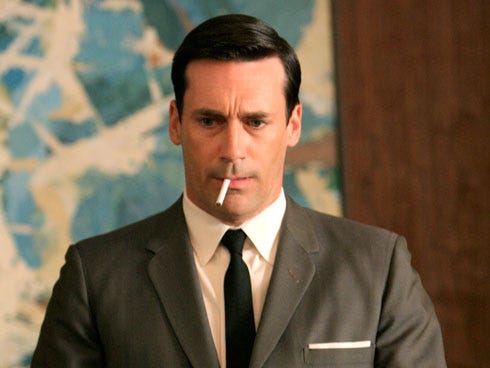
The deaths matter to this story for a specific reason. Don Draper is a man running from his origins. Jon Hamm, by contrast, is a man whose origins were taken from him before he could choose to run. That distinction is visible in the performance, if you know to look for it. Don Draper performs invulnerability because he is protecting something. Hamm plays Draper as a man performing invulnerability — two layers of controlled surface, each authentic in its own register. You cannot manufacture that quality from craft alone. Some of it has to come the hard way.
The Pivot Moment: The Deadline That Changed Everything
Three Years of Nothing
Hamm moved permanently to Los Angeles in 1995. He brought $150 and a car, moved into a house with four other aspiring actors, and waited tables while attending auditions. For three years, he booked nothing. In 1998, William Morris dropped him without a single credit to show for the relationship. Despite this, he kept waiting tables and kept auditioning. Briefly, he worked as a set decorator on a softcore pornography film. The industry read his face — that jaw, that weight, the forty-year-old gravity it carried on a twenty-seven-year-old man — as a casting problem. They were wrong about the problem. They were simply wrong about the decade.
The Ultimatum
Hamm set a private condition for himself: book a role before thirty, or go home to Missouri and build a different life. Crucially, this was not a performance for anyone else. Nobody knew about the deadline. He made it quietly, in a city that had found no use for him yet, because he needed a boundary for how long he would live inside the uncertainty.
At twenty-nine, he started booking work. A guest appearance on NBC’s Providence in 2000 grew into nineteen recurring episodes because audiences responded to him in a way that bypassed the normal gatekeeping — they simply liked watching him. Space Cowboys followed. Then Kissing Jessica Stein, We Were Soldiers. The face the industry had called a liability started reading as authority. Hamm hadn’t changed. The room had changed around him.

The Climb: From Providence to the Audition That Mattered
Seven Years Before Don Draper
From 2000 to 2007, Hamm built steadily and without fanfare. He appeared in The Division, CSI: Miami, and Numb3rs, and took a recurring role in The Sarah Silverman Program. Technically, he was a working actor — the category that sustains careers and rarely generates profiles. His name appeared in credits. His face accumulated time on screen. The foundation built quietly.
Meanwhile, in 1997, he had begun a relationship with actress and screenwriter Jennifer Westfeldt. Together, they co-founded Points West Pictures in 2009. Her film Friends With Kids — which she wrote, directed, and starred in — Hamm produced and appeared in. The relationship and the professional partnership shared the same structure: two people building something together before the external validation that usually marks progress had arrived.
Eighty Rivals and One Role
Matthew Weiner’s Mad Men pilot script circulated in 2006. AMC cast eighty actors for Don Draper — Creative Director, Sterling Cooper, Madison Avenue, 1960. Many candidates were more famous than Hamm. Several were more obviously castable by the metrics the industry uses. Hamm did not expect to get it. He auditioned anyway, at thirty-six, after twelve years in Los Angeles.
AMC cast him. The show premiered July 19, 2007. In the years since, the parallel has become obvious: Don Draper was a man who had built himself from nothing, and the actor who played him had done the same thing. The casting director understood something about structural rhymes that the industry had spent a decade missing. The same logic applied one chair over: John Slattery arrived at Roger Sterling having spent nineteen years as the most reliable character actor in rooms that never gave him the lead.
The Don Draper Chapter: What the Role Actually Built

The Salary Architecture
Mad Men ran ninety-two episodes across seven seasons. Hamm’s salary started at $20,000 per episode in Season One, rose to $100,000 by Season Three, and reached $125,000 by Season Four. For Seasons Five through Seven, it peaked at $275,000 per episode — approximately $4 million per season in acting fees alone. Additionally, streaming residuals continued accumulating long after the 2015 finale, when AMC’s deal with HBO Max created a second revenue event years after the show ended.
Furthermore, Hamm produced the series and directed two episodes — Season Five’s “Tea Leaves” and Season Six’s “Collaborators.” The producer credit generates backend returns that compound differently than acting salaries, adding a layer to the financial architecture that the episode rate alone doesn’t capture.
The Mercedes Deal
During the show’s run, Hamm secured the voiceover contract for Mercedes-Benz North America. The multi-year deal reportedly ran from 2010 through 2015 and beyond, with a total estimated value between $15 million and $25 million — roughly $3 million to $5 million annually. Consequently, the voice the industry initially had no use for became the sound Mercedes chose to attach to its brand identity in the American market. That contract likely represents the largest single revenue stream of his career outside the acting work itself, yet most profiles of Hamm still treat it as a footnote.
Beyond Mercedes, his endorsement portfolio included BetMGM, H&R Block, Progressive Insurance, Apple TV+, and Minute Maid. Each deal added to a financial structure that protected him from the post-Mad Men identity problem that terminates many actors’ earning trajectories when a defining role concludes.
Eight Nominations, One Win

The Emmy nominations began with the show’s second season and continued without interruption. Year after year, Hamm received the nomination and watched someone else collect the award. The sequence became a cultural running joke — the best actor in prestige television, recognized annually and unrewarded annually. Finally, in 2015, the show’s last year of eligibility, he won Outstanding Lead Actor in a Drama Series. The award arrived with the weight of things that have been delayed long enough to carry extra meaning. He held it and looked like a man who had been waiting since Missouri.
What He Built After Don Draper
The Post-Mad Men Problem and Its Solution
Don Draper presents a specific challenge to the actor who played him. The character is so total — so precisely the image of a certain kind of American male authority — that everything after risks reading as a lesser version of the same note. Rather than protecting the Draper brand by avoiding comparison, Hamm expanded away from it fast enough that comparison became impossible.
Bridesmaids (2011) established his comedy timing in a film that became a cultural reference point. Baby Driver (2017) grossed $227 million and demonstrated physical range the Draper role had never required. Subsequently, Top Gun: Maverick (2022) — in which he played Vice Admiral “Cyclone” Simpson — grossed $1.5 billion worldwide and required zero connection to Mad Men. Estimated earnings from that project alone run to $5 million or more. Additionally, he built voice acting credits through Minions, Invincible, Transformers One, and his executive-produced Fox animated series Grimsburg.
The Prestige Television Return

Hamm’s post-Mad Men television choices reflect the same structural intelligence as his film work. As Sheriff Roy Tillman in FX’s Fargo Season Five (2023–24), he played a villain of such deliberate menace that the role functioned as a direct argument against any residual Draper association. From there, he moved through Good Omens, The Morning Show, and Landman. In 2025, he took the lead role in Apple TV+’s Your Friends and Neighbors — his first television lead since Mad Men ended a decade earlier. Reports place his fee in the seven-figure-per-season range. The late bloomer had become the premium.
The Numbers
His net worth stands at $45 million as of 2026. That figure reflects acting fees from ninety-two episodes of Mad Men, two subsequent television leads, a decade of film work including one $1.5 billion grosser, a Mercedes voiceover deal worth up to $25 million, and a diversified endorsement portfolio. It does not fully capture the streaming residuals still compounding or the producer backend still accruing. In total, it represents not a single windfall but a deliberately constructed financial architecture built across thirty years.
The Soft Landing: Sobriety, Marriage, and What Came Next
2015: The Year of Reckonings
The year the show ended was also the year Hamm sought treatment for alcoholism. He checked into a rehabilitation facility and spoke about it publicly — without drama, without performed vulnerability, with the matter-of-fact directness of a man dealing with a thing rather than managing its appearance. That decision belongs in the biographical record alongside the Emmy and the Mercedes deal. It is part of what he built.

His eighteen-year relationship with Jennifer Westfeldt also ended in 2015. Together, the conclusion of the show, the sobriety treatment, and the end of the relationship arrived in the same twelve months. He later described the year as a reckoning — the kind that comes when a structure you have been maintaining finally demands that you examine what it has cost.
Anna Osceola and the Chapter After
Hamm met actress Anna Osceola on the set of Mad Men‘s final season, where she played a small recurring role. Years later, they began a relationship. He proposed in 2022. They married in June 2023 in Big Sur, California — a ceremony that generated photographs associated with someone who has arrived somewhere rather than someone still in transit.

Today, he hosts Saturday Night Live — four times now, most recently in April 2025 — and hosted the NFL Honors in February 2026. He appears on talk shows with the ease of a man who has had twenty years of practice being watched and no longer finds it interesting enough to require nervousness. The industry that dropped him in 1998 now schedules its events around his availability. The math on that particular irony does not require elaboration.
The Lesson in the Ledger
The Jon Hamm net worth story does not belong to the category of talent discovered early and rewarded immediately. Instead, it belongs to a rarer and less frequently told category: the person who was right about themselves for longer than anyone else was willing to confirm it. Hamm set private deadlines rather than public claims. He converted a face the industry called a liability into the standard against which prestige television now measures everything that follows.
He arrived with $150. He kept the deadline. The rest is compound interest on the decision not to go home. For the contemporary version of the same self-invention logic running through prestige finance television, see the finance archetypes Don Draper’s world produced.
Return to the full Mad Men complete guide for the show’s seven-season breakdown and the complete cast of characters. For more actor profiles, visit our Culture and Power hub.
Related Reading
- Mad Men: The Complete Guide to Every Season and Character
- Elisabeth Moss Net Worth: From Peggy Olson to Industry Titan
- Christina Hendricks Net Worth: The $10M Joan Holloway Story
Some stories are about talent. This one is about the decision to keep going past the point where going makes obvious sense. Social Life Magazine has covered careers, wealth, and the architecture of ambition for 23 years. You read us because you understand that those three things are rarely as separate as they appear.
If your brand, business, or story belongs in this conversation, we want to hear from you. Editorial features, strategic placements, and partnerships begin at sociallifemagazine.com/contact.
Ready to control your own narrative? Submit a paid feature and reach 25,000 print readers per summer issue, plus our full digital audience, at sociallifemagazine.com/submit-a-paid-feature.
Our email list reaches 82,000 subscribers — the people who study careers like this one because they’re building something of their own. Join the list here.
Polo Hamptons returns for summer 2026. Two dates. A room that already knows what it is. Sponsorship and hospitality packages at polohamptons.com.
Five summer issues. Placed where the conversation actually happens. Print subscriptions at sociallifemagazine.com/subscription.
Independent editorial takes real resources. If this kind of journalism matters to you, a $5 contribution keeps Social Life in print and online. Donate here.


