
The Before: Bayonne, a Barrel Company, and the Boy Who Chose the Stage Over the Salary
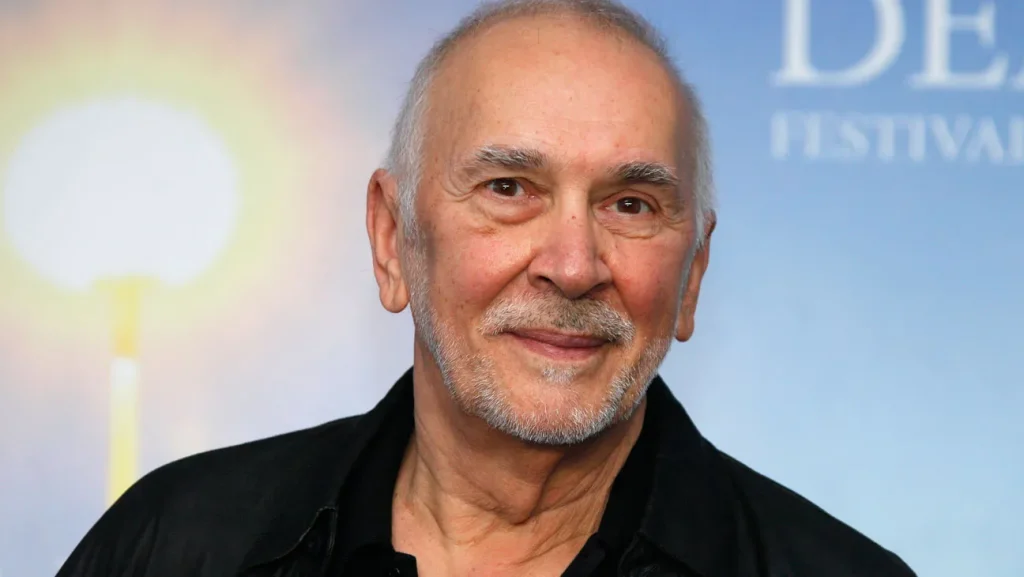
Frank A. Langella Jr. was born on January 1, 1938, in Bayonne, New Jersey, to Angelina Barbato and Frank Langella Sr., an Italian American business executive who served as president of the Bayonne Barrel and Drum Company. The company manufactured barrels. The father ran it. Subsequently, the son wanted nothing to do with barrels, containers, or any profession in which the product aimed to hold something rather than to express it.
Nevertheless, he attended Washington Elementary School and Bayonne High School before his family moved to South Orange, where he graduated from Columbia High School in 1955. By contrast, in 1959, he earned a Bachelor of Arts in drama from Syracuse University. In particular, the degree cost four years and whatever tuition Syracuse charged in the late 1950s. Specifically, the career it enabled has lasted sixty-six years and produced four Tony Awards, an Academy Award nomination, six Drama Desk Awards, induction into the American Theatre Hall of Fame, and a net worth of $5 million. Meanwhile, the gap between the honors and the fortune is not a miscalculation. It is the cost of choosing the stage.
The Turning Point
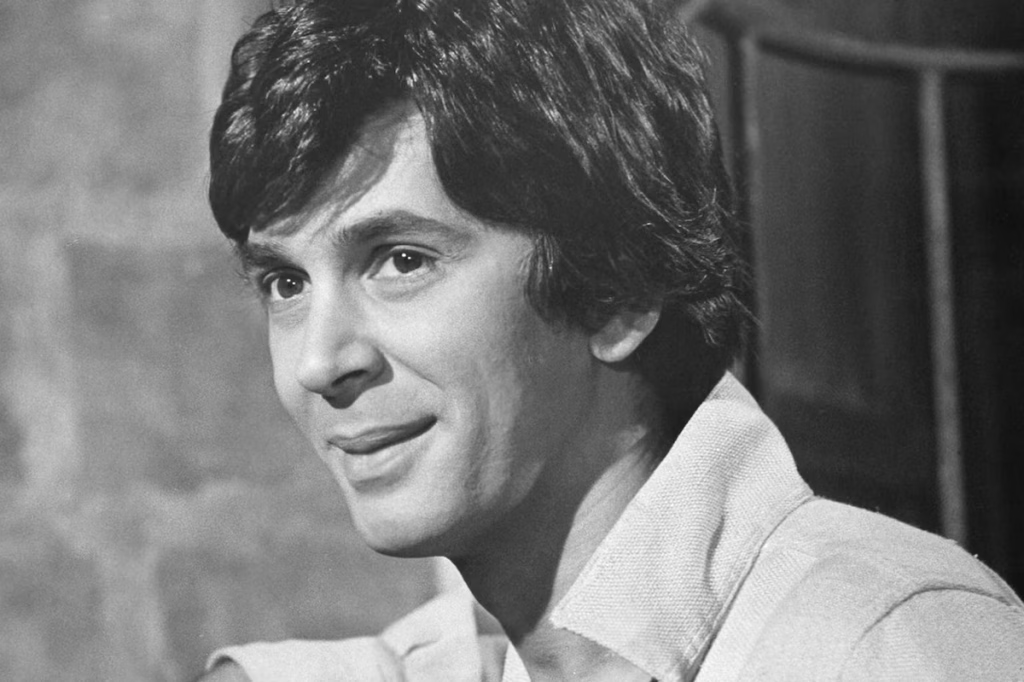
As a result, langella made his off-Broadway debut in The Immoralist (1963-1964) and his Broadway debut in Yerma (1966). Similarly, anne Bancroft, who saw him perform, recommended him to her husband Mel Brooks, who cast him in a leading role in The Twelve Chairs (1970). Despite this, the same year, he appeared in Frank Perry’s Diary of a Mad Housewife and received a Golden Globe nomination for Most Promising Newcomer. He was thirty-two years old. Hollywood was offering.
He could have accepted. In turn, the trajectory from Golden Globe nomination to leading-man salary to franchise consideration to the kind of wealth that his contemporaries — Pacino, De Niro, Nicholson — would eventually accumulate was available to him. He turned toward the stage instead. Not because he could not do film. Because the stage was where the work lived, and the work was what he wanted, and the money was what he was willing to forfeit in exchange.
The Pivot Moment: Dracula, Laurence Olivier, and the Performance That Redefined a Monster
Regardless, in 1977, Langella landed the role as Count Dracula in the Broadway revival of Bram Stoker’s novel, staged with sets designed by Edward Gorey. Still, the production should have been a curiosity — a horror character performed on a theatrical stage, a genre exercise dressed in Gorey’s ornate Gothic illustrations. Langella made it something else entirely. His Dracula was not a monster. Even so, he was a seducer — elegant, erotic, and possessed of a charisma so thorough that the audience rooted for the vampire over the heroes. The performance earned a Tony nomination and ran for two years. When Universal adapted the production for a 1979 film directed by John Badham, Langella reprised the role opposite Laurence Olivier, who played Van Helsing. The casting placed a thirty-nine-year-old American stage actor opposite the greatest British actor of the twentieth century. Langella held the frame.
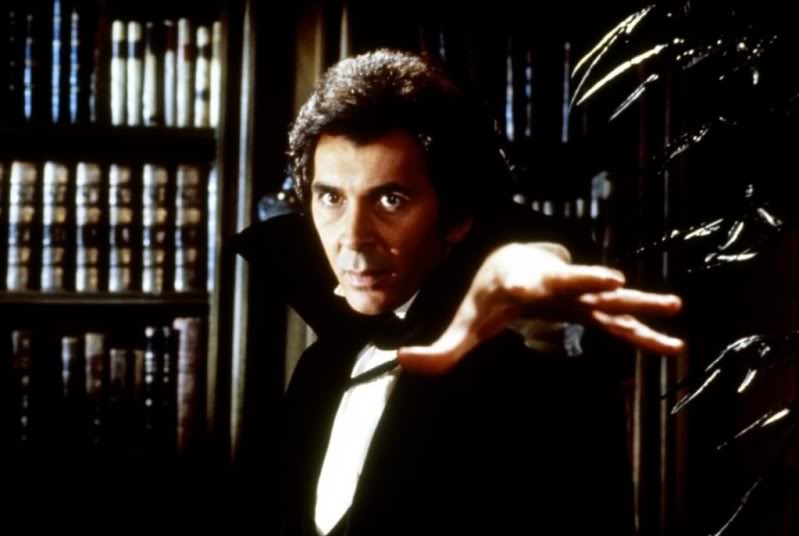
The Dracula role is the pivot because it established the principle that would govern every subsequent decade of Langella’s career: play the figure of authority — king, president, count, villain, patriarch — and invest the authority with enough humanity that the audience cannot dismiss the character as merely powerful. They must reckon with the person inside the power. The method produced Skeletor in Masters of the Universe (1987), a role Langella has called one of his favorites — a children’s film villain played with the seriousness of Lear.
Notably, it produced the devious Bajoran minister Jaro Essa in Star Trek: Deep Space Nine (1993). It produced the fictional president’s chief of staff in Dave (1993). And it produced, twenty-nine years after Dracula, the performance that would earn him the Academy Award nomination and confirm that six decades of stage work had not diminished his capacity for the screen — it had refined it.
The Climb: Nixon, Zabel, and the Art of Playing Men Who Lose Everything
In 2007, Peter Morgan cast Langella as Richard Nixon in Frost/Nixon — a play about the 1977 television interviews in which British journalist David Frost extracted a near-confession from the disgraced president. The production opened at London’s Donmar Warehouse, transferred to the Gielgud Theatre, then moved to Broadway’s Bernard B. Jacobs Theater. Langella won his third Tony Award. Ron Howard directed the 2008 film adaptation. Langella reprised the role and received nominations for the Academy Award, the Golden Globe, the BAFTA, and the Screen Actors Guild Award for Best Actor. He lost the Oscar to Sean Penn for Milk — the same film for which Josh Brolin received his own Best Supporting Actor nomination. The Wall Street cinema canon’s actors were competing against each other for the same prizes in the same year without yet knowing they would share the same fictional universe two years later.
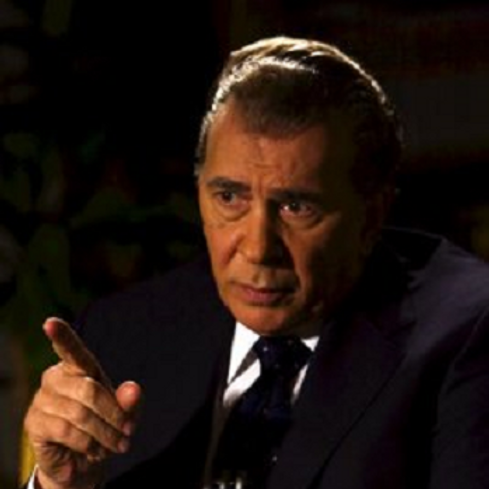
Langella’s Nixon is the performance that explains Louis Zabel. In Frost/Nixon, he plays a president who has lost everything — office, reputation, legacy — and is fighting to salvage a version of the narrative that allows him to retain some dignity. In Wall Street: Money Never Sleeps (2010), he plays the managing director of Keller Zabel Investments — a composite of Bear Stearns and Lehman Brothers — who watches his firm’s stock price collapse from $75 to $3 in a week, is humiliated at the Federal Reserve when Josh Brolin’s Bretton James offers a predatory buyout, and kills himself the following morning. The suicide is the film’s most emotionally effective sequence.
Behind the Numbers
In fact, langella plays Zabel’s final hours with the restrained grief of a man who has understood, overnight, that the institution he spent his life building has been destroyed by forces he could not control and competitors he could not trust. The mentor walks into the subway. The train arrives. Shia LaBeouf’s Jake Moore learns about it from a news alert.
The performance lasts approximately twenty minutes of screen time. It is the emotional foundation on which the entire film rests. Every subsequent plot point — Jake’s desire for revenge, his alliance with Gekko, the betrayal, the reconciliation — proceeds from Zabel’s death. Langella gives the film its gravity. Without his twenty minutes, the remaining two hours float.
The Success Formula: Why the Stage Produces Mastery and Film Produces Wealth, and Why You Cannot Have Both
Frank Langella’s career is the empirical proof of a proposition that the entertainment industry understands but refuses to state publicly: stage acting and financial wealth are inversely correlated. Broadway’s highest-paid performers earn between $50,000 and $150,000 per week for limited-run productions. A twenty-week run at the upper end produces $3 million before taxes, agent fees, and management commissions. A film actor of equivalent stature earns $3 million for a few weeks of work. Indeed, a franchise actor earns $20 million. The stage actor works harder, performs live without retakes eight times per week, and earns less per hour than many of the people watching from the orchestra section.
Langella chose the stage anyway. Four Tony Awards: Seascape (1975), Fortune’s Fool (2002), Frost/Nixon (2007), The Father (2016). Six Tony nominations total. Six Drama Desk Awards. Two Obie Awards. Four Outer Critics Circle Awards. Induction into the American Theatre Hall of Fame in 2002. He replaced Ian McKellen as Salieri in the Broadway production of Amadeus (1982). He played Cyrano de Bergerac, King Lear, Prospero, Sir Thomas More in A Man for All Seasons, and André — an elderly man losing himself to Alzheimer’s — in Florian Zeller’s The Father, which won him his fourth Tony at age seventy-eight. The range is absurd. The consistency is inhuman. And the cumulative financial reward for all of it — sixty-six years, more than a hundred credits, the most decorated stage career of his generation — is $5 million.
What the Record Shows
The $5 million is not evidence of failure. It is evidence of a different accounting system. Stage actors accumulate in a currency that does not convert to dollars: the respect of their peers, the institutional memory of their performances, and the knowledge that what they did on a given Tuesday night at the Jacobs Theatre existed in the room and then was gone, unrepeatable, preserved only in the memory of the audience and the muscle memory of the performer. Film accumulates forever. A performance captured on screen generates residuals, syndication payments, streaming fees, and merchandise licensing in perpetuity. A stage performance generates the ticket price and nothing else. Langella chose the ticket price. He chose it at twenty-eight and he is still choosing it at eighty-eight.
What He Built: The Americans, Robot and Frank, and a Memoir That Named Every Name
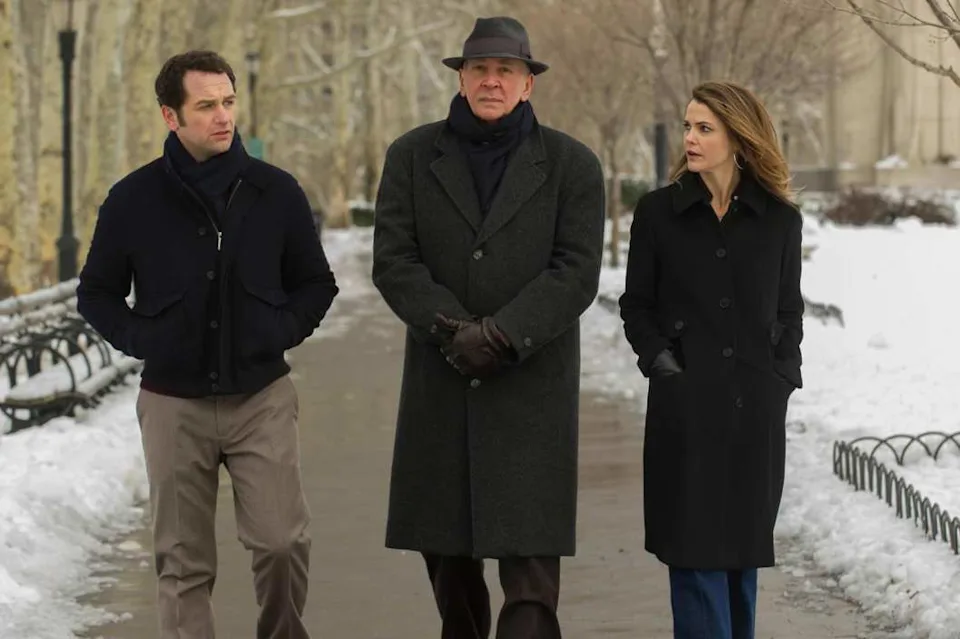
Langella’s late-career television work on The Americans (2015-2017) — in which he played Gabriel, the KGB handler responsible for managing the emotional welfare of Matthew Rhys and Keri Russell’s Soviet spies embedded in Reagan-era Washington — demonstrated that his stage-trained capacity for sustained character work translates to serialized television with a precision that most film actors cannot replicate. Gabriel is a man whose professional obligation is deception and whose personal instinct is care. He lies to the people he loves because the system requires it. The role is a variation on Louis Zabel: a patriarch inside a system he serves but cannot control, whose authority is real and whose power is borrowed.
Robot and Frank (2012) gave Langella what may be his most surprising performance: an aging jewel thief with early-stage dementia who is given a robot companion by his concerned children and proceeds to use the robot as an accomplice in a series of heists. The film required Langella to play comedy, pathos, and cognitive decline simultaneously — a calibration so precise that most actors would choose one register and perform the others as modulation. Langella played all three as equal, because that is what dementia looks like from inside: the person is funny, sad, and losing themselves at the same time, and none of those conditions takes precedence over the others. The performance was overlooked by the Academy. It was not overlooked by anyone who watched it.
The Deeper Story
In 2012, Langella published Dropped Names: Famous Men and Women As I Knew Them — a memoir that did exactly what the title promised: named the famous people he had known across six decades and described them with the candor of a man who understood that at seventy-four, the statute of limitations on discretion had expired. The book earned praise and criticized in equal measure, which is the correct response to a memoir that treats the famous as human.
The Soft Landing: $5 Million, Four Tonys, and the Proof That Some Things Cannot Be Bought
Frank Langella’s net worth stands at approximately at $5 million. It is the smallest fortune in the entire Wall Street cinema canon — smaller than Carey Mulligan’s $16 million, smaller than Charlie Sheen’s post-destruction $1 million peak-adjusted, smaller than every other actor in a cluster that spans thirty-four pieces and $85,000 words about the relationship between talent and money. The $5 million is the final data point in an empire built on the question of what wealth means, what it costs, and whether the cost is worth the acquisition.
Langella’s answer is the most radical in the canon: wealth is irrelevant. Not because money doesn’t matter — it does, and $5 million is not nothing — but because the career he built was never denominated in dollars. It was denominated in Tonys, in the quality of the silence after a final curtain falls, in the knowledge that he played Nixon so convincingly that the Academy nominated him, played Dracula so seductively that he redefined the character for a generation, played Zabel’s final subway ride so quietly that a $134 million film depends entirely on twenty minutes of his screen time, and played an Alzheimer’s patient so truthfully that the Tony committee honored him for the fourth time at seventy-eight.
The Deeper Story
The barrel company president’s son from Bayonne chose a career that Wall Street would have dismissed as irrational. Moreover, the expected return on sixty-six years of stage work is approximately $5 million. Ultimately, the expected return on sixty-six years of anything else is considerably more. Langella took the lower return. He took it because the work itself was the return, and because four Tony Awards and an Oscar nomination and the American Theatre Hall of Fame and the performances that live only in the memory of the people who were in the room when they happened constitute a form of wealth that no hedge fund can replicate, no derivative can insure, and no bankruptcy can destroy. Louis Zabel walked into the subway because his fortune was gone. Frank Langella’s fortune was never the kind that could be taken. It lives in the room. It always has.
Related: Wall Street: Money Never Sleeps True Story · Michael Douglas Net Worth: The $350 Million Gekko Fortune · Shia LaBeouf Net Worth · Josh Brolin Net Worth · Carey Mulligan Net Worth · The Wall Street Movies That Rewired How America Thinks About Money
If you’ve ever understood that some forms of wealth exist only in the room where they happen — and that covering those moments is worth more than covering the transaction — then you know why Social Life Magazine exists. We cover what the room remembers. Reach out to our editorial team to be featured.
Want to position your brand where mastery is the metric? Submit a Paid Feature and let our editors build something worth reading.
Why It Matters
Join 82,000+ subscribers who get our take on luxury, culture, and the Hamptons scene before anyone else. Subscribe to our email list.
Experience the intersection of sport, style, and status at Polo Hamptons — Bridgehampton’s premier luxury polo event, now in its seventh year with BMW as title sponsor.
Never miss a print issue. Subscribe to Social Life Magazine and get five summer issues delivered from Memorial Day to Labor Day.
Love what we do? Support Social Life Magazine and help us keep covering the culture that matters.
Author

Written by
Recent Posts

The First Decision After a Collision Can Be the Most Important One
Two Weeks in Rome and Beyond: Turkish Airlines Itineraries from Boston, Chicago and Onward to India

Top 10 Hair Transplant Clinics in Turkey 2026

Artist Alley to Online Store: How Convention Artists Can Keep Selling After the Event
When an 18-Wheeler Crash Leaves Lasting Consequences
Categories
- Art
- Articles
- Business of Luxury
- Celebrities
- Culture
- Entertainment
- Events
- Faces of Summer 2026
- Fashion
- Fashion & Style
- Featured
- Finance
- Food, Spirits, Wine
- Hamptons
- Hamptons Celebrities
- Health
- Health & Beauty
- Lifestyle
- Luxury Lifestyle
- Press
- Profiles
- Real Estate
- Technology
- The Chronicles
- Travel
- Uncategorized
- Weddings