
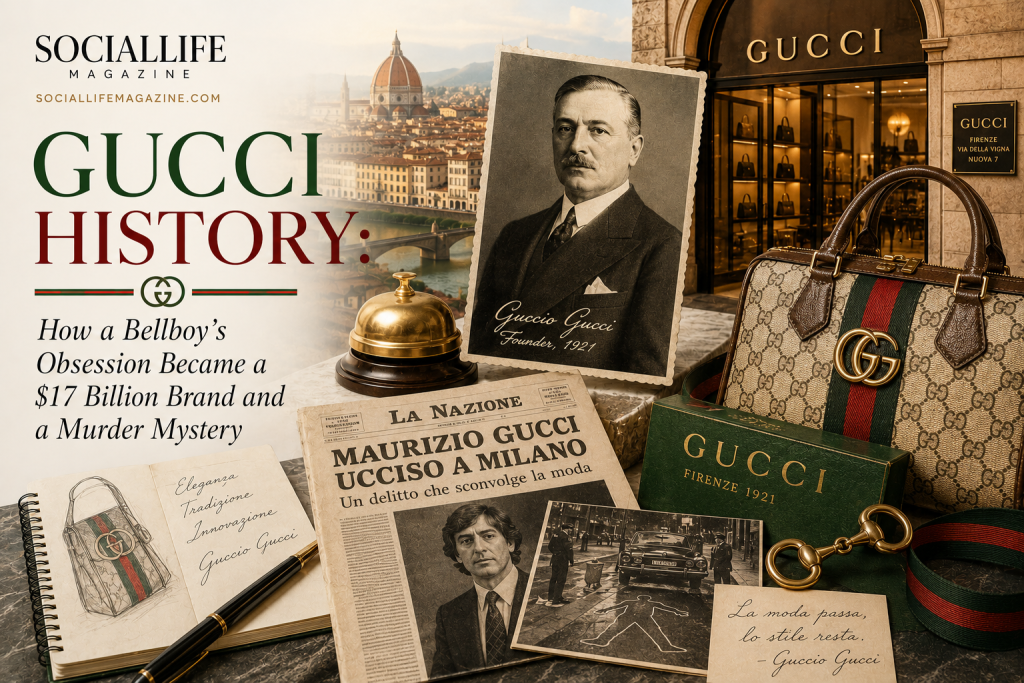
In 1921, a Florentine leather goods shop opened on Via della Vigna Nuova with exactly zero indication it would become a $7.65 billion empire, survive a family murder, and cycle through creative directors the way lesser brands cycle through interns. Gucci history reads less like a corporate timeline and more like a season of prestige television where every character has motive and nobody gets a clean exit.
Guccio Gucci spent his twenties as a bellboy at London’s Savoy Hotel. Not exactly the origin story fashion publicists prefer. But those years watching British aristocrats handle their luggage with more care than they handled their marriages gave him something no design school could: a fluent understanding of what wealth wants to carry. He returned to Florence and opened a shop selling leather bags that borrowed the sensibility of English riding culture and dressed it in Tuscan craftsmanship.
From Florence to Fifth Avenue
Guccio built the business on three product categories: luggage, handbags, and small leather goods. Each piece featured the signature red and green webbing inspired by horse saddle girths, a nod to the equestrian culture that Tuscan aristocrats treated as a personality trait rather than a hobby. By the 1930s, the workshop on Via della Vigna Nuova had expanded into a proper retail operation with a reputation that traveled faster than the tourists who bought the products.
By the 1950s, Gucci had become the label that separated old money tourists from new money tourists on the Via Condotti. Grace Kelly carried a Gucci bag. Jackie Kennedy carried a different one. Both purchases functioned less as fashion choices and more as membership applications to a club with no written rules but very strict enforcement.
The Bamboo Handle Bag
Introduced in 1947 because wartime restrictions limited traditional materials, the bamboo handle bag became the first accidental icon in Italian fashion house history. Japanese bamboo replaced the unavailable leather and rattan. Artisans flame-heated each piece to create the curved handle, a process so labor-intensive that it turned a supply chain problem into a luxury differentiator. Constraint produced innovation, which is the sentence every design professor wishes their students would internalize before spending $200,000 on an MFA.
Aldo Gucci, Guccio’s eldest son, understood something his father never fully grasped: American money was louder, faster, and fundamentally less patient than European money. He opened the first U.S. store on East 58th Street in Manhattan in 1953 and introduced the interlocking GG logo in honor of his father’s initials. Within a decade, Gucci had become the brand that Hollywood’s A-list wore to signal they understood quality without needing to explain it.
Elizabeth Taylor, Audrey Hepburn, Peter Sellers. Each celebrity sighting compounded the brand’s symbolic capital in ways that no advertising budget could replicate. When Jackie Kennedy was photographed carrying a shoulder bag so frequently that Gucci renamed it the Jackie 1961, the brand crossed from fashion into mythology. A single first lady turned a handbag into a cultural artifact worth more than its leather.
The Family War That Almost Killed the Brand
Every dynasty contains the seeds of its own destruction. For the Guccis, those seeds sprouted in the 1970s when the family split into factions that made the Medicis look like a functional household. Aldo fought with his brother Rodolfo over expansion strategy and profit distribution. Rodolfo’s son Maurizio fought with everyone, including cousins who held minority stakes and opinions about how to run a luxury brand without having done anything to build it. Tax fraud charges landed Aldo in a Florida federal prison for a year. Lawsuits multiplied like accessories in a spring collection.
Maurizio Gucci eventually gained full control of the company in 1983 through a combination of legal maneuvering and the kind of familial betrayal that requires a good therapist and a better lawyer. He spent lavishly on renovations of the brand’s image, hiring Dawn Mello from Bergdorf Goodman to reposition Gucci as a serious fashion house rather than a logo-slathered tourist trap. Financially, the strategy was catastrophic. Artistically, it planted the seeds for everything that came next.
Investcorp, the Bahrain-based investment group, bought Maurizio’s remaining stake in 1993 for $170 million. Two years later, Maurizio was shot dead on the steps of his Milan office. His ex-wife, Patrizia Reggiani, ordered the hit. She served 18 years in prison and upon release reportedly said she would have preferred to use a gun herself but her arthritis made it impractical. That line alone belongs in the history of fashion as its most chilling footnote.
Tom Ford and the Resurrection
When Tom Ford became creative director in 1994, Gucci was a brand with legendary name recognition and near-fatal business metrics. Revenue had cratered. Product quality had diluted. Licensing deals had scattered the double-G logo across everything from cigarette lighters to toilet seat covers, which is not a metaphor but an actual product that existed.
Ford understood that Gucci history needed a hard edit, not a gentle revision. He stripped the product line from 22,000 SKUs to fewer than 7,000. Killed the licensing deals that had cheapened the brand into airport gift shop territory. Introduced a hyper-sexualized advertising aesthetic shot by Mario Testino that positioned Gucci as the brand for people who considered subtlety a form of cowardice. The velvet hipster suit from his 1995 collection became the decade’s defining menswear moment. Revenue went from $230 million in 1994 to $3 billion by 2003. In the architecture of Tom Ford’s career, Gucci was not a chapter but the entire foundation.
Alongside CEO Domenico De Sole, Ford turned Gucci Group into an acquisition machine. They bought Yves Saint Laurent, Balenciaga, Bottega Veneta, and Alexander McQueen. PPR (now Kering) acquired controlling interest in 1999 after a legendary boardroom battle with LVMH’s Bernard Arnault that involved poison pills, white knights, and the kind of corporate warfare that makes the fashion industry’s petty feuds over hemline lengths feel appropriately trivial.
The Post-Ford Identity Crisis
Ford and De Sole departed in 2004 after failing to negotiate creative independence from PPR. Their exit felt like the season finale of a show that peaked too early. What followed was a period of competent but uninspiring creative direction. Frida Giannini held the reins from 2006 to 2014, producing collections that sold well enough but never generated the cultural electricity that Ford’s era had made standard. She leaned into the heritage motifs, the horse bits and bamboo handles, as talismans against irrelevance. Gucci had become profitable but predictable, which in luxury fashion is a more dangerous condition than being broke and brilliant.
Alessandro Michele changed that equation overnight. Appointed by then-CEO Marco Bizzarri after a design team presentation that reportedly lasted 30 minutes, Michele debuted in January 2015 with a collection that replaced Ford’s minimalist sex appeal with maximalist gender fluidity, baroque embroidery, and a wholesale rejection of everything the brand had represented for the previous twenty years. Models carried severed head replicas of themselves down the runway. Floral suits showed up on Harry Styles, Jared Leto, and A$AP Rocky within weeks. Revenue doubled to $10 billion by 2019. Michele proved that Gucci’s cultural capital could be rebuilt from scratch every generation, provided the architect was willing to demolish everything the previous one constructed.
The Demna Gambit and Gucci’s Current Bet
Michele departed in November 2022 as sales growth decelerated. Sabato De Sarno arrived, stayed briefly, and left in 2025 after failing to reverse the revenue slide. Kering’s stock price dropped 40% from its 2021 peak. Chairman Francois-Henri Pinault needed a provocation, not a placeholder.
He hired Demna Gvasalia, the Balenciaga creative director famous for selling trash bag purses at $1,790 and platform Crocs at $850. Appointing Demna to lead Gucci represents the most aggressive creative bet in modern luxury. It signals that Kering has decided irony, subversion, and cultural commentary will drive the next era of Gucci history more reliably than pretty clothes ever could.
The financial stakes could not be higher. Gucci accounts for roughly 50% of Kering’s total revenue. A failed creative transition does not just damage one brand; it threatens the entire conglomerate’s market position against LVMH and Richemont. Pinault is betting the house, almost literally, on the idea that a designer who made ironic fashion into a $1 billion business at Balenciaga can scale that sensibility to Gucci’s $10 billion ambitions.
Whether this works depends on a question that has haunted every luxury conglomerate since Tom Ford proved it could be done: can a creative director’s vision scale to $10 billion without becoming the very thing it set out to critique? Every successor since Ford has answered that question differently. None has answered it permanently.
What Gucci History Reveals About Fashion Power
Strip away the murder, the family feuds, and the creative director carousel, and Gucci’s arc illustrates something fundamental about luxury empires. Brand value compounds through scarcity, mythology, and the careful management of who gets access. Product quality matters, but it matters less than the story wrapped around the product. A bamboo handle bag from 1947 is a nice handbag. That same bag, photographed in Grace Kelly’s hand by paparazzi, becomes a $35,000 artifact of cultural capital.
Across the broader Italian fashion empire landscape, Gucci’s trajectory parallels Prada’s intellectual minimalism and inverts it. Where Miuccia Prada built her brand on quiet subversion, Gucci built on loud reinvention. Both strategies work. Neither works forever. Every generation of luxury consumers demands a new story, and the houses that survive are the ones willing to let the old story die.
For the Hamptons Set
Gucci occupies a specific position in the social hierarchy. A Gucci bag on Main Street in East Hampton signals awareness of fashion’s current conversation without the try-hard energy of wearing something no one recognizes. It is the luxury equivalent of ordering a negroni: sophisticated enough to register, familiar enough to feel effortless. The Gucci East Hampton boutique on Newtown Lane has become a mandatory stop on the summer shopping circuit, sandwiched between Tiffany and Ralph Lauren in a retail corridor that functions as a runway for social capital.
Understanding Gucci history matters because it reveals the mechanics of how fashion brands manufacture desire across generations. A bellboy watched aristocrats. An empire rose. The family destroyed itself. A Texan rebuilt the ruins. Then a maximalist redefined the aesthetic. Now a Georgian provocateur will attempt it again. Each chapter follows the same logic: cultural capital compounds until it doesn’t, then someone burns the old playbook and writes a new one. That pattern is not unique to Gucci. But no brand has performed it with more drama, more frequency, or more spectacular collateral damage along the way.
Where The Conversation Continues
Connect With Social Life
Social Life Magazine has covered the intersection of luxury fashion, power, and the Hamptons for over two decades. Our five summer issues, distributed from Memorial Day through Labor Day across the East End, reach 25,000 readers who define the season’s cultural conversation. From Westhampton to Montauk, this is the publication that brands trust when the audience matters more than the impression count.
We deliver an additional 15,000 copies to Upper East Side doorman buildings during fall and winter, extending the Hamptons conversation into Manhattan’s most exclusive residential addresses. Our 82,000 email subscribers receive curated editorial that blends fashion authority with Hamptons insider access.
Polo Hamptons, our signature sporting and lifestyle event in Bridgehampton, brings together the brands and personalities that shape luxury culture. Christie Brinkley hosts. Getty and McMullan photograph. The corporate cabana and sponsor activations create direct engagement with an audience that treats attendance as a social credential.
The Social Life Guest House in Sag Harbor offers select brands the opportunity to integrate into our editorial through experiential activations. It is a restored residence designed for content creation, product placement, and the kind of organic media coverage that feels editorial because it is.
Whether you are a luxury brand seeking Hamptons credibility, a wellness company building prestige positioning, or a financial services firm targeting high-net-worth audiences, Social Life Magazine offers a platform that combines print authority, digital reach, and experiential access in one integrated partnership.
Contact Cass Almendral, Head of Business Development, at [email protected] to discuss editorial features, event sponsorships, and brand activations for the 2026 season.
For Polo Hamptons corporate cabana inquiries, reach Justin Mitchell at [email protected].
Author

Written by
Recent Posts

The First Decision After a Collision Can Be the Most Important One
Two Weeks in Rome and Beyond: Turkish Airlines Itineraries from Boston, Chicago and Onward to India

Top 10 Hair Transplant Clinics in Turkey 2026
Artist Alley to Online Store: How Convention Artists Can Keep Selling After the Event
When an 18-Wheeler Crash Leaves Lasting Consequences
Categories
- Art
- Articles
- Business of Luxury
- Celebrities
- Culture
- Entertainment
- Events
- Faces of Summer 2026
- Fashion
- Fashion & Style
- Featured
- Finance
- Food, Spirits, Wine
- Hamptons
- Hamptons Celebrities
- Health
- Health & Beauty
- Lifestyle
- Luxury Lifestyle
- Press
- Profiles
- Real Estate
- Technology
- The Chronicles
- Travel
- Uncategorized
- Weddings