
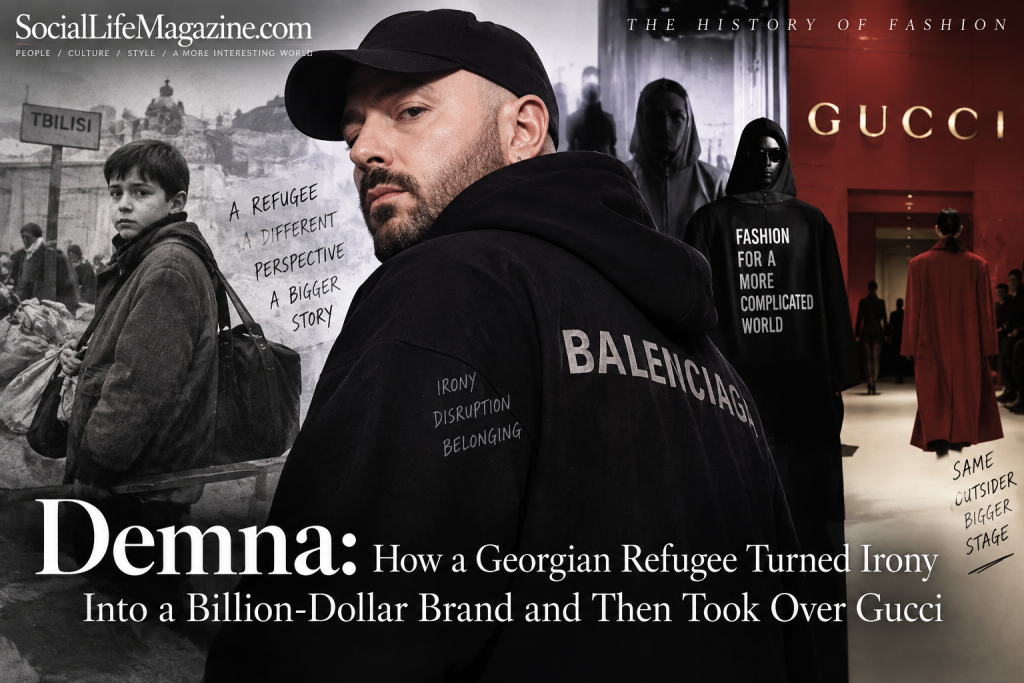
Demna Gvasalia sold a trash bag for $1,790 and a destroyed sneaker for $1,850, and both items sold out. Then he was hired to run Gucci, the most valuable single brand in the Kering portfolio. Demna’s fashion career is the most deliberately provocative trajectory in modern luxury: a Georgian refugee who turned irony into a billion-dollar business at Balenciaga and now faces the question of whether that irony can scale to Gucci’s $10 billion ambitions without collapsing into self-parody.
Born Demna Gvasalia in Sukhumi, Georgia, in 1981, he grew up during the Georgian Civil War. His family fled the conflict in Abkhazia when he was twelve, an experience of displacement and loss that he has described as foundational to his worldview. Refugees carry what they can. They wear what they have. The aesthetics of survival, oversized coats, layered clothing, plastic bags repurposed as containers, became the visual grammar that Demna would later translate into collections priced for people who have never survived anything more threatening than a cancelled reservation at Nobu.
Vetements and the Disruption Template
Before Balenciaga, Demna co-founded Vetements in 2014 with his brother Guram. The label operated on a principle of radical ordinariness: DHL delivery uniforms reimagined as fashion, Champion hoodies deconstructed and reassembled at couture prices, oversized silhouettes that made every wearer look like they were wearing someone else’s clothes. Vetements generated enormous cultural heat and relatively modest revenue (estimated at $100 million at peak). The brand functioned less as a commercial enterprise and more as a thesis statement about what fashion could mean in a post-everything era.
Fashion critics divided sharply. Traditional designers dismissed Vetements as trolling. Younger editors embraced it as the most honest commentary on luxury consumption since Rei Kawakubo’s Comme des Garcons in the 1980s. Both readings were probably correct simultaneously, which was exactly Demna’s point. Irony and sincerity occupied the same garment. You could wear a $1,200 Champion hoodie as a joke or as a genuine expression of taste, and neither interpretation was more valid than the other.
Balenciaga: Irony at Industrial Scale
Kering appointed Demna as creative director of Balenciaga in 2015, the year Vetements was still fashion’s hottest conversation. The appointment placed Demna in direct succession to Cristobal Balenciaga, the founder whom Christian Dior called “the master of us all.” Taking that legacy and applying the Vetements sensibility to it was either cultural vandalism or the most audacious creative bet in French fashion since Tom Ford walked into Gucci.
Revenue told the story. Under Demna, Balenciaga grew from approximately $400 million to over $1.7 billion by 2022. The Triple S sneaker (a chunky, intentionally ugly shoe priced at $895) launched the “dad shoe” trend that dominated streetwear for three years. The Hourglass bag, the City bag, and the Le Cagole motorcycle bag each generated hundreds of millions in revenue. Balenciaga became Kering’s third-largest brand behind Gucci and Saint Laurent, a position nobody anticipated when Demna was hired.
His runway shows became cultural events that transcended fashion. Spring 2022 was staged as a red carpet event where models walked through artificial paparazzi. Fall 2022 was held in a mud pit, with models trudging through shin-deep sludge in couture gowns. Each show generated more social media conversation than most competing brands’ entire seasons combined. The strategy was confrontation as marketing: make the audience uncomfortable enough to talk about it, and the talking does the advertising.
The BDSM Campaign Crisis
In November 2022, Balenciaga released two advertising campaigns that triggered the worst brand crisis in luxury fashion’s modern history. One featured children holding teddy bears dressed in BDSM-style harnesses. Another included a document referencing a Supreme Court case about child exploitation, partially visible on a desk in the background. The backlash was immediate, universal, and commercially devastating. Celebrity ambassadors (including Kim Kardashian) distanced themselves. Revenue dropped an estimated 30% in the following quarter.
Demna issued a personal apology. Balenciaga sued the production company. Kering pledged internal reforms. The crisis tested whether irony as brand strategy could survive a moment when the irony went wrong. Demna’s previous provocations (the trash bag, the destroyed sneakers, the IKEA bag knockoff) had operated in a register where the joke was on luxury consumption itself. The BDSM campaign crossed a line where the provocation involved children, and no amount of artistic framing could make that acceptable.
Balenciaga’s recovery has been slow but measurable. Revenue stabilized in 2024. Demna’s collections following the crisis have been more restrained aesthetically while maintaining the conceptual ambition. The question of whether the brand permanently lost trust with a segment of its consumer base remains open.
Gucci: The Biggest Bet in Luxury
In 2025, Kering appointed Demna as creative director of Gucci, replacing Sabato De Sarno after less than two years. The move stunned the industry. Gucci accounts for roughly half of Kering’s total revenue. Handing it to a designer whose most famous products include a trash bag purse and whose most recent controversy involved children in BDSM imagery was either visionary or reckless, with no middle ground available for interpretation.
Francois-Henri Pinault’s logic appears to be that Gucci’s problem is not quality or distribution but cultural relevance. Under Alessandro Michele, Gucci had it in abundance. Under De Sarno, it evaporated. Demna’s proven ability to generate conversation, controversy, and consumer desire simultaneously is precisely what Gucci needs. The risk is that Demna’s irony, which worked brilliantly at Balenciaga’s $1.7 billion scale, may not translate to Gucci’s $10 billion expectations. Irony requires an audience sophisticated enough to be in on the joke. At $10 billion, the audience includes people who are not in on anything.
What Demna Reveals About Fashion’s Attention Economy
Among the designers reshaping the Italian and French luxury corridors, Demna’s fashion career represents the most radical proposition: that provocation is not a marketing tactic but a design language. Every trash bag, every destroyed sneaker, every mud-pit runway is an argument about what luxury means when traditional luxury codes (craftsmanship, heritage, exclusivity) have been replicated by fast fashion and diluted by democratized access. If everyone can buy a monogram bag, the monogram stops signaling anything. Demna’s answer is to signal through discomfort, through objects so deliberately ugly or confrontational that wearing them requires the same confidence that carrying a Bottega Veneta requires through understatement.
For the Hamptons social circuit, Demna’s influence is visible in the fashion choices that provoke double-takes rather than approving nods. A Balenciaga oversized hoodie at a Southampton benefit is not an outfit. It is a position paper on what luxury means when everyone at the party can afford the same things. Whether Demna can bring that energy to Gucci without alienating the Newtown Lane customer who wants a GG belt, not a philosophical argument, is the most expensive open question in fashion right now.
Where The Conversation Continues
Connect With Social Life
Social Life Magazine has covered the intersection of luxury fashion, power, and the Hamptons for over two decades. Our five summer issues, distributed from Memorial Day through Labor Day across the East End, reach 25,000 readers who define the season’s cultural conversation. From Westhampton to Montauk, this is the publication that brands trust when the audience matters more than the impression count.
We deliver an additional 15,000 copies to Upper East Side doorman buildings during fall and winter, extending the Hamptons conversation into Manhattan’s most exclusive residential addresses. Our 82,000 email subscribers receive curated editorial that blends fashion authority with Hamptons insider access.
Polo Hamptons, our signature sporting and lifestyle event in Bridgehampton, brings together the brands and personalities that shape luxury culture. Christie Brinkley hosts. Getty and McMullan photograph. The corporate cabana and sponsor activations create direct engagement with an audience that treats attendance as a social credential.
The Social Life Guest House in Sag Harbor offers select brands the opportunity to integrate into our editorial through experiential activations. It is a restored residence designed for content creation, product placement, and the kind of organic media coverage that feels editorial because it is.
Whether you are a luxury brand seeking Hamptons credibility, a wellness company building prestige positioning, or a financial services firm targeting high-net-worth audiences, Social Life Magazine offers a platform that combines print authority, digital reach, and experiential access in one integrated partnership.
Contact Cass Almendral, Head of Business Development, at [email protected] to discuss editorial features, event sponsorships, and brand activations for the 2026 season.
For Polo Hamptons corporate cabana inquiries, reach Justin Mitchell at [email protected].
Author

Written by
Recent Posts
The Skincare Habits That Make a Real Difference Over Time
Hamptons-Ready Beauty: Polished Makeup for Long Summer Days
Is Now a Good Time to Sell a Home in NJ?

The Hidden Work Behind a Seamless Hotel Weekend
Choosing Scratching Furniture for a British Shorthair
Categories
- Art
- Articles
- Business of Luxury
- Celebrities
- Culture
- Entertainment
- Events
- Faces of Summer 2026
- Fashion
- Fashion & Style
- Featured
- Finance
- Food, Spirits, Wine
- Hamptons
- Hamptons Celebrities
- Health
- Health & Beauty
- Lifestyle
- Luxury Lifestyle
- Press
- Profiles
- Real Estate
- Technology
- The Chronicles
- Travel
- Uncategorized
- Weddings