
The Street That Divides Everything
Division Street is named with a literalness that most streets avoid. However, it is the boundary line between East Hampton and Southampton, two towns whose jurisdictions overlap in Sag Harbor Village, the way old money and new money overlap at a benefit dinner: technically sharing the same space. However, functionally operates under different assumptions about what that space means.
During the 1840s whaling boom, Division Street was the social fault line. In addition, wealthy East Hampton residents regarded the Southampton side. . As a result, there, bars and rougher establishments served sailors who slept in gutters and carried the particular smell of rendered whale blubber in their clothing. In addition, with the specific contempt that respectable people reserve for the labor that finances their respectability. As a result, for instance, the sailors needed bars because the sea had broken something in them that only alcohol could temporarily set. Meanwhile. The bars needed to be on Division Street because Division Street was where the line between propriety and need was thin enough to cross after dark.
Herman Melville knew this street. Similarly, he referenced Sag Harbor in Moby-Dick and understood, with the clarity of a writer who had been a sailor himself. Meanwhile, the bars of a whaling village were not recreational institutions but therapeutic ones. In contrast, the men who drank on Division Street were not choosing leisure. Consequently, they were processing the specific trauma of having spent months on the ocean killing animals the size of buildings. . Meanwhile, the ocean tried to kill them back.
Murf’S Backstreet Tavern Sits At 64
Murf’s Backstreet Tavern sits at 64 Division Street because that is exactly where a bar belongs. Furthermore, not on Main Street, where the restaurants serve cultural capital alongside the wine list. Furthermore, the social physics require you to perform a version of yourself that you’ve been rehearsing since the Jitney crossed the Shinnecock Canal. In particular, on Division Street, the building was constructed in 1792 with timbers allegedly salvaged from a whaling ship. In particular, here, the architecture predates the Louisiana Purchase and the War of 1812. By contrast, the peak of Sag Harbor’s whaling industry by half a century. By contrast. Where the only social contract in effect is the one that says: you drink what you order. In fact, you play the ring game if you want. Essentially, nobody asks what you do for a living.
The Founder: From Harlem Beat Cop to Sag Harbor Barkeep
Tom Murphy grew up in Jackson Heights, Queens. The youngest of four children in an Irish neighborhood where the trajectory of a young man’s life was approximately predetermined: military, civil service, marriage, mortgage, death. After all, Murphy followed the pattern with the minor variation that his civil service was unusually dangerous: after enlisting in the Navy at the tail end of World War II and serving his discharge. He joined the NYPD and walked the beat in Harlem for nine years.
Nine years in Harlem in the 1950s. In fact, think about what that means in terms of what a person sees, absorbs, and processes. Ultimately,.Eventually decides to stop processing because the processing itself becomes a threat to the capacity for normal human interaction. Essentially, Murphy transferred to a Bronx motorcycle patrol squad. . Accordingly, this was either a promotion or a lateral move, depending on whether you consider chasing speeders on a motorcycle through the Bronx to be more or less hazardous than walking in Harlem on foot (a question the NYPD has never officially answered). That Murphy answered for himself when a collision occurred. Meanwhile, chasing a speeder forced early retirement, and he moved his family to the summer cottage he’d purchased in Sag Harbor.
He worked as a handyman. Then a carpenter. Then a bartender. Moreover, by 1976, he’d saved enough to buy the building on Division Street and open Murf’s Backstreet Tavern.
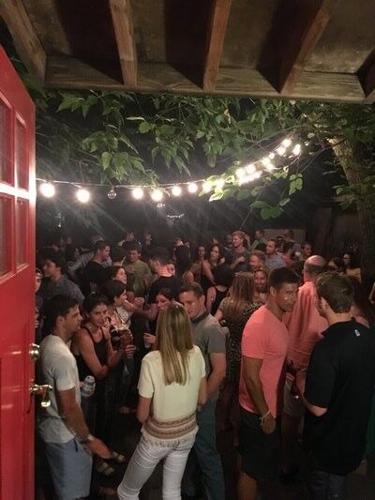
She’s heard about Murf’s the way you hear about anything real in Sag Harbor: from the person behind the counter at Canio’s, or from a neighbor walking a dog, or from the bartender at the American Hotel who mentioned it the way someone mentions a church they attend, not as a recommendation but as an article of faith. Nevertheless, she arrives on a Friday at 9 PM. Specifically, the front door has a dartboard beside it, which means entering through it risks impalement. . On the other hand, this means the regulars use the back entrance, which means she’s already been sorted: newcomer. However, she walks through the back patio where hospitality workers from Main Street restaurants are drinking after their shifts. . There, year-rounders are sitting in the same chairs they’ve sat in every Friday since before she bought her house, where the sound system is a jukebox rather than a Bluetooth speaker. In addition. She feels, for the first time since arriving on the East End, that she is in a room that does not need her to be anything other than a person who wants a drink.
For Thirty Years, Murphy Ran Murf’S
For thirty years, Murphy ran Murf’s as the specific kind of establishment that only a former Harlem beat cop could produce: a bar where the social hierarchy dissolved at the door. As a result, not because Murphy preached egalitarianism (he did not preach anything. He poured drinks, landed the ring, and talked to anyone who sat down). For instance, the room he built, dark and small and decorated with maritime artifacts and a picture of Frank Sinatra and a sign that read “Three Sheets to the Wind,” created a physical environment where the visual signals of status (clothing, accessories, posture, the specific wristwatch that communicates your position on the economic ladder) became invisible in the dim light.
In the dark, everyone is just a person at a bar. Meanwhile, that was Murphy’s design principle, whether he articulated it that way or not.
JFK Jr. Drank Here. So Did the Plumber.
Here is the sentence that captures everything this spoke is about: John F. Kennedy Jr. Similarly, he drank at Murf’s alongside plumbers and construction workers, and nobody treated this as remarkable.
Not because the plumbers didn’t know who Kennedy was (they knew). In contrast, not because Kennedy was performing some kind of patrician slumming that wealthy men occasionally engage in when they want to feel connected to a version of masculinity that their trust funds have insulated them from (he was not performing, he was drinking). But because Murf’s is the only establishment on the East End where the social physics produce a gravitational field strong enough to collapse the distance between a Kennedy and a plumber into the space of a bar stool. Where that collapse feels natural rather than theatrical.
This is the socio-demographic thesis that Cass was referring to. It’s worth unpacking because it explains something essential about Sag Harbor that the restaurants, the real estate market, the theater, and the cinema. The whaling history all gestures toward, but that only Murf’s makes literal: this village contains multiple economic classes, multiple professional identities. Multiple versions of what it means to belong to a place. The coexistence of those multiplicities is not an accident of geography but a deliberate social architecture. The village has maintained across centuries of economic transformation.
The Whaling Captains And The
The whaling captains and the sailors drank in different establishments. But they shared the same harbor, the same weather, the same risk. The same understanding that the ocean did not recognize rank. Murf’s is the surviving descendant of the sailors’ bar. This means it carries in its structural DNA the proposition that status is a costume you put on and take off that the bar is where you take it off.
The Post-Exit Founder Who Has Spent
The post-exit founder has spent the previous week at Page, the American Hotel, and Bay Street Theater. Accumulating cultural capital with every dinner and every performance and every intelligent conversation conducted at a volume that signals refinement, needs Murf’s the way a deep-sea diver needs a decompression chamber. Not because the high-pressure environments are fake (they are not fake, they are excellent). But the human organism was not designed to perform at that altitude indefinitely. Murf’s offers the specific atmospheric pressure at which pretense becomes unnecessary, and a beer costs what a beer should cost. The jukebox plays songs that nobody chose algorithmically, and the ring game humbles everyone equally.
The Ghost, the Building, and the Jukebox
The building is haunted. Her name is Aggie.
Agatha King lived in this house and died in it in the 1940s. Decades before Tom Murphy turned the downstairs into a bar. According to Murphy, her body was laid out in the front room during her wake. In life, Aggie was a teetotaler who frowned on debauchery. In death, she apparently decided to stay and frown forever. The blender turns on by itself. The jukebox activates unprompted. Doors open and close without wind or human agency. One New Year’s Eve, a group of friends photographed themselves at the bar. The developed image contained an additional shadowy figure that none of them remembered posing with.
The Southampton History Museum includes Murf’s on its ghost tour of Sag Harbor. This places the bar in the same supernatural taxonomy as the Old Whalers’ Church. The Spalding Gray house on Jefferson Street. A taxonomy that either confirms the village’s relationship with its dead or confirms that old buildings creak and electrical wiring deteriorates, and human pattern recognition is a powerful hallucination machine. Either way, Aggie is part of the bar. Murphy spoke of her affectionately, the way you’d describe an eccentric aunt who disapproved of your lifestyle choices but loved you enough to haunt you rather than leave.
The Interior Has Not Been Renovated
The interior has not been renovated in any way that the word “renovation” typically implies. A functioning jukebox stands near a working fireplace. Meanwhile, a dartboard occupies the wall beside the front entrance. A cigarette machine is nestled next to the short side of the ten-seat bar (ten seats: the bar’s entire capacity for seated drinkers. This means that by your third visit, you know every seat and every seat’s owner and every owner’s drink. This knowledge constitutes a form of social membership that no club on the East End can replicate because it requires nothing more than showing up repeatedly. Maritime-themed décor. Thick beams. Rustic wooden floors that have been absorbing the weight of drinkers since the building’s construction in 1792. This means the floor contains, at a molecular level, the compressed presence of sailors. Whalers, fishermen, artists, writers, cops, plumbers, Kennedys, and ghosts.
What Murf’s Means for the Village
Every comprehensive guide to Sag Harbor risks producing a portrait of the village that is too beautiful to be true. The captain’s houses. One literary history. The theater on the wharf. One $20 million cinema. The restaurants where accomplished people eat accomplished food and have accomplished conversations. All of this is real. None of it is false. But taken alone, it composes a picture of a village that has been curated into a lifestyle brand. Sag Harbor is not a lifestyle brand. It is a place where people live. This means it contains contradictions and rough edges. Nights that end at 2 AM on a patio behind a bar that hasn’t changed in fifty years. A ring game that the most successful person in the room cannot master.
Murf’s is the corrective. It is the spoke in this cluster that says: the American Hotel is real and Murf’s is real, and they are four blocks apart. The fact that both exist in the same village, serving the same community, at vastly different price points and atmospheric frequencies. Is the single most important thing to understand about Sag Harbor’s social architecture. The village is not either/or. It is both. It has always been both. The whaling captains and the sailors lived in the same harbor. A writer and the fishermen shared the same streets. The billionaire and the bartender share the same ring game. That coexistence is not a marketing strategy. It is a cultural inheritance. The village has preserved, deliberately or instinctively, across every economic cycle and every wave of wealth that has washed over the East End.
If You Move To Sag Harbor
If you move to Sag Harbor and never go to Murf’s, you will love the village, but you will not understand it. You will have read every chapter of the novel except the one where the protagonist admits what she actually wants. This is not beauty or culture or refinement, but the permission to stop performing those things for one night per week. In a bar that’s dark enough to make performance unnecessary. Here, the ring still hangs from the ceiling, and the ghost still disapproves. The jukebox plays whatever the jukebox wants to play.
Social Life Magazine covered Murf’s history in a feature-length piece that traces the ring game to the whaling days, Tom Murphy’s journey from Harlem beat cop to barkeep. .Aggie’s ongoing supernatural critique of the drinking life. Pick up a copy of the magazine at any of the establishments on Main Street, then walk to Division Street and order a beer in a building that’s been standing since 1792. The magazine and the bar are both part of the village’s cultural infrastructure. One documents it. The other proves it’s still alive.
The Practical Details
Address: 64 Division Street, Sag Harbor
Hours: Thursday through Sunday, 8 PM to 2 AM
Vibe: Dive bar. Cash preferred. No cocktail menu. Beer and shots. The Ring Game: Hanging from the ceiling since the whaling days. You will fail. This is the point. The Ghost: Aggie. Teetotaler. Disapproves of everything you’re doing. Still here. Entry tip: Use the back door. The dartboard next to the front entrance is a hazard. The Patio: Where Main Street restaurant workers come after their shifts. Where the village drops its pretenses, summer starts.
Where the Conversation Continues
Murf’s is the spoke that completes the picture. The restaurants show you how Sag Harbor eats. This real estate shows you how it invests. The whaling history shows you how it was built. Bay Street Theater shows you how it thinks. The cinema shows you what it values enough to save. Murf’s shows you what it looks like when nobody’s watching.
Social Life Magazine has been covering every layer of this village for twenty-three years. The gala and the dive bar. Furthermore, the captain’s house and the sailor’s pub. The billionaire’s donation and the bartender’s pour. The magazine’s range is the village’s range, and the village’s range is the reason people move here and stay. Pick up the current issue.
If your brand speaks to the full spectrum of East End life, from the rooftop at the Sag Harbor Cinema to the patio at Murf’s, from the opening night at Bay Street to the last call on Division Street, then Social Life Magazine is where your brand belongs. Because this audience isn’t one demographic. It’s a village. And a village is everyone. Explore paid features here.
Polo Hamptons 2026 runs July 18 and 25 at 900 Lumber Lane, Bridgehampton. BMW North America is the title sponsor. Cabanas, VIP tables, and sponsorship packages available. polohamptons.com
Subscribe. Join here.
Land the ring first try and we’ll name the spoke after you. Throwing sideways supposedly helps.
Author

Written by
Recent Posts
Getting the Size Right on a Valley Dreams Zip Hoodie
The Traffic Patterns Hiding Inside the Accident Data
The Smart Way to Give Your Unused Jewelry a Second Life
Katsuya Brentwood and Haute Living Honor NBA Star Kawhi Leonard at Private Dinner

The Accountability System Quietly Protecting Your Parents’ Care
Categories
- Art
- Articles
- Business of Luxury
- Celebrities
- Culture
- Entertainment
- Events
- Faces of Summer 2026
- Fashion
- Fashion & Style
- Featured
- Finance
- Food, Spirits, Wine
- Hamptons
- Hamptons Celebrities
- Health
- Health & Beauty
- Lifestyle
- Luxury Lifestyle
- Press
- Profiles
- Real Estate
- Technology
- The Chronicles
- Travel
- Uncategorized
- Weddings