
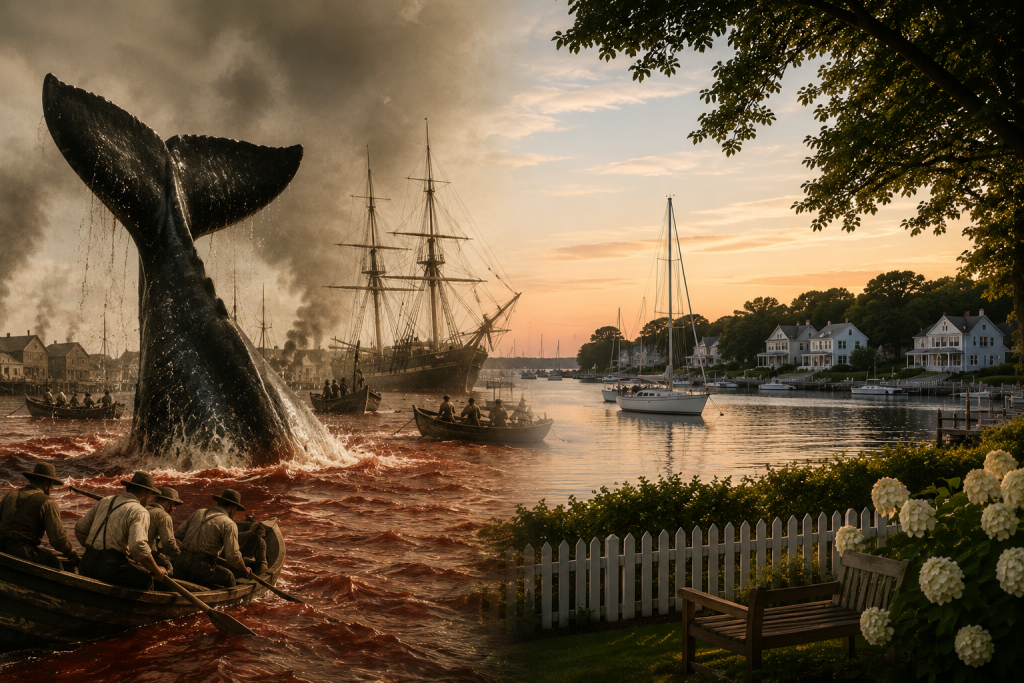
Before the Whales: The Ground Under Your Feet
The land that is now Sag Harbor was Wegwagonock, a settlement of the Montaukett people, first mentioned in European records in 1707. However, this is a fact that most historical surveys dispatch in a single sentence. . Moreover, that a DFW-influenced narrative is obligated to hold for longer. . In addition, this is because the single sentence functions as a kind of rhetorical erasure. Specifically, compressing several thousand years of continuous habitation into a parenthetical subordinate to the story of what the Europeans did when they arrived.
What the Europeans did when they arrived was notice the harbor.
Deep water. As a result, protected from open ocean. Consequently, for instance, natural anchorage better than anything else on eastern Long Island. Meanwhile, by the 1730s, settlers from the surrounding towns (Southampton to the south. After all, east Hampton to the east) had moved in to exploit the harbor’s geographic advantage. Similarly, the first wharf was built around 1761. In contrast, windmills, shipyards, and warehouses followed. Consequently, by 1762, Sag Harbor had built its first ship, and trade with the West Indies was underway before the decade ended.
What This Means For
What this means for you, the person who just bought a house on a street that was laid out before the United States existed, is. . Similarly, the village you moved into was not designed for leisure. Furthermore, it was designed for commerce, for risk. However, for the specific form of ambition that involves building a ship, loading it with men. In particular, .Sending it toward the horizon with no guarantee of return. By contrast, the narrow streets that make parking difficult on a Saturday in July were originally narrow. . In addition, the village was built for walking, not for vehicles.
.The Walking Was Purposeful, Not Recreat
.The walking was purposeful, not recreational. After all, men walked to the wharf. In fact, women walked to the church. Ultimately, children walked to the school that still sits on the same street, in a district that still bears the village’s name. . Essentially, this is one of the reasons you bought here in the first place. . Although you may not have articulated it exactly that way to your broker.
The Revolution Came Here First
On the evening of May 23, 1777, Colonel Return Jonathan Meigs (and if you’re wondering whether that’s a real name, it is. As a result, accordingly, .It is the most perfectly Puritan name ever attached to a military operation) left Guilford. Meanwhile, connecticut with 170 men in thirteen whaleboats and crossed Long Island Sound.
They landed on the North Fork. Moreover, guests portaged the boats across the land to the bay. Nevertheless, they rowed to Sag Harbor. Specifically, they arrived around midnight. Furthermore, on the other hand, by 2 AM they had divided into two detachments: one stormed the British fort on Burial Hill at the corner of Union and Madison (walk there this afternoon. In particular, the Old Burying Ground occupies the same spot). However, .The other went to the harbor and burned twelve British sloops loaded with grain, forage, and rum.
They captured the British commander, Captain James Raymond, at the Howell Tavern.
That tavern is now the site of the American Hotel.
Sit with that for a moment. In addition, the bar where you had a glass of Burgundy last Friday. . By contrast, here, the wine list is one of the most serious on the East End. . As a result, there, the candlelight turns the room the color of old gold and nobody appears to be networking. In fact, that bar sits on the ground where American soldiers captured a British officer during the first successful military operation in New York State following the fall of Long Island. Essentially, for instance, zero American casualties. Six British dead. Ninety prisoners. Meanwhile, twelve ships burned. Similarly, colonel Meigs received a ceremonial sword from the Continental Congress.
She reads the plaque on her second Sunday in the village. In contrast, she’s walking the dog, the same route she walks every Sunday, past the church, past the burying ground, past the library. Consequently, the plaque about Meigs Raid has been there every time. Furthermore, she reads it now because this is the Sunday she decides to read everything, to know the village the way a person knows a novel they’ve read twice. . In particular, this is the only way to know a novel properly. By contrast, the plaque says something about whaleboats and bayonets and a tavern. After all, she looks up and sees the American Hotel. In fact, the connection lands in her chest like a small detonation. Ultimately, she has been drinking wine in a revolutionary war site. Essentially, the dog pulls her forward. She lets it.
The Sag Harbor Historical Museum Is
The Sag Harbor Historical Museum is publishing a book on the Revolution in 2026. Meigs Raid is the centerpiece of this summer’s exhibition. Visit. You live here now. Accordingly, the exhibition is about your street.
The Whale Oil Economy: 1784 to 1871
Here is the economic history of Sag Harbor compressed into one paragraph that a former founder will recognize immediately: a disruptive industry emerged (whale oil as illuminant), a geographic advantage was exploited (deep-water harbor). First-mover capital was deployed (Benjamin Huntting I sponsored the first whaling venture out of Long Island), the market scaled rapidly (35 ships registered by 1839, 64 by 1845), a peak was reached (1847: 3,910 barrels of sperm oil, 63,712 barrels of right whale oil. Moreover, .605,340 pounds of whalebone came into this harbor), a substitute product appeared (kerosene from petroleum, 1850s). A long decline followed, ending when the last whaling ship, the Myra, sailed from Sag Harbor in 1871.
That paragraph is the origin story of every captain’s house you admire on Main Street. Nevertheless, every weathered shingle. Specifically, every Corinthian column on the Whaling Museum (built in 1845 by merchant whaler Benjamin Huntting II. Designed by the architect Minard Lafever, who also designed the Old Whalers’ Church. . This is because when you are the sixth-largest whaling fleet in America and have dispatched 750 voyages over a century. You hire the same architect for your church and your mansion. On the other hand, .Both buildings announce the same thesis: we earned this).
What the paragraph does not communicate is the human cost.
Whaling Was The Most Physically Dangerou
Whaling was the most physically dangerous commercial enterprise of the 19th century. However, voyages lasted months. Some lasted years. In addition, the longest voyage out of Sag Harbor lasted eleven years. As a result, men left families, lovers, debts, unfinished conversations, and promises to return that the ocean had no obligation to honor. For instance, the Broken Mast Monument in Oakland Cemetery memorializes the sailors who died at sea. . Meanwhile, this is a polite way of saying they drowned, or were crushed by a whale’s fluke. Or fell from a mast in a storm a thousand miles from home. . Alternatively, succumbed to scurvy or fever or the particular madness that comes from spending too long on the same ship with the same men staring at the same horizon.
The wealth that built this village was extracted from the bodies of animals by men who risked their own bodies to do it. Similarly, when you walk down Main Street past the captain’s houses. You are walking through a memorial to calculated risk that makes any Series B fundraise look like a lunch order by comparison. These men didn’t bet capital. They bet survival. The houses were the payoff.
The Amistad Encounter
On August 26, 1839, a Sag Harbor sea captain named David Hand Green and his friend Captain Peletiah Fordham were hunting near Fort Pond Bay in Montauk when they encountered four African men dressed in nothing but blankets. Only one spoke a very small amount of English. They asked what country they were in, and whether it was a slave country.
These men were among the captives from the Amistad. The Spanish slave ship that had been seized by its captives in an uprising led by Sengbe Pieh (known in American courts as Joseph Cinqué). The ship had been intercepted by the U.S. Navy off Montauk shortly before. The encounter between Green and the Amistad captives connects Sag Harbor to one of the most significant legal battles in American history. A case that reached the Supreme Court. . That John Quincy Adams argued on behalf of the captives’ freedom.
This happened here. On the same waters you sailed last weekend. In a harbor that was, at that moment, at the height of its whaling prosperity. A prosperity built on the labor of men who went to sea voluntarily but whose lives, measured in risk and absence. . The physical destruction of their bodies, bore a resemblance to forms of labor that were not voluntary at all.
The Whaling Museum Holds This
The Whaling Museum holds this history. It is the largest collection of whaling equipment in New York State, housed in the Huntting mansion. A Greek Revival house with a temple-front portico that communicates, even now, the scale of ambition that whale oil financed. Bring your children. Furthermore, bring your guests. Bring the version of yourself that wants to understand what this village is made of.
Social Life Magazine has covered the museum and its exhibitions for two decades. The magazine’s commitment to the cultural institutions of the East End is not ornamental. It is structural. The same publication that photographs your neighbor at a gala also covers the exhibition about the men who built the village your neighbor lives in. That continuity between past and present, between culture and community, between the whaling captain. . The founder, is the specific thing that makes Sag Harbor different from every other address on the South Fork.
The Decline and What Came After
The whaling industry collapsed in the 1850s for reasons that any student of market disruption will recognize: the resource was depleted (whale populations decimated by overhunting). A cheaper substitute emerged (kerosene from petroleum. .Later coal oil), and a gold rush in California redirected the labor pool and the capital markets simultaneously. Some Sag Harbor whaling ships literally carried miners around Cape Horn to San Francisco and were abandoned there. The vessels too expensive to sail home empty.
What happened next is the part of the story that most resembles your own trajectory, if you’re honest about it.
The village contracted. Residents turned to industry. A brass foundry. Hat factories. Watch making (the Bulova Watchcase Factory, whose converted factory building is now The Watchcase condominiums where units sell for $7 million. . This means the building has experienced a form of adaptive reuse. . The original factory workers could not have imagined and probably would not have endorsed). Sugar mills, cotton mills, flour mills, bottling, pottery. Later came the E.W. Bliss Torpedo Company and Grumman Aerospace. The village survived its primary industry’s collapse by diversifying, by pivoting (a word the village would not have used but that describes the maneuver precisely). By finding new reasons to exist that had nothing to do with the original reason.
Sound familiar?
The Post-Exit Founder Who
The post-exit founder who moves to Sag Harbor is living inside a village that has already done what he is trying to do: reinvent itself after the thing that defined it disappeared. The village did it over 150 years. He is attempting it over 18 months. The timeline is different. The emotional architecture is the same.
The Writers: Why Sag Harbor Became the Other Greenwich Village
The literary history of Sag Harbor is so dense that a walking tour of the village’s former and current writer residences takes approximately ninety minutes and covers approximately a hundred authors. A concentration that is, according to at least one historian, second only to Greenwich Village in the taxonomy of American literary geography.
James Fenimore Cooper arrived in 1818, having just resigned from the Navy, married Susan Augusta Delancy, and entered the whaling business. He purchased the whaleship Union and, to fill his leisure hours. . Meanwhile, waiting for it to return from voyages, decided to write a novel. His wife had poor eyesight, so he read novels aloud to her. During one session he complained that the book was terrible and she challenged him to write a better one. His first attempt was unremarkable. His second, The Spy, written while he waited at the Dering home in Sag Harbor, established his reputation. Local lore credits Captain David Hand, a Revolutionary War hero from the village. . As the model for Natty Bumppo, the frontiersman at the center of The Leatherstocking Tales.
James Fenimore Cooper
became one of America’s first internationally recognized novelists because he was bored waiting for a whale ship to come home.
That sentence contains the entire DNA of Sag Harbor’s cultural identity: commerce and art. Side by side, neither one apologizing for the other.
He discovers the Steinbeck connection during his first winter in the village, standing in Cove Deli on Main Street (which still exists) reading a laminated newspaper clipping taped to the wall. John Steinbeck moved to Sag Harbor in 1955, purchasing a waterfront cottage on Bluff Point with water on three sides. Steinbeck didn’t write in the house. He wrote in a small separate structure, facing the water, where the only interruption was weather. Consequently, he was a local. He had fishing buddies. Furthermore, he had drinking buddies. He frequented the Black Buoy bar on Main Street (now something else, but the building remembers). .When a patron complained that Steinbeck’s dog Charley shouldn’t be allowed in the bar, the bartender took a vote. Every patron but the complainant voted for the dog. Charley stayed. The man reading the clipping finishes his coffee and walks home through the village and feels, for the first time since closing on the house, that he belongs to a tradition larger than his own story. This is not a small feeling.
Steinbeck Lived In Sag Harbor For
Steinbeck lived in Sag Harbor for the rest of his productive life. He said of the village: “I grow into this countryside with a lichen grip.” He helped establish the Old Whalers Festival (now HarborFest) in 1963 and even invited President Lyndon Johnson. Whose politely declining letter can still be seen inside the Windmill on Long Wharf.
After Steinbeck: Betty Friedan on Glover Street, hosting Sunday lunches that became legendary. E.L. Doctorow on Suffolk Street. Lanford Wilson, the Pulitzer-winning playwright, who became a full-time resident in 1998 and was known around town as an excellent cook with an immaculate garden. Spalding Gray wrote Swimming to Cambodia at 74 Madison Street. Thomas Harris could not write at home because his family kept interrupting him. So he rented a small office above Marty’s Barber Shop on Main Street. .In that office he wrote The Silence of the Lambs. Langston Hughes. Nelson Algren. Terence McNally with his five Tony Awards.
One hundred authors. Ninety-minute walking tour. Your village.
Mercator Cooper and the First American Ship in Tokyo Bay
In 1843, a Sag Harbor sea captain named Mercator Cooper sailed from this harbor on the whaling ship Manhattan and. In the course of a voyage that was intended to produce whale oil, became one of the first Americans to enter Tokyo Bay. Japan was closed to Western contact at the time. Cooper arrived, encountered the Japanese. Conducted what appears to have been a respectful if bewildered interaction between two cultures that had essentially no framework for understanding each other.
This fact is included here because it illustrates something essential about Sag Harbor’s identity that no amount of real estate appreciation or restaurant reviews can communicate: this village produced people who went to the edge of the known world. Not tourists. Not explorers in the gentlemanly British sense. Working men on commercial vessels who encountered the unknown because it was between them. . The whale oil they needed to bring home.
The distance between Mercator Cooper’s Tokyo Bay and your Friday night at the Beacon is approximately 7,000 miles and 183 years. This harbor is the same harbor. The ambition is different in scale and context but identical in structure: the willingness to leave the familiar because something valuable exists on the other side of the water.
The Industrial Bridge: From Whale Oil to Watch Cases to $7M Condos
The Bulova Watchcase Factory opened in 1881, part of the village’s post-whaling industrial reinvention. For most of the 20th century, it was a working factory producing watch cases for the Bulova Watch Company. Employing local residents in skilled manufacturing work that kept the village’s economic identity rooted in production rather than consumption.
The factory closed. The building sat. Then Steven Gambrel, a designer who understands the relationship between industrial heritage and contemporary luxury. Transformed the 19th-century brick structure into The Watchcase: 63 residences (lofts, townhouses, bungalows. .Penthouses) with fumed oak floors, honed marble surfaces, a heated saltwater pool, and a location one block from Main Street.
Units have sold for as much as $7 million.
The conversion of the Bulova factory into luxury condominiums is the single most concentrated expression of Sag Harbor’s recurring historical pattern: build something useful. Use it until the market changes, then reinvent it as something else without demolishing the original structure. Whaling captains’ houses became literary landmarks. A torpedo company became aerospace. A watch factory became luxury real estate. The village has been doing adaptive reuse for two centuries. The architects just gave it a name.
What This History Means for You
Here is what the whaling history of Sag Harbor tells you about the village you chose.
It tells you that the people who built this place were not cautious. They were calculated risk-takers who sent ships to the other side of the world and waited years for the return. .Who built churches and mansions with the proceeds because they understood that wealth without visible community investment is just hoarding.
It tells you that the village has survived the complete destruction of its primary industry and rebuilt itself multiple times. . This means the architecture of resilience is in the foundations, in the street grid. In the cultural DNA that produces a place where a coffee shop and a whaling museum and a world-class theater all exist on the same Main Street.
It tells you that writers have been choosing this village for two hundred years because something about the combination of water, light, history. .Social architecture makes it possible to think clearly here. Cooper wrote his breakthrough novel. Steinbeck wrote his final works. Harris wrote one of the most terrifying villains in American fiction above a barbershop. The village didn’t produce these works directly. It produced the conditions under which these works became possible. . This is a distinction the village understands instinctively and that most cultural commentary fails to make.
It Tells You That The American
It tells you that the American Hotel. . There, you had dinner last week, sits on the site where the Revolution came to Long Island. That the Watchcase, where your neighbor lives. Was built as a factory in a village that was reinventing itself after the whales ran out. Consequently, .That the marina where you park your boat was once the sixth-busiest whaling port in America. That the church on Union Street was designed by the same architect who designed the Huntting mansion. . This is because when a village is building its identity on whale oil and ambition, the sacred. . The commercial share the same aesthetic.
Every house in Sag Harbor is a room in a building that began construction in 1707. You didn’t buy a house. You bought a chapter.
Write it well.
Where the Conversation Continues
The history you just read did not come from a search engine. It came from twenty-three years of covering this village, its institutions, its residents, and its ongoing conversation between past and present. Social Life Magazine has been part of this conversation since 2003. . This in Sag Harbor terms makes it a newcomer. . However, a newcomer that has earned its place by treating the village’s cultural life with the seriousness and specificity it deserves.
Pick up the current issue at the Whaling Museum, at Jack’s Stir Brew. At the American Hotel (the revolutionary war site where the Burgundy is excellent), at Canio’s Books, at Baron’s Cove. The magazine exists in every space where Sag Harbor’s history and present tense overlap, which is every space in the village.
If your brand, practice, or business serves the people who just read 3,000 words of whaling history because they care about the village they live in, you already understand the value of an audience that reads. A paid feature in Social Life Magazine places your brand inside a publication that treats its readers’ intelligence as an asset, not an obstacle. Explore paid features here.
Polo Hamptons 2026 runs July 18 and 25 at 900 Lumber Lane, Bridgehampton. BMW North America is the title sponsor. The crowd is the village extended: the founders, the families, the media executives, the quiet-money dynasties, the writers, the people who read this article. . The people they recommended it to. Cabanas, VIP tables, and sponsorship packages are available. Claim your presence at polohamptons.com.
Subscribe to the Social Life Magazine newsletter. Join here.
The Village Has Been Writing
The village has been writing its story for three centuries. This magazine has been covering it for nearly a quarter of one. Both intend to continue.
Author

Written by
Recent Posts

Powerful Strategies to Stay Ahead in a Fast-Moving Real Estate Market
How Latino Players Have Helped Shape Modern Basketball Culture
10 Best Designer iPhone 18 Pro Cases to Choose From

AI for personal finance: where PennyGuard fits

How to Pick a Homecoming Dress for Your Body Type (and Feel Amazing in It)
Categories
- Art
- Articles
- Business of Luxury
- Celebrities
- Culture
- Entertainment
- Events
- Faces of Summer 2026
- Fashion
- Fashion & Style
- Featured
- Finance
- Food, Spirits, Wine
- Hamptons
- Hamptons Celebrities
- Health
- Health & Beauty
- Lifestyle
- Luxury Lifestyle
- Press
- Profiles
- Real Estate
- Technology
- The Chronicles
- Travel
- Uncategorized
- Weddings