
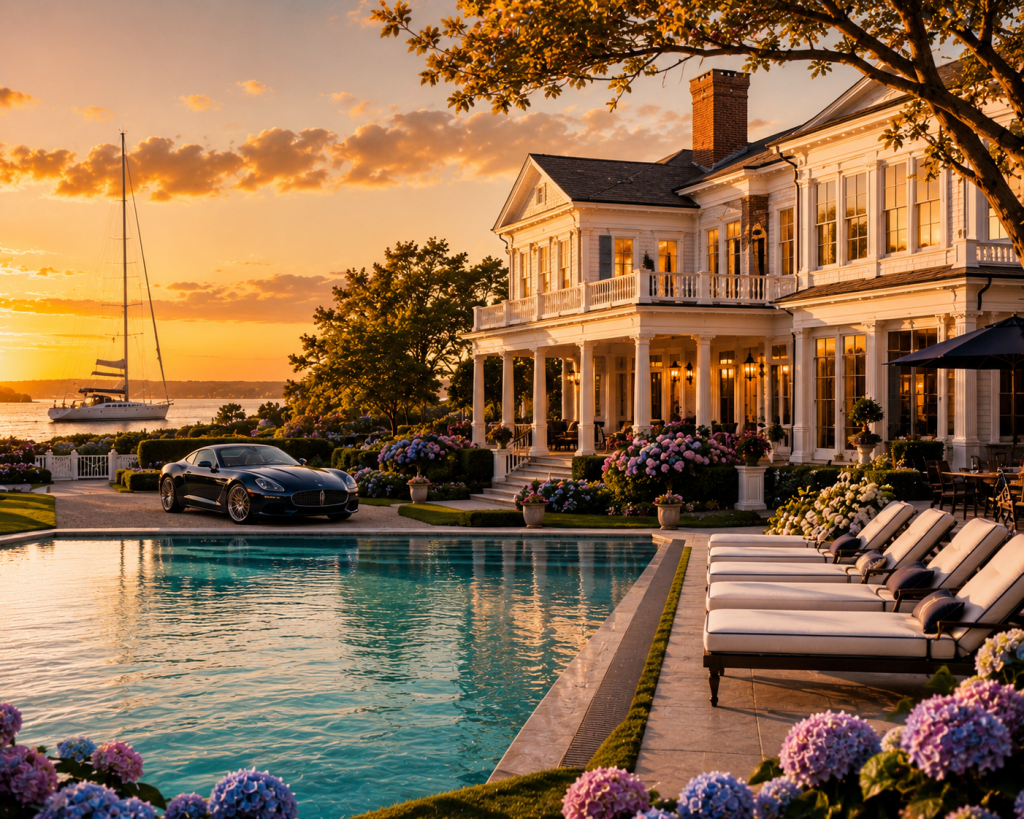
The Most Expensive Vocabulary Lesson in America
In Southampton real estate, the phrase “south of the highway” functions as a complete sentence. Essentially, it communicates price range, social tier, beach proximity, and aspiration in four words. The highway in question is Montauk Highway (Route 27), a two-lane road that bisects the village and, in doing so, creates the single most consequential socioeconomic border in American residential real estate. Everything south of it is the estate section. Everything north is where the people who maintain the estate section live.
He closed the fund in March. $220 million, third vehicle, 2.8x gross on Fund II. The carry alone puts him somewhere north of $30 million liquid, depending on taxes and the ex-wife’s attorneys. His accountant said buy something before the capital gains clock starts, his attorney said not in Connecticut. His wife said not in Westchester. He said: What does $5 million buy me in Southampton? His broker paused for exactly one second, which is the polite version of laughing.
The median listing price in Southampton Village hit $3.32 million in May 2026. For new construction, the median sits at $5.39 million. Similarly, the median home price across the broader Town of Southampton crossed $2 million for the first time in 2025. Yet these numbers, like most aggregate statistics applied to luxury markets, obscure more than they reveal. Southampton real estate operates on a tier system where $3 million and $30 million buy properties in the same village that might as well exist in different countries.
This guide maps those tiers for the buyer who has just experienced a liquidity event and wants to understand what the money actually purchases, because in Southampton, the hedgerow is the curriculum and the price is the tuition.
For a broader view of Hamptons real estate across all villages, see Social Life Magazine’s Hamptons Real Estate Guide. For the power streets ranked and analyzed, see Hamptons Real Estate Power Rankings.
The Tier System
Tier 1: Oceanfront Trophy ($30M to $175M+)
Streets: Gin Lane, Meadow Lane, First Neck Lane.
This is not a buyer’s guide. If you are purchasing on Gin Lane, you do not need a buyer’s guide. Rather, you need a family office, a tax attorney who bills at $2,000 an hour, and a broker who has your cell phone number.
Gin Lane may be the most prestigious residential street in America that most Americans have never heard of. In 2024, the two most expensive Hamptons sales both occurred here: La Dune, an oceanfront estate, sold at auction for $88.48 million (split between 376 and 366 Gin Lane). Properties on the lane trade between $20 million and $100 million. Notably, roughly 70% of transactions above $50 million happen off-market. You will never see them on Zillow. You were never supposed to.
Meadow Lane and the Billionaires Row Math
Meadow Lane earned its nickname (“Billionaires Row”) by concentrating more financial firepower per linear foot than any residential address in the country. Ken Griffin of Citadel bought Calvin Klein’s modernist compound here for $84 million in 2020. Leon Black of Apollo Global lives here. Robert Kraft paid $43 million. Henry Kravis of KKR is a neighbor. The Mylestone estate sold for $112.5 million in 2023. Combined net worth of the lane’s residents likely exceeds $50 billion.
First Neck Lane intersects with Gin Lane and carries prices from $20 million to $30 million for non-oceanfront estates. The 2024 sale at 484 First Neck Lane closed at $27.5 million.
What you get: Direct ocean access. Significant acreage (2 to 10+ acres). Historic or architect-designed compounds. Peer communities of ultra-high-net-worth families. Helicopter commute to Manhattan in 35 minutes. Privacy that money can buy and only lineage can fully guarantee.
What you need to know: Sellers at this level prefer discretion. Brokerages maintain dedicated teams for clients who require confidentiality. The listing price is the opening position of a negotiation that may last months and involve attorneys on both sides who bill more per hour than most of the country earns per day.
Tier 2: Estate Section South of the Highway ($5M to $30M)
Streets: Ox Pasture Road, Halsey Neck Lane, Wickapogue Road, Tuckahoe Lane, Lewis Street, Great Plains Road, Coopers Neck Lane.
This is where $5 million becomes a real number. And this is the tier that the question in the headline actually answers.
At $5 million in the Southampton estate section, you are buying one of three things:
Option A: The fixer on a good street. An older Shingle Style or Colonial Revival on Ox Pasture Road or Halsey Neck Lane that needs a kitchen, bathrooms, and possibly a roof. Typically, the house is 3,000 to 4,000 square feet on a half-acre to one-acre lot with mature hedgerows that took fifty years to grow. Location is correct. Bones are good. Still, the renovation will cost $1 million to $2 million and take eighteen months, during which you will miss one full summer season.
Option B: The village proper charmer.
A turnkey 4-bedroom on a quiet street south of the highway within walking distance of Main Street and biking distance of Cooper’s Beach. Smaller lot (a third of an acre to half an acre). Updated kitchen, new pool, landscaping that photographs well for the listing but will need your landscaper’s attention by August. This is the entry-level “I own in Southampton” house, and there is no shame in it.
Option C: New construction north-adjacent. Alternatively, consider a brand-new 5,000 to 6,000-square-foot house on a one-acre lot in the southern portion of the north-of-highway zone. Five bedrooms, a heated gunite pool, a two-car garage, and finishes that look like a Restoration Hardware catalog had an affair with a Hamptons architect. The new construction median in Southampton Village is $5.39 million, and this is what that number actually looks like.
She walks the property on a Thursday in April. The listing says “south of the highway, estate section, walk to beach.” It does not say that the walk to the beach takes twenty-two minutes, that the kitchen was last renovated when Clinton was president (the first one), or that the pool has a crack in the shell that will cost $45,000 to repair. She offers $4.6 million. The seller’s agent calls it insulting. They close at $4.85 million in June. She spends the summer explaining to friends that she bought in the estate section, which is true, and that she can walk to the beach, which is technically true, and that the house is perfect, which will be true after the renovation she has already scheduled for September.
Moving Up the Ladder
At $8 million to $12 million, the estate section opens considerably. You are now looking at:
Renovated Shingle Style homes on Ox Pasture Road with 6,000 to 8,000 square feet, seven bedrooms, pool, pool house, and the kind of hedgerow frontage that makes the property invisible from the road (which, again, is the point). Properties on Ox Pasture regularly trade between $10 million and $25 million.
A French modern at 355 Ox Pasture sold for $10.23 million: 6,800 square feet, seven bedrooms, 8.5 bathrooms, 1.9 acres with formal boxwood hedges, theater, gym, sauna, wine cellar. It had been listed at $13.5 million in 2017 and took three years to sell, which tells you something about the patience required at this tier.
At $15 million to $30 million, you cross from the estate section into the estate section’s estate section. Properties on Halsey Neck Lane and the inland portions of First Neck Lane. Significant compounds with guest houses, tennis courts, and staff quarters. The kind of property where the driveway is longer than most Manhattan city blocks.
Tier 3: Village Proper ($2M to $5M)
Streets: Main Street adjacent, Prospect Street, South Main Street, Windmill Lane, Hill Street.
Walkable to shops and restaurants. Within biking distance of Cooper’s Beach. Smaller lots, older houses, the kind of charming Colonial Revival that photographs well and requires constant attention. Property taxes in this range run $20,000 to $40,000 annually, which in Manhattan terms is two months of a rental but in Southampton terms is the price of belonging to a village that was founded in 1640.
This tier suits the buyer who values location over square footage and wants to walk to Sant Ambroeus on a Saturday morning without starting a car.
Tier 4: North of the Highway ($800K to $2M)
Streets: North Sea Road, County Road 39, various.
This is where the year-round community lives. The teachers, the firefighters, the restaurant workers, the contractors who renovate the estate section houses, and the recent first-time buyers who scraped together enough for a three-bedroom ranch on a quarter-acre lot. North of the highway is not prestigious. It is essential. Without Tier 4, Tiers 1 through 3 do not function.
The Hidden Costs Your Broker Won’t Mention First
Property Taxes
Suffolk County property taxes in the Southampton estate section are substantial. In general, expect $25,000 to $60,000 annually for a $5 million to $10 million property. The Shinnecock Hills school district assessment can add an additional layer. Property taxes in Southampton are not the highest in the Hamptons (East Hampton gives strong competition), but they are high enough that the annual carrying cost of a $5 million house includes a five-figure check to the county every quarter.
Insurance
Flood insurance for properties in coastal zones has increased dramatically in recent years. Specifically, homes south of the highway in flood-designated areas may require policies costing $10,000 to $30,000 annually. Wind insurance is separate and additional. Ask your broker about the specific flood zone designation before you fall in love with the ocean views.
Maintenance
A Southampton estate is not a Manhattan co-op. There is no superintendent. Hedgerows need trimming ($5,000 to $15,000 annually depending on linear footage). Meanwhile, the pool needs opening in May and closing in October ($3,000 to $5,000). Landscaping is year-round ($2,000 to $8,000 per month during growing season). A caretaker for a property you occupy only from Memorial Day through Labor Day will cost $40,000 to $80,000 annually.
The total annual carrying cost of a $5 million Southampton estate (taxes, insurance, maintenance, landscaping, pool, caretaker, utilities) runs $80,000 to $150,000 before you spend a dollar on the renovation you will inevitably need.
The Renovation Math
Naturally, most properties in the $5 million range south of the highway will require some renovation. Kitchens run $100,000 to $300,000. Bathrooms run $50,000 to $100,000 each. A pool replacement costs $150,000 to $250,000. A full gut renovation of a 5,000-square-foot house costs $1 million to $3 million depending on finishes and the speed at which you want it completed (summer deadlines carry a premium).
The total cost of ownership for a $5 million purchase with a moderate renovation (kitchen, two bathrooms, pool resurfacing, landscaping) approaches $7 million to $8 million before you host your first dinner party.
What Your Address Actually Means
The Social Geography
In Southampton, your street functions as a credential. In fact, this is not metaphorical. When you tell someone at the Meadow Club that you are “on Ox Pasture,” you have communicated a net worth range, a social tier, and an aesthetic sensibility in three words. When you say you are “north of the highway,” you have communicated something different.
Naturally, the hierarchy is not spoken aloud. It does not need to be. Instead, the hedgerow does the talking.
Gin Lane says: legacy wealth, generational presence, oceanfront. That name alone opens doors at the Bathing Corporation.
Meadow Lane says: financial power, recent arrival (relative to Gin Lane), helicopter commute.
Ox Pasture Road says: serious money, taste, enough acreage to be invisible from the road but close enough to the village to walk to dinner.
First Neck Lane says: old Southampton, the kind of family that has been summering here since before the highway was built.
Village proper, south of the highway says: you belong, you are accessible, you chose charm over acreage.
North of the highway says: you are local, and locals know something about Southampton that seasonal residents do not.
The Broker Landscape
In particular, Southampton real estate is dominated by a handful of brokerages whose names carry their own social weight. Saunders and Associates, Corcoran, Compass, Sotheby’s International Realty, Douglas Elliman, and Brown Harris Stevens all maintain Southampton Village offices. At the Tier 1 and upper Tier 2 levels, the relationship between broker and client operates more like a private banking relationship than a typical real estate transaction. Discretion is the product.
For off-market properties (which represent the majority of the ultra-luxury inventory), you need a broker with established relationships on both sides of the transaction. The best way to find that broker is not to search online. It is to attend the right charity benefit (Southampton Hospital Foundation, Parrish Art Museum gala, Polo Hamptons) and mention, casually, that you are looking.
The Investment Thesis
Why Southampton (and Not East Hampton)
The question every first-time Hamptons buyer eventually asks is: Southampton or East Hampton? The answer depends on what you are optimizing for.
Southampton offers: the oldest establishment pedigree on the East End (founded 1640). The nation’s number-one beach (Cooper’s Beach, ranked first by Dr. Beach in 2025). The most exclusive private clubs (Bathing Corporation, Meadow Club, Shinnecock Hills). Proximity to the 2026 U.S. Open at Shinnecock Hills and Polo Hamptons in Bridgehampton (ten minutes). A village center with walkable dining (Sant Ambroeus, FENIKS, 75 Main) and year-round commerce.
East Hampton offers: a more visible cultural and celebrity scene. More restaurants per capita. A downtown that skews younger. Further Lane and Lily Pond Lane, which compete with Meadow Lane and Gin Lane for the most expensive addresses on the East End. The Maidstone Club, which rivals the Bathing Corporation for exclusivity.
Southampton trends older, quieter, and more establishment. East Hampton trends more visible, more competitive, and more photographed. The price differential between comparable properties is narrowing but historically has favored Southampton as slightly less expensive at the top tier and roughly equivalent at the $5 million to $10 million tier.
For Sag Harbor, the value proposition is different entirely: village charm, harbor access, and cultural capital at roughly 60% to 70% of Southampton Village pricing for comparable square footage.
The Long-Term View
Hamptons real estate has appreciated steadily over the past two decades. The 2020 to 2021 pandemic surge added a premium that has partially but not fully corrected. In reality, the 2025 median crossing $2 million for the first time reflects a structural shift.
Southampton’s particular advantage is its institutional infrastructure. Specifically, the private clubs, the hospital foundation, the Parrish Art Museum, Shinnecock Hills Golf Club, and the village government create a stability premium.
Properties south of the highway in the estate section have historically outperformed the broader Hamptons market during recovery periods and have held value more consistently during downturns. The hedgerow, it turns out, provides insulation in more ways than one.
The Timeline: From Liquidity Event to First Summer
Months 1 to 2 (post-liquidity): Engage a broker with estate section specialization. Tour ten to fifteen properties to calibrate your eye. Do not make an offer during the first two weeks. Everything looks beautiful when you are still euphoric from the exit.
Month 3: Narrow to three to five properties. Engage a real estate attorney. Order surveys and inspections. Research flood zone designations and insurance costs.
Month 4: Make your offer. Negotiate. Close. This process typically takes 60 to 90 days in the Hamptons, longer for complicated estates with multiple structures.
Months 5 to 8: Renovation planning and execution. If you want to be in the house by Memorial Day, you need to close by December and begin construction by January. Hamptons contractors book out months in advance, and the good ones (the ones the estate section uses) book out a year.
Month 9: Your first summer. You walk to Cooper’s Beach in bare feet. On Saturdays, you eat at Sant Ambroeus without checking your phone. Eventually, you attend Polo Hamptons with your broker, who is now your friend, which is how she planned it.
He closes on a Thursday in November. The house is on a street he had never heard of six months ago, in a village he had visited only twice before, in a zip code that costs more per square foot than the office where he built the fund. The hedgerow is twelve feet high. The pool needs resurfacing. The kitchen is from 2008. He does not care; he owns south of the highway. He sends a photo to his partner, who responds with three words: “You made it.” The question now is what he does with the arrival.
Where the Conversation Continues
Social Life Magazine has covered East End real estate for twenty-three years, through boom and correction and pandemic and the $88 million Gin Lane auction that made every broker’s phone ring for a week. The Southampton Village Dossier is the definitive guide to the village where these addresses carry their weight.
If your real estate practice, financial advisory firm, or luxury brand serves the buyer described in this guide, Social Life Magazine’s paid feature program places your story in front of 25,000 copies per issue, distributed at the restaurants, hotels, and beach clubs where purchase decisions are discussed over rosé and lobster rolls.
Polo Hamptons 2026 (July 18 and 25, 900 Lumber Lane, Bridgehampton) is where new Southampton homeowners meet the neighbors they will see at the Meadow Club, the Southampton Hospital gala, and every charity benefit between Memorial Day and Labor Day. BMW North America is the title sponsor. Christie Brinkley is the host. The cabana is where the introduction happens.
To receive Social Life Magazine delivered to your door (or to the door of the house you just purchased south of the highway), visit our subscription page.
Five million dollars buys you a house in the estate section. What it costs to live there is a different number entirely. And what it means to belong is a number that has never been printed on a listing sheet, because in Southampton, the things that matter most are the things that never appear on paper.
Author

Written by
Recent Posts

hiTechMODA Season 16
How to Keep Your Personal Number Private When Booking Events, Rentals and Services
Understanding Compensatory Damages in a Personal Injury Case

When Online Family Therapy Makes Sense for Modern Families

Carrier Oils, Essential Oils, and Oil Blends: What Beauty Brands Need to Know
Categories
- Art
- Articles
- Business of Luxury
- Celebrities
- Culture
- Entertainment
- Events
- Faces of Summer 2026
- Fashion
- Fashion & Style
- Featured
- Finance
- Food, Spirits, Wine
- Hamptons
- Hamptons Celebrities
- Health
- Health & Beauty
- Lifestyle
- Luxury Lifestyle
- Press
- Profiles
- Real Estate
- Technology
- The Chronicles
- Travel
- Uncategorized
- Weddings