
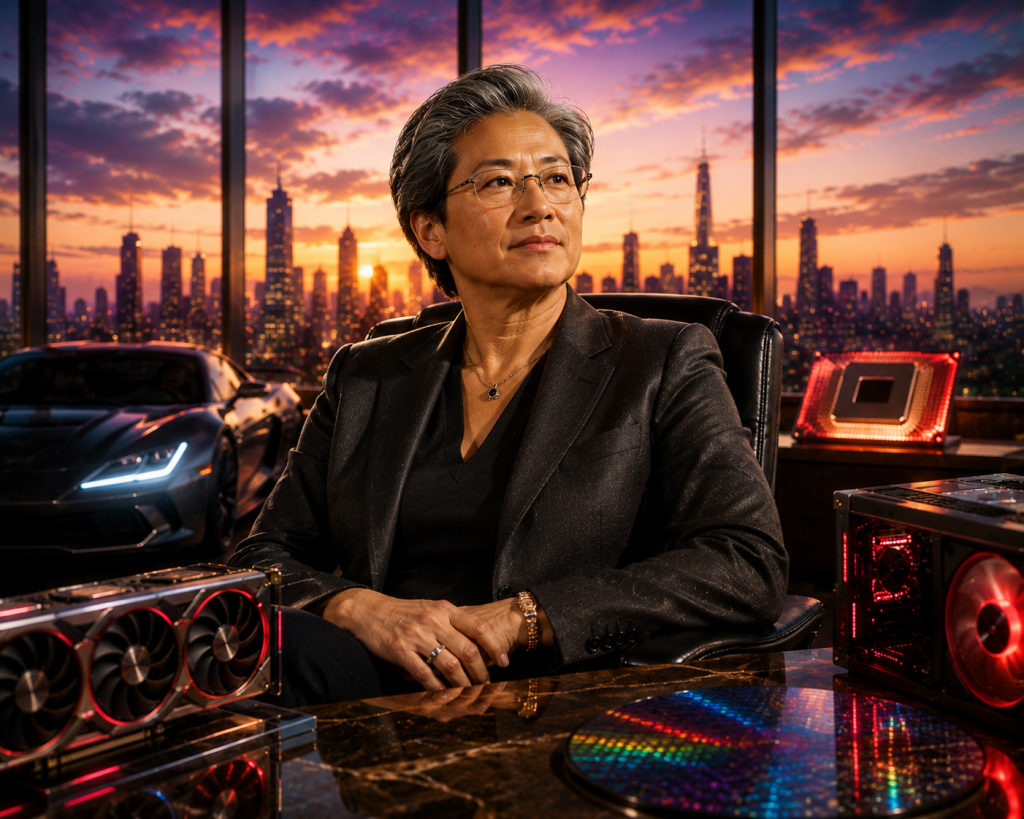
Lisa Su Net Worth 2026: The AMD CEO Giving Nvidia Its Only Real Fight
Lisa Su net worth 2026 is estimated between $1.3 billion and $1.6 billion, nearly all of it concentrated in AMD stock. She holds approximately 3.77 million shares of Advanced Micro Devices as of May 2026, a position worth roughly $1.6 billion at current prices. That fortune was built not by founding a company, but by resurrecting one. When Lisa Su became CEO of AMD in October 2014, the stock traded at roughly $3 per share. The company was widely considered a failing also-ran in the semiconductor industry, hemorrhaging market share to Intel on one side and losing the GPU war to Nvidia on the other. Analysts debated not whether AMD would decline, but when it would die.
Today AMD’s market capitalization exceeds $250 billion. Its stock has climbed more than 14,000% under Su’s leadership. Time Magazine named her CEO of the Year in 2024. MIT invited her to deliver its 2026 commencement address. And in the defining industry battle of this decade, the fight for AI chip supremacy, Lisa Su is the only person on earth who has Jensen Huang looking over his shoulder. She is the Dark Horse in the story of the AI billionaires reshaping American wealth.
Before AMD: Queens to MIT to the Clean Room
Lisa Su was born on November 7, 1969, in Tainan, Taiwan, the same city where Jensen Huang was born six years earlier. The family moved to the United States when she was two or three years old, settling in Queens, New York. Her father was a statistician. Her mother was an accountant who later started her own business. Immigrants, analytical, exacting. They expected their daughter to be exceptional.
Su delivered early. As a child, she dismantled her brother’s remote-controlled cars to understand how they worked. The impulse was not destructive. It was diagnostic. She wanted to see the engineering, to hold the circuitry, to understand why the thing moved when you pressed the button. That instinct, the need to open the machine and read its logic, would define every subsequent decision in her career.
She enrolled at the Massachusetts Institute of Technology and never left. Bachelor’s degree in electrical engineering. Master’s degree. Ph.D. Her doctoral work focused on Silicon-on-Insulator technology, a manufacturing technique that would become foundational to modern chip design. MIT was not just her school. It became her intellectual home. She established the Lisa Su Fellowship Fund there in 2018 and was selected to deliver the university’s commencement address on May 28, 2026.
The Pre-AMD Resume: IBM, Texas Instruments, Freescale
After MIT, Su built her career at three companies that taught her three different things. Texas Instruments taught her high-volume semiconductor manufacturing. At IBM, she rose to Vice President of Semiconductor Research and Development, overseeing teams that pushed chip architecture toward the performance thresholds that AI would eventually demand. At Freescale Semiconductor, she ran the networking and multimedia division.
Each role added a layer to her operating system. Texas Instruments gave her manufacturing discipline. IBM gave her R&D vision and corporate scale. Freescale gave her the experience of running a business unit inside a company that was struggling, a preview of what she would face at AMD. By the time she joined AMD in 2012 as Senior Vice President and General Manager of Global Business Units, Su had spent two decades building the exact skill set required to save a company that most of Silicon Valley had already written off.
The AMD Turnaround: From $2 Billion to $250 Billion
The numbers tell the story with brutal clarity. When Lisa Su became CEO in October 2014, AMD’s market capitalization was approximately $2 billion. Revenue was declining. The company had lost its competitive edge against Intel in CPUs and against Nvidia in GPUs. Employees were demoralized. Analysts recommended selling the stock. The company was burning cash and running out of reasons to exist.
Su’s strategy was methodical, not flashy. She restructured AMD’s product roadmap around two bets: Ryzen processors for the CPU market and EPYC processors for data centers. Both bets required years of R&D investment before generating revenue. Both bets required AMD’s board to trust a CEO who had been in the job for less than a year. The gamble paid off spectacularly.
Ryzen launched in 2017 and immediately challenged Intel’s decade-long dominance in desktop and laptop processors. EPYC entered the data center market and began taking server share from Intel for the first time in a generation. AMD’s stock price went from $3 to over $150 in eight years. Revenue grew from $4 billion to nearly $26 billion. Market capitalization climbed from $2 billion past $250 billion. Su had not just turned AMD around. She had turned it into something Intel and Nvidia had to take seriously.
The AI Chip War: Nvidia’s Only Real Challenger
Nvidia controls 80-90% of the AI accelerator chip market. AMD controls most of the remainder. Every other competitor, Intel, Google’s custom TPUs, Amazon’s Trainium, occupies a sliver. In the race to power artificial intelligence, only two companies matter at commercial scale in the AI chip hierarchy, and Lisa Su runs the second one.
AMD’s AI strategy centers on the Instinct accelerator line. The MI300X, launched in December 2023, became the company’s fastest-ramping product in history. Meta deployed MI300X chips for all live traffic on its Llama 405B model. Google uses AMD EPYC processors in its AI Hypercomputer infrastructure. OpenAI signed a multi-year chip supply agreement with AMD in late 2025. These are not charity partnerships. They are hedge positions. Every major AI company needs an alternative to Nvidia, and AMD is the only credible option.
The product roadmap ahead is aggressive. MI350 chips, offering 35 times the inference performance of predecessors, shipped in the second half of 2025 and became the fastest-ramping product in company history. MI400 targets 2026. MI450, which Su has called “a huge step function,” is in development. AMD’s Helios rack-scale system, built to a standard developed jointly with Meta, represents the company’s most ambitious play yet: delivering not just chips but entire AI infrastructure platforms. Su’s target for AI chip revenue alone was $5 billion for 2025, with a 35% compound annual growth rate projected over the next three to five years.
The Cousin Rivalry: Silicon Valley’s Most Expensive Family Feud
Lisa Su and Jensen Huang are first cousins once removed. Huang’s mother is Su’s grandfather’s sister. Each was born in Tainan, Taiwan. They immigrated to the United States as children, earned engineering degrees, and now run companies that design the chips powering the artificial intelligence revolution. And neither knew the other existed until well into their careers.
“We were really distant, so we didn’t grow up together,” Su told Bloomberg in 2024. “We actually met at an industry event. So it wasn’t until we were well into our careers.” When asked about family dinners with her competitor cousin, Su’s response was characteristically dry: “No family dinners. It is an interesting coincidence.”
The family connection transforms what would otherwise be a straightforward corporate rivalry into something more resonant. Two Taiwanese-American engineers, born in the same city six years apart, running competing semiconductor companies worth a combined $5.3 trillion, both leading the AI chip buildout that is reshaping the global economy. Huang joked publicly that Su’s family was responsible for sending him to the Kentucky reform school where he washed dishes as a child. Whether the joke landed at the family reunion is unknown, primarily because there does not appear to be one.
The Money: How $1.6 Billion Breaks Down
Lisa Su’s wealth is concentrated almost entirely in AMD equity. As of May 2026, she holds approximately 3,767,444 shares of AMD common stock, worth roughly $1.6 billion. She also holds a small position of about 6,535 shares in Analog Devices, worth approximately $3 million, a rounding error in the context of her AMD holdings.
Her compensation package reflects her position at the top of the S&P 500. In 2019, Su was the highest-paid CEO in the entire index, with total compensation of $58.5 million. More recent packages have exceeded $30 million annually, composed primarily of stock awards and performance incentives. SEC filings show 26 sell transactions in AMD stock over the past five years and zero purchases, a pattern consistent with a CEO whose compensation comes in stock and who periodically liquidates shares for diversification and personal expenses.
Compared to Huang’s $165 billion, Su’s $1.6 billion looks modest. And compared to the $600 billion Curtis Priem left on the table, her timing looks impeccable. But context matters. Huang founded Nvidia. Su was hired to save AMD. Huang held a founder’s stake through thirty-three years of compounding. Su built her position through compensation packages tied to the turnaround she engineered. Dollar for dollar, Su may have created more shareholder value per dollar of personal investment than any CEO in the semiconductor industry. She took over a company worth $2 billion and turned it into one worth $250 billion. The ratio is 125-to-1.
The Person Behind the Balance Sheet
Lisa Su is famously private about her personal life. She lives in the San Francisco Bay Area. She is married to Dan Beyer, a technology executive. Public details about her personal spending, real estate, or lifestyle are scarce by design. Su does not cultivate a public persona the way Huang does with his leather jackets or the way Musk does with everything. She cultivates results.
What is publicly known paints a picture of disciplined focus. More than 40 patents in semiconductor technology bear her name. She is a member of the American Academy of Arts and Sciences and the National Academy of Engineering. Her leadership style emphasizes transparency, execution, and what she calls “pragmatic technology optimism.” WIRED described her as “out for Nvidia’s blood,” a characterization she has not disputed.
Su’s philanthropy centers on STEM education, particularly for women and underrepresented groups. The Lisa Su Fellowship Fund at MIT supports graduate students in engineering. Her broader giving focuses on creating pathways for people who look like her, Taiwanese-American women in a field that remains overwhelmingly male and overwhelmingly white, to build careers in technology.
The Dark Horse Thesis: Why Lisa Su Matters to This Empire
In the AI Billionaires narrative, Lisa Su occupies the Dark Horse role because her fortune, while substantial, understates her impact. Huang is worth 100 times more. Musk is worth 500 times more. But Su is the only person running a company that can credibly challenge Nvidia’s monopoly on AI chips. If AMD’s AI business hits its growth targets, if MI450 delivers the performance Su has promised, if the Helios rack system gains adoption at Meta and Oracle’s projected scale, then the AI chip duopoly becomes real rather than aspirational, and Su’s net worth trajectory changes accordingly.
More importantly, Su represents a different model of wealth creation in the AI age. She did not found her company or inherit a position. Instead she walked into a burning building in 2014 and rebuilt it into a $250 billion enterprise through engineering discipline, product execution, and the refusal to accept that AMD’s best days were behind it. In a landscape dominated by founders with founder’s stakes, Su is the hired gun who outperformed most of them.
The Dark Horse is not the one you expect to win. It is the one whose odds are too low relative to their actual ability. Lisa Su’s net worth says $1.6 billion. Her competitive position says the gap between AMD and Nvidia will narrow. If it does, and if AI chip demand continues growing at the rates every major technology company projects, then the woman who took apart remote-controlled cars in Queens may end up building the only real competition to the most valuable company on earth.
The Insider Angle: Two Cousins, Two Coasts, One Industry
Stand at the intersection of semiconductor power and you will find two addresses that matter. Jensen Huang’s $38 million Pacific Heights mansion, overlooking the Golden Gate Bridge, represents Nvidia’s established dominance. Lisa Su’s quieter Bay Area residence, details deliberately withheld from public view, represents the challenger. Each home sits within thirty miles of AMD’s and Nvidia’s Santa Clara headquarters. The occupants share a birthplace in Taiwan and are reshaping how humans interact with machines.
On the East End, the implications are tangible. AI chip wealth does not flow exclusively through Nvidia. AMD employees with vested RSUs, stock options that appreciated 14,000% over a decade, and performance bonuses tied to the company’s resurrection are entering the luxury real estate market with the same purchasing power and the same appetite for oceanfront property as their Nvidia counterparts. The difference is attention. Nvidia gets the headlines. AMD gets the wire transfers.
At Polo Hamptons on July 18 and 25, the guest list reflects this duality. Finance and technology converge on the field at 900 Lumber Lane in Bridgehampton. Some of that technology money traces to Nvidia’s GPU monopoly. Some of it traces to the woman in the Bay Area who decided that monopoly should not go unchallenged. Lisa Su would not call herself a Dark Horse. She would call herself an engineer who reads the data, builds the product, and lets the market decide. The market, so far, has decided she is worth $1.6 billion and counting.
Where the Conversation Continues
You are reading this because the difference between a monopoly and a duopoly is not academic to you. It is the difference between one stock ticker running your portfolio and two. Between one company setting prices and two companies competing on performance. Lisa Su’s story is the story of what happens when a monopoly meets an engineer who refuses to concede.
If you are building something that belongs in this conversation, if your brand, your property, your event, or your company should be part of the editorial ecosystem that covers this world, we want to hear from you. Reach us directly through our contact page.
For brands and businesses seeking premium editorial visibility in the publication that has covered East End luxury for twenty-three years, explore our paid feature submission process. Your story, told with the authority and reach of Social Life Magazine.
Stay inside the conversation before it moves without you. Subscribe to our newsletter at sociallifemagazine.com/enflyer for weekly updates on the people, properties, and power moves shaping the East End.
Polo Hamptons returns July 18 and 25 at 900 Lumber Lane, Bridgehampton. BMW is the title sponsor. Full details at polohamptons.com.
Never miss an issue. Social Life Magazine publishes five summer issues (Memorial Day through Labor Day, Westhampton to Montauk, 25,000 copies each) plus Fall and Winter editions delivered to Upper East Side doorman buildings. Subscribe at sociallifemagazine.com/subscription.
If this publication has earned your attention and you want to support independent luxury journalism on the East End, contributions help keep the work going. Every dollar funds the editorial coverage that no algorithm can replace.
Author

Written by
Recent Posts
AI Chip Billionaires: The Hardware Fortunes Powering Every AI on Earth
Lisa Su Net Worth 2026: The AMD CEO Giving Nvidia Its Only Real Fight
Curtis Priem Net Worth 2026: The Nvidia Cofounder Who Left $600 Billion on the Table
Jensen Huang Net Worth 2026: From Denny’s Dishwasher to a $165 Billion Fortune
AI Billionaires 2026: The New Money That Makes Old Money Nervous
Categories
- Art
- Articles
- Beauty & Skincare
- Celebrities
- Chronicles
- Events
- Fashion
- Fashion & Style
- Featured
- Food & Beverage
- Food, Spirits, Wine
- Hamptons
- Hamptons Celebrities
- Hamptons Guide|Arts & Culture
- Hamptons Guide|East End Dining
- Hamptons Guide|East End Living
- Health
- Health & Beauty
- Lifestyle
- Luxury Lifestyle
- Luxury Lifestyle|The Chronicles
- Press
- Profiles
- Real Estate
- Technology
- The Chronicles
- Travel
- Uncategorized
- Weddings