
The System Nobody Explains
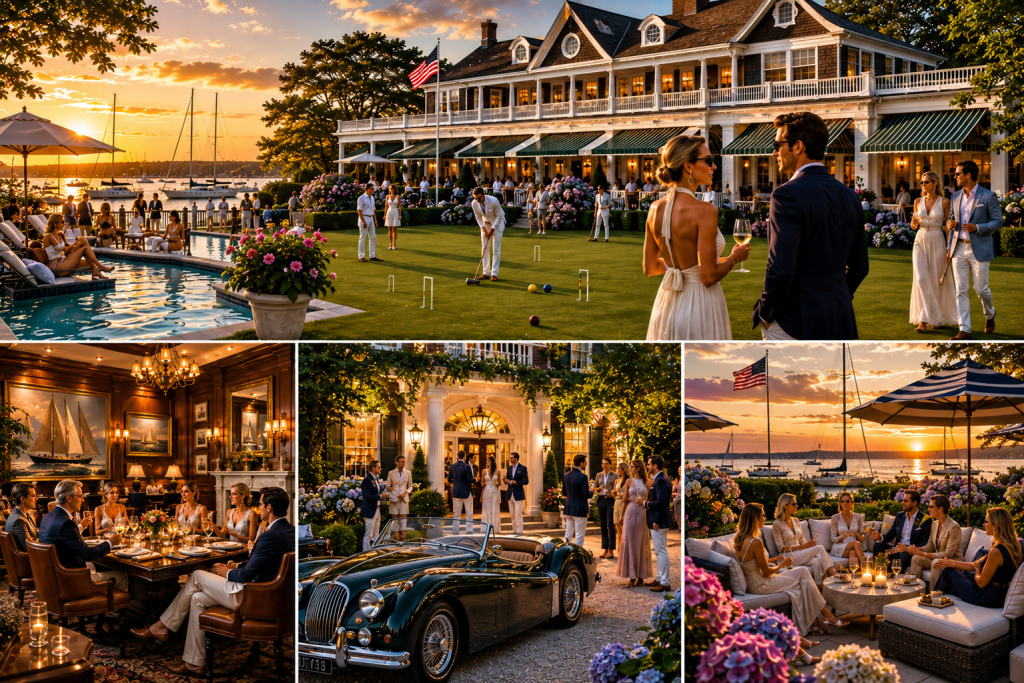
Southampton’s private clubs are not amenities. Nor are they perks of homeownership. Rather, they are the operating system of the village’s social life, and understanding their hierarchy is understanding Southampton itself. Town and Country once observed that club affiliations define life in Southampton: Shinnecock Hills for golf, the Bathing Corporation for the beach, the Meadow Club for tennis and dancing. That observation remains accurate in 2026.
What nobody tells the newly arrived homeowner (the one who just closed on a $5 million property in the estate section and assumes the hard part is over) is that buying south of the highway is the beginning of the process, not the end. The house gets you an address. The clubs get you a life. And the clubs operate on a logic that has very little to do with how much money you have.
The $6,000 Landscaper and the Missing Cabana
He bought the house in November. By January he had renovated the kitchen, resurfaced the pool, and hired a landscaper who charges $6,000 a month to maintain hedgerows he did not plant. By March he had asked his broker about the Bathing Corporation. She paused for exactly one second (the pause that means “I will explain this gently”) and said: “The Bathing Corp is not something you apply to. It is something that happens to you. Or doesn’t.” He spent the summer at [Cooper’s Beach](/southampton-beaches-coopers-beach/), which is the best public beach in America, which is not nothing. But he understood, by September, that the $50 parking fee was not the same as a cabana. And that the cabana was not available.
This guide maps the Southampton private clubs for the reader who needs to understand the system, whether to navigate it, to accept it, or simply to appreciate the social engineering of a village that has been sorting its residents for over a century.
Tier 1: The Inherited Institutions
The Bathing Corporation of Southampton
14 Gin Lane, Southampton. Founded 1923. bathingcorp.com.
The Bathing Corporation is the most exclusive private club on the East End. Indeed, it may be the most exclusive beach club in America. Members refer to it simply as “The Beach Club,” with the definite article doing the heavy lifting. The club has no social media presence. Photos of the interior are nearly nonexistent (the most widely circulated image dates to 1928). It does not advertise membership. One cannot join without being recommended by a member, and members often joke that someone has to die before new members are considered. This is not entirely a joke.
The facilities occupy a narrow strip between Agawam Lake and the Atlantic, featuring a saltwater pool, a covered restaurant, a shaded pavilion, and a Spanish hacienda-style clubhouse that has not been photographed for Instagram because the members who use it do not post on Instagram. Perhaps 400 carefully screened families share approximately 400 feet of private beach. Nannies in white dresses and floppy straw hats watch children in the sand. The scene has not changed meaningfully in decades. This is the point.
The membership roster reads like a Social Register directory. Names like Rockefeller, Astor, and Vanderbilt carry weight. The annual Blue Book, a Southampton society phonebook sold each Memorial Day, identifies all members. Rejected applicants have reportedly included David Koch, Richard LeFrak, and the Noel family. Notably, the club did not admit Jewish members until relatively recently in its history.
What Membership Costs and Means
What it costs: The initiation fee is not publicly disclosed. Reports vary widely. In reality, though, the financial cost is irrelevant. The Bathing Corporation does not select for wealth. It selects for lineage. Your grandmother held a cabana. Your mother held a cabana. Now you hold a cabana. In fact, the surest path to membership is inheritance. Marriage is the second surest path. A decade of philanthropy on the right Southampton boards (Southampton Hospital Foundation, Parrish Art Museum) is the third, followed by a quiet recommendation from an existing member who has watched you long enough to decide you belong.
What it means: Membership in the Bathing Corporation communicates something that no amount of money can purchase: generational presence. It is the difference between being rich and being established. In Southampton’s social grammar, the distinction is everything.
The Meadow Club
631 Meadow Lane, Southampton. Founded 1887.
The Meadow Club is older than the Bathing Corporation by 36 years and operates on a complementary logic. Where the Bathing Corp is about the beach, the Meadow Club is about the court and the ballroom. Founded in 1887 on the estate of J. Bowers Lee, one of Southampton’s first summer residents, the club established an international tennis tournament (the Southampton Invitation, 85 editions, 1888 to 1973) that was for decades one of the premier grass court events in the world.
The facilities are staggering: 36 grass tennis courts across more than eighteen acres, making it one of the largest collections of natural grass tennis surfaces in the Western Hemisphere. Two Har-Tru courts. Two all-weather courts. Paddle tennis. Croquet. A 25-yard swimming pool. Banquet facilities. Pickleball (because even Southampton cannot resist the zeitgeist entirely). The club hosts eight summer dances in a white ballroom hung with chandeliers strung with crystal beads.
The Price of the Meadow Club
What it costs: Initiation fees reportedly range between $150,000 and $500,000, with some sources estimating significantly higher for full membership. Annual dues run $15,000 to $40,000 depending on membership tier. Yet the financial barrier is, again, less relevant than the social one. The club values lineage over liquid assets. Your great-grandfather’s membership carries more weight than your hedge fund’s performance. The club did not admit Jewish members until the late 1970s. Through the 1990s and early 2000s, journalists reported no Black members.
What it means: The Meadow Club is where the younger generation of Southampton society has traditionally gathered. If the Bathing Corporation is the grandparents’ club, the Meadow Club is where the grandchildren learn the steps (literally, at the summer dances). Membership is a marker of social arrival that specifically signals athletic engagement and cultural fluency with the traditions of the Anglo-American country club.
She is fourteen years old and attending her first Meadow Club dance. Her mother bought her a white dress from the same boutique on Jobs Lane where her grandmother bought a white dress in 1987. The ballroom smells like gardenias. The boy asking her to dance goes to Buckley. His family has been members since his great-grandfather played in the Southampton Invitation. She does not know this. All she knows is that the chandeliers are beautiful and that the grass courts outside are so green they look painted. She will remember this evening for the rest of her life, though she does not know that yet either. This is how Southampton reproduces itself: one dance at a time.
Tier 2: The Golf Cathedrals
Shinnecock Hills Golf Club
200 Tuckahoe Road, Southampton. Founded 1891.
Shinnecock Hills is the oldest incorporated golf club in America, a founding member of the USGA, and the only venue to host the U.S. Open in three different centuries. The full history, the course, and the 2026 championship are detailed in the U.S. Open at Shinnecock Hills spoke. What belongs here is the club’s role in Southampton’s social architecture.
Shinnecock Hills is the golf club. In a village with access to Sebonack, National Golf Links, and several other world-class courses, Shinnecock occupies a tier that the others compete with but do not reach. Specifically, the Stanford White clubhouse (1892), the William Flynn course (1931), and the history create an institutional weight that newer clubs cannot manufacture.
What it costs: Initiation reportedly runs well into six figures for traditional membership, with annual dues adding significantly more. However, Shinnecock, like the Bathing Corporation and the Meadow Club, is not primarily a financial transaction. It is a social one. The old-line clubs maintain initiation fees that are, by Hamptons standards, relatively modest (under $75,000 by some reports), because the real barrier is not money. The real barrier is the question of whether you are the kind of person the existing membership wants to play golf with, which is a question that takes years, not dollars, to answer.
What it means: Shinnecock membership communicates institutional alignment. It says: I play golf seriously. I respect the history of the game. I understand that a club founded in 1891 operates on principles that a club founded in 2006 does not.
Sebonack Golf Club
405 Sebonack Road, Southampton. Founded 2006.
If the old-line clubs select for lineage, Sebonack selects for capital. Opened in 2006 on land adjacent to both Shinnecock Hills and the National Golf Links of America, Sebonack was designed by Jack Nicklaus and Tom Doak, two architects whose philosophies are nearly opposite (Nicklaus builds manicured challenges for elite players; Doak lets the land dictate the design). The collaboration, commissioned by owner Michael Pascucci, produced a course that overlooks Great Peconic Bay and consistently ranks among the top courses in America.
What it costs: At opening in 2006, the initiation fee stood at $500,000 for golf-only membership and $650,000 including access to on-site cottages. Ten founding members paid $1 million each. Annual dues run $15,000 to $30,000. Notably, Michael Bloomberg and Leon Black were among the founding members. The club has approximately 200 members.
What it means: Sebonack is the “new guard” club. In Hamptons terms, “new guard” means members who made their fortunes in the last 40 years instead of the last 140. For the VC or business owner with a recent liquidity event, Sebonack is the entry point to a world-class course without waiting a decade for a Shinnecock recommendation. Essentially, the initiation fee is the highest in the Hamptons while the social barrier is the lowest of the top-tier clubs. Still, the currency is financial achievement rather than ancestral presence.
The Social Infrastructure Budget
Family office advisors increasingly recommend what they call “social infrastructure budgeting”: allocate five to ten percent of your time to club engagement and track it like a board commitment. Anyone who ghosts after initiation does not get the introductions. On the other hand, the member who attends the right three events per quarter (the charity auction, the member-guest tournament, the winter gala) becomes woven into the social fabric where trust gets built. At Sebonack, the 18th hole conversation is where your next board seat gets floated.
National Golf Links of America
Sebonack Road, Southampton. Founded 1911.
Adjacent to Sebonack and overlooking the same stretch of Peconic Bay, the National Golf Links was designed by C.B. Macdonald. He is widely regarded as a founding father of American golf course architecture. The course consistently ranks among the ten best in America. In contrast to Sebonack, membership is smaller and more selective, with initiation fees reportedly under $75,000 but social barriers commensurate with Shinnecock Hills.
Tier 3: The Pathway Institutions
How to Get In (When You Cannot Get In)
The reader who has made it this far is asking the question that this entire guide has been building toward: how does someone who did not grow up in this system gain access to it?
The answer is not pleasant. It is honest.
Step 1: Buy the house. First, you cannot participate in Southampton’s social architecture without a Southampton address. South of the highway is preferable. The house is the prerequisite, not the destination.
Step 2: Philanthropy. Essentially, this is the audition that never calls itself an audition. Board membership at the Southampton Hospital Foundation, a trustee position at the Parrish Art Museum, a table at the right charity gala: these engagements place you in rooms where Bathing Corporation members serve on committees and Meadow Club members chair events. A $50,000 donation to the right cause gets your name in the right program. Philanthropy on the East End is not generosity. It is strategy. (It is also, in fairness, generosity. Both things can be true.)
Step 3: Time. Southampton’s club system rewards patience. Naturally, the recommendation for the Bathing Corporation comes after years, not months. Similarly, a Meadow Club invitation comes after the existing membership has observed you at enough charity benefits, school events, and casual encounters at Sant Ambroeus to decide that you understand the village’s unwritten codes. In each case, the timeline is measured in summers, and each summer is a data point.
The Advisors and the Alternative
Step 4: The right broker, the right advisor, the right neighbors. Your real estate broker (if she is the right broker) knows which committees to join. Meanwhile, a good wealth advisor (one who understands social capital as well as financial capital) knows which galas to attend. And your neighbors (if you have chosen the right street) are already members of the clubs you want to join. The introduction happens casually, at a dinner party, over wine. It feels organic. It is not.
Step 5: Accept the timeline or choose a different path. If the old-line clubs require a decade of patience, the new-guard clubs (Sebonack, Atlantic Golf Club, The Bridge in Bridgehampton) offer a faster entry point. Financial barriers are higher. Yet social barriers are lower. In short, the trade-off is transparent.
The alternative: Polo Hamptons (July 18 and 25, 900 Lumber Lane, Bridgehampton) functions as a social accelerator. The cabana packages and VIP tables place you in proximity to the exact audience that populates the membership rolls of every club described in this guide. BMW North America sponsors. Christie Brinkley hosts. The guest list reads like a cross-section of the Bathing Corporation, the Meadow Club, and Shinnecock Hills, except at Polo Hamptons, no one needs a recommendation. They need a cabana reservation.
The Unwritten Rules
What the Clubs Are Actually Sorting For
Southampton’s private clubs are often described as exclusionary, and they are. But the exclusion operates on a logic that is more nuanced than simple snobbery (though snobbery is certainly present). What the clubs are sorting for is cultural fluency: the ability to read and reproduce the behavioral codes of a specific social class.
Do you know when to arrive and when to leave? Can you understand that the dress code (“tennis whites”) is not a suggestion? Are you aware that bragging about your net worth at the Meadow Club dance is a disqualifying offense, while modestly mentioning your charitable work is not? Essentially, do you understand that the Bathing Corporation’s refusal to have a website is not technophobia but a statement about the kind of attention the club prefers?
These codes are learned, not explained. They pass through families, through schools (Buckley, Chapin, Spence, Dalton, Collegiate), through summer friendships that began at age eight and continue at age forty-eight. A newcomer who understands this process and engages with it patiently will eventually receive the invitation. Anyone who tries to shortcut it will not.
The Diversity Question
Southampton’s private clubs have a history of exclusion that extends well beyond wealth-based sorting. Historically, the Bathing Corporation, the Meadow Club, and the old-line golf clubs maintained restrictions on Jewish, Black, and other minority members. For instance, the Meadow Club did not admit Jewish members until the late 1970s. Shinnecock Hills, despite being built on Shinnecock Nation land with the labor of 150 Shinnecock Indians, maintained membership practices that excluded the very people whose name the club carries.
These histories are part of the Southampton private clubs story, not separate from it. Over time, the clubs have evolved, and their current membership is more diverse than it was a generation ago. Nevertheless, the pace of change has been glacial by any standard other than the clubs’ own. A full accounting of this history is beyond the scope of a guide, but a guide that omitted it would be dishonest.
The Complete Club Map
| Club | Founded | Type | Initiation (reported) | Social Tier |
|---|---|---|---|---|
| Bathing Corporation | 1923 | Beach | Undisclosed | Old guard (lineage) |
| Meadow Club | 1887 | Tennis/Social | $150K to $500K+ | Old guard (lineage) |
| Shinnecock Hills | 1891 | Golf | Under $75K (old-line) | Old guard (lineage) |
| National Golf Links | 1911 | Golf | Under $75K (old-line) | Old guard (lineage) |
| Sebonack | 2006 | Golf | $500K to $650K+ | New guard (capital) |
| Atlantic Golf Club | 1992 | Golf | ~$250K | New guard (capital) |
| The Bridge | 2002 | Golf/Social | ~$550K | New guard (capital) |
Where the Conversation Continues
Social Life Magazine has covered Southampton’s social architecture for twenty-three years, through membership cycles and generational transitions and the quiet negotiations that happen between the second and third courses at benefit dinners. The Southampton Village Dossier places the club system in the context of the village’s full residential, culinary, and cultural landscape.
If your brand, practice, or advisory firm serves the audience described in this guide (and if you recognized yourself in any of the preceding paragraphs, it does), Social Life Magazine’s paid feature program places your story in front of 25,000 copies per issue, distributed at the restaurants, hotels, and beach clubs where the club conversation happens over lunch.
Polo Hamptons 2026 (July 18 and 25, 900 Lumber Lane, Bridgehampton) is the event where the club system’s walls come down for an afternoon. Bathing Corporation members, Meadow Club members, Shinnecock members, Sebonack members, and everyone who aspires to join them share the same field, the same champagne, and the same view of Christie Brinkley hosting alongside BMW North America. The cabana is the membership that requires no lineage. The VIP table is the initiation fee that takes one phone call instead of one decade.
To receive Social Life Magazine delivered to your door, visit our subscription page.
The Bathing Corporation has no website. Meanwhile, the Meadow Club has 36 grass courts. Shinnecock Hills has hosted six U.S. Opens. Sebonack charges $650,000 to walk through the door. And Southampton, the village that has been sorting its residents since 1640, continues to do what it has always done: decide who belongs, and let the hedgerows communicate the verdict.
Author

Written by
Recent Posts
Jetsetter Style: Castello del Sole

The First Decision After a Collision Can Be the Most Important One
Two Weeks in Rome and Beyond: Turkish Airlines Itineraries from Boston, Chicago and Onward to India

Top 10 Hair Transplant Clinics in Turkey 2026

Artist Alley to Online Store: How Convention Artists Can Keep Selling After the Event
Categories
- Art
- Articles
- Business of Luxury
- Celebrities
- Culture
- Entertainment
- Events
- Faces of Summer 2026
- Fashion
- Fashion & Style
- Featured
- Finance
- Food, Spirits, Wine
- Hamptons
- Hamptons Celebrities
- Health
- Health & Beauty
- Lifestyle
- Luxury Lifestyle
- Press
- Profiles
- Real Estate
- Technology
- The Chronicles
- Travel
- Uncategorized
- Weddings