
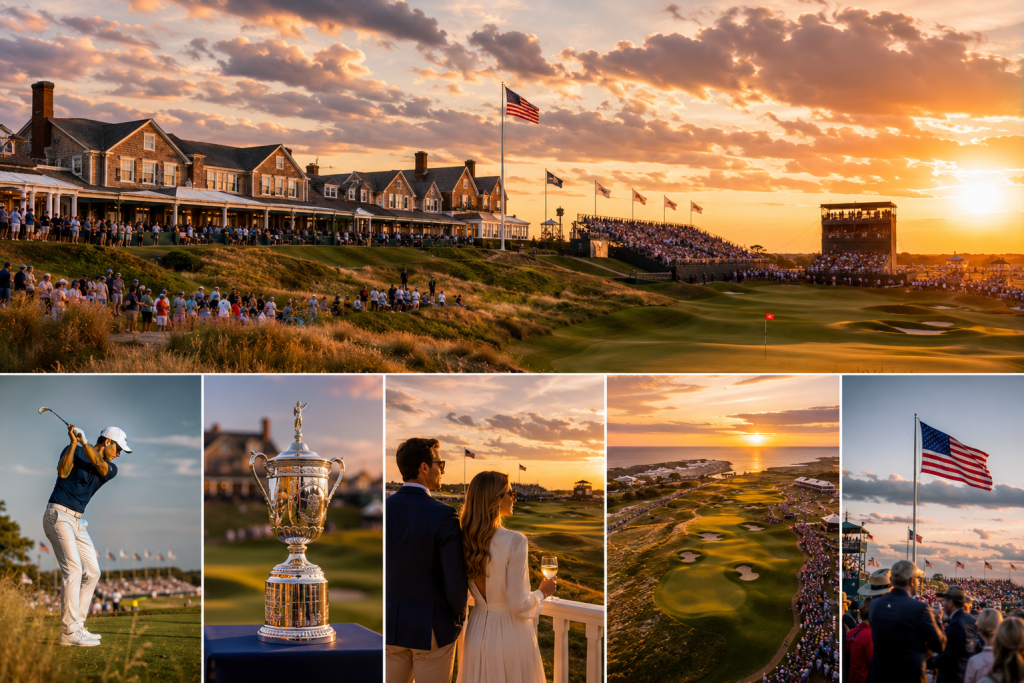
The Cathedral Opens Its Doors
In three weeks, a village that has spent 386 years perfecting the art of not being noticed will become the most televised zip code in American sports. The 2026 US Open at Shinnecock Hills runs June 18 to 21 in Southampton, New York, and it will bring approximately 150,000 spectators, a temporary Long Island Rail Road station, a BLADE helicopter landing zone on Shinnecock Nation land, and the kind of logistical chaos that makes Southampton’s two-lane roads weep. The village that hides behind hedgerows is about to show itself to the world.
He has played golf for thirty-one years. A 4.2 handicap, a membership at a club in Westchester that costs $85,000 annually, and not once in all of it has he set foot on Shinnecock Hills. He has never met anyone who has. Still, he paid $1,158 for a weekly gallery pass. He will walk thirteen miles over four days in June heat and tell you, if asked, that it was worth every step. Because Shinnecock is not a golf course. It is a cathedral. And you do not need to be a member to attend the service.
This is the sixth time Shinnecock Hills Golf Club has hosted the U.S. Open and the only venue in history to host the national championship in three different centuries: 1896, the twentieth century (1986, 1995, 2004, 2018), and now the twenty-first. The USGA has accepted 10,201 entries. A field of 156 players will compete for 72 holes of stroke play over a links-style course that the USGA calls one of the “cathedrals of golf” and that the wind, on any given Thursday, can turn into something considerably less sacred.
What a Shinnecock Open Really Is
For the uninitiated: a U.S. Open at Shinnecock Hills is not simply a golf tournament. It is the week when Southampton’s social infrastructure (the private clubs, the estate-section hedgerows, the restaurants where your reservation reveals your status) collides with the largest spectator event on the East End. Understanding both is understanding the week.
The Course: 135 Years of Sacred Ground
How Shinnecock Began
Shinnecock Hills Golf Club was founded in 1891, which makes it the oldest incorporated golf club in the United States. The founding story reads like something a DFW character would spend three pages deconstructing: a group of prominent New York businessmen, including William K. Vanderbilt (grandson of Cornelius), traveled to Biarritz, France, in 1890 and encountered a Scottish golf professional named Willie Dunn building a course at the resort. They became, in the parlance of their era, enamored. They came home and decided to build something similar on the rolling, sandy terrain of Southampton.
Willie Davis, another Scottish professional, laid out the original twelve holes in 1891. Over 150 members of the Shinnecock Indian Nation helped clear the land. In 1892, the architectural firm of McKim, Mead and White (Stanford White’s firm, the same that designed the original Penn Station) built what is widely considered the first purpose-built golf clubhouse in America. The Shingle Style structure sits on the highest point of the property, overlooking Great Peconic Bay, and remains substantially unchanged after 134 years.
By 1894, Dunn had expanded the course to eighteen holes. That same year, Shinnecock Hills became one of the five founding clubs of the United States Golf Association. The club admitted women from its inception, making it one of the first in America to do so. Members added a nine-hole ladies-only course in 1893.
The Course You Will See in June
The course that the 2026 field will play is largely the creation of William Flynn, who redesigned Shinnecock in 1931 after a new road (the current Route 27) was planned through several of C.B. Macdonald’s holes south of the clubhouse. Juan Tripp, the founder of Pan American Airlines, was instrumental in hiring Flynn. The resulting layout, built on linksland that slopes toward Peconic Bay, plays as a par 70 stretching to approximately 7,440 yards from the championship tees.
In 2012, Bill Coore and Ben Crenshaw (the design team behind Sand Hills and Bandon Trails) made enhancements to several greens and fairways without altering Flynn’s fundamental routing. The course is defined by its fescue-lined fairways, severely contoured greens, and exposure to wind that comes off the bay and the Atlantic in shifting patterns that turn a 380-yard par four into a 450-yard problem between morning and afternoon rounds.
Golf Digest has ranked Shinnecock Hills as high as second among all courses in America. Johnny Miller once called it “golf’s holy grail.” The USGA appreciates Shinnecock so much that it awarded the 2026 championship before the 2018 Open had even been played, and has already scheduled a return in 2036.
The History: Five U.S. Opens and the Story America Almost Missed
1896: John Shippen and the Thirteen Words That Changed Everything
The most important moment in Shinnecock Hills history is not a shot, a score, or a trophy. It is a sentence. In 1896, the USGA chose Shinnecock to host its second U.S. Open. The club, as a courtesy to the host venue, invited Shinnecock Hills to enter its best player. The members chose John Shippen Jr., a sixteen-year-old caddie of African American and Shinnecock Indian descent who had learned the game under Willie Dunn’s instruction. They also entered Oscar Bunn, a full-blooded Shinnecock Indian from the grounds crew.
The field of twenty-eight players, dominated by Scottish and English professionals, signed a petition threatening to boycott the tournament if Shippen and Bunn were allowed to compete. USGA president Theodore Havemeyer, one of the wealthiest men in America (his family owned the American Sugar Refining Company), delivered a response that history has recorded in various phrasings but whose substance is consistent: the Open would be played with or without them. They could leave or stay as they pleased.
Shippen’s Round
They stayed. Shippen shot an opening-round 78 and trailed the leader by just two strokes. He contended for the title until an 11 on the 13th hole in the final round dropped him to a tie for fifth. The USGA awarded him $10 in prize money, officially making him the first American-born professional golfer and the first Black professional golfer.
Shippen went on to play in five more U.S. Opens and worked at Maidstone, the National Golf Links of America, and other courses before spending the last thirty years of his career as the professional at Shady Rest Country Club in Scotch Plains, New Jersey, the first exclusive golf club for African Americans. The PGA of America did not register him as a member until 2009.
He is sixteen years old and the best golfer at the club and the son of a preacher on the reservation. The other players do not want him here. The president of the governing body tells them they can leave. They stay. He shoots 78 in the first round. Two strokes off the lead. He is the first American to compete for his own national championship.The trophy goes to a Scotsman. The ten dollars goes to Shippen. The history goes to everyone.
The Twentieth Century: Floyd, Pavin, Goosen, Koepka
Shinnecock did not host another U.S. Open for ninety years after Shippen’s debut, a gap that reflects the complicated relationship between the club’s extreme privacy and the USGA’s need for infrastructure. When the Open returned in 1986, Raymond Floyd won at age 43, still one of the oldest U.S. Open champions. Corey Pavin took the title in 1995 with a famous four-wood approach on the final hole that stopped five feet from the pin.
In 2004, Retief Goosen won his second U.S. Open at Shinnecock in a championship remembered for its controversy: the USGA’s Saturday setup let the seventh green dry out so severely that balls would not hold the putting surface, and some players argued the course had crossed the line from demanding to unfair. Phil Mickelson finished second, the third of what would eventually become a record six runner-up finishes at the U.S. Open.
2018: Koepka, Mickelson, and the Most Controversial Saturday in Memory
The most recent Shinnecock Open, in 2018, produced both a worthy champion and a moment that may never be replicated. Brooks Koepka, then 28, became the seventh man to win consecutive U.S. Open titles (and the first since Curtis Strange in 1988 and 1989), beating Tommy Fleetwood by one stroke with a final-round 68 that required par saves on the 11th, 12th, and 14th holes that each felt like surviving a car crash at slow speed.
But the Saturday will be remembered longer than the Sunday. The USGA’s aggressive pin positions combined with afternoon wind to turn the course into something several players described as unfair. Dustin Johnson, who had led by four strokes at halfway, shot 77 and dropped into a four-way tie. Fleetwood shot a 63 in the morning calm that remains one of the great U.S. Open rounds.
And then there was Mickelson on the 13th green. Having missed a short downhill putt, Mickelson watched his ball trickling away from the cup, aided by gravity and wind, toward the edge of the putting surface. Rather than waiting for it to stop, he jogged after it and, while the ball was still moving, swatted it back toward the hole. The USGA assessed a two-stroke penalty rather than disqualification. He later said his “anger and frustration got the best of me.” Many of his peers felt the game would have benefited from a stronger response.
Koepka’s name is on the trophy. Mickelson’s name is on the anecdote. Shinnecock, as always, is on the course.
The 2026 Championship: What You Need to Know
Dates and Format
Practice rounds run Monday through Wednesday, June 15 to 17. Championship rounds run Thursday through Sunday, June 18 to 21. The format is 72-hole stroke play with a cut to the low 60 scores and ties after 36 holes. If two or more players are tied after 72 holes, a two-hole aggregate playoff takes place Sunday evening.
Tickets
Gallery passes offer grounds access to follow players across the course. Weekly passes start around $1,158. Daily tickets are available for practice and championship rounds, with practice-round tickets being the most affordable entry point.
Trophy Club featuring Corona Premier is a climate-controlled hospitality facility along the 4th fairway offering upgraded food and beverage for purchase, live television coverage, and executive restrooms. Daily tickets and weekly packages available.
Grandstand seats at the 7th, 13th, and 15th holes offer reserved viewing with all-inclusive food and non-alcoholic beverages. Daily tickets and multi-day packages available.
The 1895 Club is the premium all-inclusive hospitality experience overlooking the 17th hole, with behind-the-scenes access and top-tier amenities. Named for the year Shinnecock became a USGA founding club, it represents the most luxurious way to watch a U.S. Open, with daily tickets and five-day packages. Pricing ranges into five figures.
Corporate hospitality information is available at hospitality.usga.org. If you are reading this article and your company has not yet secured a hospitality package, your competitors probably have.
Getting There: The Logistics Briefing
This is where championship week gets real. Southampton is not built for 150,000 visitors. The village’s two-lane roads handle roughly 5,000 cars on a busy summer Saturday. Championship week will push daily vehicle volume to four or five times that. Montauk Highway becomes a parking lot by 6 AM. Tuckahoe Road is closed to through-traffic during championship hours.
There is no general fan parking at Shinnecock Hills Golf Club. This fact alone disqualifies the “I’ll just drive” plan that many first-time attendees default to.
LIRR: The MTA is building a temporary platform adjacent to the Stony Brook Southampton campus. Service runs from Penn Station on the Montauk Branch, approximately two hours each way. The MTA runs morning and afternoon trains daily, with increased service during championship rounds. Fans exit the train, pass through security screening, and cross a pedestrian bridge over County Route 39 to reach the grounds.
Blue Lot (Calverton Airfield): Satellite parking with U.S. Open Express Shuttle service. Fans driving from points west of Shinnecock Hills are strongly encouraged to use this option or the LIRR rather than attempting to navigate Montauk Highway.
Shinnecock Nation Reservation parking: Premier parking passes are available for purchase on the Shinnecock Nation Reservation, adjacent to the course. These will sell out.
BLADE: The official helicopter service provider for the 2026 U.S. Open. BLADE will operate Thursday through Sunday with a landing zone on the Shinnecock Nation Powwow Grounds. If you are the kind of person who helicopters to golf tournaments, you already know the number.
Rideshare and private car service: Drop-off is available at Stony Brook Southampton campus (via Montauk Highway) and at local train stations. Private car service with pre-arranged drop-off at the Stony Brook zone is, realistically, the option that avoids 45-minute shuttle waits while maintaining door-to-gate flexibility.
The Week Beyond the Course
Southampton During Championship Week
The U.S. Open transforms Southampton for seven days. Main Street restaurants that normally require a Thursday reservation will require a Monday call. Hotel rooms that were available in April are now sold out or priced at levels that make Meadow Lane real estate look like a bargain per square foot.
But the transformation is also an opportunity. Championship week brings a concentration of corporate decision-makers, financial executives, and brand leaders to the East End that no other single event can match. The corporate hospitality tents at Shinnecock function as deal rooms with better catering. The restaurants function as closing dinners. The hotels function as war rooms.
If your brand is visible during U.S. Open week, it is visible to the exact audience that spends the other 51 weeks making the decisions that matter.
Where to Eat During Championship Week
The restaurants closest to the action will be packed. Plan accordingly.
Sant Ambroeus (30 Main Street, Southampton) is the room where the quiet money eats. Milanese elegance, cacio e pepe that regulars say rivals Rome, and a vine-covered patio that functions as the village’s most reliable stage for the Thursday-through-Sunday performance of casual affluence. Book now or accept defeat. For the full Southampton dining guide, see Best Restaurants in Southampton 2026.
75 Main (75 Main Street, Southampton) operates at the intersection of celebrity sightseeing and legitimately excellent Mediterranean cuisine. Open year-round. James Beard Award-winning chef Mark Militello runs the kitchen.
Southampton Publick House is the antidote to everything described above: a brewpub with housemade ales and the kind of unpretentious energy that reminds you this village was, not long ago, a farming community. One of the few genuinely relaxed rooms on the East End.
For Sag Harbor dining (fifteen minutes east and a different universe), consider Le Bilboquet or the bar at Murf’s.
Where to Stay
If you have not booked accommodations for championship week, your options are narrowing rapidly. The 1708 House (126 Main Street) offers B&B intimacy with a cellar dating to 1648. Southampton Inn (91 Hill Street) is the reliable middle ground. The Capri Southampton (281 County Road 39A) is the boutique play with a pool scene and the NAIA restaurant.
For expanded options, see Where to Stay in Southampton or Sag Harbor Hotels.
From the U.S. Open to Polo Hamptons: The Three-Week Corridor
The 2026 U.S. Open ends Sunday, June 21. Polo Hamptons 2026 opens Saturday, July 18, at 900 Lumber Lane in Bridgehampton, with BMW North America as title sponsor and Christie Brinkley hosting. Three weeks separate the two events, and the audience overlap is almost total: the corporate executive who attends Shinnecock on Thursday is the same person who books a cabana at Polo Hamptons on Saturday.
Social Life Magazine covers both. If your brand activated at the U.S. Open and wants to maintain visibility through the peak of Hamptons summer, Polo Hamptons offers cabana packages, VIP tables, and sponsorship opportunities that extend the conversation Shinnecock starts.
The July 18 and July 25 dates bracket the heart of the season. The guest list reads like a subscriber roll for this magazine.
The Meaning of Three Centuries
Why Shinnecock Matters Beyond Golf
Shinnecock Hills Golf Club is not merely old. It is constitutive. The club helped invent organized golf in America. It hosted the moment when the USGA decided, in 1896, that the national championship would be open to everyone regardless of race (a principle the PGA of America would not adopt for another sixty-five years). Stanford White was commissioned to build the first real golf clubhouse. It sits on land that the Shinnecock Nation inhabited for thousands of years before any colonist arrived, and 150 members of that nation helped clear the ground on which the first twelve holes were laid.
When you walk the course during championship week, you are walking ground that connects the founding of New York’s first English settlement (1640, two miles south) to the founding of American golf (1891) to the founding of the USGA (1894) to the first integrated professional sporting event in American history (1896, by a teenager named Shippen who finished fifth and was paid ten dollars). That is a lot of history for a single zip code.
Southampton has been making the same argument since the Puritans landed at Conscience Point: build well, maintain what you build, and the rest follows. Shinnecock Hills is the proof.
Where the Conversation Continues
Social Life Magazine has covered the East End for twenty-three years, across every village from Westhampton to Montauk, through five U.S. Opens at Shinnecock and twenty-three seasons of Polo Hamptons. The Southampton Village Dossier is the definitive guide to the village that hosts the 2026 championship.
If your brand serves the audience that attends a U.S. Open (and if you have read this far, it does), Social Life Magazine’s paid feature program puts your story in front of 25,000 copies per issue, distributed across the restaurants, hotels, coffee shops, and beach clubs where championship week’s decisions get made.
Polo Hamptons 2026 (July 18 and 25, Bridgehampton) picks up where Shinnecock leaves off. Cabana packages, VIP tables, and sponsorship opportunities alongside BMW North America. If your brand activated at the Open, keep the momentum through July.
To receive Social Life Magazine delivered to your door, visit our subscription page.
John Shippen paid his entry fee in 1896 with money borrowed from club members who believed he belonged. The USGA president told the objectors they could leave. They stayed, and American golf became American. One hundred and thirty years later, the cathedral opens its doors again. The question is not whether you should be there. The question is where you will be standing.
Author

Written by
Recent Posts

AI Chip Billionaires: The Hardware Fortunes Powering Every AI on Earth

Lisa Su Net Worth 2026: The AMD CEO Giving Nvidia Its Only Real Fight

Curtis Priem Net Worth 2026: The Nvidia Cofounder Who Left $600 Billion on the Table

Jensen Huang Net Worth 2026: From Denny’s Dishwasher to a $165 Billion Fortune

AI Billionaires 2026: The New Money That Makes Old Money Nervous
Categories
- Art
- Articles
- Beauty & Skincare
- Celebrities
- Chronicles
- Events
- Fashion
- Fashion & Style
- Featured
- Food & Beverage
- Food, Spirits, Wine
- Hamptons
- Hamptons Celebrities
- Hamptons Guide|Arts & Culture
- Hamptons Guide|East End Dining
- Hamptons Guide|East End Living
- Health
- Health & Beauty
- Lifestyle
- Luxury Lifestyle
- Luxury Lifestyle|The Chronicles
- Press
- Profiles
- Real Estate
- Technology
- The Chronicles
- Travel
- Uncategorized
- Weddings