
The Model Builders: AI Billionaires Reshaping Trillion-Dollar Industries
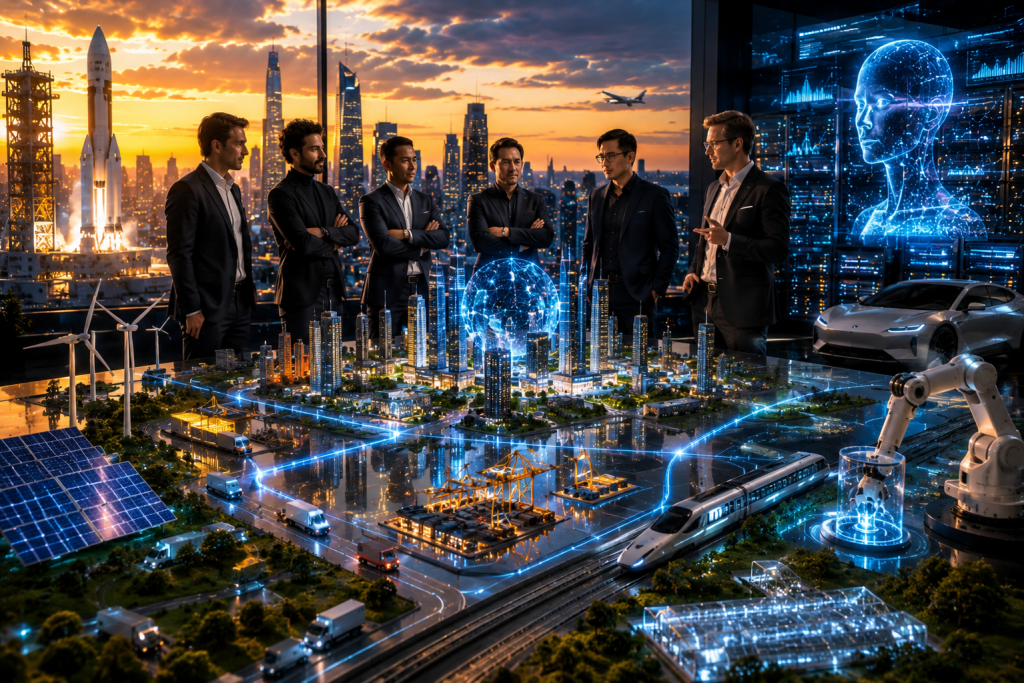
If the chip billionaires are the landlords and the model builders of AI are the architects of the AI economy, the AI billionaires at the intelligence layer are the architects. Building the models, shipping the products, generating the headlines. Sam Altman’s OpenAI, Elon Musk’s xAI, and Dario Amodei’s Anthropic are the companies that turned artificial intelligence from an academic discipline into a consumer product, a geopolitical weapon, and a financial phenomenon. This hub of the AI billionaires 2026 story is where the drama lives, the firings, the lawsuits, the philosophical schisms, the trillion-dollar valuations, because the model builders are the ones whose decisions determine whether AI becomes the most beneficial or most dangerous technology in human history.
Sam Altman: The Cautionary Tale of Power Without Equity
Sam Altman’s net worth of $3.3 billion comes entirely from venture investments made before OpenAI existed. Earning $76,001 per year, owning zero shares in a company valued at $730 billion. He was fired by his own board on a Friday in November 2023 and reinstated by Tuesday after 91% of the company’s staff threatened to leave with him. Altman is the most powerful person in artificial intelligence and the person who benefits least from its financial explosion.
His story is a cautionary tale about the gap between building and owning. Altman built the organization that launched ChatGPT and triggered the global AI arms race. He invested in over 400 companies through Y Combinator that generated his actual fortune. He married Oliver Mulherin in Hawaii in 2024, had a son via surrogacy in 2025, and lives in a $27 million San Francisco mansion. But the company that makes him the most consequential person in technology does not make him a single dollar. The cathedral builder negotiated himself out of owning the cathedral.
Elon Musk: The Contradiction Engine at $852 Billion
Elon Musk’s AI-driven net worth surpassed $852 billion in February 2026 after the SpaceX-xAI merger created a combined entity valued at $1.25 trillion. Musk owns approximately 42% of that entity. He co-founded OpenAI with Altman in 2015, left in 2018, built a competing company (xAI) in 2023, sued OpenAI in 2024, and became richer from AI than from any other source by 2026. Tesla’s own proxy filing acknowledged that “a majority of Mr. Musk’s wealth is now derived from other business ventures.”
Musk’s Grok chatbot competes directly with ChatGPT, Gemini, and Claude. His Colossus supercomputer is one of the largest AI training clusters on earth. His stated goal of “orbital data centers,” AI compute infrastructure deployed via SpaceX’s launch capability, represents the most ambitious integration of AI and physical infrastructure ever attempted. Whether the SpaceX IPO, expected in mid-to-late 2026, prices at $1.5 trillion or higher will determine whether Musk becomes the world’s first trillionaire this year or next.
The OpenAI Crisis: Five Days That Defined AI Governance
The OpenAI boardroom drama of November 2023 was the defining governance crisis in AI history. Altman fired on Friday. Mira Murati named interim CEO. Emmett Shear installed as replacement. Microsoft blindsided. Over 700 employees threatening mass departure. Sutskever signing the letter asking for the reinstatement of the CEO he had just fired. Altman reinstated by Tuesday. The entire board dissolved and rebuilt.
Amazon is making a movie about it. The fact that a five-day corporate governance dispute warranted a Hollywood production captures the scale of the stakes. OpenAI’s crisis was not a personnel matter. It was a live test of whether the most powerful AI company on earth could survive the removal of its CEO, and the answer was no. Power in the model-building layer resides in the talent, not the board seats. Altman won because the employees chose him. The board learned what happens when you fire the person everyone else would follow into a new company.
Dario Amodei: The Pivot That Chose Safety
Dario Amodei was Vice President of Research at OpenAI before leaving in 2021 to co-found Anthropic with his sister Daniela. Their departure was driven by concerns about whether OpenAI was moving too fast and prioritizing commercial products over safety research. Anthropic, the maker of Claude, is now valued at over $60 billion and positions itself as the “responsible AI” alternative.
Amodei published a 15,000-word essay called “Machines of Loving Grace” arguing that AI could cure cancer, reverse climate change, and uplift developing nations. He wrote it while building safety systems designed to prevent AI from doing the opposite. His pivot is not financial. It is philosophical. What happens when you believe the technology you are building might be dangerous but you build it anyway because you believe not building it would be worse? Anthropic’s answer is: build it carefully, test it rigorously, and hope that caution scales as fast as capability.
What the Intelligence Layer Means for Everyone Else
The model builders sit at the center of the AI economy’s attention economy. They generate the headlines that move markets, attract investment, and shape public perception of artificial intelligence. Altman’s firing made front-page news worldwide. Musk’s xAI merger moved billions in market capitalization. Amodei’s safety concerns influence regulatory policy in Washington, Brussels, and Beijing.
But the intelligence layer depends on every other layer to function. The models run on chips designed by Jensen Huang and Lisa Su, train on data labeled by Alexandr Wang and Lucy Guo’s companies, and attract investment from the venture capital class that will be covered in a subsequent hub. The model builders are the most visible AI billionaires, but they are not self-sufficient. Without hardware, the models stop running. Absent data, they stop learning. Absent capital, they stop scaling.
That interdependence is the structural lesson of the intelligence layer. Power in AI is distributed across the stack. Model builders hold the narrative. Chip makers hold the infrastructure. Data barons hold the training material. Investors hold the capital. Between them, they account for $2.9 trillion in combined wealth and the most consequential technology race since the space program. Where that race leads, and who profits from it, is the question this empire exists to answer.
The Attention Premium and the Infrastructure Discount
Here is the structural irony of the intelligence layer, and it is an irony that maps precisely onto every previous technology revolution if you squint hard enough and ignore the parts that do not fit: the model builders capture the most attention and the least durable competitive advantage. ChatGPT is a product that can be replicated. Grok is a product that can be replicated. Claude is a product that can be replicated. The models themselves, the actual neural network architectures, are increasingly commodity. What cannot be replicated is the chip monopoly beneath them (Nvidia), the labeled data that trains them (Scale AI, Surge AI), or the capital required to scale them (SoftBank, a16z). The model builders sit at the narrative apex of the AI economy and the structural nadir of its defensibility.
This is not to say the model builders are unimportant. It is to say that their importance is disproportionately weighted toward the present rather than the future. Altman, Musk, and Amodei are the people Congress calls. They are the people journalists profile. They are the people whose photographs appear on magazine covers and whose quotes anchor newspaper articles and whose product launches generate the kind of breathless coverage that makes everyone in the room feel like they are witnessing history. And they might be witnessing history. But history, as anyone who has studied technology transitions knows, tends to reward the infrastructure providers more than the application builders. IBM built the mainframes. Google built the search engine. Apple built the phone. The application builders won the attention war and the infrastructure providers won the wealth war, and the AI economy is following the same pattern with the same predictable asymmetry.
The Deeper Read
Altman’s $76,001 salary is the most visible expression of this asymmetry. He runs the most famous AI company on earth and cannot convert that fame into financial participation because his company’s governance structure, designed for a world where AI was a research project rather than a $730 billion commercial enterprise, separated fame from equity before anyone understood what equity in an AI company would eventually be worth. The attention premium accrues to Altman. The financial premium accrues to Nvidia, to Scale AI, to the investors who backed OpenAI when it was a nonprofit nobody cared about. That gap between attention and return is the model builders’ defining condition, and it is a condition that no amount of product launches, congressional testimony, or magazine profiles can resolve.
Where the Conversation Continues
You are reading this because the companies building artificial intelligence are not merely technology firms. They are the institutions reshaping finance, governance, and culture in real time.
If your brand, property, event, or company belongs in this conversation, reach us through our contact page.
For premium editorial visibility, explore our paid feature submission process.
Subscribe at sociallifemagazine.com/enflyer for weekly updates.
Polo Hamptons returns July 18 and 25. BMW is the title sponsor. Details at polohamptons.com.
Subscribe at sociallifemagazine.com/subscription. Contributions help keep independent luxury journalism going.
Author

Written by
Recent Posts
hiTechMODA Season 16
How to Keep Your Personal Number Private When Booking Events, Rentals and Services
Understanding Compensatory Damages in a Personal Injury Case

When Online Family Therapy Makes Sense for Modern Families

Carrier Oils, Essential Oils, and Oil Blends: What Beauty Brands Need to Know
Categories
- Art
- Articles
- Business of Luxury
- Celebrities
- Culture
- Entertainment
- Events
- Faces of Summer 2026
- Fashion
- Fashion & Style
- Featured
- Finance
- Food, Spirits, Wine
- Hamptons
- Hamptons Celebrities
- Health
- Health & Beauty
- Lifestyle
- Luxury Lifestyle
- Press
- Profiles
- Real Estate
- Technology
- The Chronicles
- Travel
- Uncategorized
- Weddings