
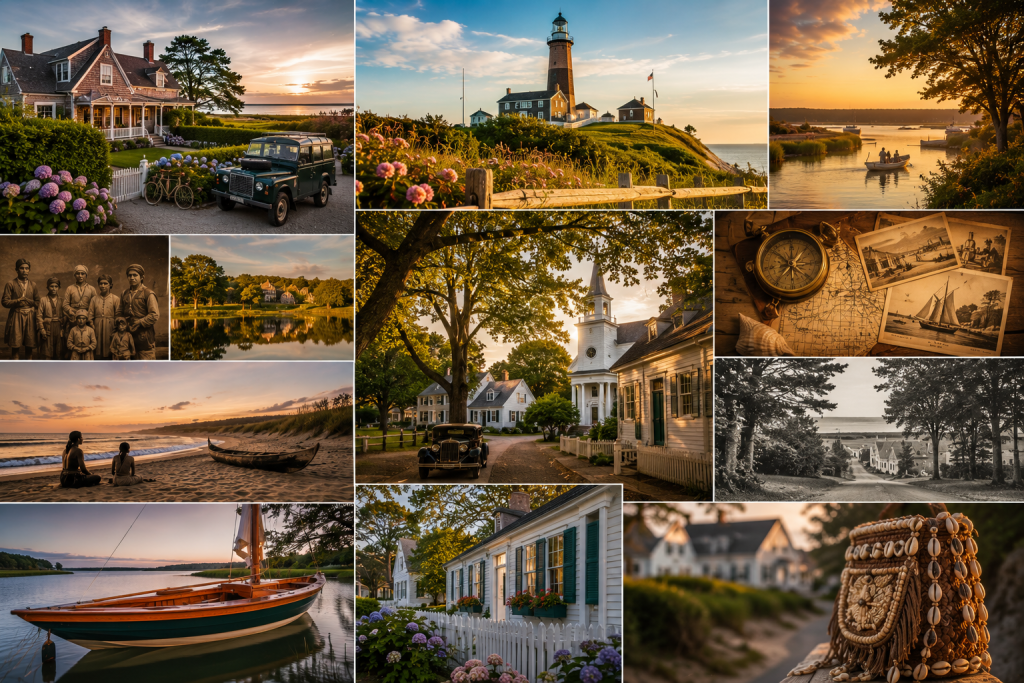
346 Years of Refusing to Become Anything Other Than Itself
The Amagansett history you need to understand begins with a word. The Montaukett people, an Algonquian-speaking Native American culture occupying the eastern end of Long Island for centuries before European contact, named this stretch of coastline for its freshwater spring. “Amagansett” translates to “place of good water,” a reference to the source near what is now Indian Wells Beach. By 1680, that name had attached itself to a settlement. Three hundred and forty-six years later, the water is still good and the hamlet still hasn’t decided what it wants to be when it grows up. That refusal is the history.
Every Amagansett story begins here, whether the subject is the $115 million Further Lane sale, the restaurant scene that refuses to compete, or the farm stands that function as the hamlet’s primary social institution. To understand where Amagansett is going, you first have to understand that it was never going anywhere. It was already here.
The Founding Families: 1680 to 1700
Amagansett was settled in 1680 through land grants from the Town of East Hampton (itself established in 1648). The first European families to arrive were the Bakers, who received acreage in 1680. Subsequently, the Schellingers arrived around 1690, followed by the Conklins in 1695 and the Barnes family in 1700. Abraham and Jacob Schellinger were Dutch brothers, the sons of a New Amsterdam merchant who moved east to join the English settlers already establishing farms along the South Fork.
A Settlement Unlike Its Neighbors
What made Amagansett distinct from the start was what it lacked. Sag Harbor had its harbor and would develop into a major whaling port. Southampton, founded in 1640, had institutional density from its earliest years. East Hampton Village had the colonial governance structure and the church at the center of town. By contrast, Amagansett was a collection of farms at the end of the road. No harbor for commercial shipping. No village green for civic assembly. Instead, just land, ocean, and the freshwater spring the Montaukett had named. Early industries included whaling (from shore, not ship), shoemaking, and agriculture. Certainly, the soil was good. The ocean was close. For the founding families, ultimately, that was enough.
Abraham Schellinger’s land purchase in 1683 would prove historically significant in a way he could not have anticipated. On that land, in 1725, his descendants built a cottage for Catherine Schellinger. Today, that cottage (known as Miss Amelia’s Cottage, after its last occupant, Mary Amelia Schellinger, who lived there from 1841 to approximately 1929) stands at the corner of Main Street and Windmill Lane. It is listed on the National Register of Historic Places. Remarkably, thirty Schellinger children are believed to have been born inside its walls. In 1964, a supermarket and parking lot were planned for the site. The Amagansett Historical Association formed specifically to save it. Essentially, the hamlet’s oldest house survived because the community decided a 250-year-old cottage mattered more than convenient parking.
The Montaukett Heritage
Before the Baker and Schellinger families arrived, the Montaukett people had occupied the eastern end of Long Island for centuries. Their territory extended from what is now East Hampton through Montauk. The freshwater spring at Indian Wells was a known and valued resource. Chief Wyandanch, who led the Montaukett during the mid-17th century, had welcomed the first English settlers to the region and maintained a complex relationship with colonial authorities. In 1653, Narragansetts under Ninigret attacked the Montaukett village. They killed 30 and captured prisoners, including Wyandanch’s daughter. Lion Gardiner helped secure her release, and the Montaukett, devastated by smallpox and fearing further attacks, accepted temporary refuge among the East Hampton settlers.
Stephen Talkhouse: The Walker Who Became a Legend
The most famous Montaukett in Amagansett’s history was Stephen Taukus “Talkhouse” Pharaoh, born around 1819 in a wigwam at Accabonac (now Springs). A descendant of Chief Wyandanch, Talkhouse served in the Civil War, hunted whales in the Pacific, and by some accounts panned for gold in California. However, what made him legendary was his daily walking habit. He covered 25 to 50 miles on foot between Montauk, East Hampton, and Sag Harbor, delivering letters and selling hand-carved scrub brushes along the way. Notably, his speed and endurance attracted the attention of P.T. Barnum, who featured him in his circus as “The Last King of the Montauks” and staged races against horse-drawn wagons. (He was neither a king nor the last Montaukett, but Barnum’s interest in accuracy was, characteristically, limited.)
Talkhouse died on August 30, 1879, reportedly while walking one of his trails. He rests in Indian Fields, Montauk, overlooking Lake Montauk, marked by a government military headstone. Today, the bar and music venue that bears his name at 161 Main Street keeps a large photograph of him as the permanent backdrop to its stage. Over 50 Rock and Roll Hall of Fame artists have performed beneath that image. In death, Talkhouse still presides over Amagansett’s cultural life. Certainly, no other hamlet on the East End can claim a Montaukett walker as its patron saint.
Operation Pastorius: The Night the War Came Ashore
Amagansett’s most dramatic historical episode occurred on the night of June 12, 1942, and it reads like a thriller that a screenwriter would reject for being too implausible. The German submarine U-202, commanded by Captain Hans-Heinz Lindner, surfaced off the coast and four Nazi saboteurs rowed an inflatable raft to what is now Atlantic Avenue Beach. Their mission, codenamed Operation Pastorius (after the founder of the first German settlement in America), was to sabotage U.S. infrastructure: hydroelectric plants, railroad bridges, and defense factories. They carried $175,000 in cash and enough explosives for a two-year campaign.
John Cullen and the Flashlight
At the time, a 21-year-old Coast Guard patrolman named John Cullen was walking the beach alone that night. His only weapons were a flashlight and a flare gun. When he encountered the landing party, the lead saboteur, George Dasch, claimed to be a fisherman from Southampton. Then Dasch tried a bribe, shoving $260 into Cullen’s hand. Then he tried a threat. Wisely, Cullen took the money and ran back to the Coast Guard station. As a result, by dawn his superiors had unearthed the buried explosives and uniforms. Meanwhile, the four saboteurs had already boarded the 6:59 a.m. Long Island Rail Road train to Penn Station.
Consequently, the operation collapsed almost immediately. Dasch, whether from conscience or cowardice, contacted the FBI the next day using the codename “Pastorius.” Within two weeks, all eight agents (a second group had landed near Jacksonville, Florida) were in custody. Six were executed by electric chair. Dasch and one other cooperator received prison sentences, were later deported, and lived out their lives in Germany.
What the Beach Remembers
The Coast Guard station near Atlantic Avenue Beach was eventually moved to a private residence in 1966 to protect it from demolition. In 2007, it was moved back near its original location. Today, the East Hampton Town Marine Museum on nearby Bluff Road houses whaling relics and a cannon recovered from HMS Culloden, a British warship that ran aground off Montauk Point in 1781.
The Columbia history professor stands on Atlantic Avenue Beach on a Saturday morning in July.
Her students read about Operation Pastorius in her Modern American History seminar.
She looks at the sand. Eighty-four years ago, four men climbed out of a raft right here.
A kid with a flashlight stopped them. That kid was younger than her students.
She takes off her shoes. The sand is warm. Families set up umbrellas nearby.
Nobody knows. Nobody ever knows. That is Amagansett’s relationship with its own history.
Every story here is enormous. Yet the sign is absent. And the beach is just a beach.
She walks to the water. The good water. It was always the thesis.
Marilyn, Arthur, and the Windmill on Deep Lane
In the summer of 1957, Marilyn Monroe and Arthur Miller rented a converted windmill at 64 Deep Lane on Quail Hill. Built in the 1830s, the windmill had been converted into a private home by Samuel Rubin, founder of the Faberge cosmetics company. At 1,100 square feet with two bedrooms and one bathroom, it was modest by any standard. Yet for Monroe and Miller, the windmill served as an escape within an escape: their primary rental was a cottage on the 100-acre Stony Hill Farm, but the press camped at the main house. So they would slip away to the windmill on Quail Hill, invisible from the road.
The Photographs That Survive
Sam Shaw, reportedly Monroe’s favorite photographer, captured the actress that summer in a blue polka-dot dress standing in green fields. She looks unguarded, almost anonymous. Miller described the setting in his autobiography: “Our rented house in eastern Long Island faced broad green fields that made it hard to believe we were so near the ocean.” Other notable tenants of the windmill have since included Ralph Lauren, Kurt Vonnegut, and Terence Stamp. Eventually, the property listed for $11.5 million in 2020. Amagansett’s response to hosting the most famous woman in the world for a summer has been, characteristically, no response at all. No plaque, no marker, no tour. The windmill remains privately owned. The hamlet keeps its secrets by never pretending to have any.
From Farms to Further Lane: The 20th Century Transformation
For most of its history, Amagansett was a farming and fishing community. Potato fields dominated the landscape. The ocean provided livelihood through whaling (initially shore-based, later ship-based) and clamming. The hamlet’s economy was modest, seasonal, and connected to the land in ways that distinguished it from the commercial bustle of Sag Harbor or the institutional wealth accumulating in Southampton.
The Quiet Shift
The transformation began slowly. First, artists and writers discovered the East End in the mid-20th century. They were drawn by the light, the landscape, and the relative isolation. Monroe and Miller’s 1957 summer was part of a broader cultural migration that included Jackson Pollock in Springs, Willem de Kooning in East Hampton, and a network of literary and artistic figures who treated the South Fork as a working retreat. Amagansett attracted a particular type within this migration: people who wanted the East End without the social apparatus of East Hampton Village or the cultural density of Sag Harbor.
In 1998, President Bill Clinton, vacationing in East Hampton, gave a Saturday radio address from the Amagansett Fire House. The choice of venue was telling. Clinton could have spoken from any number of grander settings. Instead, he chose a volunteer fire station in a hamlet without a village government. Granted, the gesture was small. The symbolism was precise. Even a sitting president, in Amagansett, scales down.
The Nine-Figure Era
Then the 21st century brought the money. Ron Baron paid $103 million for 40 acres of Further Lane land in 2007. Barry Rosenstein’s $147 million purchase of three contiguous parcels in 2014 set a national record. Then, in July 2025, Len Blavatnik paid $115 million for a single 8.5-acre oceanfront parcel on Further Lane, establishing the highest price ever paid for a single residential property in Hamptons history. Combined resident wealth on Further Lane now exceeds $50 billion. Jerry Seinfeld paid $32 million for a 12-acre estate in 2000, buying it from Billy Joel. It includes a private baseball diamond and a 22-car Porsche garage. Larry Gagosian, the world’s most powerful art dealer, maintains a Further Lane residence. Lorne Michaels of Saturday Night Live lives nearby.
Yet the hamlet’s character has resisted the transformation that the money would seem to demand. Amagansett still has no village government. Still no police department of its own. Still no commercial district beyond a single crossroads. The restaurant scene remains modest by Hamptons standards. The farm stands remain the primary social institution. Miss Amelia’s Cottage, built in 1725, still stands on land the Schellingers purchased in 1683. In Amagansett, 346 years of history adds up to a single conclusion: the place was complete before anyone arrived to improve it.
The Landmarks That Remain
Amagansett’s historical landmarks are few and modest, which is consistent with everything else about the hamlet. Miss Amelia’s Cottage (1725, National Register) stands at Main Street and Windmill Lane, operated by the all-volunteer Amagansett Historical Association. On Bluff Road, the East Hampton Town Marine Museum preserves whaling artifacts and the HMS Culloden cannon. Nearby, the Amagansett Free Library (founded in 1910) anchors the community’s intellectual life. Meanwhile, the original Coast Guard station (now restored near Atlantic Avenue Beach) connects the hamlet to its most dramatic wartime chapter. And the Stephen Talkhouse at 161 Main Street, built in 1834 by whaler Erastus Barnes, connects the hamlet to its Montaukett heritage through a photograph and a stage.
Compare that inventory to Southampton‘s roster of historic homes, museums, and institutional landmarks. Or to Sag Harbor‘s whaling museum, custom house, and literary heritage. Amagansett’s historical footprint is deliberately small. After all, it fits a hamlet that has never sought attention, never incorporated as a village, and never treated its own story as a marketing asset. Indeed, the history is there. It simply doesn’t announce itself. Like everything else in Amagansett, you have to know where to look. Yet once you find it, you understand why nobody put up a sign.
Where the Conversation Continues
Social Life Magazine has told the story of the East End for 23 years. Five summer issues, 25,000 copies each, distributed from Westhampton to Montauk in the restaurants, hotels, and bookstores where the Hamptons conversation happens. Fall and winter issues reach 15,000 Upper East Side doorman buildings. History doesn’t just live in museums. It lives in the publications that take it seriously.
If your brand serves the Amagansett audience (luxury real estate, cultural institutions, hospitality, heritage preservation, fine art, philanthropy), a feature in Social Life Magazine positions you inside the community’s story. Learn more at sociallifemagazine.com/submit-a-paid-feature.
Polo Hamptons 2026 returns to 900 Lumber Lane in Bridgehampton on July 18 and July 25. BMW North America is title sponsor. Christie Brinkley hosts. Cabana reservations and sponsorship at polohamptons.com.
Subscribe at sociallifemagazine.com/subscription for every issue delivered.
Amagansett means “place of good water.” The Montaukett knew. The Schellingers confirmed it. Three centuries later, nobody has found a reason to argue.
Author

Written by
Recent Posts

hiTechMODA Season 16
How to Keep Your Personal Number Private When Booking Events, Rentals and Services
Understanding Compensatory Damages in a Personal Injury Case

When Online Family Therapy Makes Sense for Modern Families

Carrier Oils, Essential Oils, and Oil Blends: What Beauty Brands Need to Know
Categories
- Art
- Articles
- Business of Luxury
- Celebrities
- Culture
- Entertainment
- Events
- Faces of Summer 2026
- Fashion
- Fashion & Style
- Featured
- Finance
- Food, Spirits, Wine
- Hamptons
- Hamptons Celebrities
- Health
- Health & Beauty
- Lifestyle
- Luxury Lifestyle
- Press
- Profiles
- Real Estate
- Technology
- The Chronicles
- Travel
- Uncategorized
- Weddings