
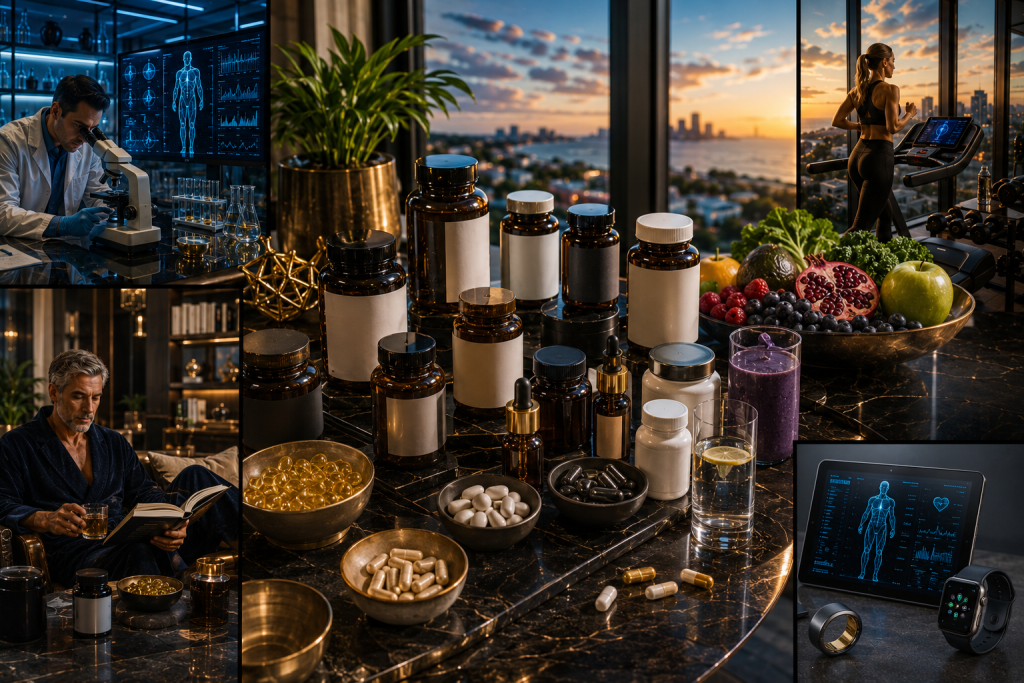
Bryan Johnson swallows more than 100 pills every morning. David Sinclair, the Harvard geneticist who wrote “Lifespan,” takes NMN, resveratrol, and vitamin D3 mixed into yogurt before sunrise. Daymond John stacks supplements alongside 40-hour fasts and cold plunges. Gwyneth Paltrow shares her “wellness standbys” on Instagram: Clearlight sauna, Prenuvo full-body scan, longevity colostrum, protein powders. The details vary. The pattern does not. Every figure in the longevity movement takes a curated stack of compounds designed to slow, stall, or reverse biological aging. The longevity supplements billionaires take have moved from fringe biohacking into mainstream wellness, and the East End is paying attention.
What follows is a compound-by-compound guide to the core longevity supplement stack. Not everything on this list has robust human clinical trial data. Not everything is appropriate for every person. What every compound shares is a place in the protocols of the most visible longevity practitioners on the planet and a mechanism of action grounded in published research. Each also carries a price tag that puts it within reach of anyone who considers health a line item worth funding.
NMN: The NAD+ Precursor at the Center of Everything
Nicotinamide mononucleotide (NMN) is the most discussed compound in the longevity supplement space. It is a direct precursor to NAD+, the coenzyme that plays a central role in cellular energy production and DNA repair. NAD+ levels decline with age, and that decline is linked to fatigue, metabolic dysfunction, cognitive impairment, and accelerated cellular aging. NMN supplementation aims to restore those levels.
Bryan Johnson takes 500mg of NMN six days per week. David Sinclair takes 1 gram every morning. Sinclair has stated that NMN doubles NAD+ levels in humans and considers it superior to NR (nicotinamide riboside), another popular NAD+ precursor. Animal studies have shown NMN slows multiple aspects of aging. Human trials are ongoing but early results are promising for metabolic and cardiovascular markers.
Cost: quality, third-party-tested NMN runs $50 to $150 per month at 1 gram daily. The FDA raised questions in late 2022 about whether NMN could be sold as a dietary supplement, given that it was being investigated as a drug. As of 2026, NMN supplements remain widely available, but the regulatory landscape continues to evolve. For East End clients who prefer clinical delivery, NAD+ IV drips bypass the supplement entirely, delivering the compound directly into the bloodstream at $500 to $1,000 per session.
Resveratrol: The Sirtuin Activator
Resveratrol is a polyphenol found naturally in grape skins, berries, and red wine (in very small amounts). It activates SIRT1, a gene associated with longevity, DNA repair, and cellular stress resistance. Sinclair considers resveratrol synergistic with NMN: resveratrol activates the sirtuin genes, while NMN provides the fuel (NAD+) those genes need to function.
Sinclair takes 1 gram daily, mixed with full-fat yogurt for absorption. Resveratrol is fat-soluble, meaning it has significantly better bioavailability when consumed with a fat source. Taking it with water dramatically reduces absorption. Johnson also includes resveratrol in his stack. The compound has shown benefits in animal studies for cardiovascular health, inflammation reduction, and lifespan extension, though human clinical data remains limited.
Cost: $20 to $60 per month for quality resveratrol supplements. Some longevity researchers, including the team at NOVOS Labs, argue that pterostilbene (a related compound) may be more effective than resveratrol in humans due to better absorption and longer half-life. Among the longevity supplements billionaires take, resveratrol remains the most widely used sirtuin activator, but the science is evolving toward potentially superior alternatives.
Spermidine: The Autophagy Trigger
Spermidine is a polyamine that triggers autophagy, the body’s cellular recycling process. During autophagy, cells clear out damaged proteins, dysfunctional organelles, and accumulated waste. The process declines with age. Restoring it through fasting or supplementation is a core strategy in longevity medicine. Spermidine effectively mimics the autophagy-inducing effects of fasting without requiring caloric restriction.
Sinclair takes 1mg to 2mg daily, typically derived from wheat germ extract. Johnson includes spermidine in his Blueprint stack. The compound has shown lifespan extension in animal models (yeast, flies, worms, and mice) and is associated with reduced cardiovascular mortality in human observational studies. A 2018 study found that higher dietary spermidine intake correlated with lower all-cause mortality.
Cost: $30 to $70 per month. Spermidine is one of the more affordable compounds in the longevity stack and one of the best-supported by animal evidence. Natural food sources include aged cheese, mushrooms, soy products, and wheat germ, though supplemental doses deliver more consistent and measurable amounts.
Fisetin: The Senolytic Compound
Fisetin is a flavonoid found in strawberries, apples, and persimmons. Its primary longevity application is as a senolytic: a compound that selectively clears senescent cells. These are sometimes called “zombie cells,” old cells that have stopped dividing but refuse to die. They accumulate in tissues with age and release inflammatory signals (the senescence-associated secretory phenotype, or SASP) that accelerate aging in neighboring cells.
A 2018 study at the Mayo Clinic found that fisetin was the most potent senolytic among 10 flavonoids tested in mice. Treated mice showed reduced tissue damage, lower inflammation, and extended lifespan. Johnson takes fisetin as part of his daily stack. Sinclair has included 500mg in his protocol, though his exact current usage has evolved over time as he emphasizes personalization over fixed stacks.
Cost: $20 to $50 per month. Fisetin occupies a strategic position among the longevity supplements billionaires take because it addresses a different aging mechanism (cellular senescence) than NMN (NAD+ decline) or spermidine (autophagy). A complete stack targets multiple pathways simultaneously. Fisetin handles the cleanup crew.
The Supporting Compounds
Calcium alpha-ketoglutarate (Ca-AKG) is an intermediate in the Krebs cycle that has shown lifespan extension and reduced chronic inflammation in animal studies. Johnson takes it daily. Cost: $30 to $60 per month. CoQ10 (ubiquinone or ubiquinol) supports mitochondrial energy production and is commonly included in longevity stacks at doses of 100mg to 200mg daily. Cost: $15 to $40 per month.
Vitamin D3 appears in virtually every longevity protocol. Sinclair, Johnson, and Paltrow all supplement it. Deficiency is widespread and linked to immune dysfunction, bone loss, and increased mortality. Cost: $5 to $15 per month. Vitamin K2 often accompanies D3 to support calcium metabolism and cardiovascular health. Omega-3 fatty acids (EPA and DHA from fish oil or algae) round out the foundational tier, supporting brain health, inflammation management, and cardiovascular function. Cost: $15 to $40 per month.
TMG (trimethylglycine) is increasingly included in NAD+-focused stacks as a methyl donor. High-dose NMN or NR supplementation can deplete methyl groups, and TMG helps maintain healthy methylation balance. Quercetin, another flavonoid, is sometimes paired with fisetin for enhanced senolytic activity. Metformin, a prescription diabetes medication, has shown lifespan extension in animal models and is used off-label by some longevity practitioners, though recent evidence has raised questions about its effects on exercise adaptation. Cost for metformin: $10 to $30 per month as a generic prescription.
What a Starter Stack Costs
The full Sinclair-level stack (NMN, resveratrol, spermidine, fisetin, vitamin D3, K2, omega-3, and quercetin) runs approximately $200 to $400 per month depending on brand choices and sourcing quality. That figure covers the supplement cost alone, without bloodwork, consultations, or clinical monitoring.
A simplified starter stack for someone entering the longevity supplements space might include NMN ($50 to $100/month), vitamin D3 ($5 to $15/month), omega-3 ($15 to $30/month), and spermidine ($30 to $50/month), totaling $100 to $195 per month. That four-compound foundation targets NAD+ restoration, foundational nutrition, inflammation management, and autophagy activation, covering four of the most important longevity pathways at an accessible price point.
For context, a single NAD+ IV drip session at a Hamptons clinic costs $500 to $1,000. A monthly oral NMN supplement delivering similar NAD+ support costs $50 to $100. The IV drip delivers 100% bioavailability in a single session. Oral supplementation requires daily consistency but costs a fraction of the clinical alternative. Many longevity practitioners use both: IV loading phases followed by oral maintenance. A qualified longevity clinic can help determine which approach fits your biology and your budget.
Where The Conversation Continues
The supplement stack is one layer of the longevity economy. Social Life Magazine covers every layer, from the compounds in the bottle to the clinics administering them to the billionaires funding the research that makes all of it possible.
If you manufacture, distribute, or retail longevity supplements and want editorial visibility with the East End audience, reach out at [email protected].
For brands seeking premium placement, explore our Paid Feature options.
Stay current at sociallifemagazine.com.
Polo Hamptons returns July 18 and 25, 2026, at 900 Lumber Lane, Bridgehampton. BMW is the title sponsor. For sponsorship inquiries, visit polohamptons.com.
Already a reader? Subscribe to Social Life Magazine for five summer issues and Fall/Winter editions.
Support independent East End journalism via PayPal.
Frequently Asked Questions
What supplements do longevity billionaires take?
The core longevity supplements billionaires take include NMN or NR (NAD+ precursors), resveratrol (sirtuin activation), spermidine (autophagy support), fisetin (senolytic activity), CoQ10 (mitochondrial energy), calcium alpha-ketoglutarate (inflammation reduction), vitamin D3, vitamin K2, and omega-3 fatty acids. Bryan Johnson takes 100+ daily supplements. David Sinclair takes NMN, resveratrol, and vitamin D3 as his core stack. Protocols vary by individual but target the same aging pathways: NAD+ decline, cellular senescence, autophagy, and metabolic health.
How much does a longevity supplement stack cost per month?
A full longevity stack (NMN, resveratrol, spermidine, fisetin, D3, K2, omega-3, quercetin) costs approximately $200 to $400 per month depending on brands and quality. A simplified starter stack (NMN, D3, omega-3, spermidine) runs $100 to $195 per month. NMN is the most expensive single component at $50 to $150 monthly for quality third-party-tested products at 1 gram daily. Prescription compounds like metformin add $10 to $30 per month.
Is NMN or NR better for longevity?
David Sinclair considers NMN superior to NR because NMN is the more direct precursor to NAD+ and has shown more stable results in boosting NAD+ levels in his research. NR has not demonstrated lifespan extension in published studies, while NMN has shown promising results in animal models. However, NR has more published human clinical trial data as of 2026. Both compounds aim to raise NAD+ levels. Many longevity practitioners choose NMN based on Sinclair’s advocacy and the available preclinical evidence.
Do longevity supplements actually work?
Evidence varies by compound. NMN, spermidine, and fisetin have shown lifespan extension in animal studies. Vitamin D3 and omega-3 have extensive human clinical data supporting overall health benefits. Resveratrol has promising animal data but limited human evidence. Most longevity supplements target well-understood biological pathways (NAD+ metabolism, autophagy, cellular senescence) but lack the long-term human randomized controlled trials that would constitute definitive proof. Longevity practitioners like Sinclair and Johnson argue that waiting for 20-year trials means aging without intervention during the wait.
Author

Written by
Recent Posts

The Season Nobody Ate
The Quiet Luxury of Slowing Down: Why Mindful, Hands-On Hobbies Are the Hamptons Set’s New Self-Care Ritual

Refined Housewarming Gifts for a Beautiful New Home

22nd Annual Author’s Night

Von Dutch, Women’s Magazine and Reserve Jets Celebrate NYFW With Adriatique
Categories
- Art
- Articles
- Business of Luxury
- Celebrities
- Culture
- Entertainment
- Events
- Faces of Summer 2026
- Fashion
- Fashion & Style
- Featured
- Finance
- Food, Spirits, Wine
- Hamptons
- Hamptons Celebrities
- Health
- Health & Beauty
- Lifestyle
- Luxury Lifestyle
- Press
- Profiles
- Real Estate
- Technology
- The Chronicles
- Travel
- Uncategorized
- Weddings