
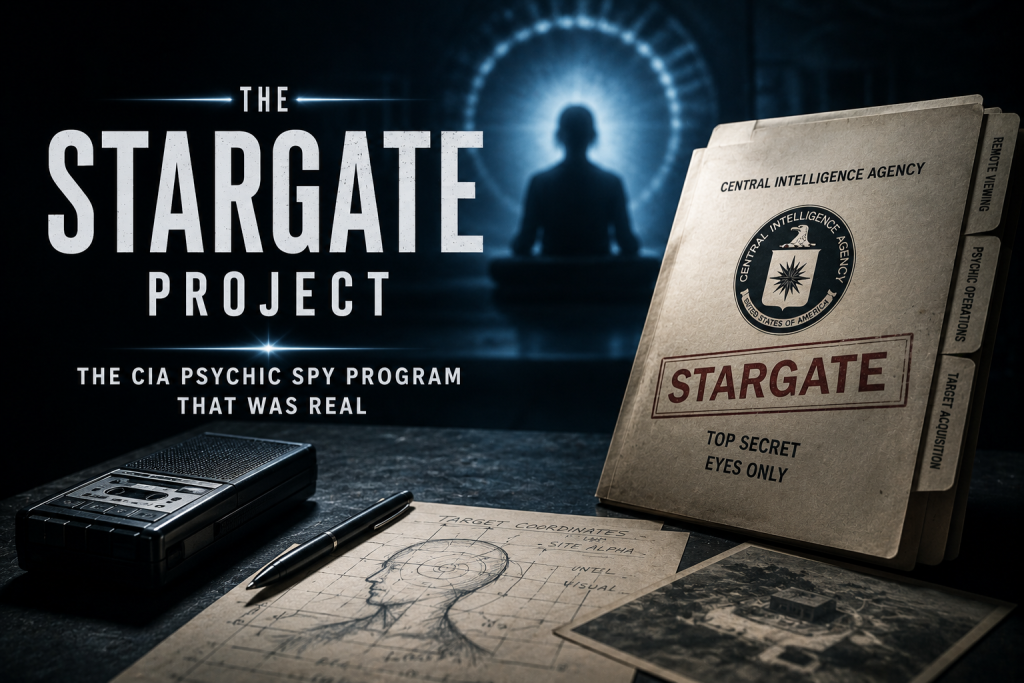
The CIA Hired Psychics. It Wasn’t a Joke.
From 1978 to 1995, the Central Intelligence Agency funded a classified research program that employed professional psychics to gather intelligence on Soviet military installations, hostage situations, and nuclear facilities. The program was called the Stargate Project. It was run out of Fort Meade, Maryland. It cost American taxpayers approximately $20 million over its lifetime. And for 17 years, remote viewers sat in windowless rooms, closed their eyes, and attempted to describe locations they had never visited using nothing but their minds.
When the program was declassified in 1995, the CIA concluded that remote viewing had not produced intelligence reliable enough to justify continued funding. But the Stargate Project was not a fringe operation dreamed up by a rogue agent. It was authorized at the highest levels. The intelligence community took it seriously. It produced thousands of documented sessions. And some of those sessions, according to participants and program managers, were startlingly accurate.
The Stargate Project is also the missing link between the documented history of MKUltra and the conspiracy mythology of the Montauk Project. Stranger Things is set in 1983, squarely in the Stargate era. Eleven’s abilities mirror the remote viewing capabilities the CIA was actively developing. The show’s fiction and the government’s reality overlap in ways that make both harder to dismiss.
How It Started
In 1972, the CIA learned that the Soviet Union was investing heavily in psychic research. According to declassified briefings, Soviet scientists had been conducting experiments in telepathy, psychokinesis, and remote perception at institutes in Moscow and Leningrad since the 1960s. The intelligence community’s concern was straightforward: if the Soviets developed a viable psychic intelligence capability and the United States did not, the Cold War balance could shift in ways that no missile defense system could counter.
The initial American research began at Stanford Research Institute (later SRI International) in Menlo Park, California. Physicists Russell Targ and Harold Puthoff led the early experiments. Their work focused on “remote viewing.” They coined the term to describe the alleged ability to perceive distant locations without physical access, using only mental concentration. In theory, the concept was simple. But the execution was anything but. The CIA funded the research initially through a contract worth $50,000. By the time the program ended 23 years later, total investment had reached approximately $20 million.
The program operated under several code names during its long existence. It began as Project Scanate, then became Gondola Wish, then Grill Flame, then Center Lane, then Sun Streak, and finally Stargate. Each name change reflected a reorganization or transfer between agencies. At various points, the program was managed by the CIA, the Defense Intelligence Agency, and the Army Intelligence and Security Command. The constant renaming made the program difficult for outsiders to track, which may have been part of the point.
What Remote Viewers Actually Did
A typical remote viewing session followed a structured protocol. A viewer would be given a set of geographic coordinates or a sealed envelope containing a target description. Without knowing the target, the viewer would enter a relaxed state. They would then attempt to describe what they “saw.” They would sketch images, describe colors and shapes, note environmental details like temperature and terrain, and record emotional impressions. A monitor sat nearby, asking open-ended questions but providing no feedback or confirmation.
The protocols were deliberately rigorous. Ingo Swann, an artist and self-described psychic who helped develop the methodology, created “coordinate remote viewing” (CRV), a structured system that divided each session into progressive stages. In the early stages, the viewer recorded only basic sensory impressions. Later stages allowed for more detailed sketches and analytical descriptions. Each stage was designed to filter subjective noise from perceptual data. Whether it succeeded remains debated. But the protocols gave the program a scientific framework that distinguished it from casual psychic experimentation.
The sessions produced decidedly mixed results. In many cases, the descriptions were vague or wrong. But in certain sessions, viewers produced details that matched their targets with a specificity difficult to attribute to pure chance. The tension between the hits and the misses defined the program’s entire 17-year existence.
The Sessions That Worked
Several remote viewing sessions became legendary within the intelligence community, even among skeptics who doubted the program’s overall value. The most frequently cited involves a viewer who allegedly described a new class of Soviet submarine at a shipyard in Severodvinsk before satellite imagery confirmed the submarine’s existence. Multiple details from the viewing session reportedly matched the later photographs.
In another case, Pat Price, a former police commissioner from Burbank, California, allegedly described a Soviet satellite monitoring facility in the Ural Mountains with enough accuracy that the CIA sent a verification team. According to physicists Targ and Puthoff, who ran the SRI experiments, the team confirmed several of Price’s specific details, including the layout of buildings and the position of a large crane.
A third case involved the 1988 kidnapping of Marine Colonel William Higgins in Lebanon. According to program participants, remote viewers provided information about Higgins’ location that was later corroborated by intelligence from traditional sources. Whether the remote viewing data was genuinely useful or merely coincidental with independently gathered intelligence has never been definitively resolved.
Skeptics have argued that these successes can be explained by statistical probability, cold reading techniques, or contamination from external sources. Believers counter that the consistency of certain viewers’ results across hundreds of sessions is difficult to explain through chance alone. The debate, like the program itself, never reached a conclusion that satisfied both sides.
The Viewers
The Stargate Project employed a small team of viewers, typically six to eight at any given time. Some had military backgrounds. Others were recruited from civilian life based on tests suggesting psychic aptitude. The selection process was informal by intelligence community standards, relying as much on demonstrated results as on any screening methodology.
Of these, the most prominent was Joseph McMoneagle, a retired Army warrant officer who claimed to have conducted over 450 remote viewing sessions during his time in the program. McMoneagle was awarded the Legion of Merit, partly for his classified intelligence work. His post-program career included consulting, public lectures, and multiple books about remote viewing. He remains the most publicly visible alumnus of the Stargate Project.
Ingo Swann was the program’s intellectual architect. His coordinate remote viewing protocols imposed structure on what had previously been an uncontrolled process. Before joining the SRI experiments, Swann had participated in psychokinesis research at the American Society for Psychical Research in New York. His dual identity as artist and psychic gave the program a degree of cultural credibility that a purely military operation would have lacked.
Pat Price produced some of the program’s most celebrated results before his unexpected death in 1975. Price died of a heart attack in Las Vegas under circumstances that conspiracy theorists have questioned ever since. No evidence of foul play was found. But in a program already surrounded by secrecy, an unexplained death became another layer of mythology, much like the death of Morris Jessup, who investigated the Philadelphia Experiment before dying under similarly debated circumstances in 1959.
Why It Was Shut Down
In 1995, Congress directed the CIA to evaluate the Stargate Project and determine whether it should continue. As a result, the CIA hired the American Institutes for Research to conduct the review. The AIR report, authored by statistician Jessica Utts and psychologist Ray Hyman, produced a split conclusion that perfectly captured the program’s fundamental ambiguity.
Utts argued that the statistical evidence for remote viewing was strong enough to reject the null hypothesis. In other words, something real appeared to be happening. Hyman disagreed, arguing that methodological flaws in the experimental design made the results scientifically unreliable. However, both agreed on one critical point: even if remote viewing was real, the intelligence it produced was too vague and inconsistent to be operationally useful in the field.
The CIA accepted Hyman’s conclusions and terminated the program. Subsequently, all remaining files were declassified. The remote viewers were dismissed. The windowless rooms at Fort Meade were reassigned. And the U.S. government officially stopped paying people to see with their minds. Still, the declassification itself ensured that the Stargate Project would live on as one of the most documented examples of government-funded paranormal research in history.
The Stranger Things Connection
Eleven’s primary ability in Stranger Things is remote viewing. In the show’s first season, she locates the Demogorgon by entering a sensory deprivation tank and projecting her consciousness to a distant location. This is precisely what Stargate viewers did, minus the interdimensional monster. The flotation tank, the closed eyes, the mental projection to an unseen target: all elements drawn directly from the CIA’s real program.
The timeline reinforces the connection. Stranger Things is set in 1983. The Stargate Project was fully operational in 1983. MKUltra, which the show references by name, had ended a decade earlier. But the government’s psychic research hadn’t stopped. It had simply moved to a new program with a new name and a new set of code words. Eleven exists at the intersection of MKUltra’s documented abuse and Stargate’s documented ambition. She is what happens when mind control meets remote viewing.
Where All Three Threads Converge
The Montauk Project conspiracy occupies the same timeline. According to Preston Nichols, the experiments at Camp Hero ran through the early 1980s and involved psychic subjects who could perceive and manipulate distant locations. Whether Nichols was aware of the Stargate Project when he wrote his book in 1992 is unclear. But the parallels between his unverified claims and the declassified program are close enough that conspiracy and documented history become genuinely difficult to untangle.
The Duffer Brothers wove all three threads (MKUltra, Stargate, Montauk) into one narrative. The result is a show that feels more like a dramatization of classified events than a work of pure imagination. That feeling is the Stargate Project’s lasting contribution to popular culture. It proved that the U.S. government took psychic phenomena seriously enough to fund research for nearly two decades. Once that fact is established, everything else in the Stranger Things mythology becomes at least a little bit more plausible.
The declassified Stargate files are publicly available through the CIA’s Electronic Reading Room. They contain thousands of pages of session transcripts, target descriptions, viewer sketches, and administrative correspondence. For anyone who has watched Eleven float in a tank and locate a monster with her mind, the real transcripts provide a strange mirror. The language is bureaucratic rather than dramatic. The targets are Soviet installations rather than interdimensional gates. But the underlying premise is identical: a person sits in a room, closes their eyes, and perceives something that should be beyond perception. The CIA paid for this. For 17 years. And when they stopped, it was not because they proved it impossible. It was because they proved it unreliable. The difference matters.
Where the Conversation Continues
The Stargate Project is the documented proof that the U.S. government took psychic research seriously enough to fund it for 17 years. It sits in a conspiracy corridor that runs from Tesla’s Wardenclyffe Tower to Plum Island to Camp Hero at the tip of the South Fork. Social Life Magazine has covered the East End for 23 years, and the stories at the intersection of history, conspiracy, and culture land here first.
If you have a story, a brand, or a project that belongs in these pages, reach out at sociallifemagazine.com/contact.
For brands looking for premium editorial placement, our paid feature submission portal is open at sociallifemagazine.com/submit-a-paid-feature/.
Stay in the loop with our weekly email blast covering events, openings, and who’s doing what Out East. Sign up at enflyer.sociallifemagazine.com.
Polo Hamptons 2026 returns to Bridgehampton on July 18 and July 25 with BMW as title sponsor. For event details and sponsorship opportunities, visit polohamptons.com.
Never miss a feature, a profile, or a party recap. Subscribe to Social Life Magazine at sociallifemagazine.com/subscription.
If the work we do matters to you, you can support independent East End journalism directly via PayPal.
Author

Written by
Recent Posts

hiTechMODA Season 16
How to Keep Your Personal Number Private When Booking Events, Rentals and Services
Understanding Compensatory Damages in a Personal Injury Case

When Online Family Therapy Makes Sense for Modern Families

Carrier Oils, Essential Oils, and Oil Blends: What Beauty Brands Need to Know
Categories
- Art
- Articles
- Business of Luxury
- Celebrities
- Culture
- Entertainment
- Events
- Faces of Summer 2026
- Fashion
- Fashion & Style
- Featured
- Finance
- Food, Spirits, Wine
- Hamptons
- Hamptons Celebrities
- Health
- Health & Beauty
- Lifestyle
- Luxury Lifestyle
- Press
- Profiles
- Real Estate
- Technology
- The Chronicles
- Travel
- Uncategorized
- Weddings