
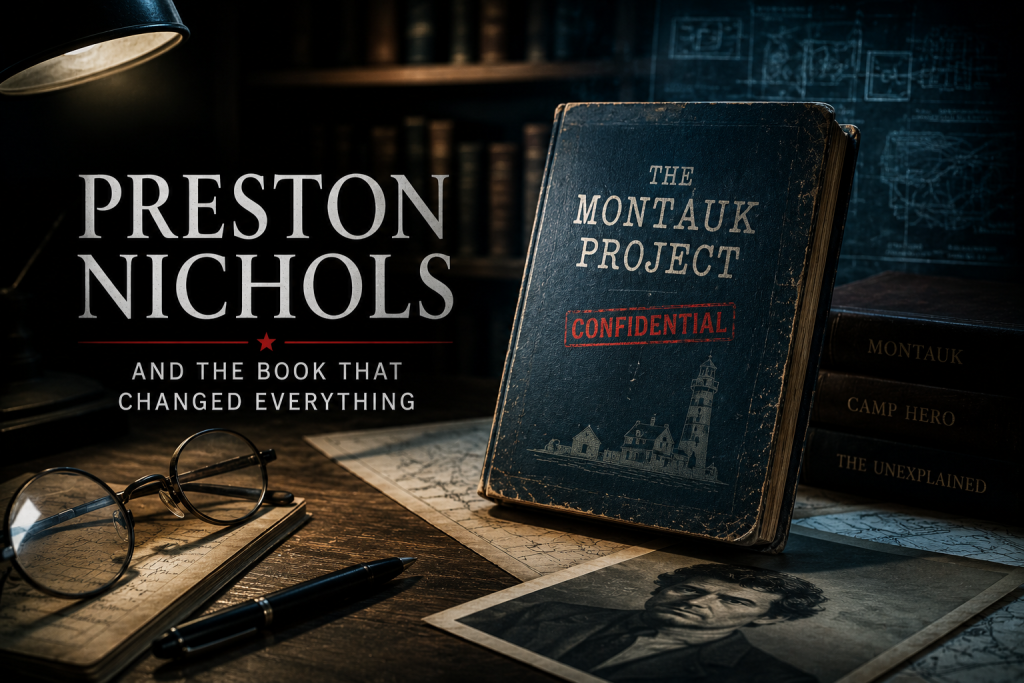
The Man Who Invented Montauk
In 1992, a self-described electronics engineer from Long Island published a book that would change the trajectory of American conspiracy culture. The book was called The Montauk Project: Experiments in Time. The author was Preston Nichols. And the story he told, whether fact or fiction or something deliberately positioned between the two, would eventually provide the raw material for the most successful Netflix franchise in history.
Nichols claimed to have recovered suppressed memories. Those memories involved classified experiments at Camp Hero, the decommissioned Air Force station at the tip of Montauk. According to his account, the experiments involved mind control, time travel, psychic warfare, and the opening of portals to other dimensions. Children were allegedly abducted from surrounding communities and used as test subjects. A creature was supposedly summoned from another dimension. When the project collapsed, the underground laboratories were sealed with cement and everyone involved had their memories erased.
Yet no credible evidence has ever corroborated any of these claims. Preston Nichols never provided verifiable documentation. He never named accomplices who could be independently contacted. He died in 2018 without having proven a single element of his story. Yet his book remains in print. Its influence has grown with each passing decade. And its impact on popular culture, through Stranger Things, is now measured in billions of dollars.
The Book
Nichols co-wrote Experiments in Time with Peter Moon, a writer with interests in occultism, sacred geometry, and fringe science. The book was self-published through Sky Books, a small press that Moon operated out of Westbury, Long Island. It received no mainstream media coverage at the time of its release. Distribution was limited to conspiracy bookstores, UFO conference tables, and the early internet forums where alternative history communities were beginning to form.
Still, the narrative structure of the book is, in fact, unusual and arguably brilliant. Nichols presents his claims as recovered memories, acknowledging from the outset that his recollections might be incomplete or distorted by the electromagnetic memory suppression he allegedly underwent. In the first chapter, he and Moon write: “Whether you read this as science fiction or non-fiction, you are in for an amazing story.” This deliberate ambiguity has proven to be the book’s greatest strategic asset. It allows believers to treat it as testimony and skeptics to treat it as fiction, while both groups keep reading and both groups keep talking about it.
The book spawned three sequels: Montauk Revisited (1994), Pyramids of Montauk (1995), and The Music of Time (2000). Indeed, each volume expanded the mythology further, connecting the Montauk experiments to ancient Egypt, Aleister Crowley, the Philadelphia Experiment, and Nikola Tesla’s electromagnetic research. By the time the series was complete, it had built a self-reinforcing narrative universe in which every major conspiracy eventually connects back to Camp Hero.
The Core Claims
At the center of Nichols’ narrative are several interconnected claims, each more extraordinary than the last. First, that the AN/FPS-35 radar tower at Camp Hero was modified to operate at specific frequencies (410-420 MHz) that could directly influence human consciousness. The radar array was allegedly repurposed from its original air defense function into a psychotronic weapon capable of altering thoughts, emotions, and perceptions across a wide geographic area.
Second, that underground laboratories extending as many as 12 levels beneath the radar tower housed hundreds of researchers and support staff. According to Nichols, these facilities were invisible to the town of Montauk because the workers were transported by submarine and the construction materials were delivered under cover of military renovation projects. The underground tunnels are the physical foundation of every claim the conspiracy makes. Without them, there is no location for the experiments. With them, the conspiracy has an infrastructure.
The Children and the Creature
Third, that children from surrounding communities, later called “the Montauk Boys,” were abducted and subjected to electromagnetic frequency experiments designed to develop psychic abilities. These children were allegedly programmed into psychic soldiers through a process that combined MKUltra-style conditioning with the electromagnetic technology housed in the radar tower. The most talented among them, a young man named Duncan Cameron, supposedly developed the ability to open portals to other dimensions using his mind alone.
Fourth, that the project was shut down catastrophically when Cameron accidentally summoned a creature from his own subconscious into physical reality. After the creature was contained, the underground levels were flooded with cement. All participants allegedly had their memories erased using the same electromagnetic technology that had powered the experiments. The creature, the cement, the memory wipe: these are the narrative elements that transformed a conspiracy theory about a military base into a story with the architecture of a horror film.
Who Was Preston Nichols?
Biographical information about Nichols is sparse and often contradictory. He described himself as an electrical engineer. His degree was from the New York Institute of Technology. According to his own accounts, he also worked at Brookhaven National Laboratory on Long Island. That Department of Energy facility has its own place in the East End’s conspiracy corridor. He claimed expertise in radio frequency engineering, psychic research, and music production.
Life on Long Island
Outside the conspiracy community, Nichols was largely unknown. He gave lectures at UFO conferences and appeared on conspiracy-oriented radio programs. He maintained a small but devoted following of readers. They attended his public events on Long Island. In particular, those who met him described him as simultaneously brilliant, eccentric, and impossible to pin down on factual specifics. When pressed for documentation, he would reference the memory suppression. Physical evidence, he argued, had been destroyed or confiscated.
Nichols lived on Long Island for most of his life. He reportedly maintained a workshop filled with electronic equipment. Some of it, he claimed, was recovered from Camp Hero. He conducted what he described as ongoing research into electromagnetic frequencies and their effects on consciousness. Yet whether this research produced any verifiable results is unknown. What is known is that Nichols dedicated the last 26 years of his life to the mythology he created, living inside his own narrative with a commitment that even his skeptics found striking.
Nichols died on October 5, 2018, at the age of 72. Still, his death received almost no mainstream media coverage. Yet in the years since, his influence has grown rather than diminished. Stranger Things brought the Montauk mythology to a global audience that had never heard of Preston Nichols. His book sold modestly during his lifetime. Now it benefits from a reflected spotlight that he never lived to see.
The Influence on Stranger Things
The Duffer Brothers have been transparent about drawing from the mythology. Their original pilot was titled Montauk. The show’s protagonist, Eleven, is structurally modeled on the Montauk Boys: a child raised in captivity inside a government laboratory, subjected to experiments that develop psychic abilities, used as a weapon by people who view her as an asset rather than a human being. Hawkins National Laboratory is Camp Hero. The Upside Down is the portal Duncan Cameron allegedly opened. Dr. Brenner is the scientist running the project.
Of course, the adaptation is not literal. The Duffers moved the setting to Indiana and aged up the time period. They added Spielberg’s suburban warmth and layered in Stephen King’s horror. But the narrative architecture is Nichols’ invention. Without Experiments in Time, there is no Stranger Things. The book provided the premise and the setting. It also provided the emotional core: children used as weapons by a government that has lost its moral compass.
The Documented Foundations
The show also drew from documented programs that validated the Montauk mythology’s plausibility. MKUltra proved the government really did experiment on unwitting citizens. The Stargate Project proved the government really did fund psychic research. The Philadelphia Experiment provided a World War II origin story. Nichols connected all of these threads into a single narrative centered on Camp Hero. The Duffer Brothers simply adapted the package.
The Finale Callback
In the Stranger Things series finale, Hopper tells Joyce he wants to move to Montauk. Ross Duffer described this as “a wink to the fans.” But it was also, whether intended or not, a tribute to Preston Nichols. In fact, the man who invented the mythology never got a writing credit on the show. But his fingerprints are on every episode. After all, his story started in a self-published book with no distribution. It ended in one of the most-watched series finales in streaming history, with the main character choosing to live in the town where it all began.
The question that haunts the Nichols story is not whether his claims are true. It is why they resonated so deeply. Long Island in the early 1990s was fertile ground for conspiracy. The Cold War had just ended. Military bases were being decommissioned across the country. Camp Hero’s radar tower stood visible from Route 27, a physical reminder that something classified had happened at the end of the road. Nichols walked into that vacuum with a story that explained the sealed buildings, the fenced bunkers, and the underground infrastructure that everyone could see but nobody could access. His narrative gave Montauk a mythology worthy of its geography. A fishing village at the end of a peninsula, surrounded by military history, haunted by an abandoned radar installation that looked like it belonged in a science fiction film. Nichols saw what was there and imagined what might be beneath it.
The Legacy
Ultimately, the most remarkable thing about Preston Nichols is not whether his claims are true. It is the fact that his claims have outlived him, outlived his book’s original audience, and outlived the cultural context in which they were first made. The Montauk Project mythology has become a permanent fixture of American conspiracy culture, referenced in music (the band The Montauk Project), in film (the 2011 documentary The Montauk Chronicles), and in the architecture of the most successful streaming franchise in Netflix history.
Camp Hero State Park is now one of the most visited conspiracy tourism destinations on the East End. The sealed buildings and the radar tower that still moves on its own draw visitors who have read Nichols’ book, watched Stranger Things, or both. The Montauk Monster, which washed ashore at Ditch Plains in 2008, added a biological dimension to the mythology. Plum Island, sitting just off the North Fork, added the Nazi scientist angle through Operation Paperclip. Each new element reinforces the others. And all of them trace back to one man’s self-published book in 1992.
Whether you believe Preston Nichols or not, you have to acknowledge the scale of what he built. A single book, with no mainstream publisher and no verifiable evidence, created a mythology powerful enough to inspire a billion-dollar franchise. It also turned a decommissioned base into a pilgrimage site. That is, by any measure, an extraordinary achievement. The question of whether it is also true is, at this point, almost beside the point.
Where the Conversation Continues
Preston Nichols turned a decommissioned Air Force station into one of the most famous conspiracy locations on Earth. Social Life Magazine has covered the East End for 23 years. Five summer issues reach 25,000 readers from Westhampton to Montauk. The stories that define this place land here before they land anywhere else.
If you have a story, a brand, or a project that belongs in these pages, reach out at sociallifemagazine.com/contact.
For brands looking for premium editorial placement, our paid feature submission portal is open at sociallifemagazine.com/submit-a-paid-feature/.
Stay in the loop with our weekly email blast covering events, openings, and who’s doing what Out East. Sign up at enflyer.sociallifemagazine.com.
Polo Hamptons 2026 returns to Bridgehampton on July 18 and July 25 with BMW as title sponsor. For event details and sponsorship opportunities, visit polohamptons.com.
Never miss a feature, a profile, or a party recap. Subscribe to Social Life Magazine at sociallifemagazine.com/subscription.
If the work we do matters to you, you can support independent East End journalism directly via PayPal.
Author

Written by
Recent Posts

hiTechMODA Season 16
How to Keep Your Personal Number Private When Booking Events, Rentals and Services
Understanding Compensatory Damages in a Personal Injury Case

When Online Family Therapy Makes Sense for Modern Families

Carrier Oils, Essential Oils, and Oil Blends: What Beauty Brands Need to Know
Categories
- Art
- Articles
- Business of Luxury
- Celebrities
- Culture
- Entertainment
- Events
- Faces of Summer 2026
- Fashion
- Fashion & Style
- Featured
- Finance
- Food, Spirits, Wine
- Hamptons
- Hamptons Celebrities
- Health
- Health & Beauty
- Lifestyle
- Luxury Lifestyle
- Press
- Profiles
- Real Estate
- Technology
- The Chronicles
- Travel
- Uncategorized
- Weddings