
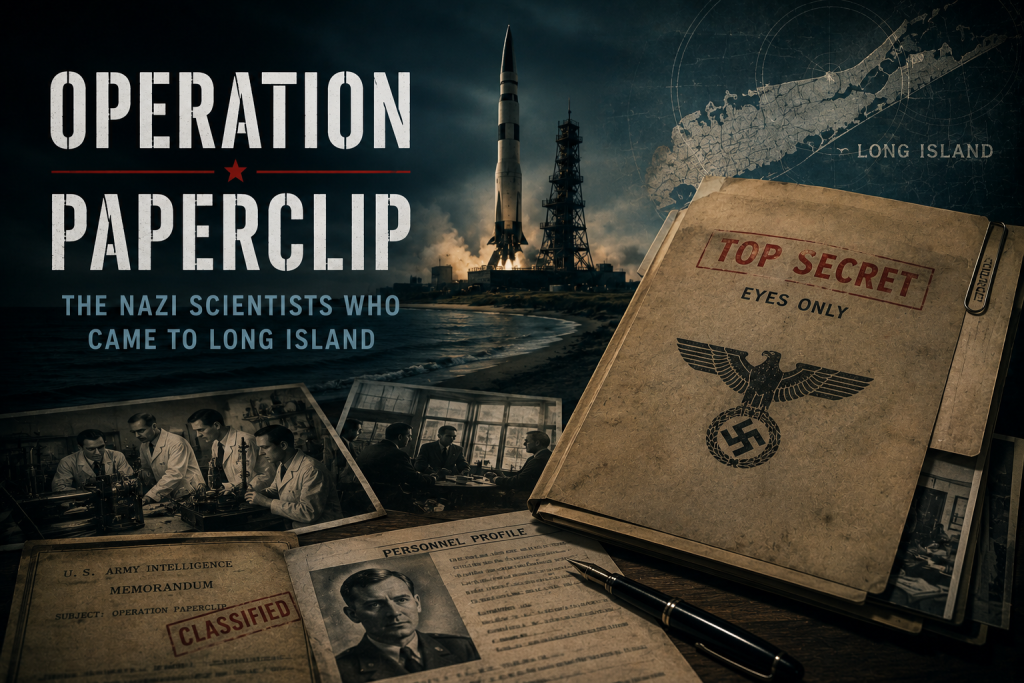
The Scientists America Imported
After World War II ended in 1945, the United States faced an uncomfortable strategic reality. Hundreds of German scientists who had developed the most advanced weapons technology on Earth were suddenly available. The Soviet Union, of course, wanted them. So did Britain and France. As a result, the question facing American intelligence officials was not whether to recruit former Nazis. It was how many to recruit and how quickly they could be moved.
The answer was Operation Paperclip. Between 1945 and 1959, the U.S. government secretly recruited over 1,600 German scientists, engineers, and technicians. Specifically, their expertise spanned rocketry, aviation, chemical warfare, and biological weapons. Indeed, many had been members of the Nazi Party. Some had also used concentration camp labor. In some cases, they had committed acts that would later be classified as war crimes. In addition, their records were “sanitized” by attaching clean paperclips to their files, replacing damning dossiers with fabricated biographies. Ultimately, that clerical trick gave the program its name.
What makes Operation Paperclip essential to the East End conspiracy corridor is where some of these scientists ended up working. According to investigative journalist Michael Christopher Carroll’s book Lab 257, at least one Paperclip recruit, the virologist Erich Traub, worked at Plum Island, the federal Animal Disease Center sitting just off the North Fork in Long Island Sound. The same island that conspiracy theorists have connected to the Montauk Monster, Lyme disease, and the broader mythology that eventually inspired Stranger Things.
The Scale of the Recruitment
Operation Paperclip was not a small or improvised intelligence operation. It was one of the largest transfers of scientific talent in modern history. The program’s most famous recruit was Wernher von Braun, the rocket engineer who had designed the V-2 ballistic missile for the Nazi regime. Von Braun went on to lead NASA’s Saturn V program, which put American astronauts on the moon. He became one of the most celebrated scientists in America. His Nazi past was, for decades, largely ignored by the public.
But von Braun was only the most visible example. The recruitment extended across virtually every technical discipline the military valued. Aerodynamics engineers who had designed the Messerschmitt Me 262 (the world’s first operational jet fighter) were brought to Wright-Patterson Air Force Base in Ohio. Chemical weapons specialists were installed at Fort Detrick in Maryland and Edgewood Arsenal. Aviation medicine researchers who had conducted freezing and high-altitude experiments on concentration camp prisoners were quietly absorbed into the U.S. military’s medical research infrastructure. Each recruit represented both a strategic gain and a moral compromise.
Notably, the program operated despite a direct order from President Harry Truman that no one with Nazi affiliations should be admitted to the United States. Instead, intelligence officials circumvented this directive by altering the scientists’ personnel files. They removed evidence of party membership, SS rank, and involvement in wartime atrocities. The paperclip on the clean file became the mechanism of institutional erasure. What the government couldn’t justify, it simply rewrote.
Erich Traub and Plum Island
For the East End conspiracy narrative, the most significant Paperclip recruit was Erich Traub. Before the war, Traub had studied virology at the Rockefeller Institute in Princeton, New Jersey. Interestingly, he was, by training, an American-educated scientist. During the war, however, he returned to Germany and ran the Nazi biological weapons program on Insel Riems, a small island in the Baltic Sea. Specifically, his specialty was weaponizing animal viruses, with a particular focus on foot-and-mouth disease and rinderpest.
The parallels between Insel Riems and Plum Island are striking and specific. Both are islands. Each housed a government biological research facility. And both studied animal diseases that could devastate agricultural economies. The man who ran one was brought across the Atlantic to work at the other. The distance between Nazi Germany’s bioweapons island and America’s disease research island was not measured in miles. It was measured in one recruitment operation and a falsified personnel file.
Indeed, Carroll’s research in Lab 257 indicates that Traub worked at Plum Island in the early 1950s before returning to Germany in 1953. The connection was facilitated through Fort Detrick, which served as a hub for Paperclip scientists working in biological research. According to Carroll, “Traub experimented with over 40 lethal viruses on large test animals” during his time in the Nazi program. His arrival at Plum Island placed a scientist whose career had been built on offensive biological warfare inside a facility whose mission was supposedly defensive.
The Official Denial
The Plum Island Animal Disease Center has consistently denied that any weapons research took place at the facility. Dr. Luis Rodriguez, one of the lead researchers, has stated publicly: “I think the biggest misconception is that we work on secrets and that our research is secret.” Yet the Traub connection, documented in declassified records and Carroll’s extensively sourced book, gives the conspiracy narrative a foundation that extends well beyond speculation. It extends into the documented history of American intelligence operations.
The Lyme Disease Theory
The most explosive allegation connected to Operation Paperclip and Plum Island involves Lyme disease. In 1975, a cluster of children and adults in Lyme, Connecticut, began presenting with an unusual form of arthritis. Investigators eventually identified the cause as a tick-borne spirochete bacterium, later named Borrelia burgdorferi. The disease was named after the Connecticut town where the outbreak was first documented.
Notably, Lyme, Connecticut, sits directly across Long Island Sound from Plum Island. In fact, the distance is only approximately 10 miles. For conspiracy theorists, of course, that proximity was deeply significant. Their theory: weaponized ticks carrying the Borrelia bacteria escaped from Plum Island, either through negligent containment or through infected birds, and established themselves on the Connecticut shoreline. In addition, the wind and current patterns in the Sound move from west to east, which means debris from Plum Island’s shoreline naturally drifts toward the Connecticut coast. Whether infected ticks could survive such a crossing is a question that scientists have not definitively answered.
The Congressional Response
Still, the theory gained enough traction that in 2019, the U.S. House of Representatives actually passed an amendment requiring the Department of Defense Inspector General to investigate whether the Pentagon experimented with weaponized ticks at Plum Island or other facilities between 1950 and 1975. The amendment was sponsored by New Jersey Representative Chris Smith, who cited Kris Newby’s book Bitten: The Secret History of Lyme Disease and Biological Weapons as supporting evidence.
The scientific consensus, however, does not currently support the bioweapon theory. Studies of preserved tick specimens have found Borrelia burgdorferi in ticks dating back well before Plum Island’s facility existed, suggesting the bacterium has been present in North America for centuries. Still, the investigation was authorized. And the fact that Congress considered the theory credible enough to demand an official inquiry tells you something about the cultural weight of the Paperclip narrative. When the government recruits Nazi scientists and installs them at a classified facility 10 miles from a disease outbreak, the public’s willingness to believe the worst is not irrational. It is earned.
The Broader Conspiracy Corridor
Operation Paperclip connects Plum Island to the broader network of government facilities and conspiracy theories that stretches across Long Island’s eastern reaches. Camp Hero, 10 miles to the south, allegedly housed the Montauk Project. Brookhaven National Laboratory, 50 miles to the west, is a Department of Energy facility with its own persistent mythology. Tesla’s Wardenclyffe Tower stood 70 miles to the west in Shoreham before its demolition in 1917.
Without exception, each facility operated in secrecy. Each has been the subject of conspiracy allegations. And Operation Paperclip provides the connective tissue that makes the entire corridor feel like a single story. After all, if the U.S. government was willing to recruit Nazi scientists and falsify their records (it was), then the leap to believing the government conducted secret experiments at Camp Hero or developed biological weapons at Plum Island requires less imagination than it otherwise would. In other words, Paperclip established a documented precedent for institutional deception. Every conspiracy theory on the East End borrows credibility from that precedent.
The documented history is damning enough on its own terms. A government that falsified personnel records to import war criminals. Then a classified facility where a Nazi bioweapons expert studied the same diseases he had previously weaponized. And finally, a disease outbreak 10 miles away that Congress thought suspicious enough to investigate. And a military base at the tip of the South Fork where, according to Preston Nichols, the experiments continued underground for decades after the public was told the base was closed.
The Documented Record
Of course, the documented record of Operation Paperclip is publicly available. Declassified files, congressional testimony, and investigative journalism have established the program’s scope, methods, and moral failures beyond reasonable dispute. Annie Jacobsen’s 2014 book Operation Paperclip: The Secret Intelligence Program That Brought Nazi Scientists to America provided a comprehensive account based on newly declassified documents, interviews with Paperclip family members, and records from the National Archives. Indeed, her research confirmed that the program’s architects knew exactly what they were doing: importing scientists whose wartime activities would have disqualified them under any honest assessment of Truman’s executive order.
The Pattern of Deception
For the East End, Operation Paperclip’s significance extends beyond Plum Island. It establishes a pattern of government behavior that makes every subsequent conspiracy theory on Long Island more difficult to dismiss. If the government falsified records to import Nazi scientists (it did), and if one of those scientists worked at a classified facility 10 miles from a mysterious disease outbreak (he did), then the pattern invites extrapolation. Camp Hero’s sealed buildings. MKUltra’s destroyed files. The Montauk Monster’s vanished carcass. As a result, each unexplained element gains plausibility from the documented precedent of institutional deception that Paperclip represents.
The Stranger Things Throughline
The Duffer Brothers wove Operation Paperclip’s logic directly into Stranger Things. Hawkins National Laboratory is a government facility conducting secret experiments on American citizens. Its cover-up is institutional. The deception is systematic. And the victims are powerless. This is not speculative fiction. It is the documented playbook of Operation Paperclip, MKUltra, and the Stargate Project, repackaged as entertainment for a streaming audience.
In the show, Dr. Brenner operates with impunity. His superiors protect him. The victims are silenced. And the records are destroyed. This is precisely how Paperclip worked in practice. The scientists’ files were falsified. Their victims had no recourse. Their sponsors in the intelligence community ensured that the moral questions were never asked in any forum where the answers might have consequences.
The Montauk Monster, which washed ashore at Ditch Plains in 2008, brought the Plum Island connection into the public imagination. But it was Operation Paperclip that gave Plum Island its darkest dimension. Without Erich Traub, the island is a government agricultural lab with an unfortunate location. With Traub, it becomes a node in a network of institutional deception that stretches from postwar Berlin to Cold War Long Island to a Netflix writers’ room in Los Angeles.
Where the Conversation Continues
Operation Paperclip brought Nazi scientists to Long Island. That is not a conspiracy theory. It is documented history. Social Life Magazine has covered the East End for 23 years, and the stories at the intersection of documented fact and persistent mythology land here first.
If you have a story, a brand, or a project that belongs in these pages, reach out at sociallifemagazine.com/contact.
For brands looking for premium editorial placement, our paid feature submission portal is open at sociallifemagazine.com/submit-a-paid-feature/.
Stay in the loop with our weekly email blast covering events, openings, and who’s doing what Out East. Sign up at enflyer.sociallifemagazine.com.
Polo Hamptons 2026 returns to Bridgehampton on July 18 and July 25 with BMW as title sponsor. For event details and sponsorship opportunities, visit polohamptons.com.
Never miss a feature, a profile, or a party recap. Subscribe to Social Life Magazine at sociallifemagazine.com/subscription.
If the work we do matters to you, you can support independent East End journalism directly via PayPal.
Author

Written by
Recent Posts

hiTechMODA Season 16
How to Keep Your Personal Number Private When Booking Events, Rentals and Services
Understanding Compensatory Damages in a Personal Injury Case

When Online Family Therapy Makes Sense for Modern Families

Carrier Oils, Essential Oils, and Oil Blends: What Beauty Brands Need to Know
Categories
- Art
- Articles
- Business of Luxury
- Celebrities
- Culture
- Entertainment
- Events
- Faces of Summer 2026
- Fashion
- Fashion & Style
- Featured
- Finance
- Food, Spirits, Wine
- Hamptons
- Hamptons Celebrities
- Health
- Health & Beauty
- Lifestyle
- Luxury Lifestyle
- Press
- Profiles
- Real Estate
- Technology
- The Chronicles
- Travel
- Uncategorized
- Weddings