
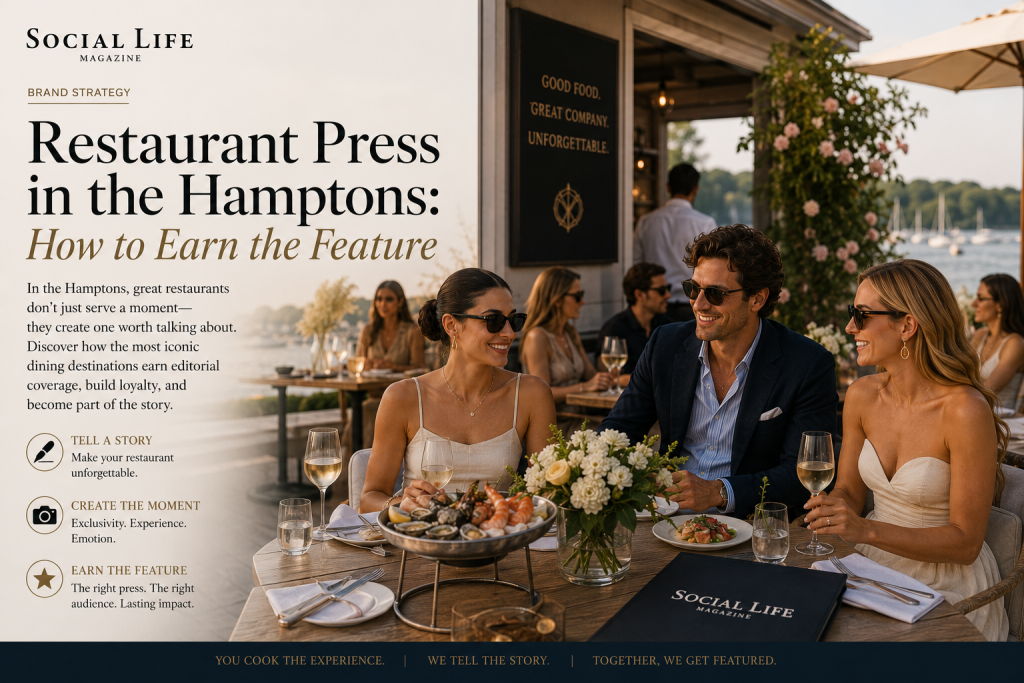
Most restaurant press gets chased the wrong way. An owner buys ads and runs a summer discount, hoping the seats fill. The promotion works for a weekend. The crowd it pulls never comes back, and by Labor Day the room is busy with the wrong people and empty of the right ones.
Another restaurant did the opposite. It ran no discount. It earned a feature in a magazine the right diners read, and let the story make the room hard to get into. By fall it was the reservation everyone was asking a friend to help them land.
This is the truth the discount hides. A restaurant does not sell a table. It sells a reputation, and a table is just where the reputation gets eaten. Nobody chases a place because it was cheap. They chase the place a magazine called the one to know.
So the question is not how many seats you can fill tonight. The question is whether the right people want in. Get that right and the room sells itself. Get it wrong and you are discounting your way to a full house of strangers.
Read this as a buyer’s guide to a market most owners misread. The page is for sale. The reputation is what it buys.
Get this right and the room sells itself at full rate. Get it wrong and you keep buying covers that vanish. The difference is not budget. The difference is whether the right people want in.
A Restaurant Sells a Table, but It Lives on a Reputation
The table is the product, but the reputation is the business. So the work is not just filling seats. The work is becoming the name people say when a friend asks where to eat out here.
An ad cannot build that name. It announces you exist, which the right diner reads as a place that has to ask. By contrast, a feature says a publication chose to write about you, and chosen is the opposite of asking.
So the same dollar does two different jobs. Spent on an ad, it begs for a booking. Spent on a feature, it earns a reputation. And the reputation is what fills the room for years, not for a weekend.
So stop paying to be seen. Start earning the right to be wanted. One reads as a place that needs you. The other reads as the place you need to get into.
This is the same logic that runs every curated room out here. The full case for why the right people beat the big numbers gets made in the guest list is the product. A restaurant is that case with a kitchen.
The Feature Makes You the Reservation People Chase
Out here, the hardest table to get is the most wanted table. So the goal is not an open room. The goal is a room people have to work to get into.
A feature is how that starts. When the right magazine names you, the right diners decide they need to go. Because the story framed you as the place to know, the booking becomes a small badge of being in the know.
So the reservation turns into a kind of currency. People mention they got in. They bring the friends they want to impress. And every one of those friends becomes a diner you never had to chase.
This is why the feature beats the promotion every time. A promotion fills the room with people hunting a deal. The feature fills it with people hunting the experience, and only one of those crowds ever comes back at full price.
So treat it as the most efficient buy on your whole list. One story can do what a season of ads cannot. The room is small. The right diners are all in it.
The Right Crowd Brings the Next Right Crowd
A restaurant is judged by who is in it. So the crowd is not just your customer. The crowd is your advertising, since the right faces in the room tell every other guest they are in the right place.
This is where the feature earns its keep. It seeds the room with the people the rest want to sit near. Because the right crowd showed up first, the next crowd follows, and the room sorts itself upward from there.
The discount does the opposite. It fills the room with whoever wanted the cheapest night out. So the next guest reads the room and quietly decides this is not their place.
So you are not just selling dinners. You are curating a crowd that sells the next reservation for you. That is the difference between a busy night and a reputation.
So the smartest spend is on the crowd, not the coupon. Seed the room with the right faces once and it keeps filling itself, since people come to sit where the right people already sit.
Your Story Is the Dish You Cannot Put on the Menu
Every restaurant has a menu. Few have a story. The story is why you opened, who is in the kitchen, what you refuse to compromise, since those are the things a reader actually remembers.
So the work is not to describe the food. The work is to tell the one true story only your room can tell. Because that story is yours alone, no place down the road can serve the same thing.
This matters most in a season full of openings. On paper, a dozen new rooms can read the same. By contrast, the one with a story becomes the one with a name, since the story is the part a diner repeats to a friend.
The version that turns your story into a feature starts at a paid feature. It is the on-ramp to the page, built around a story that is actually true.
Why a Discount Is the Wrong Buy
It helps to name the discount’s exact mistake. It chases volume, when a restaurant runs on reputation. So it counts covers, a number that feels good tonight, while training the room to wait for the next deal.
The discount also flattens the brand. A room that competes on price signals it competes on price, and price is the wrong fight out here. By contrast, the featured room signals it is the one worth the wait, which is the only fight worth winning.
So the discount wins the night and loses the reputation. It feels productive, since the seats fill fast. Yet the filling is the problem, not the proof. Because cutting the price reads as needing the cover, the deal quietly lowers the standing it meant to raise.
Scarcity Beats a Coupon
The most valuable thing a restaurant owns is the table it cannot give everyone. So scarcity is not a problem to solve. It is the asset to protect.
A feature builds that scarcity the right way. It makes the room wanted, so the hard booking feels earned rather than annoying. Because people value what they had to work for, the wait becomes part of why they brag about going.
So the move is to be wanted, not available. The coupon makes you available and forgettable. The story makes you wanted and talked about, and talked about is the only marketing that compounds.
So protect the wait. The open table is forgettable. The hard one is the story people tell, and that story is the booking engine.
How a Restaurant Earns the Feature
Earning the feature is not about spending the most. It is about showing up with something worth telling. The page respects an owner who brings a real story over one who just wants seats filled. So bring the story, not just the budget.
The restaurants that rise tend to do three things. First, they lead with a point of view, not a promotion. Second, they protect the room and the reputation over the quick full night. Third, they return, because the page rewards the familiar name the way a regular earns the warm greeting.
So treat the first feature as a deposit, not a campaign. You are buying a place in the room’s memory. That memory compounds across seasons. Because the standing is cumulative, the patient room passes the splashy one within a year.
This whole grammar of rank sits inside the broader map of the region. The full read on how status gets sorted lives in luxury status codes. Where you eat is one of its loudest tells.
The same play runs for the brands beside you. A fashion designer earns the editorial the same way. The cover works on the same logic. And the whole approach starts at the hub, the feature is the flex.
What the Right Press Returns
Here is the part the numbers will like. A feature does not pay off only the night it runs. It pays off all season, when the right diners are still booking and still bringing the friends they want to impress.
So the return is not measured in covers. It is the full-rate bookings, the regulars, the diners who arrive already sold. Because those guests cost almost nothing to win, they are the most profitable seats in the house.
The feature also keeps working after the season. You point to it on the site, at the host stand, in the first call with a private event. Since a third party said it, the claim lands harder than anything you could say about yourself.
This is the math that separates lasting rooms from flares. The flare chases covers and burns the budget by fall. By contrast, the lasting room earns the story, banks the reputation, and lets the season fill the seats.
So run the comparison honestly. A summer of discounts, gone by fall, against one story the room keeps repeating. Framed that way, the feature is the asset and the coupon is the leak.
Reading the 2026 Season
The summer runs on a clock. Five issues land between Memorial Day and Labor Day, and the right story has to be placed before the season it belongs to.
So the timing is now. The rooms that earn the summer are the ones that started the conversation in spring, since the best slots fill early. By the time an owner is ready in July, the season is already spoken for.
The same diners who read the issue fill the field at Polo Hamptons on July 18 and 25 in Bridgehampton. So a feature and a presence work together, since the reader and the guest are the same person.
Last season the best slots were claimed by spring. So the rooms that win are the ones reading this now, not the ones calling in July.
Where the Conversation Continues
A fish does not notice the water, and the discounting owner never notices the deal is the one thing the room reads as weakness. The featured room crossed that water and stopped buying covers it could not keep. Reading the difference is the whole game, and it is the one we play for a living.
If you want the right diners chasing your table this season, start with the contact page. We help the right rooms become the ones the room reads.
For the version that puts your story inside the magazine, look at a paid feature. Because it is editorial, it earns a trust an ad never could.
Want the slots before they fill? Get on the insider list. So far it is the earliest read on the season we share.
For the field where those readers gather, there is Polo Hamptons on July 18 and 25 in Bridgehampton. Since the feature and the field work together, the early room wins both.
Readers who want the season decoded all year can take a subscription. After all, the room is easier to read once someone hands you the map.
And if you have ever filled the seats and still felt forgotten, you can support the work. Of course the room still decides. We just help your story reach it.
Author

Written by
Recent Posts
The First Decision After a Collision Can Be the Most Important One
Two Weeks in Rome and Beyond: Turkish Airlines Itineraries from Boston, Chicago and Onward to India

Top 10 Hair Transplant Clinics in Turkey 2026
Artist Alley to Online Store: How Convention Artists Can Keep Selling After the Event
When an 18-Wheeler Crash Leaves Lasting Consequences
Categories
- Art
- Articles
- Business of Luxury
- Celebrities
- Culture
- Entertainment
- Events
- Faces of Summer 2026
- Fashion
- Fashion & Style
- Featured
- Finance
- Food, Spirits, Wine
- Hamptons
- Hamptons Celebrities
- Health
- Health & Beauty
- Lifestyle
- Luxury Lifestyle
- Press
- Profiles
- Real Estate
- Technology
- The Chronicles
- Travel
- Uncategorized
- Weddings