
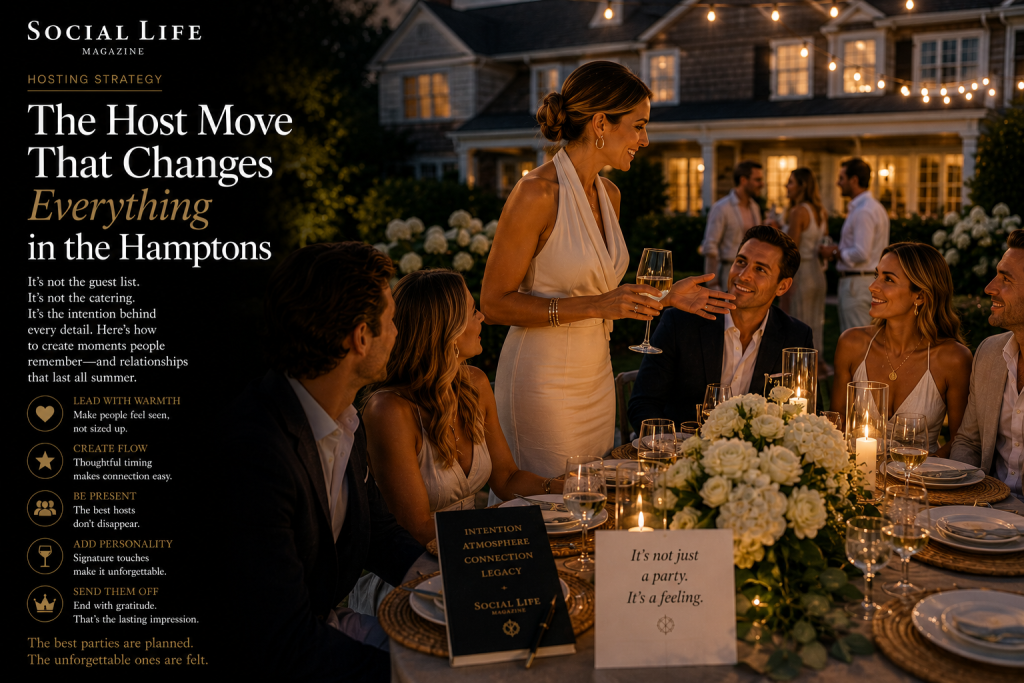
There is a person who spends every summer chasing invitations. They angle for the dinner, wait for the call, refresh the group chat hoping to be included. Then there is the person who stopped chasing and started giving the dinners, and within a season the whole room reorganized around them. That second move is the subject here, because Hamptons host etiquette is the fastest honest shortcut into the room, and almost nobody uses it on purpose.
The reason it works is simple. A guest waits to be chosen. The host does the choosing, and the one who chooses is the one with the power.
So this is not about throwing the biggest party of the summer. It is the opposite of that. It is about becoming the person whose table everyone wants a seat at, which is a different thing entirely from spending the most.
Done right, it changes your whole position. You stop being a name on someone else’s list and become the one who makes the list. That is the shift that moves you from outside to center.
So here is how the host move actually works, and how to make it without tripping the wires that sink most arrivals.
Make this one move and most of the manual becomes unnecessary. You stop needing the room’s permission once you start handing it out.
The Guest Is Chosen. The Host Chooses.
Start with the power in the room. A guest is at the mercy of the invitation. They go where they are asked, when they are asked, and hope to be asked again.
A host owns the whole equation. They decide who is in the room, what the night is, who sits next to whom. So the host holds the one thing the guest is always chasing, which is control of the room itself.
A guest reacts; a host decides. That gap is the whole reason the move works.
This is why hosting is the shortcut. It flips you from the person seeking access to the person granting it. Because you now hold what others want, the room comes to you instead of the other way around.
The deeper logic of this lives in the guest list is the product. The host is simply the person who controls the product, and control is the whole game.
Hold onto that flip. Every other advantage of hosting flows from this one fact, that you set the room instead of waiting for it.
Earn the Room First, Then Host
Here is the one piece of timing that matters. You earn the room as a guest before you host as one. Hosting cold, before anyone knows you, is the mistake that reads as buying a crowd.
Skip the cold open. A first dinner thrown by a stranger is a hard sell, no matter how good the food is.
So the order is everything. First you become the guest people are glad to see, the one who gets asked back. Then, once the room knows you, your table has gravity, since people come for you and not the spectacle.
The same dinner lands completely differently depending on when you throw it. Too early, it is a stranger buying attention. Later, after you are known, it is a friend opening their home, and the second one is the move that works.
So bank a season of being a great guest first. Then the host move has something to stand on, and the room shows up because it already likes you.
Patience here is not a delay. It is what gives the table its pull when you finally set it.
The Right Kind of Hosting, Not the Loud Kind
Now the part most arrivals get backward. The host move is not the giant catered blowout with the step-and-repeat. That reads as spending, and spending reads as new.
The move is the small, warm, perfectly judged dinner. Ten people who should meet, good food, no show. Because the intimacy signals confidence rather than effort, the small table outranks the big party every time.
So scale down, not up. The goal is not to impress the most people. It is to create the room people wish they had been in, and that room is almost always a small one.
The blowout impresses no one who matters. The small dinner that felt impossible to get into impresses everyone.
This restraint is itself a status signal. The full grammar of why quiet wins lives in luxury status codes, and the well-judged small dinner is one of its clearest moves.
Picture the dinner people talk about for weeks. It is almost never the biggest one. It is the one where the ten were exactly right.
Curate the Mix
The real art of hosting is the guest list, not the menu. Who is in the room is the entire product, since the right mix makes the night and the wrong one sinks it.
So curate like it matters, because it does. Mix the people who should know each other. Balance the talkers and the listeners, the ones who anchor and the ones who spark. Because a well-mixed table feels like magic, the guests credit you with the magic.
One wrong seat can flatten a whole table. One right one can make the night.
Obsess over the seating chart. The night is won or lost in who ends up next to whom.
This is where a host earns real standing. Anyone can feed people. The one who assembles the right ten becomes known for it, and being known for the room is the whole point.
Spend your effort on the names, not the napkins. Guests forget the flowers and remember who they sat beside.
Make the Introductions
A great host is a connector. You do not just gather people. You introduce them, with the warm line that tells each one why they should care about the other.
Think of yourself as the wiring, not the lamp. The host who connects the room becomes the part it cannot do without.
This is the move that makes you essential. When two guests meet through you and something good comes of it, they both remember who put them together. Because you became the source of a connection they value, you become someone they want to keep close.
So introduce generously and without keeping score. Give the connections away freely, since the giving is what builds the standing. The host who connects people becomes the person the whole room runs through.
Give a connection away every single time. It is the cheapest gift you can offer and the one that pays back the longest.
Generosity Without a Spotlight
The best hosts are generous in a way you almost do not notice. A glass is never empty, the shy guest is drawn in, the night runs smoothly, and none of it is announced. The care is everywhere and the effort is invisible.
So give without pointing at the giving. The host who narrates their own generosity ruins it, since the spotlight turns the gift into a performance. Because real grace hides its own work, the room feels taken care of without being told it was.
This is the line between a host and a show-off. One makes the night about the guests. The other makes it about themselves, and the room can always tell which one it is sitting inside.
Aim to be felt, not seen. The room should leave warm without quite being able to say why.
Why the Host Becomes the Hub
Put all of it together and a pattern appears. The good host stops being a guest in the social world and becomes a center of it. People start to orbit the table you set.
So the standing compounds fast. Your dinners become the ones people hope to make. Other hosts want you at their tables to return the favor, and the introductions you made keep paying you back. Because you became a source of good nights, the room reorganizes around you.
This is the quiet engine the chasers never find. They keep angling for one more invitation. Meanwhile the host has stopped needing invitations at all, since the room now comes to them.
Quietly, the math reverses. A chaser counts the invitations received. The host counts the ones they get to give.
The contrast between the two postures is its own lesson. You can read it in full in old money versus new money tells, where ease always beats effort.
Watch how fast it turns. One good season of hosting can move you from the edge of the room to the middle of it.
How This Reframes the Whole Game
Here is the shift that changes everything. Stop trying to get invited. Become the invitation.
So the whole posture flips. You are no longer waiting on the room’s permission, since you are building a room of your own. Because the giver always outranks the seeker, the host quietly leapfrogs everyone still chasing a seat.
Suddenly you are not lobbying for a seat. You are deciding who gets one, which is a position no amount of lobbying could ever buy.
This is why we call it the move that changes everything. It is the one action that turns the whole problem inside out. The person who was outside the room builds the room everyone else now wants into.
It all ties together at the hub, the new money manual. The host move is where the manual stops being defense and becomes offense.
Reading the 2026 Season
The summer is the season to make this move, since the calendar is full of nights waiting to be hosted. The people who own the season are the ones setting tables, not just sitting at them. You can see which nights actually matter in the summer social calendar.
So plan the dinners now, before the weeks fill up. The hosts who matter in August booked their nights in spring. By midsummer the calendar is crowded, and the open dates go fast.
The widest table of the summer is the field at Polo Hamptons on July 18 and 25 in Bridgehampton. It is the perfect place to gather the people you will host later, since the introductions you make there become the guest list for your own table.
Make the host move now and the season bends toward you. Wait, and you spend another summer hoping someone else remembers to set a seat.
Set one good table this summer and watch the next one fill itself. A good host never has to ask twice.
Where the Conversation Continues
A fish does not notice the water, and the chaser never notices that the host stopped needing the invitations entirely. The host crossed to the other side of the equation. Reading the difference is the whole game, and it is the one we play for a living.
The best way to learn the place is to read it all year, so start with a subscription. The room is easier to host once someone hands you the map and keeps it current.
For the earliest read on the season and the rooms that matter, get on the insider list. So far it is the closest thing to a key we hand out.
To gather the people you will host later, there is Polo Hamptons on July 18 and 25 in Bridgehampton. It is the field where your future guest list is standing right now.
If you want a quieter way in, start with the contact page. We know the rooms, and we know how the right introductions get made.
If your brand wants to be part of the story the room reads, look at a paid feature. Because it is editorial, it earns a trust that buying alone never could.
And if this saved you a summer of waiting on the call, you can support the work. Of course the room still decides. We just hand you the better seat, which is the one at the head of your own table.
Author

Written by
Recent Posts
Getting the Size Right on a Valley Dreams Zip Hoodie
The Traffic Patterns Hiding Inside the Accident Data
The Smart Way to Give Your Unused Jewelry a Second Life
Katsuya Brentwood and Haute Living Honor NBA Star Kawhi Leonard at Private Dinner

The Accountability System Quietly Protecting Your Parents’ Care
Categories
- Art
- Articles
- Business of Luxury
- Celebrities
- Culture
- Entertainment
- Events
- Faces of Summer 2026
- Fashion
- Fashion & Style
- Featured
- Finance
- Food, Spirits, Wine
- Hamptons
- Hamptons Celebrities
- Health
- Health & Beauty
- Lifestyle
- Luxury Lifestyle
- Press
- Profiles
- Real Estate
- Technology
- The Chronicles
- Travel
- Uncategorized
- Weddings