
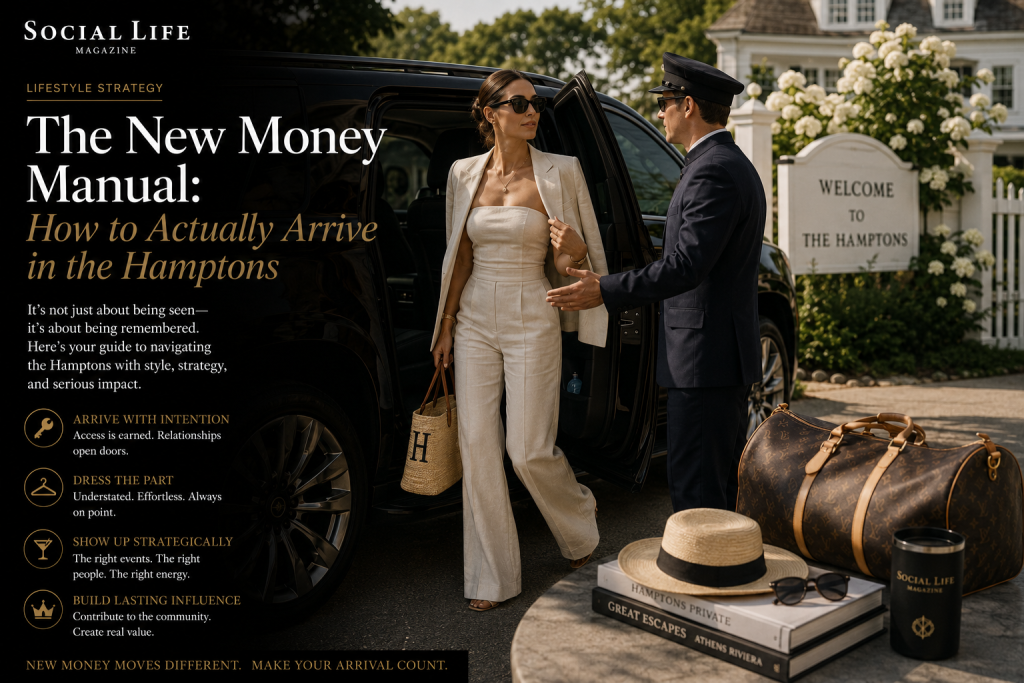
A founder closed a nine-figure exit and bought the house he had wanted for a decade. Ocean side, the right village, the kind of hedge that takes thirty years to grow. He had the address, the cars, the art. By his second summer he still could not understand why the invitations were polite and the friendships were thin, since new money Hamptons is a place where the buying is the easy part and the belonging is a separate currency entirely.
This is the thing nobody warns you about. The money gets you in the door. It does not get you in the room. The door is for sale and the room is not, and the gap between the two is where most arrivals get stuck for years.
So this is the manual for closing that gap. Not by spending more, since spending more is the tell. By understanding what the spending cannot buy, and learning the codes that the people already inside will never say out loud.
None of this is snobbery, and none of it is a verdict on you. It is just how the place works. Read the codes and the summer opens up. Miss them and you stay the person with the beautiful house and the empty calendar.
So treat this as the map you were never handed. The rest of the manual fills in each page. This is where it starts.
So read it without flinching. It is not a judgment on the new arrival. It is the head start the new arrival never gets, written by the people who watch the room every season.
Arriving Is Not the Same as Buying
The mistake is to treat arriving like a purchase. You found the house, so you assume you found the place. But the house is real estate, and arriving is something else entirely.
Arriving is when the room treats you as one of its own. It is the warm greeting, the second invitation, the friend who saves you the seat. None of those are for sale, since they are given, not bought.
So the budget that bought the house buys none of the belonging. The two run on different currencies. One is money, and the other is understanding, and only one of them is in short supply out here.
So the question is not what else to buy. The question is what to understand, since understanding is the only thing the room is grading.
This is the same sorting that runs the whole region. The full map of how it works lives in luxury status codes, and this manual is the part of it written for the new arrival.
The Money Got You the House. It Did Not Get You the Room.
Think about what the money actually delivered. A property, a set of things, a place to be. All of it visible, all of it bought, all of it the easy half.
The room is the hard half. It runs on trust, history, and the quiet sense that you understand how things are done. So the same person who can buy any house on the lane can still be a stranger at the table next door.
This is why the loudest arrivals stall. They keep buying, since buying is the tool that always worked before. But out here the buying reads as trying, and trying is the one move the room quietly marks against you.
So the work shifts from acquiring to understanding. The house is done. The room is the project now, and the room does not respond to a checkbook.
So put the checkbook down for a season. Watch how the room moves before you try to move with it. The watching is the work, and the work is free.
The Codes Are Real, and Nobody Will Explain Them
Here is the part that makes it maddening. The codes are real, but no one will say them out loud. The people inside learned them so long ago that they no longer know they are rules.
So you cannot ask. Asking marks you as someone who does not know, and the whole point of the code is that the right people already do. Because the rules are invisible, you only learn them by breaking one and feeling the temperature drop.
This is where the manual earns its keep. It says the things the room will not. Not to make you blend in as a copy, but to let you move without tripping the wire you could not see.
The clearest version of the contrast lives in reading old money tells. Read it next to this, since the codes make the most sense side by side.
The Room Reads You in Five Minutes
The room makes up its mind fast. In the first five minutes it reads a dozen small things, none of which you meant to say. The watch, the way you talk about the house, the eagerness to mention what you paid.
So the tells are not about your taste. They are about your tension. The room can feel someone straining to be read a certain way, and the strain is the tell that gives the rest away.
This is why the codes matter more than the spending. You can buy the right everything and still broadcast that you are new, since the broadcast is in the effort, not the objects. Because ease cannot be bought, ease is what the room is actually scanning for.
The good news is that tells can be unlearned. Once you see them, you stop sending them. And the day you stop sending them is the day the temperature in the room changes.
Why the Codes Exist at All
It helps to understand why the rules are there. They are a filter. The codes exist so the room can tell, fast and without asking, who understands the place and who only bought into it.
So the rules are less about manners than about membership. They are the fence that keeps the room feeling like a room. Because anyone can buy the address, the codes are how the inside stays the inside.
This is why money cannot vault the fence. The fence was built precisely against money, since money is the one thing the new arrival always has. So the gate opens for understanding, which is the thing money cannot fake.
So stop resenting the fence and start reading it. The fence is information. It tells you exactly what the room values, which is the first thing worth knowing.
This is the same reason the right room beats the big crowd. The case for that gets made in the guest list is the product, and arriving is the art of getting onto it.
The Manual, Page by Page
The manual runs in seven pages, and each one covers a different wire you could trip. So here is where to turn for what you need.
Start with the rules nobody emails you, laid out in the unwritten rules. Then the doors a checkbook cannot open, in the clubs money cannot buy into. The real test is the second invitation, which is the whole subject of how to get invited back.
Want to know what gives you away? That is what new money always gets wrong. The fastest honest shortcut is to host, and the host move that changes everything shows how. For the contrast that explains all of it, read old money tells versus new money tells.
And when you are ready to be seen in the right places, the summer social calendar is the map of which afternoons actually matter.
The Fastest Way In Is to Stop Trying to Buy In
Here is the move that feels wrong and works anyway. Stop trying to buy your way in. The harder you push with money, the more the room reads you as outside it.
So pull the spending back and let understanding lead. Less is the tell that you get it, since restraint is the one thing the new arrival rarely has the nerve to show. Because you stopped straining, the room stops bracing, and the door drifts open on its own.
This is the paradox at the center of the manual. The thing that built your fortune is the thing holding you out. So you win the room by setting down the only tool you have always trusted.
So the move is restraint, not retreat. You are not hiding the money. You are letting understanding lead, since the room follows the one who seems to need nothing from it.
What Actually Buys Belonging
If money does not buy it, something does. Belonging is earned with understanding, restraint, and time, since those are the things the room can feel and cannot be sold.
So the path is plain, even if it is not fast. Learn the codes. Hold the spending. Host well, get asked back, and let the room watch you understand it. Because each of those compounds, the patient arrival passes the loud one within a season or two.
This is the good news buried in the hard news. The room is not closed to you. It is closed to the version of you that thinks the house was the finish line, and that version is the only thing you have to retire.
Understanding Is the Currency That Compounds
Money is a currency that spends down. You buy the house and the money is gone. Understanding is the opposite, since it only grows the longer you pay attention.
So every season you read correctly makes the next one easier. The codes stop feeling foreign. The rooms start feeling like yours, and the effort that once marked you as new quietly disappears.
This is why the patient arrival wins. The loud one keeps spending and stays outside. By contrast, the one who invests in understanding builds a standing money cannot catch up to.
So the manual is not a list of tricks. It is the start of a different way of seeing the place. And once you see it, you cannot unsee it, which is the moment you finally belong.
Reading the 2026 Season
The summer is when all of this gets decided. The season is short, the rooms are full, and the calendar is where you either understand the place or expose that you do not.
So the time to learn the codes is before the season, not during it. The arrivals who win the summer are the ones who read the map in spring. By July the right rooms are already deciding who belongs, and they decide fast.
The center of that calendar is the field at Polo Hamptons on July 18 and 25 in Bridgehampton. It is where the room gathers in the open, so it is the best place to be read correctly, or to read everyone else.
Learn the codes now and the season works for you. Wait, and you spend another summer in the beautiful house, watching the room happen somewhere you were not asked.
Where the Conversation Continues
A fish does not notice the water, and the new arrival does not notice the codes until one of them is broken. The manual makes the water visible. Reading it is the whole game, and it is the one we play for a living.
The best way to learn the place is to read it all year, so start with a subscription. The codes are easier to follow once someone hands you the map and keeps updating it.
For the earliest read on the season and the rooms that matter, get on the insider list. So far it is the closest thing to a key we hand out.
To be in the room where the season gathers, there is Polo Hamptons on July 18 and 25 in Bridgehampton. It is the field where arriving happens in public.
If you want a quieter way in, start with the contact page. We know the rooms, and we know how the right introductions get made.
If your brand wants to be part of the story the room reads, look at a paid feature. Because it is editorial, it earns a trust that buying alone never could.
And if the manual saved you a season of standing in your own driveway, you can support the work. Of course the room still decides. We just make the codes a little easier to read.
Author

Written by
Recent Posts
How to Choose Useful Tech Gifts for Employees and Clients in 2026
The Garage Question: Which Car Goes South for the Season?
VandS Clinic Review Treatment: How Seoul Injectable and Laser Options Compare for US Patients
Before Buying a View Home: What a Sloped Lot Means for the Purchase

Powerful Strategies to Stay Ahead in a Fast-Moving Real Estate Market
Categories
- Art
- Articles
- Business of Luxury
- Celebrities
- Culture
- Entertainment
- Events
- Faces of Summer 2026
- Fashion
- Fashion & Style
- Featured
- Finance
- Food, Spirits, Wine
- Hamptons
- Hamptons Celebrities
- Health
- Health & Beauty
- Lifestyle
- Luxury Lifestyle
- Press
- Profiles
- Real Estate
- Technology
- The Chronicles
- Travel
- Uncategorized
- Weddings