
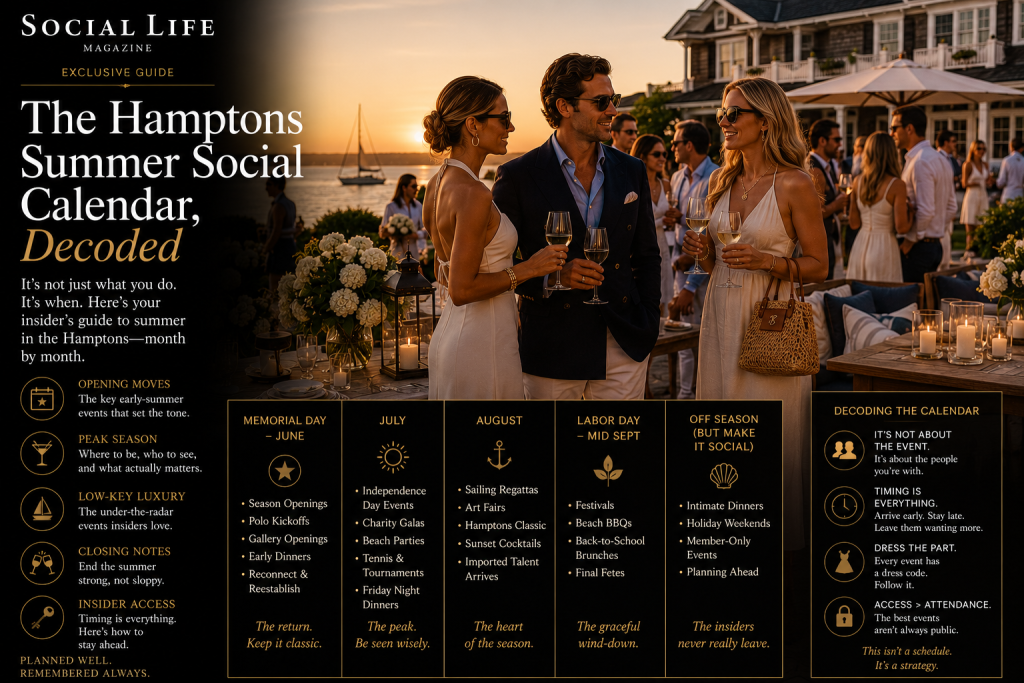
There is a person who says yes to every invitation the summer offers. They are at the Friday opening, the Saturday benefit, the Sunday brunch, the Monday thing nobody else bothered with. By August they are exhausted and somehow nowhere, since the Hamptons summer social calendar is not a list to complete. It is a code to read, and reading it means knowing the handful of afternoons that matter and skipping the rest without a second thought.
This is the mistake the calendar invites. It looks like a checklist, so the eager arrival treats it like one. But the room does not score attendance. It scores judgment, which means being at the right things and quietly absent from the wrong ones.
So this page decodes the season. Not every event, since most of them do not matter. The few that do, the rhythm they follow, and how to be exactly where the room is without looking like you are chasing it.
The summer is short and the signal is concentrated. Get the calendar right and you are seen in all the correct places. Get it wrong and you are either invisible or, worse, everywhere.
So here is the season, read the way the people who belong already read it.
Read it once and the summer simplifies. You stop managing a checklist and start choosing a few right rooms. The rest you can let pass without a flicker of regret.
The Season Has a Rhythm
The summer runs on a clock everyone here knows by feel. It opens on Memorial Day, builds through July, peaks in the long stretch of high summer, and winds down at Labor Day. Each beat has its own mood.
So the early season is for settling in, not making noise. The middle is the peak, when the rooms are fullest and the calendar is densest. The close is for the people who lasted the whole season well, since finishing strong reads better than arriving loud.
Each beat asks for something different. Read which one you are in, and you will rarely strike the wrong note.
Knowing the rhythm tells you when to move. You do not push hard in June, and you do not fade in August. You match the season’s tempo, since moving against it is its own kind of tell.
This rhythm is part of the larger grammar of the place. The full map lives in luxury status codes, and the calendar is that grammar set to a clock.
Feel the tempo before you move to it. The season has a pace, and matching it is half of looking like you have been here for years.
Being Everywhere Is Its Own Tell
The instinct of the new arrival is to maximize. More events, more faces, more chances to be seen. It feels like progress.
The room reads it as the opposite. Someone at everything looks like someone with something to prove, since the people who belong are selective by nature. So overexposure is a tell, the same way a loud entrance is.
So the move is to pick the right few and let the rest go. Three well-chosen afternoons beat thirty scattered ones. Because scarcity reads as confidence, the person who is selective about the calendar reads as the one who belongs on it.
Choose three afternoons you can commit to fully. Presence beats attendance, and the room remembers where you were, not how many places.
The Real Calendar Is Mostly Private
Here is the part no public listing shows. The events that matter most are rarely the ones with a website and a ticket. They are the private dinners, the standing weekends, the gatherings with no posted date at all.
A website shows you where the tourists will be. The real calendar is the one nobody bothers to post.
So the public calendar is only the visible half. The real one lives in group chats and word of mouth, and you reach it through people, not listings. Because the best rooms are invisible, getting onto that calendar works the same way getting into a club does.
This is why relationships are the whole game. The private calendar has no application, only sponsors. The mechanics are the same ones laid out in the clubs money cannot buy into.
Chase the listed events and you will always be a step behind. The private calendar is the one that runs the summer, and it travels by trust.
The Afternoons Matter More Than the Nights
Out here the daytime carries the signal. The afternoon gatherings, the lunches, the open-air events are where the real room shows up. The late-night scene is mostly for people performing a summer rather than living one.
Picture where the settled crowd actually spends the day. It is rarely the velvet rope. It is the open-air afternoon, in the light, where everyone can see who showed up.
So weight your calendar toward the day. The bright, easy, outdoor afternoon is where the people who matter actually are. Because the daytime crowd is the settled one, that is where being seen actually counts.
This flips the city instinct on its head. In town the night is the event. Out here the night is winding down, and the afternoon is the main stage.
Bank your best energy on the daylight. The afternoon is where the settled crowd is, and the settled crowd is the one worth being among.
The Anchor Afternoon: Polo Hamptons
If you choose one set of afternoons to anchor the summer, choose the polo. Polo Hamptons runs July 18 and 25 in Bridgehampton, hosted by Christie Brinkley, and it is the rare day when the whole room gathers in the open.
Build the summer around those two afternoons and the rest falls into place. They are the surest correct call on the entire calendar.
So it does something almost nothing else on the calendar does. It puts the private world in a public field for an afternoon. Because the people from all those invisible rooms turn up in one place, it is the single best day to be seen and to see who is who.
It is also the easiest correct move on the whole calendar. There is no membership and no waitlist, just a field and an afternoon. So it is the one anchor event a newer arrival can simply decide to attend, and look exactly right doing it.
For a newer arrival, this is the gift on the calendar. No sponsor required, just a good afternoon and the whole room in one place.
You can find the day itself at Polo Hamptons. Treat the two dates as the fixed points you build the rest of your summer around.
Plant your flag on those two dates first. Everything else on the calendar gets easier once the anchor is set.
How to Read the Calendar Like an Insider
The skill is telling signal from noise. Most of what fills the summer is noise, since the open invitations are open for a reason. The signal is the small, hard-to-get, word-of-mouth gathering.
Most of the summer is noise dressed as opportunity. The signal is quiet, and it is easy to miss if you are busy attending everything.
So learn to ask a simple question of every invitation. Who else is in the room. If the answer is the right few, go, and if it is anyone with a ticket, you can probably skip it without a cost.
This is the whole logic of the guest list applied to a calendar. The full version lives in the guest list is the product, since who is there is the only thing that ever made an event matter.
Audit every invitation by the room, not the rsvp. One question, who else is there, sorts the whole summer for you.
Timing Your Arrival in the Season
When you show up in the season matters as much as where. Arrive too hard in June and you look overeager. Disappear in August and you look like a tourist who rented for a month.
So pace yourself across the whole arc. Settle in early, build through July, and be present at the peak when it counts. Because consistency reads as belonging, the steady summer beats the burst that flames out by mid-July.
Treat June as planting and August as proof. The arc is the point, not any single night.
This is where the unwritten rules meet the calendar. How you carry yourself across the season is its own running tell, and the basics live in the unwritten rules.
Run the whole arc, not a sprint. The summer rewards the one still standing gracefully in late August.
How This Closes the Loop
The calendar is where the whole manual gets applied. Every code you learned shows up on it, since the season is the field where all of it is tested in real time.
Nothing in the manual works in the abstract. It all happens on a date, in a room, on this calendar.
So this is the page that puts the others to work. The rules tell you how to behave, the tells tell you how to read, the host move and the clubs tell you how to get in. The calendar tells you when and where to do all of it.
So read it as the schedule for everything else. The hub ties the whole manual together at the new money manual, and the calendar is where the manual finally meets the summer.
Think of the calendar as the field where the manual gets played. Everything you learned now has a date on it.
Reading the 2026 Season
The 2026 season is already taking shape, and the best afternoons are filling now. The people who will own the summer are picking their few right places this spring, not scrambling in July.
So plan the calendar now, while the dates are open. The fixed points are the two polo afternoons on July 18 and 25 in Bridgehampton, and you build the rest of the summer outward from there. By the time the season starts, your few right places should already be set.
The whole room gathers at the field, so it is where your summer should begin. Mark the dates, and let the polo be the anchor the rest of the calendar hangs on.
Set the anchor and the season organizes around it. A summer with a fixed point is a summer you can actually plan.
Read the season right and the summer arranges itself. Wait, and you spend another year saying yes to everything and landing nowhere.
Where the Conversation Continues
A fish does not notice the water, and the person at every event never notices that the calendar was a code, not a checklist. The one who read it correctly was at the right few places all along. Reading the difference is the whole game, and it is the one we play for a living.
The best way to know which afternoons matter is to read the place all year, so start with a subscription. The calendar is easier to read once someone hands you the map and keeps it current.
For the earliest read on the season and the rooms that matter, get on the insider list. So far it is the closest thing to the private calendar we share.
For the anchor afternoon itself, there is Polo Hamptons on July 18 and 25 in Bridgehampton. It is the open field where the whole room turns up at once.
If you want a quieter way onto the private calendar, start with the contact page. We know the rooms, and we know how the right introductions get made.
If your brand wants to be part of the season the room reads, look at a paid feature. Because it is editorial, it earns a trust that buying alone never could.
And if this saved you a summer of saying yes to everything, you can support the work. Of course the season still decides. We just hand you the calendar that matters.
Author

Written by
Recent Posts

The First Decision After a Collision Can Be the Most Important One
Two Weeks in Rome and Beyond: Turkish Airlines Itineraries from Boston, Chicago and Onward to India

Top 10 Hair Transplant Clinics in Turkey 2026
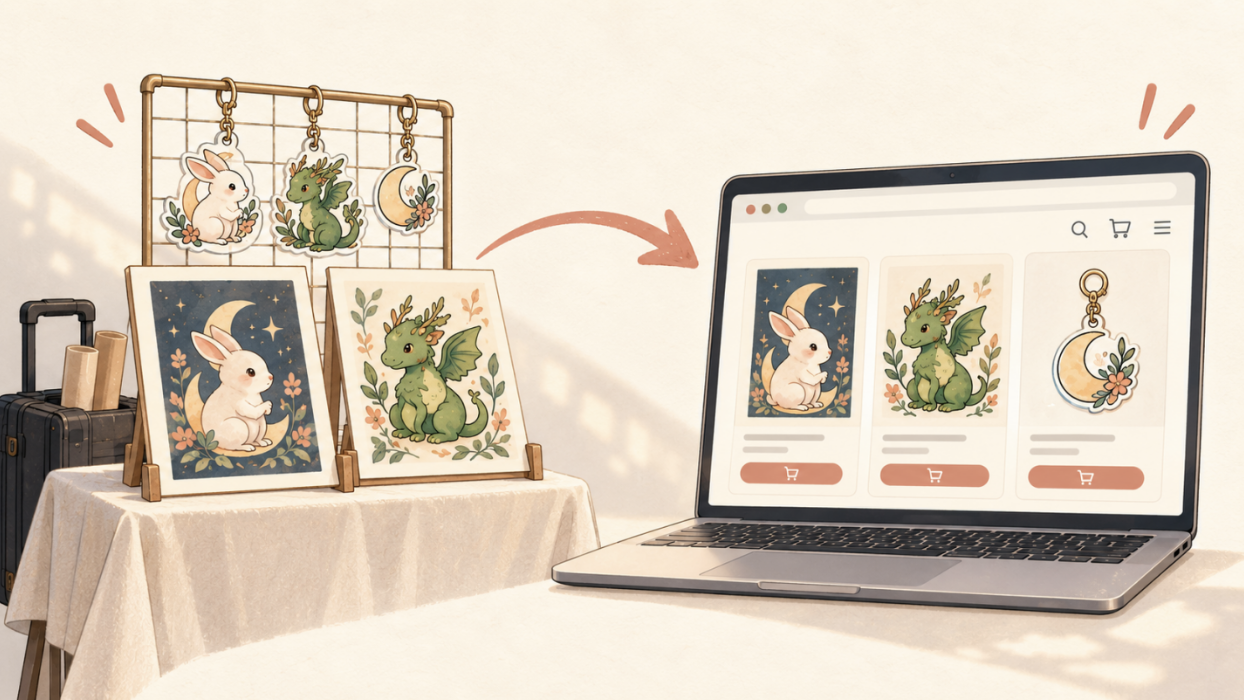
Artist Alley to Online Store: How Convention Artists Can Keep Selling After the Event
When an 18-Wheeler Crash Leaves Lasting Consequences
Categories
- Art
- Articles
- Business of Luxury
- Celebrities
- Culture
- Entertainment
- Events
- Faces of Summer 2026
- Fashion
- Fashion & Style
- Featured
- Finance
- Food, Spirits, Wine
- Hamptons
- Hamptons Celebrities
- Health
- Health & Beauty
- Lifestyle
- Luxury Lifestyle
- Press
- Profiles
- Real Estate
- Technology
- The Chronicles
- Travel
- Uncategorized
- Weddings