
Two Rabbits Walk Into a Bar at the End of the World
There is a joke in the painting, and also not a joke at all, and the fact that both of those things are true simultaneously is the entire point, and if you miss that, you have missed the painting.
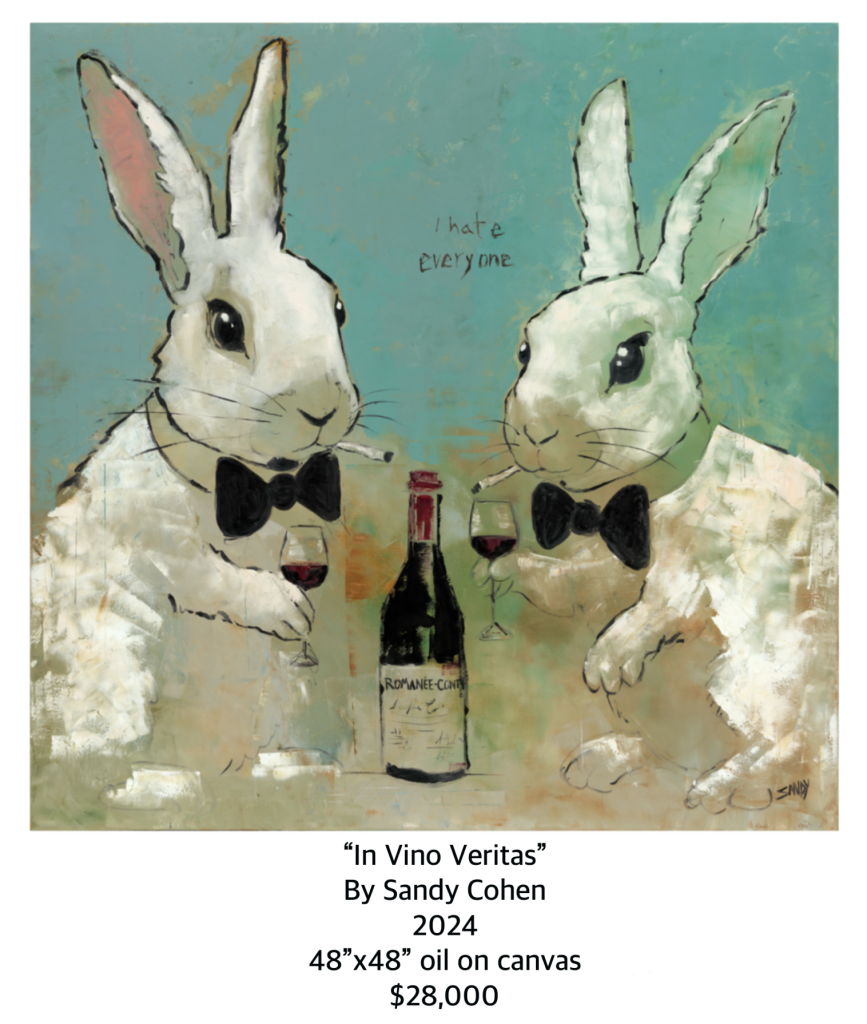
Two white rabbits sit at a table. They wear black bow ties. Between them, a bottle of Romanée-Conti, the most expensive wine produced at scale on earth, the kind of bottle that costs more per pour than most people’s car payments, the kind of bottle whose provenance matters so much that counterfeiters have built cottage industries around faking the label alone. One rabbit holds a cigarette. The other holds a cigarette. Both hold wine glasses with the studied casualness of people who have been at this table for a very long time. Graffitied into the blue-green space above their heads, in the handwriting of someone writing on a bathroom wall at the exact party everyone wanted to be invited to, are four words: “I hate everyone.”
Sandy Cohen made this in 2024. The title is In Vino Veritas. It is 48 by 48 inches, oil on canvas. The price is $28,000. You should look at it for longer than you plan to.
What the Title Actually Means
The phrase is Latin. In wine, there is truth. The Romans used it as a warning and a confession simultaneously. The idea being that the social architecture of civility, the mutual agreement we all maintain to pretend we are mostly fine with each other, holds until it doesn’t, and what dissolves it is alcohol, time, or both, and what comes out when it dissolves is the actual opinion.
But Cohen does something more interesting than illustrate the phrase. She reverses the polarity. The rabbits are not drunk. They are not loose. They are impeccably dressed, seated with the formal posture of people who have been to these dinners before, who know exactly how long to hold the glass before sipping, who understand the vocabulary of the table. The Romanée-Conti is not a prop. It is the most correct bottle you could order if you knew what you were doing. These are not people cutting loose. These are people who have arrived, fully, at the thing the whole social performance was supposedly pointing toward. The bottle. The table. The clothes. The event.
And still: I hate everyone.
That is not what drunkenness says. That is what clarity says.
The Animal as Mirror
Cohen has been deploying animal proxies for human behavior since her return to the art world in 2017, after nearly two decades of illness, the kind of devastation that keeps a person bedridden and dependent on a wheelchair and that would have ended most artistic careers permanently. It did not end hers. Instead, it clarified something. You can see it in her work, the way the animal figures carry human pathology without human defensiveness. A dog in a blue suit praying toward the word LOVE etched faint on its own palm. A lion sitting in a leather chair with Louis XIII Cognac in a white-gloved hand and LONG LIVE THE KING casual on the wall behind him. A Doberman on a park bench in the city, mid-dream.
The animals absorb what humans refuse to acknowledge about themselves. They are not metaphors exactly. They are more like confessions, the way we give them to a priest, which is to say to someone who is not fully human in the social sense, which is to say to someone you can tell the truth to precisely because the social calculus doesn’t apply to them the same way.
You can read the full scope of Cohen’s collector circle, which includes Sheikh Saud Al Thani of Qatar, Grammy winners, Wall Street legends, and a Supreme Court widow, at Sandy Cohen: The Hamptons Artist Whose Collectors Are Already the Canon. The rooms that have her work are telling you something. Those rooms have always been the review.
The Specific Genius of the Romanée-Conti
Cohen did not put a generic wine bottle in this painting. She put the bottle. Romanée-Conti, Domaine de la Romanée-Conti, the 4.5-acre Burgundian grand cru that produces roughly 6,000 bottles a year for the entire world, that sells at auction for tens of thousands of dollars a bottle, that is categorically unavailable to anyone who has not already been in the money long enough to know where to call. You do not encounter this bottle by accident. You encounter it because you have been somewhere for a long time, or because someone who has been somewhere for a long time brought you there.
But then you sit across from someone over that bottle, someone also impeccably dressed, also holding a cigarette with the practiced nonchalance of the veteran partygoer, and you look at them, and above you both, in the handwriting of someone who has finally stopped trying to manage the room, are those four words.
The luxury is real in this painting. Cohen does not mock the bottle. She does not satirize the bow ties in the cheap way a lesser artist would. The precision of her draftsmanship insists on the legitimacy of the scene. These are objects that carry actual cultural weight and actual economic weight, and she paints them with the respect they have earned. Yet what she has also done is paint what happens after you acquire them all. After you learn the vocabularyfter you know which wine to order and how to hold the glass. After the whole apparatus of social performance is fully operational and humming and you are inside it with the right person at the right table with the right bottle.
The truth that arrives then, in vino or otherwise, is the text on the canvas.
Cohen’s Hamptons Studio and the Psychology of the Thing
Cohen primarily creates from her studio in the Hamptons, where she has maintained a presence long enough that the serious rooms know her name. There is something fitting about that geography. The Hamptons is, among other things, the most elaborate social performance in the American northeast, the annual theater of status signaling in which the same people who were pretending to be casual on the Upper East Side drive east to be casual at a higher register, to acquire the right table at the right restaurant, the right house on the right road, to sit across from the right person over the right bottle. Gallery 23
Which is to say: Cohen is painting her neighborhood. Not the landscape. Not the dunes or the light or the shingled houses or the beach roses. She is painting the interior life of the people who come to the neighborhood, the subtext that sits under all the performance, the four-word graffiti that nobody writes because it would ruin the party and everybody thinks.
Her work has appreciated over 2,000% since she relaunched in 2017, while her brand has become a household name Out East and synonymous with collectible art. That is not separate from the content. That is the content made manifest. The work that tells the truth about luxury has become a luxury object. Cohen understood this would happen, or something in her understood it, which is the kind of understanding that comes not from calculation but from having been away long enough to see the thing clearly. website
There is a companion read in this series, the deep-dive on Many Lives, Many Masters, which explores what survives every social performance, what the kneeling dog with the word LOVE faint on its palm knows that the party doesn’t. In Vino Veritas and Many Lives, Many Masters are not officially paired works. But they are having the same conversation. One painting tells you what remains after everything else falls away. The other tells you what you realize when you’ve assembled everything that was supposed to make it not fall away.
What the Rabbits Know
Cohen’s biography reverberates through her visual command. A meteoric rise, devastating collapse, decades of immobility, and an improbable reemergence form the crucible from which this imagery rises. Her work refuses fragility, rejects apology, and replaces passive beauty with sovereign architecture. amNewYork
The rabbits in In Vino Veritas are not victimized by the realization above their heads. They are not surprised by it. They are sitting with it the way you sit with a thing you have known for a while and have finally decided to stop performing around. The cigarettes are still burning. The wine is still in the glasses. The bow ties are still on. The party did not end. They are still at the table, still dressed for the event, still holding the bottle that signals they won.
And above them, in the handwriting of someone who has earned the right to say it: I hate everyone.
Not because the win was not real, not because the bottle is not extraordinary, not because the table is not the table they wanted to be at. But because arriving somewhere fully, which is to say arriving with absolute clarity about the texture of the thing you spent so long reaching for, produces a very specific kind of knowledge. The knowledge is uncomfortable. It is also, in the Latin sense, true. And the only honest response to truth is to write it on the wall, in the good handwriting of someone who learned calligraphy and graffiti both, and let the paint dry around it.
Cohen painted this in 2024. You will keep thinking about it.
In Vino Veritas by Sandy Cohen. 2024. 48″x48″, oil on canvas. $28,000. Available at SandyCohenArt.com. Follow her studio practice at @sandycohensart on Instagram.
To read more in our ongoing series on Sandy Cohen’s work, start with the collector circle piece and the deep-dive on Many Lives, Many Masters.
To feature your collection, practice, or brand in Social Life Magazine, visit sociallifemagazine.com/advertise. Twenty-five thousand print copies, Westhampton to Montauk, Memorial Day through Labor Day. The rooms that already know this painting know where to find us.
Author

Written by
Recent Posts

AI for personal finance: where PennyGuard fits

How to Pick a Homecoming Dress for Your Body Type (and Feel Amazing in It)

World Cup Injury Attorney for Vancouver Events
What a 3-Carat Engagement Ring Actually Costs in 2026: The Real Numbers
The Skincare Habits That Make a Real Difference Over Time
Categories
- Art
- Articles
- Business of Luxury
- Celebrities
- Culture
- Entertainment
- Events
- Faces of Summer 2026
- Fashion
- Fashion & Style
- Featured
- Finance
- Food, Spirits, Wine
- Hamptons
- Hamptons Celebrities
- Health
- Health & Beauty
- Lifestyle
- Luxury Lifestyle
- Press
- Profiles
- Real Estate
- Technology
- The Chronicles
- Travel
- Uncategorized
- Weddings