
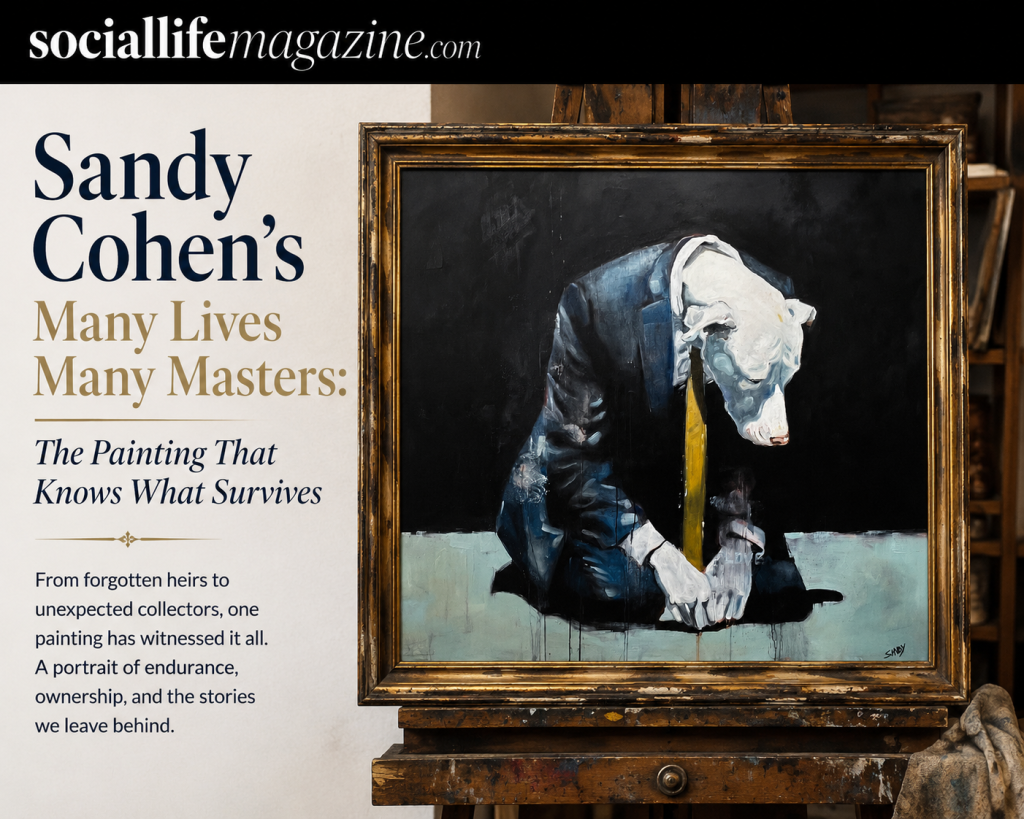
There is a painting in a studio on the East End of Long Island that will stop you the way very few things stop you anymore. It will stop you completely. Specifically, it will stop you the way you were stopped as a child. Before you learned to keep moving. Before the cultural consensus emerged that stopping was a form of weakness or sentiment or both. Oil on canvas, sixty inches by sixty inches, large enough that your peripheral vision cannot escape it. A figure in a blue suit, white shirt, gold tie, kneels at what might be a table or might be the edge of everything. The head of a white dog bends forward in something that is either the last posture before collapse or the first posture of prayer.
On one of its hands, faintly, almost gone, are the letters L-O-V-E. You will stand there longer than you planned because the painting is showing you the one thing that survives everything else. That one thing is what you have been trying, for most of your adult life, to metabolize into something more manageable.
Sandy Cohen made this. The title is Many Lives, Many Masters. The price is $43,000.
Born Into Art, Stopped Cold, Then Unstoppable
Cohen was born in Israel and raised in New York City. At eight years old, she became the youngest student accepted into an adults-only art program at the Metropolitan Museum of Art. Her technique was so advanced the instructor asked her to teach the rest of the workshop. She sold her first piece at thirteen. Before starting high school, she was granted admission to the Fashion Institute of Technology. At nineteen, legendary pop artist Peter Max discovered her and recognized what the market would later confirm.
Then, that same year, Cohen’s body shut down. She became severely disabled with a devastating neurological condition due to adverse reactions to antibiotics. That event kept her bedridden and dependent on a wheelchair for nearly two decades. She did not stop creating entirely. But the world stopped seeing it, and for almost twenty years the work accumulated in silence.
She re-emerged onto the art scene in 2017, after years of fighting for her health and her dream. Within the first year, her paintings were featured at Art Basel and galleries across the country. European galleries followed. By the end of that first year, two separate royal families had acquired her work. That is not a comeback story. That is a detonation. Her works have since appreciated over 2,000%. Her collector list has grown to include Sheikh Saud Al Thani of Qatar’s royal family, Prince Moulay Rachid of Morocco, Grammy winners, Wall Street legends, and Hollywood producers. You can read the full scope of that list in the hub piece on Cohen’s collector circle.
The Accumulation the Soul Carries
Malcolm Gladwell spent a considerable portion of Outliers arguing that mastery is not a gift but an accumulation. Ten thousand hours of deliberate practice. The slow compression of experience into instinct. What he was describing was something older than any of those examples. He just framed it through hockey players and software billionaires. Brian Weiss drew from his book Many Lives, Many Masters. He was a psychiatrist who became, against every instinct of his training, a believer in the continuity of the soul across lifetimes. His central argument: what we call character, what we call the self, arrives already shaped by everything it has already survived.
Cohen looked at this idea and painted it as a white dog in a suit kneeling at the end of something. The white dog is the soul, and she tells you this directly. This directness makes her work disarming in the way that completely honest people are disarming. You are accustomed to art that withholds its meanings the way status withholds its criteria. So when an artist simply tells you what she is painting, you suspect a trap. You look around for the real message. Then you realize the real message is the stated one. You have been so thoroughly trained in suspicion that sincerity now reads as sophisticated.
The Posture Between Two States
The soul is a white dog, and it has dressed itself in every lifetime as a person. Now it is kneeling. A blue suit, somewhere between deep water and a boardroom. Gold tie the color of autumn, which is the color of ending. The posture, as Cohen says, sits between collapse and prayer. It is the most precise description of a human position since Rodin. It is also the most honest description of what it feels like to have survived more than one version of your own life.
What Remains After Everything Is Shed
By the time the soul arrives at the moment Cohen has painted, it has shed the memory of the faces. After that, the specific textures of the specific griefs go too. Then the names and addresses. The decades. The wars and the recoveries and the particular colors of the light in the particular rooms where the particular losses occurred. All of it shed, the way water sheds everything except its nature. What remains, faint on the hand, almost erased but not quite, is LOVE.
No name. No face. Not even a memory of a specific warmth in a specific winter. Just the word itself, the category, the essential thing that was always the cargo. The soul has been carrying this since before it had a word for it. It will carry it after the word is gone too. Cohen knows about the long accumulation from a different direction than Weiss or Gladwell. Cohen has already lived more than one life in this body alone. She knows what survives and painted it without guessing.
What survives is not the early reputation. Not the prodigy story or the Peter Max validation or any specific cultural capital assembled before the body failed. What survives is the drive, which is another word for love: love of the work, love of the communication. That is the specific thing that happens between a painting and a person when the painting is honest enough and the person is present enough.
Where to Find the Work
Many Lives, Many Masters is available at SandyCohenArt.com. For the companion piece about what the living do with accumulated weight while still inside the digital world, see Magnus Canis. For the full collector circle that has formed around Cohen’s work, read Sandy Cohen: The Hamptons Artist Whose Collectors Are Already the Canon. To feature Sandy Cohen or your own collection in Social Life Magazine, visit sociallifemagazine.com/submit-a-paid-feature.
Author

Written by
Recent Posts

AI for personal finance: where PennyGuard fits

How to Pick a Homecoming Dress for Your Body Type (and Feel Amazing in It)

World Cup Injury Attorney for Vancouver Events
What a 3-Carat Engagement Ring Actually Costs in 2026: The Real Numbers
The Skincare Habits That Make a Real Difference Over Time
Categories
- Art
- Articles
- Business of Luxury
- Celebrities
- Culture
- Entertainment
- Events
- Faces of Summer 2026
- Fashion
- Fashion & Style
- Featured
- Finance
- Food, Spirits, Wine
- Hamptons
- Hamptons Celebrities
- Health
- Health & Beauty
- Lifestyle
- Luxury Lifestyle
- Press
- Profiles
- Real Estate
- Technology
- The Chronicles
- Travel
- Uncategorized
- Weddings