
The Fourth has come and gone, which means the season has now revealed its true character. June was rehearsal. July is the performance, and the past week has offered an unusually clear reading of what the summer is actually about — which, as ever out here, is the quiet and continuous sorting of the authentic from the performed. Herewith, a dispatch from the front, in four parts.
1. The White Party, and the Great Credential Arms Race
Michael Rubin’s annual white-clad spectacular in Bridgehampton remains the season’s most reliable gossip engine, and this year was no exception. The A-list turnout was, by all accounts, formidable — the sort of guest list reported in outlets far less discreet than this one. But the truly local conversation, the one happening the morning after over iced coffee, was about the credentials.
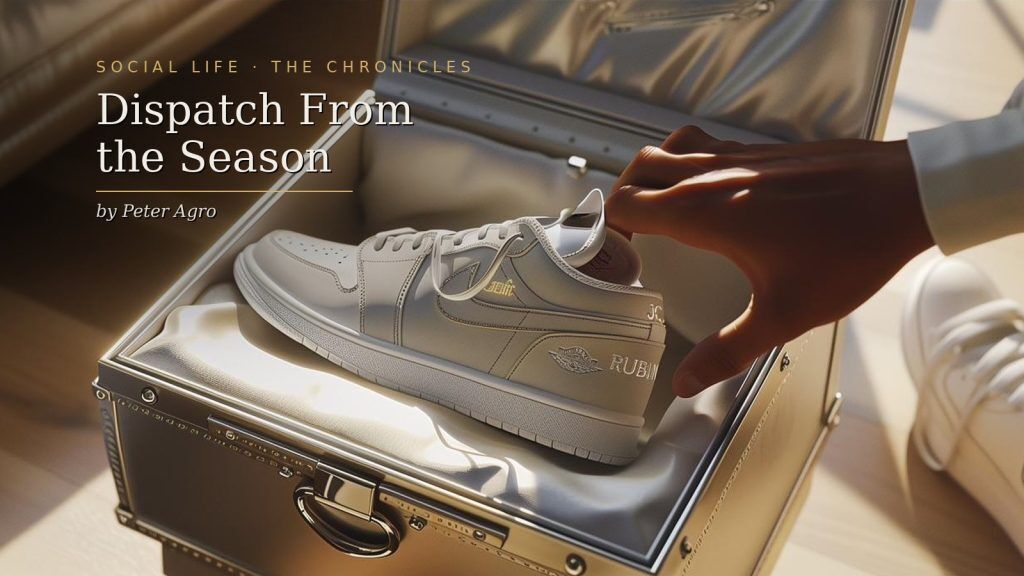
Because Rubin has quietly won an arms race no one else knew they were running. Forget the paper invitation or the digital QR code. For recent editions, the invitation itself has been a custom illustration by the contemporary artist George Condo — Drake, among others, posted the Condo piece that arrived with his — which is a remarkable thing to think about: the throwaway object, the thing that in any other life goes in a drawer, is a signed work by one of the most collected living artists. And the party favor to match: a bespoke, all-white Travis Scott x Air Jordan 1 Low, produced in a run of just 350, each pair stamped with the individual guest’s name and initials on the tongue and lace guard, delivered in a white briefcase, marked firmly “not for resale.” A sneaker, in other words, that money genuinely cannot buy, because the only way to obtain one is to have been wanted at the party.
When the invitation is an original Condo artwork and the party favor is a shoe that cannot be bought at any price, the event has stopped being a party and become a small, exquisitely guarded economy.
And here is the detail that makes the whole apparatus sing, the one this column cannot resist. After all of that — the framed art, the briefcased sneakers, the multi-tiered everything — the actual wristbands inside, the humble bands that separate the merely-admitted from the truly-inner-sanctum, are kept deliberately minimal: clean matte white, fabric or silicone, whispering rather than shouting. At a party where the guests are wearing generational wealth on their wrists in the form of rare watches, a loud plastic band would simply ruin the line of the thing. The credential that gets you in is a museum acquisition. The credential once you’re inside is nearly invisible. That is the entire logic of this place, distilled into a single evening: spend extravagantly to arrive, and then, once you belong, wear it so quietly that only the other initiates can see.
2. The Impossible Reservations
The culinary map has been redrawn this season, and a few addresses have become genuine battlegrounds. Tutto Caffè has taken over the iconic former Golden Pear space in Bridgehampton with a casual all-day concept, and has instantly become the default morning ground for the high-profile local — the place to be seen not trying to be seen, which is the most strenuous kind of being seen there is. Out in Montauk, a buzzy Manhattan nightlife name has installed a summer residency at Gurney’s, where the crowd has developed a collective obsession with tableside martinis and late-night caviar. And in Southampton, a Parisian supper club has brought its seductive, high-energy vibe to town as the current epicenter of the weekend’s late dinners.
A reservation you cannot get is, of course, the only kind worth wanting. The table you can walk into has already told you everything you need to know about it.
And a note for the mourners: people are still not entirely over the sudden closing of Estia’s Little Kitchen, gone after twenty-seven years on the turnpike. There is a lesson buried in the contrast — that the places we grieve are never the battlegrounds. No one will weep, in twenty-seven years, over a caviar residency. We weep for the ones that felt like they belonged to us. Keep that distinction in mind; it explains almost everything about what follows.
3. The $2 Million Rental and the Quiet Counter-Revolution
The headline number this season is the two-million-dollar summer rental, a figure that has solidified what everyone is calling a new Gilded Age of mega-mansions — flawless, enormous, and hyper-polished to a mirror shine. This is the loud story, and it is true.
But underneath it runs a far more interesting current, and it is the one this column has been tracking all summer in other forms. A growing faction of the genuinely established is quietly trading the flawless new build for something with a history — for authentic vintage charm over modern flash. You can read the shift in the buzz around the reopening of The Hedges Inn in East Hampton, whose widely praised redesign leans hard into full-service nostalgia rather than the loud gloss of the moment. The tell, as always, is that the people with the most to prove buy the biggest and shiniest thing available, while the people with nothing left to prove increasingly want something that looks as though it was always theirs. Patina, it turns out, is the one luxury that cannot be purchased new — only inherited, or convincingly waited for.
4. The Wardrobe Follows the Money
And sure enough, the clothes are telling the same story. Glance around Pierre’s or Sant Ambroeus this month and the loud micro-trends of recent summers have simply evaporated. The season’s uniform has gone quiet and expensive in the least obvious way: monochromatic ivory, soft sand, pale mint, muted blue. Oversized linen co-ords, clean silhouettes, the seamless day-to-night midi that carries a person from beach walk to late reservation without a costume change.
It is being called fabric-first, capsule dressing, sustainability — and it is all of those things. But it is also the exact same instinct playing out in the real estate and, honestly, in the wristbands: the retreat from loud, and the growing understanding among people who no longer need to announce themselves that the most expensive-looking thing in any room is the thing that declines to shout. The whole season, read correctly, is one long argument on that single point.
Which is the dispatch, in the end. The party performs, the counter-current retreats, and the summer goes on quietly sorting everyone into those who need the room to know and those who have stopped keeping score. We are, at time of writing, roughly at the midpoint. There is a great deal of season left, and the sorting, mercifully, is never finished.
Author

Written by
Recent Posts

Dispatch From the Season: The Great Hamptons Sorting
The Man Who Isn’t at Your Party: Howard Stern’s Hamptons
A Field Guide to the Hamptons Casualty

Aesthetic Medicine Distributor: The Foundation of Patient Confidence in Modern Aesthetic Medicine
What Makes a Custom Wool Rug Worth the Higher Price Tag
Categories
- Art
- Articles
- Business of Luxury
- Celebrities
- Entertainment
- Events
- Faces of Summer 2026
- Fashion
- Fashion & Style
- Featured
- Finance
- Food, Spirits, Wine
- Hamptons
- Hamptons Celebrities
- Health
- Health & Beauty
- Lifestyle
- Luxury Lifestyle
- Press
- Profiles
- Real Estate
- Technology
- The Chronicles
- Travel
- Uncategorized
- Weddings