
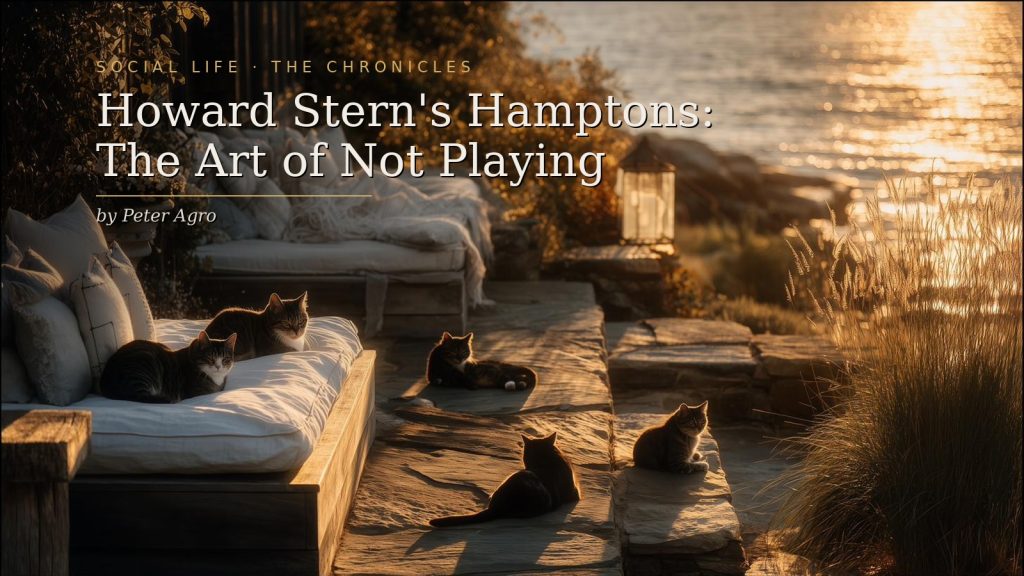
Somewhere in Southampton, behind a hedge that has been persuaded to mind its own business, one of the most famous voices in America is not at your benefit. He is not at anyone’s benefit. He is home, and being home is, for Howard Stern, the entire point of having the house.
This makes him a genuine curiosity out here, where the prevailing logic runs in exactly the opposite direction. The rest of the season is organized around being seen — the gala, the dinner, the strategically casual run-in at the farm stand. Stern owns one of the great oceanfront addresses in the Hamptons and appears to use it primarily as a place the party cannot reach. He has, in other words, cracked something that the strivers spend whole summers failing to solve, and he did it by understanding one thing about himself that most people never work out at all.
The Show Is the Dinner Party
Here is the key that unlocks him. For four hours a day, Howard Stern performs — brilliantly, exhaustively, for an audience of millions. He asks the probing question, works the room, reads the guest, manages the silences, lands the joke. He does, professionally and at the highest level, precisely the thing the Hamptons dinner party demands of its guests: he is *on*. He has been doing it since before most of your fellow benefit-goers owned their first pair of boat shoes.
So consider what that means when the microphone goes off. The striver arrives at the dinner party hungry, because the table is his only stage and he has a whole self to prove across the space of one seating. Stern has already proven it, that morning, to more people than will attend every gala on the South Fork combined. He does not need the table. He has had his stage, and it was excellent, and now he would like to go home and feed the cats.
The man performs for a living. Why on earth would he do it for free, at your dinner, on a Saturday?
What He Does Instead
The documented facts of Stern’s Hamptons life read like a quiet rebuke to the entire social calendar. He practices Transcendental Meditation. He and his wife Beth are devoted to rescuing cats — genuinely, unglamorously, at scale. He plays chess. He takes photographs. During the pandemic he simply broadcast the show from a studio in the house, collapsing the commute between his stage and his sanctuary to a walk down the hall, which may be the most enviable arrangement any performer has ever engineered.
None of this is the behavior of a recluse, a word that gets attached to him lazily. A recluse is hiding. Stern isn’t hiding; he’s just *finished for the day*. There is a categorical difference between the person who avoids the party because he fears it and the person who skips it because he has already had a better one, alone, on his own terms, with the people and animals he actually likes. One is anxiety. The other is arrival.
The Flex of Not Playing
All summer this column has been describing a game — who sits where, who leaves when, who is trying too hard and who has mastered the art of appearing not to try. Stern reveals the game’s final, unspoken level, the one above all the others: not playing it. Declining the invitation not as a strategy to seem more desirable, but because you genuinely have something you would rather be doing, and no longer require the room’s approval to feel like yourself.
This is, of course, maddening to the striving class, because it cannot be imitated. You can buy the house, learn the rules, master the exit. You cannot fake no longer needing it; the need announces itself in everything you do, and its absence is equally legible. The people out here with the least to prove are always, in the end, the ones who already proved it somewhere else — in a studio, on a stage, in a career — and came to the Hamptons not to compete but to rest.
There is a lesson in the hedge, if the ambitious care to take it, though most won’t. The goal was never to win the season. It was to reach the point where the season no longer has anything you want. Stern seems to have arrived there years ago, and spends his summers exactly as a person should who has nothing left to prove: quietly, comfortably, and emphatically not at your party. One suspects he is having a wonderful time.
Author

Written by
Recent Posts

AI for personal finance: where PennyGuard fits

How to Pick a Homecoming Dress for Your Body Type (and Feel Amazing in It)

World Cup Injury Attorney for Vancouver Events
What a 3-Carat Engagement Ring Actually Costs in 2026: The Real Numbers
The Skincare Habits That Make a Real Difference Over Time
Categories
- Art
- Articles
- Business of Luxury
- Celebrities
- Culture
- Entertainment
- Events
- Faces of Summer 2026
- Fashion
- Fashion & Style
- Featured
- Finance
- Food, Spirits, Wine
- Hamptons
- Hamptons Celebrities
- Health
- Health & Beauty
- Lifestyle
- Luxury Lifestyle
- Press
- Profiles
- Real Estate
- Technology
- The Chronicles
- Travel
- Uncategorized
- Weddings