
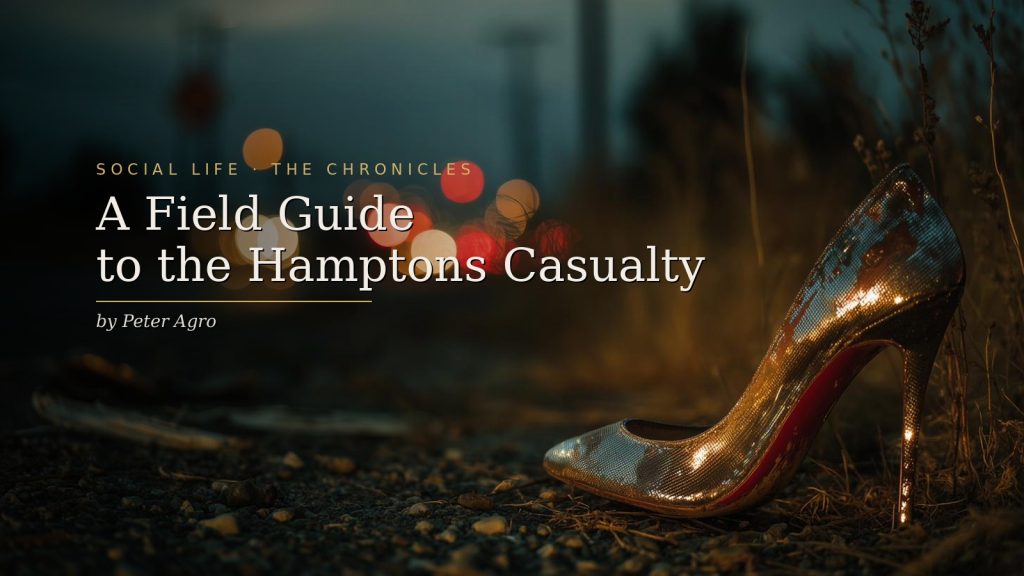
There is a specific sound a rosé bottle makes at four in the afternoon, and the newcomer does not yet know to fear it. It is the sound of a plan going well. By seven, that same newcomer will be explaining something urgent and incomprehensible to a hedge fund manager’s wife, and by nine he will be walking home along the shoulder of Montauk Highway, carrying one shoe and the beginnings of a story he will not be allowed to forget.
Every summer produces these casualties, and I want to be clear that I say this with love. The scene needs them. Nothing bonds a table of veterans faster than the shared spectacle of someone discovering their limits in public, and the newcomer, bless him, is only doing what we all secretly enjoy watching. What follows is a small taxonomy of the season’s most reliable disasters — offered, as always, in the hope that recognizing yourself early spares you the starring role.
The Man Who Thought Rosé Was a Soft Drink
He arrives at the day party genuinely believing he has paced himself. It is pink. It is cold. It tastes of summer and virtue. He has had, by his own accounting, “a couple of glasses,” a figure that bears no relationship to the six the host actually poured, because the host has been topping him up with the quiet efficiency of a man conducting an experiment.
The rosé does not announce itself. This is its great cruelty. It waits, patient and floral, until he stands up to find the restroom and discovers that the lawn has developed a gentle pitch, like the deck of a ship. From here events accelerate. The newcomer who has been ambushed by afternoon wine is a figure of real pathos, and also the single most dependable source of entertainment on the entire South Fork.
The Pool Situation
At a certain hour, at a certain kind of party, someone ends up in the pool who did not intend to. Sometimes he is pushed. More often he pushes himself, having decided, with the tragic confidence of the recently over-served, that a swim is exactly what the evening needs and that his linen suit will be fine.
It will not be fine. He emerges to a towel and a nickname. Only one of them is returnable.
The Hamptons forgives almost anything except taking yourself too seriously — and, on a case-by-case basis, what you did to the crudités table on your way into the pool.
The Missing Shoe
No one has ever solved the mystery of the shoe. It is one of the season’s constants, as reliable as the traffic on the LIE: at any given moment in July, somewhere between a party and a home, a newcomer is walking barefoot on one side, carrying or entirely lacking a single shoe, unable to reconstruct where it went or why he is now committed to this arrangement.
The shoe is never both shoes. That would suggest a decision. It is always exactly one, which suggests a mystery — a small sacrifice made to the gods of the evening, an offering left in a hedge or a taxi or the passenger seat of someone he has only just met. He will find it funny in September. In the moment, lit by a passing Range Rover, he is simply a man and his shoe, contemplating the choices that brought them to the highway.
The Over-Sharer at Dinner
Drink lowers the newcomer’s volume control and raises his sense of intimacy, a combination that produces the evening’s most memorable monologue. Somewhere around the main course he decides that these people — whom he met ninety minutes ago — are his true friends, and that this is the moment to tell them about the divorce, the lawsuit, the thing his business partner did, and his frank assessment of his own therapist’s competence.
The table listens with the exquisite politeness reserved for a slow-motion accident. No one stops him. Stopping him would be a mercy, and mercy is not on the menu; the story is simply too good to interrupt. He will wake at dawn with the specific dread of a man who remembers the general shape of the evening but none of the load-bearing details, and he will spend the next weekend wondering why everyone greets him with such warm, knowing smiles.
In Defense of the Disaster
Here is the thing the newcomer cannot see from inside the wreckage: the summer needs him, and is fonder of him than he fears. A season with no casualties would be a season with no stories, and the Hamptons runs on stories the way its roads run on Range Rovers. The man in the pool, the barefoot pilgrim on the highway, the dinner-table confessor — they are not the season’s failures. They are its folklore.
And there is a strange grace waiting on the far side of the humiliation. The newcomer who can laugh at the video — and there is always a video — who tells the story on himself before anyone else can, who returns the following weekend with his head high and his shoes accounted for, discovers that he has been quietly forgiven, even adopted. The scene has a deep affection for anyone willing to be its comedy. The only unforgivable move is to have done all of it and learned nothing, to arrive next July with the same rosé and the same certainty, having missed the one lesson the missing shoe was trying, patiently, to teach.
Author

Written by
Recent Posts

The New York Women’s Foundation’s 2026 Neighborhood Dinner

Marco Maranghello

The Baker House 1650
MvVO ART Show

Casita Maria Center for Arts and Education
Categories
- Art
- Articles
- Business of Luxury
- Celebrities
- Culture
- Entertainment
- Events
- Faces of Summer 2026
- Fashion
- Fashion & Style
- Featured
- Finance
- Food, Spirits, Wine
- Hamptons
- Hamptons Celebrities
- Health
- Health & Beauty
- Lifestyle
- Luxury Lifestyle
- Press
- Profiles
- Real Estate
- Technology
- The Chronicles
- Travel
- Uncategorized
- Weddings