
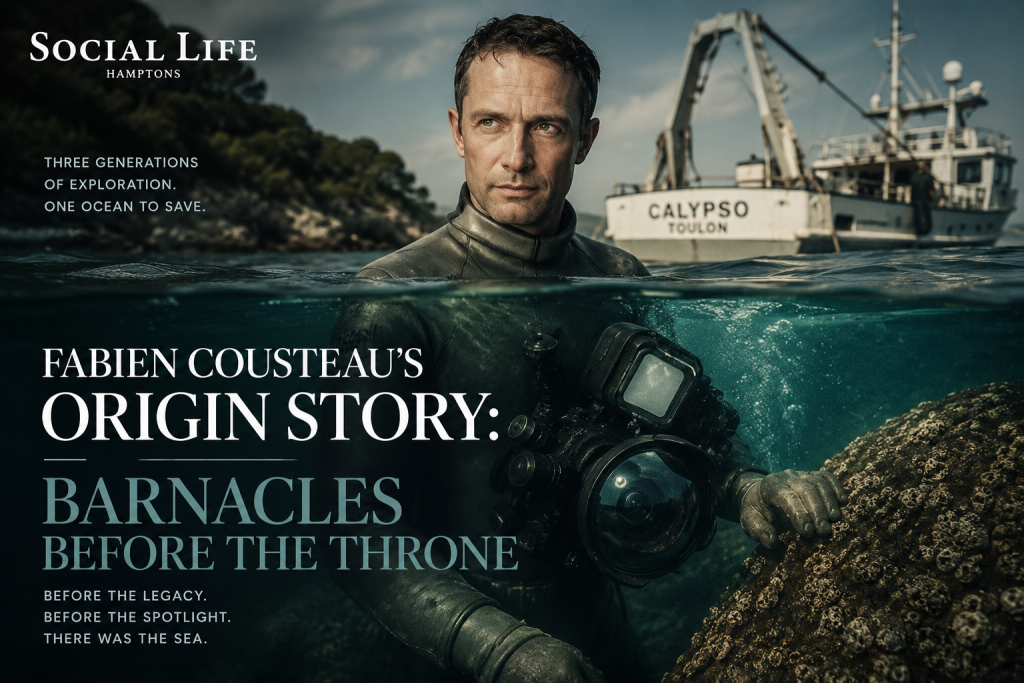
The Fabien Cousteau origin story starts with a job title no dynasty brochure would print: barnacle scraper. He was 12 years old, officially joining the crew of the Calypso, the most famous research vessel afloat. His grandfather, of course, commanded the ship. His father, meanwhile, directed expeditions from its deck. The kid got a scraper and a hull, because in this family the deep end was the shallow end. Before that, at age 4, he made his first scuba dive in the Mediterranean with Jacques-Yves Cousteau himself supervising the descent. Most children inherit a last name. This one inherited a depth gauge.
What follows is the rare origin story where the mythology is the documented part, and the struggle happened in an office park.
Born Into the Frame
He was born October 2, 1967, in Paris, the first grandson of the most famous ocean explorer alive. By then the Cousteau brand was already global: the Aqua-Lung, the red cap, the Oscars, the television specials that taught two generations what a manta ray was. His father, Jean-Michel Cousteau, would build his own exploration empire. His sister, Céline, likewise became a documentarian. The family did not have a business so much as a mythology with payroll.
Childhood, accordingly, did not look like childhood. Family bonding happened on expedition in the Amazon, in Papua New Guinea, across the Mediterranean, rather than around a dinner table. Summers meant the Calypso and the wind-powered Alcyone, ships where a boy was expected to be useful or be ballast. The scraping of barnacles at 12 was not hazing, though. It was the family’s version of a trust structure: work first, legend later.
Notice what this bought him, in the currency that matters out here. Not money, but an unfakeable backstory. You cannot, after all, purchase a childhood aboard the Calypso at any auction, and everyone who meets him knows it.
A Shark Named Curiosity
Around age 6 or 7, two pieces of pop culture rewired him. The first was Jaws, which terrified a generation out of the water yet pulled this particular child deeper in. The second was the Tintin comic Red Rackham’s Treasure, which features a shark-shaped submersible. He has told interviewers the image lodged itself as childhood fantasy and stayed there for decades.
Hold that thought, because almost forty years later he built the thing. Troy, his 14-foot shark-shaped submarine, swam among great whites in 2005 for a CBS special. In other words, the kid who read the comic became the man who commissioned the machine. We cover that saga, and the rest of the record, in the accomplishments spoke linked below.
The lesson for anyone raising heirs in a great family: the obsessions arrive early and they do not negotiate. The only question is whether the family treats them as a distraction or as research and development.
The Coma Years
Now the part the tribute reels skip. After Norfolk Academy in Virginia, he took a degree in environmental economics at Boston University, by his own admission an unremarkable student. Then he did the most radical thing available to a Cousteau. He got a normal job.
For roughly three years he worked in marketing at Seventh Generation, the household products company, with stints testing dive gear and a sales job at a friend’s retail firm. The motive was self-respect. He wanted proof that he could exist outside the family business, that doors would open without the surname doing the knocking. Every heir on the East End knows this itch, and most scratch it with a vanity fund.
His verdict on corporate life was surgical. He described it as professionally entering a coma. The ocean, he said, was calling the whole time, pulling him toward adventure, exploration, and storytelling. The detour proved its point and then expired. Independence had been established. Beige had been sampled. The water won.
The Return, on His Own Terms
The comeback was not a press conference. It was a contract. From 2000 to 2002 he served as an Explorer-at-Large for National Geographic, working on a documentary about a mystery shark attack that aired in August 2002. The assignment mattered because the badge was his own, earned outside his father’s production company and his grandfather’s shadow.
From there the record compounds. The shark submarine in the mid-2000s came first. Then came the PBS series Ocean Adventures with his father and sister, running from 2006 to 2009, including dives in all 13 US national marine sanctuaries. By 2014 he was ready for the family’s sacred number: 31 days living underwater, one day longer than his grandfather’s 1963 Conshelf II mission. NC Sea Grant now estimates his lifetime bottom time at roughly 25,000 hours.
Since then he has stacked institutions. He founded the nonprofit Plant A Fish in 2010, then the Fabien Cousteau Ocean Learning Center in 2016, and unveiled the PROTEUS underwater habitat project in 2020. The barnacle scraper now negotiates with NOAA.
What the Detour Actually Taught
Strip the salt water off this story and it is a case study in converting inherited standing into earned standing. The name was symbolic wealth of the purest kind, recognized on every continent, attached to nothing he had personally done. His answer was to spend three years proving he could live without it, then a lifetime adding entries the name never held.
Consider the one-day margin of Mission 31. He did not triple his grandfather’s record, though the technology existed to try. He beat it by exactly one day, deeper, then spent the surplus energy on livestreams to 100,000 students. The message was precision, not patricide: honor the legend, then extend it. Family offices spend millions on succession consultants to produce exactly that sentence.
His stated maxim distills the whole education: people protect what they love, they love what they understand, and they understand what they’re taught. He learned that on a ship where a 12-year-old with a scraper was being taught, hull-first, to love the thing he would spend his life protecting.
Raised Inside a Production Company
Here is the detail biographers underplay: the Calypso was not just a ship. It was a floating studio with a science department attached. The Captain financed expeditions by selling television, and everyone aboard doubled as crew for the cameras. A child raised in that environment learns something no film school teaches. Science that nobody watches is philanthropy. Science that everybody watches is an industry.
Fabien took the lesson to heart, and his projects prove it. Mission 31 ran the first 24/7 livestream from a saturation habitat, reaching an estimated 330 million people across its media footprint. PROTEUS, likewise, is designed around a production studio the way a casino is designed around the tables. Everything else is amenities.
Compare that instinct with the average conservation nonprofit, which produces a gala, a newsletter, and an annual report nobody reads past page two. The Cousteau firmware says the story is the product, the science is the supply chain, and the audience is the endowment. He was, in effect, a content executive by age 10, before the term existed and long before it paid this well.
The Ghost in the Family Ledger
No Cousteau origin runs clean, because the family history carries a fracture. In 1979 his uncle, Philippe Cousteau Sr., died in a seaplane crash. Philippe had been the designated heir of the Calypso era, the cinematic one, the pilot. His death rearranged the dynasty overnight, and it pushed Jean-Michel, Fabien’s father, into a larger role beside the Captain. Every exploration family has its lost aviator. This one had cameras rolling for decades on either side of the grief.
The fracture also multiplied the brand. Today there are Cousteaus on several continents doing ocean work under the same surname: Fabien and his sister Céline on one branch, cousins Philippe Jr. and Alexandra on another. Editors mix them up constantly, which is its own status lesson. When a name becomes an industry, precision becomes a luxury good. For the record, Fabien is the one who lived underwater for a month and is raising $135 million to do it permanently.
Because the inheritance was shared, differentiation became strategy. His chosen lane was depth, literally: habitats, saturation living, the patient science of staying down. Nobody else in the family owns that territory.
The Aristocracy of the Wetsuit
Out east we sort aristocracies by acreage and board seats. The Cousteaus built a different ladder, and it helps to name what actually sits on its rungs. Their wealth was never primarily financial. It was reputational, the accumulated trust of a public that let this family narrate the ocean for seventy years. That trust converts to money on demand, through sponsorships such as his Seiko ambassadorship, through speaking fees, through capital raises. But the reserve currency is belief.
Belief, in fact, has stricter rules than money. It cannot be borrowed against quietly or spent twice. One greenwashed partnership, one fudged dataset, and the account empties for a generation. So the family discipline that looks like romance, the ships and the red caps and the field notes, is really risk management for a reputation portfolio.
Fabien absorbed those rules before he could drive. It is why his record favors verifiable stunts over vague advocacy: 31 days at 63 feet is a number, not a mood. Notably, the same logic governs whom he will stand beside now. The man vets partners the way his grandfather vetted dive tables, because in his ledger a bad association is a decompression injury.
The Origin Story as Blueprint
Every founder profile in this magazine circles one question: what did the early years install that money later amplified? Run the Fabien Cousteau origin story through that filter and the installation list is short and absolute. Salt water before school. Usefulness before status. Storytelling as the family’s actual product, with science as its supplier. The rest of his career, the subs and the habitats and the $135 million capital raise, runs on that firmware.
The origin also explains his ease in rooms like Bridgehampton, where he accepted an honor from the South Fork Natural History Museum in July 2026. He grew up as the junior member of a floating aristocracy, so terrestrial ones hold no terror. A man who has been 63 feet down for a month does not sweat a seating chart.
For the East End’s own dynasties, his arc reads as both invitation and indictment. The invitation: your heirs can convert your name into something the obituaries will lead with. The indictment: it requires handing them a scraper instead of a title.
Where The Conversation Continues
The full portrait of the man and his $135 million underwater station lives in our Fabien Cousteau hub profile. Follow the record from shark sub to sea floor in the Proteus bet, and see where he thinks travel must go next in making tourism answer to the ocean. Social Life Magazine tells the origin stories that the East End’s most consequential rooms trade on. If your brand belongs inside those stories rather than beside them, the July issue is taking names.
Author

Written by
Recent Posts
Jetsetter Style: Castello del Sole

The First Decision After a Collision Can Be the Most Important One
Two Weeks in Rome and Beyond: Turkish Airlines Itineraries from Boston, Chicago and Onward to India

Top 10 Hair Transplant Clinics in Turkey 2026

Artist Alley to Online Store: How Convention Artists Can Keep Selling After the Event
Categories
- Art
- Articles
- Business of Luxury
- Celebrities
- Culture
- Entertainment
- Events
- Faces of Summer 2026
- Fashion
- Fashion & Style
- Featured
- Finance
- Food, Spirits, Wine
- Hamptons
- Hamptons Celebrities
- Health
- Health & Beauty
- Lifestyle
- Luxury Lifestyle
- Press
- Profiles
- Real Estate
- Technology
- The Chronicles
- Travel
- Uncategorized
- Weddings