
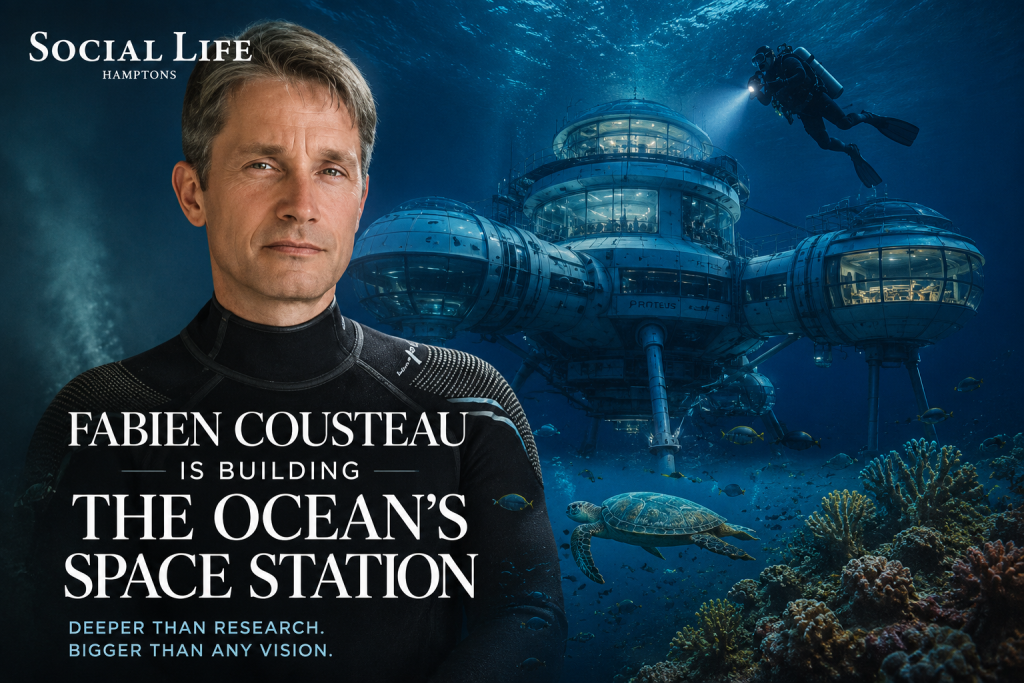
On July 11, 2026, the South Fork Natural History Museum filled a Bridgehampton evening with $50,000 tables. The honoree was Fabien Cousteau, first grandson of Jacques-Yves Cousteau, standing beside Jean Shafiroff under a theme about protecting living waters. Tickets started at $1,500, and the room was full anyway. Because the East End knows a bankable legend when it sees one, the gala sold what galas always sell: proximity. Yet the man being honored was not selling nostalgia. Fabien Cousteau came to Bridgehampton with a blueprint for a $135 million underwater station called PROTEUS, and a question for every fortune in the room.
The question is simple. Space has its station, its billionaires, its merchandise. So where is the ocean’s?
The Name Is the First Asset
Every dynasty trades on something. The Cousteau family trades on the rarest currency in the room: a name that signals adventure, science, and mid-century glamour all at once. His grandfather invented the Aqua-Lung with Émile Gagnan, won three Oscars, and made the Calypso more famous than most navies. That inheritance is not money. It is permission, the kind that opens doors before you knock.
Fabien Cousteau understood early that permission cuts both ways. A famous name buys the meeting, but it also invites the suspicion that you are a tribute act. So he spent five decades converting inherited fame into earned credibility, one stunt and one dataset at a time. He first strapped on scuba gear at age 4 in the Mediterranean. By 12 he was scraping barnacles off the Calypso as a crew member, not a passenger. NC Sea Grant now estimates he has logged roughly 25,000 hours underwater.
For the newly rich, this is the playbook worth studying. Inherited capital is a down payment, not a house. The interest compounds only if you build something the original never attempted.
From Shark Suit to Sea Floor
His résumé reads like a dare escalating. In the mid-2000s he commissioned Troy, a 14-foot submarine shaped like a great white shark, so he could swim among the real ones without cages or chum. The project was budgeted at $100,000 and two months. It ultimately cost about $200,000 and a year, which is the most honest line item in exploration. The CBS special aired in 2006, and he described the sharks at Guadalupe as “like 747s underwater.”
Then came the family flex. In June 2014 he led Mission 31, living for 31 days in the Aquarius habitat, 63 feet beneath the Florida Keys. The number was not an accident. His grandfather’s Conshelf II team spent 30 days underwater in the Red Sea in 1963. Fabien went one day longer, and deeper, on a budget of about $1.8 million. The mission produced roughly ten scientific papers and, by his 2024 accounting, over three years’ worth of experiments in a single month. Skype sessions from the sea floor reached more than 100,000 students on six continents.
One day longer than the legend. In any family business, that is the whole psychology in a single integer.
PROTEUS, Explained Without the Lab Coat
Now for the main event. PROTEUS is his planned underwater habitat off Curaçao, designed by Yves Béhar, pitched as the International Space Station of the ocean. The design calls for up to 4,000 square feet at roughly 60 feet deep, housing around 12 aquanauts. Aquarius, the habitat he lived in for Mission 31, is about 400 square feet. This is the difference between a submarine bunk and a villa with a moon pool.
The station plans a video production studio with continuous livestream, laboratories, and the first underwater greenhouse. That last detail is personal. After a month of freeze-dried food on Mission 31, Cousteau decided the future of undersea living needed a kitchen garden. Power would come from wind, solar, and ocean thermal energy conversion.
Why bother living down there at all? Because saturation changes the math. A surface diver gets minutes on the bottom. An aquanaut living at depth can work the reef for eight to twelve hours a day. As Cousteau put it, the only way to learn more about the ocean is to spend more time in it.
The Money Is the Story
The price tag is $135 million, roughly $60 million to build and $75 million for the first three years of operations. Proteus Ocean Group, the for-profit company behind it, is run by CEO Lisa Marrocchino while Cousteau plays founder and chief oceanic explorer. In May 2022, the Italian engineering firm DRASS signed on to build it, taking equity instead of profit margin. A century-old saturation-diving contractor betting its fee on the outcome is a statement, not a press release.
Washington noticed too. NOAA signed a cooperative research agreement in May 2023, followed by the US Navy’s Undersea Warfare Center that September. Northeastern University plans to send co-op students to live and work aboard. There is even a proposed subsea data center, because nothing says 2026 like servers cooled by the Caribbean.
Still, honesty matters here. The station remains unbuilt, and the timeline has slipped from 2025 toward 2027. The funding gap is real, and Cousteau knows exactly which rooms hold that kind of capital. Bridgehampton, for instance.
The Anti-Doom Salesman
What separates Fabien Cousteau from the professional worriers of the conservation circuit is tone. He does not lecture. He recruits. His stated maxim, adapted from his grandfather, runs: “People protect what they love, they love what they understand, and they understand what they’re taught.” Notice the verbs. Nothing in there about shame.
He is also funny in the unrehearsed way that reads as trust. Asked about his dive gear, he once said electronics and saltwater don’t mix, that things “crap out at the exact wrong time,” which is why a mechanical watch rides his wrist as a fail-safe. The man has spent a career at crush depth and talks like your most interesting dinner guest, not your most credentialed one.
His economics degree shows when the stakes come up. He calls the ocean a multi-trillion-dollar risk to the global economy and argues we should invest in depleted natural capital and live off the interest. That is Boston University environmental economics translated into terms a family office understands before dessert.
The Detour Nobody Mentions
The résumé has a hole in it, and the hole is the best part. After Boston University, where he studied environmental economics, Fabien Cousteau spent roughly three years in marketing at Seventh Generation. He wanted to prove he could exist outside the family gravity. Instead he discovered what a cubicle does to a man raised on a research vessel. He later described the period as professionally entering a coma.
The ocean, in his telling, was calling the whole time. By 2000 he had answered, signing on as an Explorer-at-Large for National Geographic and chasing a mystery shark for a 2002 documentary. The detour lasted three years. The lesson has lasted twenty-five: legacies are not escaped, only renegotiated. We tell that full story, from barnacle duty to boardroom coma to first expedition, in the origin spoke below.
For every founder’s kid summering out east while dodging the family firm, his arc is the useful case study. He left, he verified the world outside was beige, and he came back on his own terms. The name got heavier and lighter at the same time.
The Race He Will Not Call a Race
PROTEUS is not the only bid for the sea floor. A British outfit called DEEP is developing its own habitat, Sentinel, with a similar late-2020s window. Both teams talk about permanent human presence underwater the way 1960s contractors talked about the Moon. Neither has moved a resident in yet, so the title of first modern undersea campus is still on the table.
Competition, of course, is the best thing that could happen to the funding gap. Nothing loosens a checkbook like the possibility that someone else’s name ends up on the era. The space race taught American money that lesson in a single decade. An ocean race would teach it faster, because the ocean is two hours from Teterboro by way of Curaçao, not three days by rocket.
Cousteau declines the rivalry framing, mostly because his brand is collaboration. Yet the calendar is the calendar. Whoever splashes first defines the category, hosts the first undersea broadcast of the decade, and collects the first generation of naming rights. Second place gets to be thorough.
Why This Belongs to the East End
The Hamptons is an ocean economy wearing a real estate costume. Every oceanfront listing, every raw bar, every regatta and paddleboard fundraiser rests on water quality that nobody at the closing table wants to discuss. The South Fork built its fortune on the Atlantic, and the Atlantic is calling in the loan.
So when a Cousteau accepts an honor in Bridgehampton, it is not a celebrity sighting. It is a market signal. The same crowd that funded telescopes and vaccine wings is being offered the ocean as the next legacy asset class. A named laboratory module 60 feet under the Caribbean will outlast most naming rights on most buildings, and it photographs better.
Consider the adjacency. His father, Jean-Michel Cousteau, lent his name to a resort in Fiji and a dive center in the Grenadines. The family has always understood that hospitality is a delivery system for ocean literacy. Fabien’s version simply moves the guest room to the sea floor.
What He Actually Wants
Ask him about the future and the answer is never merely a building. He talks about a network of habitats across several oceans, a smart-ocean platform of sensors and livestreams, and a generation of aquanauts who are engineers and storytellers rather than career academics. He told a TED audience in 2014 that some of them might live in underwater cities. The audience laughed then. Fewer people laugh now.
The media plan is pure Calypso, updated. His grandfather turned exploration into appointment television and funded science with the proceeds. PROTEUS is designed with a production studio at its heart because, in this family, discovery has never been separate from the broadcast of discovery. That is the business model, and it has worked since 1956.
The vision also has a tourism wing, which deserves its own conversation. Cousteau has presented PROTEUS at underwater tourism summits, and his standard for hospitality is blunt: operators should answer to the ocean, not borrow from it. We unpack that argument, and the resorts that already live by it, in the vision piece linked below.
The Bottom Line for the Room
Here is the shape of the play. A 58-year-old heir with 25,000 underwater hours, a NOAA agreement, a Navy agreement, an equity-committed builder, and the most trusted surname in ocean exploration needs $135 million to finish the ocean’s first true undersea campus. The Hamptons summer economy will spend more than that on rosé and landscaping by Labor Day.
The dynasty math favors the bold here. First movers get the christening, the module names, the founding-partner lore. Everyone else gets a press release about somebody else’s legacy. In fact, that is how status has always worked out here. The house matters less than the story attached to it.
Fabien Cousteau left Bridgehampton with an award. The room he left behind is still deciding whether it wants to be in the story or merely adjacent to it.
Where The Conversation Continues
Go deeper into the cluster. Read how a boy raised on the Calypso became the family’s builder in Fabien Cousteau’s origin story, follow the money in the $135 million Proteus bet, and see his tourism doctrine in making tourism answer to the ocean. Social Life Magazine reaches the exact rooms where ocean legacies get funded. If your brand wants a seat at that table before the water rises, the July issue is where the conversation is already happening.
Author

Written by
Recent Posts

AI for personal finance: where PennyGuard fits

How to Pick a Homecoming Dress for Your Body Type (and Feel Amazing in It)

World Cup Injury Attorney for Vancouver Events
What a 3-Carat Engagement Ring Actually Costs in 2026: The Real Numbers
The Skincare Habits That Make a Real Difference Over Time
Categories
- Art
- Articles
- Business of Luxury
- Celebrities
- Culture
- Entertainment
- Events
- Faces of Summer 2026
- Fashion
- Fashion & Style
- Featured
- Finance
- Food, Spirits, Wine
- Hamptons
- Hamptons Celebrities
- Health
- Health & Beauty
- Lifestyle
- Luxury Lifestyle
- Press
- Profiles
- Real Estate
- Technology
- The Chronicles
- Travel
- Uncategorized
- Weddings