
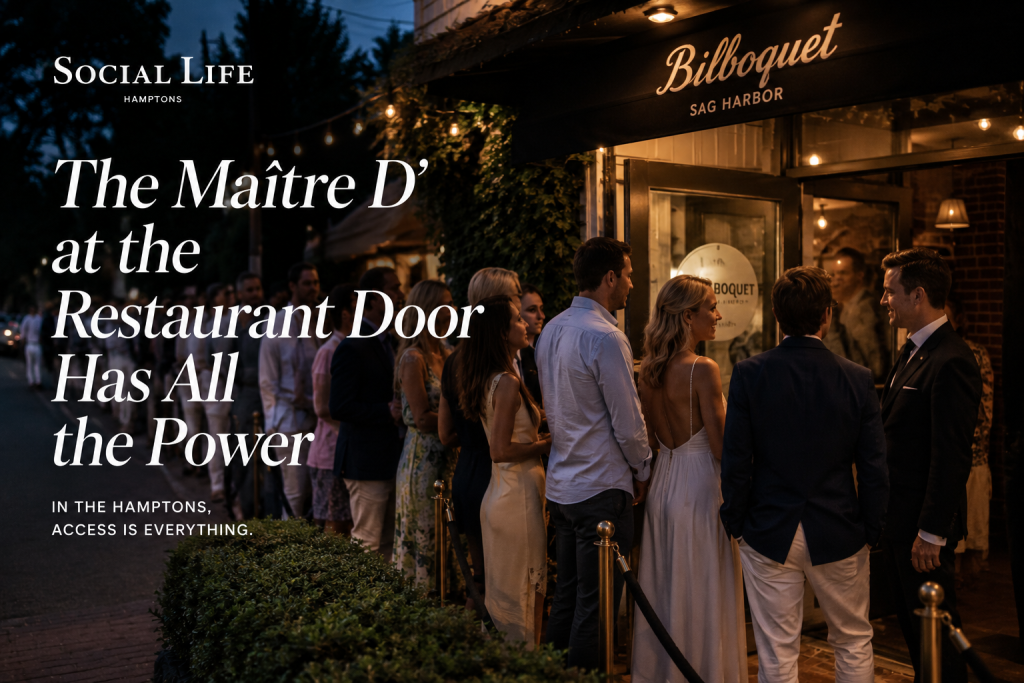
At 7:45 on a July Saturday, the podium at a Sag Harbor restaurant holds more concentrated power than most family offices. The book is full. The book has been full since Tuesday. And yet people keep walking in, because everyone knows the book is not really the system. Hamptons reservations are not bookings. They are rulings.
This is how the rulings get made: who the gatekeeper is, what he remembers, what money can and cannot buy at the door, and why the best table in the room is never actually available. A disclosure before the tour: no restaurant cooperated with this piece, which is itself the point. The podium economy runs on discretion, and everyone quoted in spirit here would deny it beautifully. What follows is assembled the way regulars assemble it, from twenty summers of watching the room work.
Why Hamptons Reservations Don’t Work Like Reservations
Begin with the arithmetic. The season is ten weekends. A prime dining room seats maybe eighty. Demand, meanwhile, is a year of Manhattan appetite compressed into seventy nights, aimed at the same six rooms. No pricing mechanism is allowed to clear that market, because restaurants can’t auction tables without becoming a scandal. So the market clears socially instead.
The apps are theater. Open any reservation platform in June and the prime rooms show 5:15 and 9:45, the dining equivalent of nosebleed seats. Those listings are real, technically. But they exist mostly to create the impression of access while the actual inventory moves through a different channel entirely.
That channel is the podium, and it operates less like hospitality than like allocation. Hamptons reservations at the hour that matters are assigned, not booked, according to a ledger no one ever sees written down.
The Podium Is a Trading Desk
The maître d’ is the market maker. He holds inventory back the way a good desk holds inventory back, releasing the 8 p.m. window four-top only when the right bid appears. The bid is rarely cash. It is standing, history, and the promise of a room that looks correct at peak hour.
His power runs on an asymmetry the industry never discusses. The salary is modest. The discretion is absolute. In a single July he will decide more socially consequential seating than a benefit committee decides all year, and unlike the committee, he answers to nobody but the owner and his own memory.
Understand what he is actually managing: not tables, but composition. A great room is cast like a scene. Two names by the window, energy at the bar, money in the corners, and one table of unknowns to keep the room honest. Every ruling serves the composition first. Your anniversary is not his problem.
The Room Map
Every room out here has a geography, and the regulars carry the map in their heads. At Le Bilboquet in Sag Harbor, the room decides who you are before the Cajun chicken arrives, and the difference between the banquette and the back reads from the street. Nick & Toni’s in East Hampton has run the quietest velvet rope in America since 1988.
Sant Ambroeus in Southampton performs the same sorting at espresso prices, which makes it the most efficient status venue per dollar on the East End. Duryea’s in Montauk sells anyone a $97 lobster Cobb while making perfectly clear which deck they belong on. At 75 Main, the point is churn: being seen entering matters more than the seat.
The map matters because placement is public. A house nobody visits is a private asset. By contrast, the 8 p.m. window table is a filing, visible to every party that walks in afterward. That visibility is the entire product, and it is why Hamptons reservations get contested like waterfront.
How Tables Actually Get Assigned
The ledger has rules, and the first rule is that regularity beats wealth. The couple who came every Thursday in May holds August claims that no walk-in can match, whatever the walk-in drives. Time, once again, is the base currency of the Hamptons social hierarchy, and the podium enforces the exchange rate nightly.
Below regularity sit the recognized channels. The house account. A hotel concierge with a standing relationship. The chef’s friend, the owner’s tennis partner, the investor who never mentions being one. Each channel carries a known weight, and the gatekeeper nets them out in seconds while appearing to consult a screen.
Then there is the $100 handshake, which half-works and fully marks you. The bill buys tonight. It also files you, permanently, as someone who needed to buy tonight. Veterans know the cheaper route: learn names, show up in the shoulder season, treat the staff like colleagues. Kindness to a runner in June is the best-performing Hamptons reservations strategy there is, and almost nobody deploys it.
What Money Can’t Book
Certain inventory never trades. The owner’s table. A standing celebrity hold. The corner that belongs, by unwritten easement, to a family that has eaten there since the restaurant had a different name. These holdings work like the Gin Lane houses that never list: their unavailability is the point.
New money runs the same failed play for Hamptons reservations every June. The offer arrives, sometimes breathtaking, and the podium declines with professional regret. Because accepting would devalue the very scarcity being purchased. A room that can be bought loses the quality that made anyone want to buy it. The gatekeeper protects the asset by refusing the bid.
The three-summer rule applies at the podium too. Season one, you take the 5:15. By season two, they know your name and your table preference. In season three, the phone gets answered differently. There is no shortcut through this, which is precisely why surviving it confers standing.
The Concierge Economy
Around the podium orbits a professional class whose entire trade is intermediated access. Hotel concierges hold standing allocations at the good rooms, which is half the reason the suites cost what they cost. Estate managers and house staff maintain their own relationships, quietly, and a good one is worth more per summer than most portfolio managers.
Delegation, though, carries a tax. Sending an assistant to plead your case files you one tier below the person who calls himself. The podium reads the org chart instantly: principals who show up in person, learn names, and say thank you outrank principals who outsource charm. Access is a relationship asset, and relationship assets resist delegation the way trust resists shortcuts.
The concierge channel also produces the season’s quietest arbitrage. A well-connected fixer can assemble a Saturday, table included, for clients who lack the standing to build it themselves. It works once or twice. Eventually the room notices that the guest and the relationship belong to different people, and Hamptons reservations revert to their natural owner: whoever actually put in the time.
August Is a Different Sport
Whatever pull you think you have in June, cut it in half for August. The month compresses the entire hierarchy into four weekends, every channel jams at once, and Hamptons reservations become the scarcest paper on the East End. Veterans bank their asks accordingly, spending podium capital in August the way traders spend a risk budget.
The month has its loopholes, and locals guard them. Sunday night is the insiders’ hour, after the weekend crowd drains west and the rooms exhale. Early in the week, the same table that was unattainable Saturday becomes a phone call. Shoulder season is the deepest discount of all: the guest who shows up in September and May holds August claims no summer-only spender can match.
Labor Day settles the accounts. The staff remembers who behaved when the rooms were at their worst, and next June’s ledger opens with this August’s balances carried forward. In that sense the season never really ends. It just adjourns, like everything else out here, pending further review.
The Ledger Never Forgets
The gatekeeper’s real instrument is memory, and the memory is actuarial. He knows who called twice last week. He knows whose card declined in 2019, who no-showed on a Saturday in peak season, and who kept a four-top waiting forty minutes without calling. Each event carries a rate, and the rates compound.
Rudeness to staff is the credit event that never fully cures. A guest can recover from a no-show with apologies and a good winter. But the person who was cruel to a busser in front of witnesses has taken a write-down that follows them across every room in three villages, because the staff economy talks to itself constantly.
Redemption exists, though it prices like distressed debt. It takes seasons of correct behavior, off-peak loyalty, and usually a sponsor: a regular in good standing willing to bring you, visibly, and vouch. The parallel to club membership is not a coincidence. It is the same system running on shorter cycles.
The Box Score of the Status Machine
Hamptons reservations matter because they are the status machine’s only nightly scoreboard. Houses are private, portfolios are invisible, and committee lists publish once a year. The dining room posts results every Saturday at eight. That frequency is what makes the podium powerful, and what makes the whole contest legible to anyone who watches.
The apprenticeships elsewhere in the system all converge here. The sharehouse veterans learned patience and coalition math in a house meeting; the podium is where they deploy it. Even the con artists who worked the East End understood the principle: a good table is the cheapest prop in the status theater, which is why every impostor books hard.
So the next time the room seems arbitrary, look again. The seating chart is the hierarchy, printed nightly, accurate to within one banquette. Learn to read it and you can skip a decade of guesswork. The man at the podium already has.
Where The Conversation Continues
Two young fish swim past an older fish, who nods and says, “Morning, boys. How’s the water?” A while later, one turns to the other and asks, “What the hell is water?” In every great dining room out here, the water is the seating chart. Most guests swim in it without seeing it. Now you’ve seen it.
If your brand or your story belongs inside this coverage, the front door is open. Social Life Magazine builds editorial features around the people and companies shaping the East End. Start the conversation here.
For founders and brands ready to move now, our Submit a Paid Feature program publishes your story with full editorial treatment. Prices are published. No awkward phone call required.
Equally important: the sharpest read on who matters Out East lands in 82,000 inboxes. Join the list and get the next piece before the party does.
And if you’d rather be in the room than read about it, Polo Hamptons convenes the crowd these dining rooms compete to seat. Sponsorship and VIP details are one click away.
The print edition ships to 25,000 Hamptons households each summer and 15,000 Upper East Side doorman buildings after Labor Day. It sits beside the phones that actually get Hamptons reservations answered. Subscribe here.
Finally, if this piece earned its keep, the most direct way to keep independent luxury journalism alive is a contribution here. Any amount. No obligation.
Author

Written by
Recent Posts
How to Measure Whether a Hair Loss Treatment Is Working
Is Online Psychiatry Covered by Insurance? What to Know Before Booking
Four Habits of Quietly Successful Entrepreneurs

The Most Common Preventable Health Concerns Doctors See Today
What Affects a Rideshare Injury Settlement?
Categories
- Art
- Articles
- Business of Luxury
- Celebrities
- Culture
- Entertainment
- Events
- Faces of Summer 2026
- Fashion
- Fashion & Style
- Featured
- Finance
- Food, Spirits, Wine
- Hamptons
- Hamptons Celebrities
- Health
- Health & Beauty
- Lifestyle
- Luxury Lifestyle
- Press
- Profiles
- Real Estate
- Technology
- The Chronicles
- Travel
- Uncategorized
- Weddings