
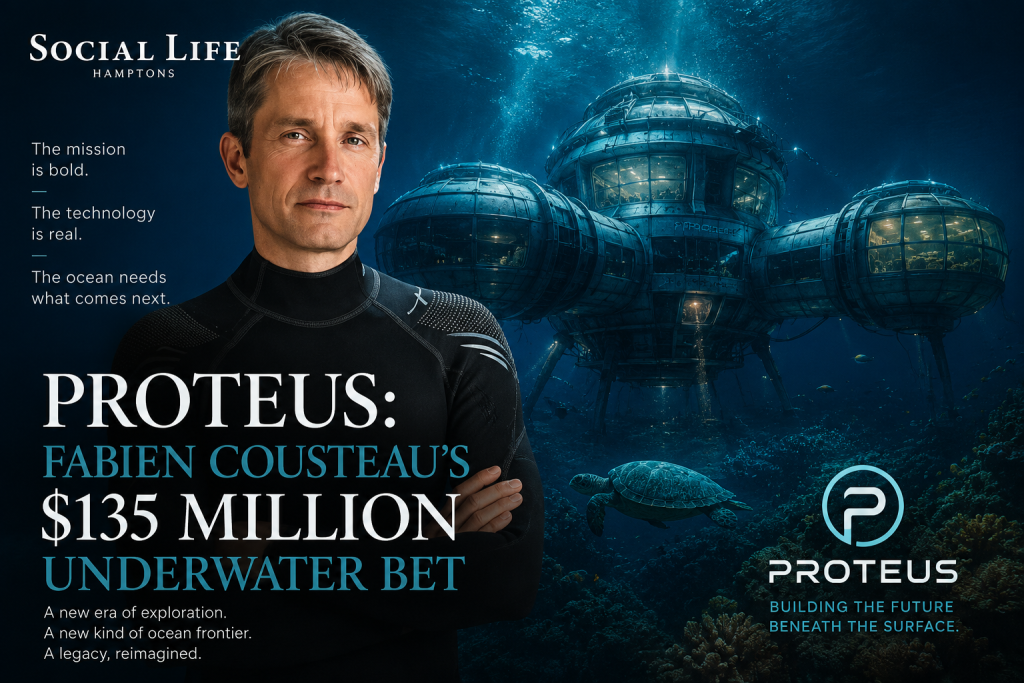
On May 24, 2022, an Italian engineering house did something it had not done in roughly a century of business. DRASS, the saturation-diving contractor that builds rescue systems for navies, agreed to construct PROTEUS, Fabien Cousteau’s planned underwater habitat off Curaçao, and took equity instead of profit margin. Builders do not bet their fee on dreams. They bet it on math instead. The math in question is a $135 million wager that the ocean’s version of the International Space Station will exist before 2030. A Cousteau’s name goes on the hull. A livestream runs from the sea floor.
To understand why serious institutions keep signing, you have to run the tape backward through three decades of escalating proof.
Exhibit A: The $200,000 Shark
Start in the mid-2000s with Troy, the submarine shaped like a great white. Fabien Cousteau wanted to observe sharks without cages or chum, because both distort behavior. So he commissioned Hollywood engineer Eddie Paul to build a 14-foot, 1,200-pound wet sub with steel ribs, bulletproof Lexan, and skin mixed from polymer, glass, and sand. It rolled its eyes. It also puffed its gills. The pilot lay prone inside with an 80-pound rebreather, exhaling no bubbles.
The budget said $100,000 and two months. Reality said about $200,000 and a year, which is the most relatable spreadsheet in this magazine’s history. The payoff came at Guadalupe Island in 2005: roughly 170 hours of footage among great whites he described as “like 747s underwater,” aired as a CBS special in 2006.
So note the pattern being installed. An absurd promise, a blown budget, a delivered machine, a broadcast. Investors, of course, call this a track record. Showmen call it a career. He was building both at once.
Exhibit B: Thirteen Sanctuaries on Public Television
Before the record attempt came the apprenticeship broadcast. From 2006 to 2009, Fabien co-starred with his father, Jean-Michel, and sister, Céline, in the PBS series Ocean Adventures. The show was a modern echo of the specials that made the family name. The episodes ran from Kure Atoll to the Amazon, and one installment sent him diving in all 13 US national marine sanctuaries between 2005 and 2006.
Public television is not glamorous money, but it is credibility money. The series certified him as more than a stuntman with a famous last name. It also taught him the difference between his grandfather’s era and his own. In 1966, an ocean special commanded the whole family’s attention at 8 p.m. By 2006, attention had splintered, so the next Cousteau vehicle would have to live where the audience lives, streaming, always on, interactive.
That realization shows up later in every PROTEUS design document. The habitat is being built around a broadcast studio for the same reason the Calypso carried cameras before it carried extra rations. In this family, the audience funds the science, and the science feeds the audience.
Exhibit C: One Day Longer Than the Legend
Then came the number the family will be quoting for a century. In June 2014, Fabien Cousteau descended to Aquarius Reef Base, a 43-by-9-foot habitat 63 feet down off Key Largo, and stayed for 31 days. His grandfather’s Conshelf II team, after all, had lived beneath the Red Sea for 30 days in 1963. The grandson went one day longer, and deeper, and called the project Mission 31 so nobody would miss the point.
Specifically, the mission cost about $1.8 million, with Aquarius running near $15,000 per day. Funding, meanwhile, came from sponsors, donors, and a crowdfunding round, plus a $2,890 Doxa dive watch whose sales kicked 25 percent to the expedition. Science partners included Northeastern, Florida International University, and MIT.
The yield is the part money people should read twice. Saturation living turned 31 days into what he now calls over three years’ worth of experiments, feeding roughly ten scientific papers on ocean acidification and reef health. Meanwhile the outreach machine hummed: a 24/7 livestream, Skype classes reaching 100,000 students on six continents, and an estimated 330 million total media impressions.
The Asset Itself
PROTEUS is the scale-up. Unveiled in July 2020 with a design by Yves Béhar’s fuseproject, the station plans up to 4,000 square feet. It would sit about 60 feet deep in a marine protected area off Curaçao. Aquarius, for comparison, offers about 400. Capacity runs around 12 aquanauts, with configurations cited up to 18. Detachable pods hold laboratories, sleeping quarters, and a medical bay arranged around a moon pool.
Two features tell you who designed the business. First, a full video production studio built for continuous livestream, because in the Cousteau model content is not marketing, it is revenue. Second, the first underwater greenhouse, born of his loathing for the freeze-dried rations of Mission 31. Power would come from wind, solar, and ocean thermal energy conversion.
The scientific pitch is time. Surface divers steal minutes at depth. Residents at saturation work the reef for eight to twelve hours a day, hunting what he calls climate refugia, super corals, and molecules that become life-saving drugs. As he frames it, we cannot make decisions about the ocean while knowing this little about it.
The Cap Table of Credibility
Now the receipts. Proteus Ocean Group, the for-profit vehicle, is led by CEO Lisa Marrocchino while Cousteau serves as founder and board member. The October 2021 groundbreaking expedition mapped 1,482 acres of reef and 1,077 acres of inner bays around the Curaçao site. Then the institutions arrived. NOAA signed a cooperative research agreement in May 2023 covering joint expeditions, technology testing, and a proposed subsea data center. The US Navy’s Undersea Warfare Center followed that September.
Academia is already assigning housing. Northeastern University professors Brian Helmuth and Mark Patterson serve as chief science advisors, and the school plans co-op placements aboard. Its team calls the habitat the closest analogue to being in outer space. Rutgers, the University of Rhode Island, and Curaçao’s CARMABI round out the bench. The UN endorsed PROTEUS as an Ocean Decade action.
Of course, a cap table of credibility is not a construction schedule. What follows is the honest part.
The Nonprofit Flywheel
The for-profit station also sits on a philanthropic chassis worth inspecting. In 2010 he founded Plant A Fish, a New York nonprofit that re-plants keystone species, such as oysters, sea turtles, mangroves, and corals, with the communities that live beside them. Then, in 2016, came the Fabien Cousteau Ocean Learning Center, which runs coral restoration, beach cleanups, and ocean-literacy programs for schoolkids.
The Learning Center is not a side project. It executed Phase 1 of PROTEUS, the high-resolution mapping of Curaçao’s marine protected area completed in September 2021, against a stated $1.5 million program goal. The structure is elegant: the charity builds public goods and goodwill, while Proteus Ocean Group carries the commercial risk. Donors get impact. Investors get an asset. The mission gets both engines pulling.
Family offices will recognize the architecture, because it mirrors their own. A foundation for the legacy, an operating company for the returns, and one surname across the letterhead. The difference is that this letterhead comes with 25,000 hours of bottom time and a NOAA countersignature.
The Slippage, Priced Honestly
The timeline has moved. Early materials pointed to 2025, then 2026, and current industry chatter tracks a window closer to 2027, pacing a British rival called DEEP and its Sentinel habitat. No construction start has been announced, and no disclosed raise has closed the full $135 million. That figure splits into roughly $60 million of build cost and $75 million for three years of operations.
Skeptics read slippage as weakness. Operators read it as an entry price. Because the hard assets are secured, specifically the mapped site, the equity-committed builder, the federal agreements, and the family brand, the remaining gap is capital and nerve. Late money buys a plaque. Early money buys the mythology, the module names, and the first broadcast from the new sea floor.
There is also a scarcity clock. Only one project gets to be the first true undersea campus of the streaming era. Whoever funds the winner owns a piece of every documentary, dataset, and NASA training rotation that flows through it afterward.
What the Record Actually Proves
Strip away the romance and judge the man like a portfolio. Every vehicle he has launched followed the same arc: outlandish spec, real engineering, delivered result, global audience. The shark sub swam. His month at 63 feet happened. The nonprofits he founded, Plant A Fish in 2010 and the Ocean Learning Center in 2016, still operate. Indeed, the Learning Center completed the high-resolution mapping of the PROTEUS site in 2021.
The brand endorsements point the same direction. Seiko has kept him as a Prospex ambassador since 2018, and luxury watch houses do not renew storytellers who miss their marks. Even his failures are the productive kind, such as budgets that doubled while the deliverable still shipped and a timeline that slid while the partners multiplied.
For the Wall Street reader keeping score, the question is not whether Fabien Cousteau is good for the money. It is whether the ocean’s first permanent address gets built with your name inside it or without.
Where The Conversation Continues
The full profile of the man behind the machine lives in our Fabien Cousteau hub. Trace the childhood that installed the nerve in Barnacles Before the Throne, and see where the doctrine goes on land in making tourism answer to the ocean. The room that funds a $135 million habitat reads Social Life Magazine in July. If your brand wants to be adjacent to the ocean’s next legacy asset, this cluster is the front door, and the July issue is open.
Author

Written by
Recent Posts
The Greek Islands, the Luxurious Way: Villa Escapes for Couples

Where Golf Meets the Good Life: Scotland’s Most Exclusive Golf Escapes
Luxury in the French Alps: Family Ski Resorts Worth the Journey
How to Improve Security at Large Social Events
Examining Truck Position After a Crash
Categories
- Art
- Articles
- Business of Luxury
- Celebrities
- Culture
- Entertainment
- Events
- Faces of Summer 2026
- Fashion
- Fashion & Style
- Featured
- Finance
- Food, Spirits, Wine
- Hamptons
- Hamptons Celebrities
- Health
- Health & Beauty
- Lifestyle
- Luxury Lifestyle
- Press
- Profiles
- Real Estate
- Technology
- The Chronicles
- Travel
- Uncategorized
- Weddings