
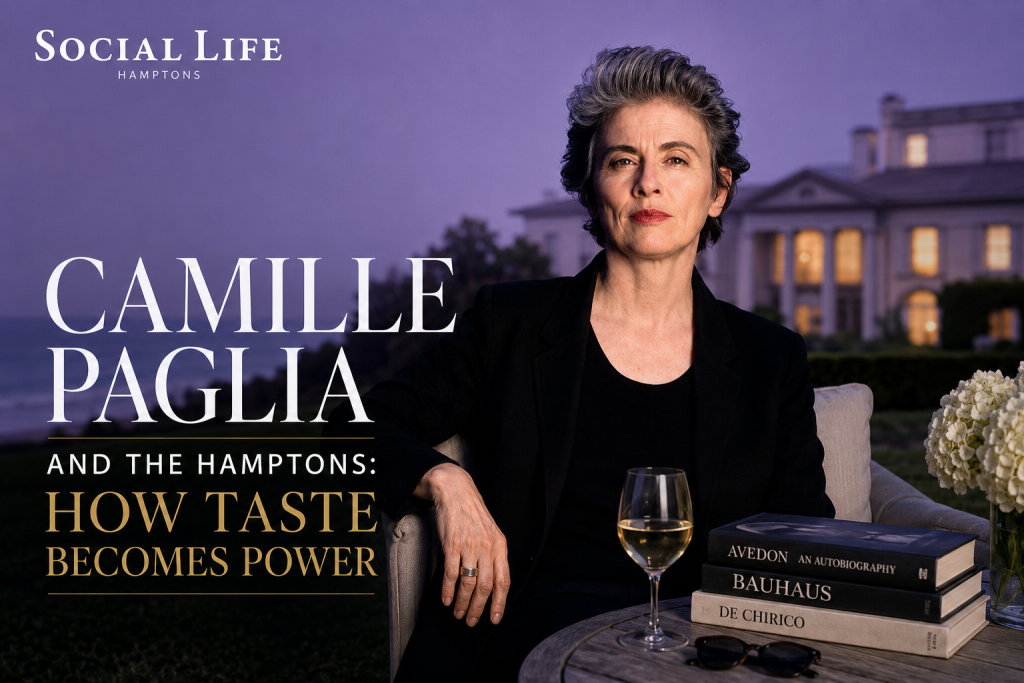
The most useful cultural critic for understanding Hamptons taste and power never summered on Gin Lane. Camille Paglia grew up in Endicott, New York, the daughter of Italian immigrants, and spent her career arguing a thesis the East End proves every July. Beauty is not decoration. Beauty is force. Taste is not preference. Taste is rank, publicly performed, ruthlessly scored. Since 1990, when Yale University Press finally published Sexual Personae after seven publishers rejected it, Paglia has insisted that hierarchy is natural, that aesthetics is where hierarchy hides, and that pretending otherwise is the one unforgivable vulgarity.
Apply that lens to a single stretch of Bridgehampton farmland on a Saturday in July and the whole machine comes into focus. Every linen blazer is an argument. Every seating chart is a verdict. This is the hub of a seven-part series on how taste becomes power on the East End, and it begins with the woman who wrote the theory.
The Woman Who Called Beauty a Power Grab
Paglia earned the nickname Hurricane Camille for a reason. Her 700-page debut argued that Western art is a long negotiation between two forces she borrowed from Greek myth. Apollo stands for order, line, form, and the made thing. Dionysus stands for nature, appetite, chaos, and the force underneath. Civilization, in her reading, is Apollo’s ongoing editing job on Dionysian raw material.
Most academics hated it. Readers bought it in bestseller numbers, because the theory explains rooms that sociology cannot. Why does a hand-rolled hem outrank a logo? Because the hem is Apollonian, a quiet act of form, while the logo is appetite announcing itself. Why does the oldest house on the lane hold rank over the newest? Because time is the one material money cannot rush. Paglia gave the unspoken rules a grammar, and the Britannica entry on her career reads like a syllabus for anyone trying to decode a Southampton benefit committee.
Nature, Hierarchy, and the East End
Sexual Personae opens with four words: in the beginning was nature. The Hamptons agree. Before the hedgerows there were potato fields, and before the fields there was the Atlantic, which still sets the terms. Land near the ocean is scarce. Scarcity builds hierarchy, and hierarchy demands a visible order, because rank that nobody can see is rank that does not exist.
Consider the numbers. Roughly 118 miles separate Manhattan from Montauk. Yet the drive measures social distance, not mileage. Each village along Route 27 holds a different rank, and residents can recite the ladder from memory. Westhampton reads differently than Water Mill. Bridgehampton reads differently than Amagansett. None of this is written down anywhere, because writing it down would break the spell. A code that requires initiation is a code that still works.
So the East End built an aesthetic code instead of a fence. Gin Lane, Further Lane, and Meadow Lane are not merely addresses. Each one is a sentence in a language about arrival, and the language is graded. Paglia would call the privet hedge a perfect Apollonian object. A hedge is nature disciplined into architecture, wildness edited into a wall, appetite trained into form. Nothing on the East End says power more fluently, and nothing says it more quietly.
The Four Currencies of a Hamptons Summer
Watch any July closely and you can see four different kinds of money changing hands, though only one of them clears a bank. There is cash, obviously, the entry ticket. Then comes knowledge, the trained eye that knows why one rosé is a statement and another is a mistake. Next is the room itself, the accumulated set of people who return your calls in February. And last there is reputation, the compounding record of having been correct in public.
Cash is the weakest of the four, because cash is the only one a stranger can bring. The other three must be earned in sequence, over seasons, in front of witnesses. That sequence is the real economy of the East End. Every event, every masthead, every guest room in this series is a mechanism for converting one currency into another, and the exchange rate is set by taste.
Where Taste Gets Enforced: The Polo Field
Theory needs a proving ground, and this month supplies one. Polo Hamptons returns for its eleventh year on July 18 and July 25 at the Fishel Estate, 900 Lumber Lane in Bridgehampton, with Christie Brinkley hosting and Getty and Patrick McMullan photographers deciding, frame by frame, who gets canonized. A polo match is Apollonian order laid over Dionysian animal power, which is why the sport has signaled rank for two centuries.
The sidelines run on the same physics. What you wear, what you pour, and where you stand are all scored in real time by people who never announce the score. The full anatomy of that scoring system gets its own piece in this series, an examination of how taste becomes power at Polo Hamptons, from the dress codes nobody prints to the rosé that arrives by donation rather than by invoice.
Houses That Teach
Paglia read paintings as arguments. A Hamptons house rewards the same method, because every object in a great room is a claim about its owner. In recent seasons the sharpest brands stopped renting billboards and started renting rooms, staging themselves inside Sag Harbor guest houses where the setting does the persuading. A candle on a marble console argues differently than a candle on a shelf in SoHo.
Notice what the house does that a showroom cannot. A showroom asks for attention. A house grants access, and access flatters the guest into receptivity. By the second glass of Léoube on the porch, the brand is no longer pitching. It has become part of an afternoon the guest wants to repeat, which is the only conversion that matters out here.
This is instruction disguised as hospitality. Brands come to these houses to learn codes they cannot learn from a deck, and the houses teach by immersion. The second spoke in this series, on aesthetic pedagogy and the Hamptons activation house, maps how a property becomes a classroom and why the tuition is worth it.
The Apollonian Page: Why Print Still Consecrates
Here is a Paglia distinction with commercial teeth. The internet is Dionysian, an infinite scroll of appetite, everything available and therefore nothing rare. Print is Apollonian, a finite object with edges, a thing that had to be chosen. Social Life Magazine prints 25,000 copies per summer issue, five issues a season, hand-distributed from Westhampton to Montauk, with 15,000 more reaching Upper East Side doorman buildings after Labor Day.
Online coverage discovers a brand. Print coverage confirms one. A feature on a coffee table in a Further Lane living room performs a ritual no impression count can imitate, because the page cannot be refreshed. The full argument runs in the series piece on consecration, online discovery versus print permanence, which doubles as a map of how brands actually climb here.
Old Money and the Long Game
Every July, new fortunes arrive convinced that this is the summer the order flips. Every September, the order remains. Paglia would find nothing mysterious in that. Heritage taste wins because it is time-based, and time is the one input that cannot be purchased at any tier. A fourth-generation member of the Meadow Club does not perform belonging, because performance is precisely what belonging excludes.
Yet the game is not closed. New money converts into old standing through patience, restraint, and correct public choices, usually over about a decade. The rules of that conversion, and the power hierarchies that enforce them, get a full treatment in the old money spoke of this series.
The Dionysian Feed
Now for the counterfeiters. Influencer culture arrived on the East End around 2016 and mistook visibility for rank. Content is Dionysian appetite in its purest modern form, endless, hungry, and unedited, which is exactly why it cannot mint prestige. Codes can’t be faked, and a camera pointed at yourself is itself a code violation, legible instantly to everyone whose opinion the performance was for.
Two spokes in this series handle the noise problem. One dissects why performed prestige collapses on contact with an actual room. The other makes the institutional case, arguing that a 23-year editorial gatekeeping function is the only filter that separates signal from feed.
Scarcity as a Design Principle
Paglia treated great art as an act of exclusion. A frame exists to keep most of the world out. The East End operates on the identical principle, and the sophistication of the place lies in how many frames it stacks. Land is the first frame, since the ocean permits no expansion. Membership is the second, because the clubs that matter stopped growing decades ago. The calendar is the third, given that the season itself runs barely fourteen weeks.
Inside those frames, every scarce object becomes a signal amplifier. A table at the right benefit carries meaning precisely because most people who wanted one did not get one. Compare that with the economics of the feed, where supply is infinite and every post cheapens the next. No algorithm can manufacture a frame. Scarcity has to be built, defended, and inherited, which is why the institutions that control it change so slowly here.
Brands that understand this stop asking how many people saw them. Instead they ask which rooms admitted them, because admission is the only metric the East End respects. Impressions expire overnight. A frame, once entered, keeps paying for years.
The Femme Fatale of the Benefit Circuit
Paglia’s most famous idea was the sexual persona, the recurring archetype that concentrates cultural power in a single figure. Western art keeps producing the femme fatale, the great mother, the beautiful boy, the androgyne. A Hamptons summer produces its own cast, and the roles are older than anyone playing them.
Consider the hostess whose invitation functions as a credit rating. Or the committee chair who can seat a hedge fund founder next to a curator and mint a friendship both will spend. Each is a persona in the Paglia sense, a role that outlives its occupant, with powers that belong to the position rather than the person. New arrivals often court the individual and miss the archetype, which is why their access evaporates when the individual moves on.
Reading a room here means reading its personae. Once you can name the roles, the choreography of any given evening becomes almost embarrassingly legible, and so does your own place in it.
The Paglia Playbook for the East End
Strip the theory down to practice and it yields five instructions. First, treat every aesthetic choice as a public argument, because it will be read as one. Second, buy form, not announcement, since the logo pays the brand while the hem pays you. Third, respect time as a material, because rooms can smell a rush. Fourth, seek witnesses over audiences, given that ten correct people outrank ten thousand followers. Fifth, remember that hierarchy never disappears, it only changes costume, and the ones who deny the game hardest are usually losing it.
Paglia’s deepest claim was that pretending status does not exist is the most dishonest move in culture. The East End, to its credit, has never pretended. Nobody here apologizes for the hierarchy. People simply compete inside it, with better manners than most arenas require. That candor is what makes a Bridgehampton field in July the best classroom in America for the oldest subject there is. Class is in session twice this month. Attendance, as always, will be taken.
Where The Conversation Continues
This hub anchors a seven-part series on taste, rank, and the machinery of Hamptons prestige. Start with the gatekeepers of Polo Hamptons, then follow the cluster through houses, print, old money, and the influencer illusion. For the rooms themselves, the season runs through Polo Hamptons, July 18 and 25 in Bridgehampton. Some conversations still happen field-side only.
Author

Written by
Recent Posts
Camille Paglia and the Hamptons: How Taste Becomes Power
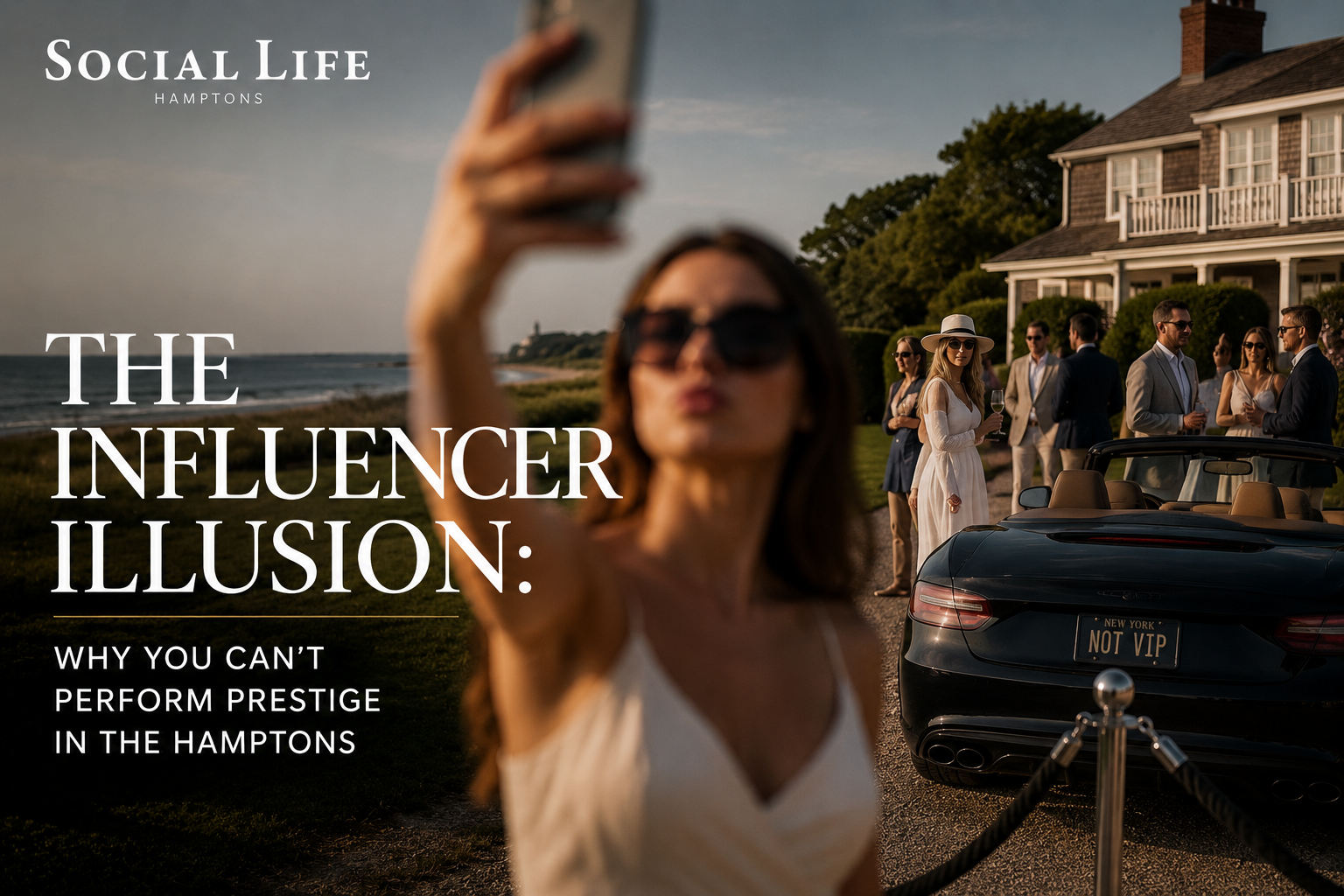
The Influencer Illusion: Why You Can’t Perform Prestige in the Hamptons
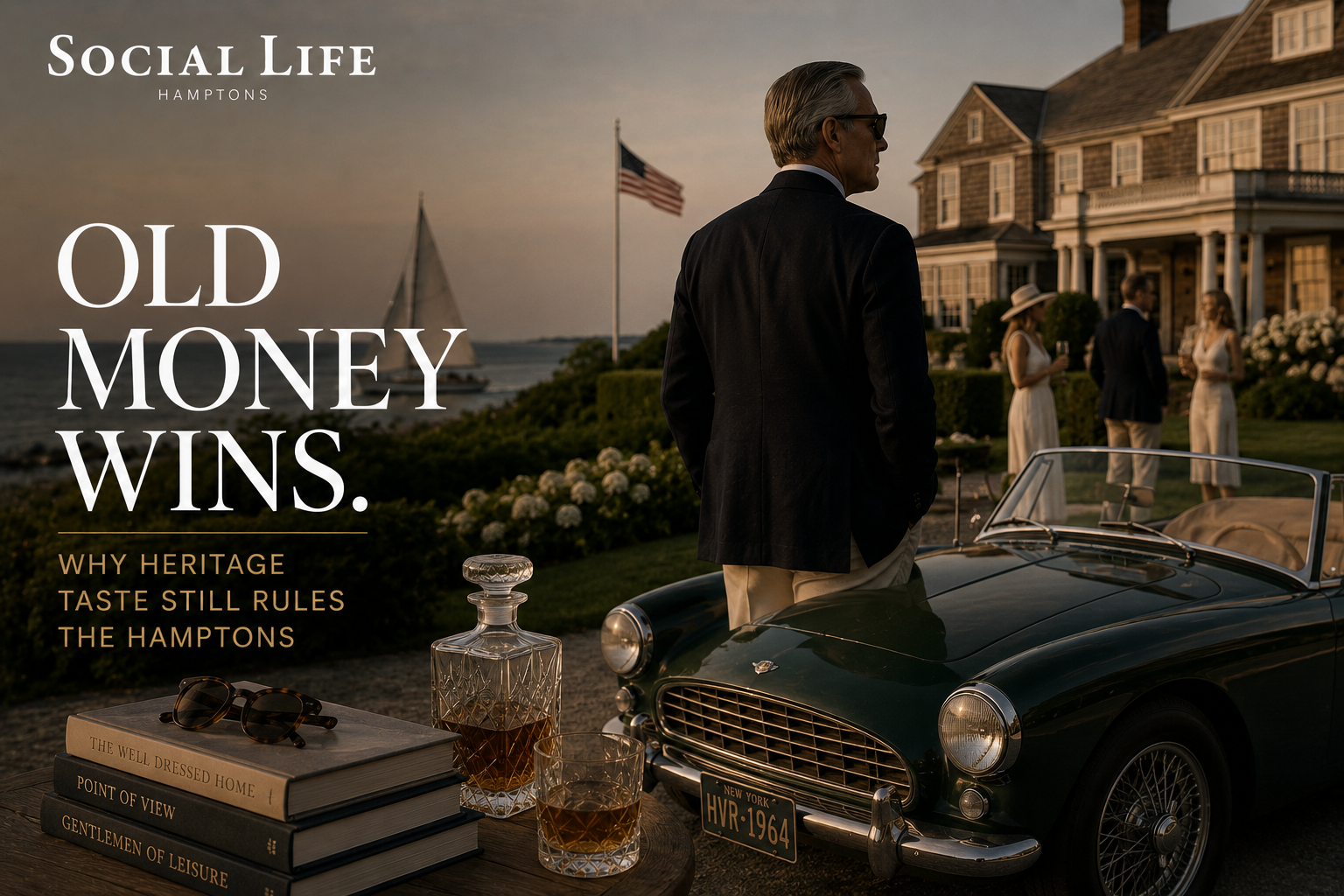
Old Money Wins: Why Heritage Taste Still Rules the Hamptons
The Arbiter: Why Editorial Authority Beats Influencer Noise
Discovered Online, Consecrated in Print: The Two Rooms of Hamptons Prestige
Categories
- Art
- Articles
- Business of Luxury
- Celebrities
- Entertainment
- Events
- Faces of Summer 2026
- Fashion
- Fashion & Style
- Featured
- Finance
- Food, Spirits, Wine
- Hamptons
- Hamptons Celebrities
- Health
- Health & Beauty
- Lifestyle
- Luxury Lifestyle
- Press
- Profiles
- Real Estate
- Technology
- The Chronicles
- Travel
- Uncategorized
- Weddings