
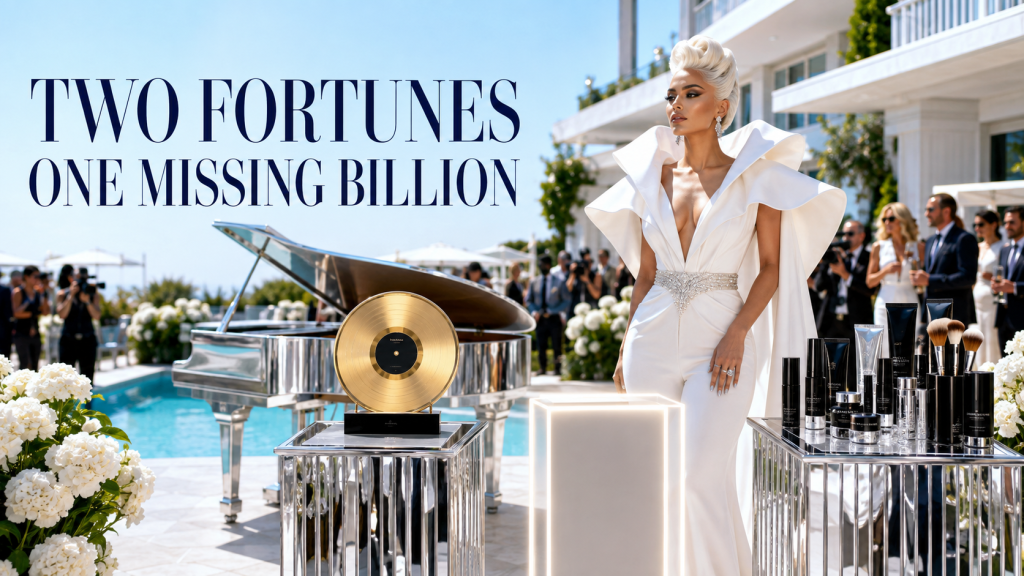
On April 13, 2026, Lady Gaga played Madison Square Garden for the ninth time in one tour cycle. That night closed The Mayhem Ball. One building sold her 122,599 tickets. The tour grossed $418.4 million worldwide, and her career touring total crossed $1 billion. Yet the Lady Gaga net worth figure still reads about $300 million. That number lands her well behind pop women she routinely outsells on the road. The gap is the entire story.
She is the only woman in this conversation running two separate income machines. Pop star money: albums, arenas, a Las Vegas residency, a catalog that refuses to age. Movie star money: an Oscar, backend participation, a reported $12 million Joker salary. Two fortunes should compound faster than one. Instead, they explain why she is rich rather than a billionaire. The difference is structural, not a matter of effort.
The $300 Million Answer to the Lady Gaga Net Worth Question
Celebrity Net Worth pegs her at $300 million. Most credible trackers in 2026 sit within shouting distance of that figure. For an artist with more than 40 million albums sold and an Academy Award, the number feels low. Of course, low is relative. It only stings next to her peers.
Method matters here. Net worth trackers count assets after taxes, fees, and lifestyle burn, not career grosses. Her lifetime earnings across two decades run far higher, approaching $900 million by some counts. Deductions do the rest of the math.
Consider the neighborhood. Forbes moved Taylor Swift to $2 billion this year. Rihanna holds around $1.4 billion, and Selena Gomez sits near $1.3 billion. Beyoncé cleared the line back in 2023. By contrast, Gaga out-grossed several of them per night on tour. Then she banked a fraction of their paper wealth.
Swift shows the model in its purest form. In May 2025 she bought back her masters for a reported $360 million, because owning the recordings beats renting them. Although the check was enormous, the asset now appreciates under her name. Gaga never got that lever, since her catalog economics were set in 2007, before artists negotiated like private equity firms.
The reason is the oldest one in wealth management: she sells labor, they sell equity. Her banner years arrive as income, such as the $39.5 million Forbes counted between June 2018 and June 2019. Income gets taxed at the top rate, then spent on production. Equity compounds quietly while its owner sleeps in. Every name above her on the richest female musicians of 2026 board owns an asset that earns overnight.
Pop Star Money: The Mayhem Machine
What The Mayhem Ball Actually Grossed
The Mayhem Ball opened in July 2025. It closed 92 shows later at the Garden. In between, it moved roughly 1.95 million tickets at an average price of $214.30. The nightly gross averaged $4.5 million. Notably, she did those numbers in arenas, not stadiums. Arena capacity caps the ceiling. So a $418.4 million total means she ran the room at maximum pressure every night. Average attendance ran 21,220 a night, so demand never sagged across nine months.
The warm-up dates were their own economy. Two Singapore shows pulled $40.8 million from 192,807 fans. The city-state paid for regional exclusivity, just as it did for the Eras Tour. Mexico City added $15.7 million more. After the final accounting, per Billboard’s tour reporting, her career road total reached roughly $1.17 billion. That covers 8.6 million tickets sold since 2007.
The Catalog, the Residency, the Chromatica Rebuild
Mayhem arrived in March 2025 and debuted at number one. It handed her two global singles, Abracadabra and the Bruno Mars duet Die With a Smile. Touring history backstops the album cycle. The Chromatica Ball grossed $112.4 million on 834,000 tickets in 2022. Before that, the Joanne run cleared $95 million.
Then there is Las Vegas, the quietest fortune in the stack. Her Enigma and Jazz & Piano residencies at MGM’s Park Theater reportedly paid about $1 million a night. The full run cleared a reported $110 million. The next residency, whenever she signs it, will price higher because Mayhem proved the demand. Still, none of this is ownership. She never had a masters-buyback moment, and her recordings sit inside the Interscope machine. The touring figures that dominate the Music Industry Net Worth Rankings 2026 are gross, not keep. Net worth grows on the keep side.
Add the one-offs that money measures only sideways. She headlined Coachella in April 2025 with an opera-scale production. A free Copacabana Beach show in Rio drew a reported 2.5 million people weeks later. Neither made her rich directly. Both kept demand hot enough to justify $214 arena tickets. The 2017 Super Bowl halftime show worked the same way, since the NFL covers production rather than paying a fee. Afterward, her catalog sales reportedly spiked 1,000 percent in a day.
Movie Star Money: The Second Fortune
A Star Is Born and the Backend That Paid Twice
Start with October 2018. A Star Is Born turned a $36 million budget into $436 million worldwide. Her fee was reported between $5 million and $10 million, modest by design. The real money lived downstream. Because she co-wrote Shallow, publishing pays her every time the diamond-certified single streams. The soundtrack she dominates went multi-platinum on top of that. She took the Best Original Song Oscar too.
Television seeded the lane before film paid it. American Horror Story reportedly paid her between $50,000 and $150,000 an episode in 2015. A Golden Globe followed, and Hollywood stopped treating her as stunt casting.
That film run bought her something rarer than cash: a seat at the prestige table. House of Gucci followed in 2021 and grossed $153 million mid-pandemic. Her Patrizia Reggiani performance carried the campaign season. Since then she has occupied a lane no other pop girl holds, the Streep-adjacent one. Awards campaigns convert directly into fee inflation there. Her paydays now read like entries on the Hollywood Actor Net Worth Rankings, a list her music peers never touch.
Social Life has traced her film ledger before, inside our Meryl Streep coverage, because she is the rare crossover the prestige economy takes seriously. While her pop peers do cameos, she runs campaigns. As a result, casting directors price her as a dramatic lead rather than a marketing line item. That distinction is worth eight figures per picture.
What Joker: Folie à Deux Cost Her
Then came October 2024. Joker: Folie à Deux paid her a reported $12 million, her biggest film check yet. The movie grossed about $206 million worldwide against a production budget near $200 million. Variety reported Warner Bros. losses of $150 million to $200 million. Her net worth kept the $12 million. The damage was priced elsewhere.
A flop of that scale reprices an actor’s next three offers. It hits hardest when your film value rests on event-picture credibility. Her Harlequin companion album underperformed too. For the first time, both machines failed in the same quarter. But the correction was brutal and brief. Within six months she had Mayhem at number one and a record-setting tour on sale. A scene-stealing Netflix turn in Wednesday followed. The film fortune paused. It did not close.
Haus Labs and the Rare Beauty That Wasn’t
Here is where the billionaire math actually broke. In September 2019, Haus Laboratories launched as an Amazon exclusive. No celebrity beauty line of that scale had bet its debut on Prime shelving before. The bet missed. Beauty customers wanted Sephora theater, testers, and status packaging. A checkout box next to paper towels offered none of it. Sales stalled, and the brand went quiet.
The 2022 relaunch fixed the retail error. Rebuilt as clean, premium makeup at Sephora, Haus Labs found a real hit in its Triclone foundation. By 2026 the brand had spread into Sephora at Kohl’s doors and flagship placement in Paris. A good business, finally. Just not a fortune-defining one. By 2020 the first version had still ranked as the third best-selling celebrity cosmetics line, so demand was never the problem. In particular, distribution was.
Compare the two women who got it right. Selena Gomez’s Rare Beauty windfall came from launching directly into Sephora in 2020. She held founder-scale equity while revenue reportedly ran past $400 million a year. Rihanna’s Fenty fortune came from a 50-50 structure with LVMH. Half of a brand built inside the world’s best luxury distributor beats all of a struggling one. Gaga, by contrast, took outside venture money early and launched into the wrong channel. Same fame, same window, no billionaire event.
Two Fortunes, No Billion: The Math That Stings
Gaga has told the origin story herself. She went bankrupt during the first extension of The Monster Ball. Everything she earned went back into the show. That instinct never left. Her spectacle budgets are legendary, and so are the grosses they produce. The money performs; it does not accumulate. In effect, she runs the most expensive small business in entertainment.
Gross is a vanity number in this business anyway. Promoters, agents, production, and the IRS take their cuts before a dollar lands. Touring stars typically keep a fraction of the headline figure once the show settles up.
There is also the payroll side of a one-woman conglomerate. Her Born This Way Foundation, a touring staff in the hundreds, and couture-grade wardrobe budgets all draw on the same stream. None of it is waste, of course. But every obligation bills against labor she must keep performing.
Look at Beyoncé’s net worth architecture for the counterexample. She also spends violently on production. Yet she owns Parkwood, her masters, and her tour vehicle. So every dollar of spectacle feeds an asset she controls. Gaga’s two fortunes both bill by the hour instead. A show pays when she sings it. A film pays when she shoots it.
The Hamptons reader recognizes this instantly. It is the salary-versus-carry problem wearing couture. The surgeon earning $4 million a year still measures himself against the founder who sold once. In fact, Gaga’s $300 million makes her the hardest-working person in the billionaire cluster. She is also the one who owns the least of what she makes. Real estate tells the same story: a $22.5 million Malibu compound, not an operating company.
What Could Move Lady Gaga’s Net Worth Past $1 Billion
Watch the asset side. Since the tour wrapped, the pieces have finally lined up. At 40, she has the road money banked and Haus Labs stable. She is engaged to investor Michael Polansky, who took co-writing credits across Mayhem. One true equity event moves the answer into ten figures. A catalog sale would do it. So would a Haus Labs exit at a real multiple, or a producing slate with backend. Both machines are running. She only needs to own one of them outright.
There is precedent all around her. For example, catalog sales by Bruce Springsteen and Bob Dylan reportedly cleared $500 million and $300 million. Her songbook is younger, yet it carries two decades of radio staples such as Bad Romance and Poker Face. Once streaming multiples firm up, that shelf becomes her single most bankable asset. The beauty exit market rewards patience too, as Charlotte Tilbury’s sale to Puig at a reported billion-plus valuation showed.
Until then, the ranking stays uncomfortable. She remains the only living entertainer holding a number-one album, a $400 million tour, and an Oscar. The Lady Gaga net worth total will read as an underachievement anyway. Because in this cluster, the scoreboard only counts what you own.
Where The Conversation Continues
Our Pop Girl Billionaires report holds the full accounting. It names who crossed the billion line and who is still selling nights of her life. Social Life Magazine tracks this money the way our readers track their own: by asset and by structure. The print issue travels from Southampton dinner tables to the Polo Hamptons field in Bridgehampton. That is where this exact conversation happens over rosé in July. Some people read about the room. Others are already in it. The summer calendar decides which one you are, and it fills early.
Author

Written by
Recent Posts

The First Decision After a Collision Can Be the Most Important One
Two Weeks in Rome and Beyond: Turkish Airlines Itineraries from Boston, Chicago and Onward to India

Top 10 Hair Transplant Clinics in Turkey 2026

Artist Alley to Online Store: How Convention Artists Can Keep Selling After the Event
When an 18-Wheeler Crash Leaves Lasting Consequences
Categories
- Art
- Articles
- Business of Luxury
- Celebrities
- Culture
- Entertainment
- Events
- Faces of Summer 2026
- Fashion
- Fashion & Style
- Featured
- Finance
- Food, Spirits, Wine
- Hamptons
- Hamptons Celebrities
- Health
- Health & Beauty
- Lifestyle
- Luxury Lifestyle
- Press
- Profiles
- Real Estate
- Technology
- The Chronicles
- Travel
- Uncategorized
- Weddings